“He has held the office since 2002 and never faced a primary. In June, he heard a councilman was thinking about running against him. He took that man to lunch and offered him a $76,295 county job that did not exist and called it a win-win.”
- Karen Hartley-Nagle, The Truthline Network
“The headlines wrote themselves.”
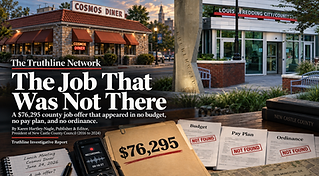


THE JOB THAT WAS
NOT THERE
A $76,295 county job offer that appeared
in no budget, no pay plan, and no ordinance
By Karen Hartley-Nagle
Former President of New Castle County Council (2016 to 2024)
Published: September 15, 2026 | A Truthline Investigative Report
On June 24, 2026, the elected Recorder of Deeds of New Castle County took a sitting county councilman to lunch and offered him a job that appears in no budget, on no pay plan, and in no ordinance, at a salary that would not exist for another seven days, three weeks before the filing deadline. Seven weeks earlier, his own office had told County Council that line would stay empty until after the election, and a man had already started in it on June 7. It is documented by a budget presentation, two pay schedules, the county legislation database, state campaign finance filings, the Delaware Code, and a recording the councilman made himself.
Ipse Dixit.
He himself said it.
*If you are reading this on your phone, skip past the Table of Contents and scroll straight to the Introduction. The report loads best on a laptop or desktop, but every word is here. Start scrolling. The story is waiting.
The Case in Seven Sentences
On Wednesday, June 24, 2026, Michael E. Kozikowski Sr., the elected Recorder of Deeds of New Castle County, took
Councilman David L. Tackett of the Eleventh District to lunch at Cosmos Restaurant on South Maryland Avenue in Wilmington and
offered him a job.
Tackett was thinking about running against him, and the filing deadline was twenty days away.
Kozikowski described a position he said he had built by taking a vacant legal aide line and upgrading it, and he named the salary
out loud: seventy-six thousand two hundred ninety-five dollars.
Seven weeks earlier, his own office had told County Council in writing that the line in question had been empty since May 21, 2022,
and would not be filled until after the primary.
The figure he named did not exist on any pay schedule in force that day. It took effect seven days later.
A man had already started in that office on June 7, seventeen days before the lunch, and he is the man a magazine identified in 2023
as County Executive Marcus Henry’s campaign consultant.
David Tackett had turned on a recorder before he sat down.
“He told County Council in May. He told David Tackett in June.
He told WHYY News in September. He never told the public.”
Key Facts, From the County’s Own Records
-
The Office of the Recorder of Deeds reported five vacancies to County Council on May 4, 2026. Two were unfunded. The three funded openings paid $37,593, $38,533, and $47,979. None of them paid $76,295.
-
Position control number 102453, Row Office Legal Aide, carried at $38,533, had been vacant since May 21, 2022. Status on the page: Requested to Post. Plan to fill: the second quarter of Fiscal Year 2027, which begins October 1.
-
$76,295 is Pay Grade 24, Step 8 on the pay schedule effective July 1, 2026. It is also Grade 27, Step 5 and Grade 28, Step 4. On June 24, the schedule then in force put all three of those cells at $74,434.
-
New Castle County recognizes no classification by the title Kozikowski described. Search the county legislation database for the words recorder of deeds across all of 2026, and three items return, all of them fees.
-
The office’s Fiscal Year 2027 budget went down 5.10 percent, carried 23.00 positions, a change of 0.00 percent, and unfunded two positions worth $192,870. County Council adopted it on May 26, 2026.
-
New Castle County was under a hiring freeze signed by County Executive Marcus Henry on February 13, 2026. The county reported 156 vacancies at the time and said the hiring process had not been initiated on forty-nine of them.
-
Tony H. Benson II announced on Instagram on June 7, 2026, that he was beginning as a Legal Assistant with New Castle County. His LinkedIn profile dates the start to July 2026.
-
Out & About Magazine identified Benson in April 2023, in a caption the magazine wrote, as campaign consultant to Marcus Henry.
-
Neither Citizens for Kozikowski nor Marcus Henry for New Castle County Executive has ever reported paying Benson a dollar. Both filed schedules for donated services reading $0.00.
-
Tackett filed a complaint with the Delaware Department of Justice on August 15, 2026, with copies to the Department of Elections and the New Castle County Ethics Commission.
-
Ten days later, on August 25, 2026, County Council passed Ordinance 26-099, requested by the Recorder of Deeds, raising recording fees and the technology fee, at an estimated $750,000 to $1,000,000 a year.
-
The primary is Tuesday, September 15, 2026. No Republican filed. Early voting opened September 2.
RETURN TO TABLE OF CONTENTS
Questions Residents Are Asking
What actually happened?
A county officeholder offered a public job to the one person who was thinking about running against him, three weeks before the filing deadline, and the person he offered it to recorded the conversation.
Was the job real?
The county has never produced an ordinance creating it, a pay plan carrying its title, or a budget line funding it. It exists in a conversation and nowhere else that anyone has shown.
Where did the number come from?
Seventy-six thousand two hundred ninety-five dollars is a cell on a New Castle County pay grid. On the day he said it, that cell read seventy-four thousand four hundred thirty-four. The figure he used took effect seven days later.
Could a councilman legally take a county job?
No. Title 9, Section 1143 of the Delaware Code bars a member of County Council from holding other county office, and Section 1147 makes the forfeiture of the seat automatic. Tackett would have lost the Eleventh District the day he accepted, and New Castle County would have paid for a special election.
Does it matter that Tackett had not filed yet?
No. The Delaware Criminal Code defines a public servant to include candidates and persons elected but not yet sworn, and Tackett was a sitting councilman that afternoon regardless. The General Assembly closed that door in 1979.
Who is investigating?
The Delaware Department of Justice has the complaint and will not confirm or deny an investigation. The Department of Elections says the matter is outside its purview. The New Castle County Ethics Commission is confidential by ordinance and cannot remove an elected officeholder or take a name off a ballot.
Is this the only time something like this has happened here?
No, and that is the part of this report that outlives the primary. The same method, a public job created outside the process and handed to a political ally, is documented in this county at a scale of about eight point four million dollars a year.
What can I do about it?
Every document named in this report is a public record. Any citizen of Delaware can request them under Title 29, Chapter 100. The county has fifteen business days to respond or explain why it will not. You do not need a lawyer, a reporter, or anyone’s permission.
Author’s Disclosure
I served as President of New Castle County Council from November 2016 to November 2024. In that role, I presided over the body that adopts every pay plan in this county, introduced the ordinances that create and strike job classifications, and sat through the annual budget presentation of every department and every row office, including the Office of the Recorder of Deeds.
Portions of this report rest on my firsthand knowledge from those eight years, and where they do, I say so in the text and put my name on it. Everything else is documentary. The documents are named where they are used and listed in full at the end.
I am not a candidate for any office. I am not involved in any 2026 primary or general election race, and I have no financial interest in the outcome of the September 15 primary. This report is not about that primary. It is about what was done, who did it, and what the law says about it. It is also the clearest example yet of something I documented in July, in the investigative report “The New Castle County Tax Reckoning”, published July 20, 2026, which laid out how positions and payroll in this county move outside the process that County Council exists to run.
- Karen Hartley-Nagle, Former President of New Castle County Council (2016 to 2024)
One-Page Summary
Every piece of this was already public. The tape only made it audible.
“Michael E. Kozikowski has been Recorder of Deeds since 2002. He has won six elections. He has never faced a primary. In June of 2026, a councilman started thinking about filing against him, and he took that man to lunch.”
On Wednesday, June 24, 2026, Michael E. Kozikowski, the elected Recorder of Deeds of New Castle County, took Councilman David L. Tackett of the Eleventh District to lunch at Cosmos Restaurant on South Maryland Avenue in Wilmington and offered him a job.
David Tackett was thinking about running against him. He had twenty days left to decide whether to file.
Over about ninety minutes, Recorder of Deeds Michael Kozikowski described a position he said he had built by taking a vacant legal aide line and upgrading it. He named a salary. Seventy-six thousand two hundred ninety-five dollars.
David Tackett recorded it.
What the county’s own documents say about that job
The line Michael Kozikowski said he upgraded is position control number 102453, Row Office Legal Aide, carried at $38,533. It had been empty since May 21, 2022.
Seven weeks before that lunch, on Monday, May 4, 2026, his own office told New Castle County Council that the line would not be filled until the second quarter of Fiscal Year 2027. That quarter begins October 1. The primary is September 15.
The figure $76,295 did not exist on any pay schedule in force on June 24, 2026. It took effect seven days later, on July 1. It is Pay Grade 24, Step 8.
New Castle County recognizes no classification by the title he described. No ordinance created it. No pay plan carries it. Search the county’s own legislation database for the words recorder of deeds across all of 2026, and three items come back: two technology fee appropriations and a fee schedule. Nothing else.
And the job was not vacant when he offered it. On Sunday, June 7, 2026, seventeen days before that lunch, a man named Tony H. Benson II announced on Instagram that he was beginning as a Legal Assistant with the New Castle County Recorder of Deeds Office. His LinkedIn profile puts the start at July 2026.
In April 2023, Out & About Magazine identified Tony H. Benson II, in a caption the magazine wrote, as campaign consultant to Marcus Henry, now the County Executive of New Castle County. Benson’s own professional profile lists the campaign services he provides: social media posting, video shooting and editing, photography, and door-to-door.
Neither the campaign committee of Michael Kozikowski nor the campaign committee of Marcus Henry has ever reported paying him a dollar. Both report receiving nothing of value from anyone for free.
“The job was not in the budget. The title was not in the pay plan. The salary was
not on any schedule in force that day. The line was not even vacant.”
What Delaware law does with that
If David Tackett had said yes, he would have lost his Council seat the moment he took the job. Title 9, Section 1143 of the Delaware Code bars a member of New Castle County Council from holding other county office, and Section 1147 makes the forfeiture automatic. His seat would have gone to a special election inside thirty days, at county expense. The arrangement Michael Kozikowski described could not have existed.
Every account of this case has quoted the first clause of Delaware’s bribery statute, which asks whether someone was influenced in his conduct as a public servant. Nobody has cited clause (2). It covers offering a benefit on an understanding that a person will or may be designated or nominated as a candidate for public office. No official act is required. That is a primary, described in the statute.
David Tackett filed a complaint with the Delaware Department of Justice on August 15, 2026, with copies to the Delaware Department of Elections and the New Castle County Ethics Commission.
The primary is Tuesday, September 15, 2026.
The finding
Nothing in this report came from a leak. It came from a budget presentation, two pay plans, a vacancy table, a legislation database, nine campaign finance reports, a magazine caption, and a man’s own public account of himself.
Every one of them was public the entire time.
“It came out of a budget presentation, two pay schedules, a vacancy table, nine campaign finance reports, a legislation search anyone can run, and a magazine caption from 2023. Nothing here came from a leak. It was public the entire time.”
The Job That Was Not There
Introduction
The chamber of New Castle County Council is on the first floor of the Louis L. Redding City/County Building on North French Street in Wilmington, and the seat at the front of it faces the room. For eight years, from 2016 to 2024, that was my seat. I was President of County Council.
From there, you watch the whole thing come across the table. Every pay plan in this county passes through that room. Every classification change that carries a dollar with it. Every ordinance that creates a job title or strikes one. They are introduced by the President of County Council, heard on a published agenda, and entered into a legislation database anyone can search from a phone. That is not a courtesy. That is Delaware law, and it exists for one reason. An administration will take whatever it is allowed to take.
Sometimes that is drift, and nobody meant anything by it. Often it is not. People in county government can be petty. They can be mean. They can be small in a way that follows a person around for years, and when they have power they use it that way, and the paperwork shows it. A title that appears for one person. A position that disappears out of a department that crossed somebody. A line item that moves the week after a vote. None of it looks like anything by itself, and every bit of it is in writing.
I spent eight years reading it.
“Every pay plan in this county crosses that chamber. Every classification change that carries a dollar crosses that chamber. Every ordinance that creates a job title crosses that chamber. This one never came near the room.”
Cosmos Restaurant is at 316 South Maryland Avenue in Wilmington.
John and Elena Alexopoulos opened it on April 1, 1981, and their family still runs it. Forty-five years on the same corner. Booths and tables, breakfast served all day, homemade soup by the gallon, and a different special every weekday. Wednesday is ham and cabbage. Sixteen dollars, smoked ham over tender cabbage and potatoes.
June 24, 2026 was a Wednesday.
That afternoon, Michael E. Kozikowski, the elected Recorder of Deeds of New Castle County, sat down at Cosmos with Councilman David L. Tackett of the Eleventh District.
Twenty-nine days earlier, on the evening of Tuesday, May 26, 2026, New Castle County Council had voted eleven to two to pass County Executive Marcus Henry’s Fiscal Year 2027 budget and raise the residential property tax rate 17.2 percent. It is the largest single rate increase in this county since 2009. New Castle County has the highest foreclosure rate in the United States, and that increase lands on reassessed values that for many households had just roughly doubled.
Two members voted no. Councilman Kevin Caneco of the Twelfth District, and David Tackett.
Tackett did more than vote no. He put his name on budget amendments naming real cuts the Henry administration could have proposed itself and did not. The administration opposed them. They failed. He voted against the budget anyway, in a room where eleven of his colleagues were about to vote yes.
Know who was sitting in that booth.
David Tackett has lived in New Castle County his whole life. He lives in Newark. He has four daughters. He has worked for Amtrak since 1991, thirty-five years on the railroad, and he served as president of Local 1284 of the International Association of Machinists and Aerospace Workers. He sat on the New Castle County Planning Board from 2000 to 2003. He has run the Varlano Civic Association and the 7&40 Alliance. On Council, he has worked public safety, open space, and senior services, and what he says about the job is this: the most important thing he can do is remain available and responsive to the people living in the community.
A machinist and a union officer who spent three years on the Planning Board and then went to Council. That is whom Michael Kozikowski took to lunch, and that is who was thinking about running against him.
“David Tackett has worked for Amtrak since 1991. He was president of Local 1284 of the Machinists. He sat on the New Castle County Planning Board from 2000 to 2003. He has four daughters. That is the man who was offered a way out of the race.”
Understand who Michael Kozikowski is, too, because it explains why he thought this was an ordinary thing to do. He has been Recorder of Deeds of New Castle County since 2002. Six elections won and a seventh on the ballot. Not one primary in twenty-four years. In this county, a row office is not a job you win. It is a job you hold, and the way you hold it is that nobody ever files against you.
The two men sat there about ninety minutes.
Somewhere in that ninety minutes, Recorder of Deeds Michael Kozikowski described a position inside his own office. He told Councilman Tackett he had built it by taking a legal aide line that was sitting empty and upgrading it. Constituent service.
Community outreach. Then he said the salary.
Seventy-six thousand two hundred ninety-five dollars.
Stop on that number, because everything in this report comes back to it.
Nobody says seventy-six thousand two hundred ninety-five dollars over lunch. A man guessing says about eighty thousand. A man being generous rounds it to a hundred. That figure is not something a person invents across a table. It is something a person reads off a page.
It came off a page. Seventy-six thousand two hundred ninety-five dollars is Pay Grade 24, Step 8, on the New Castle County pay schedule that took effect on July 1, 2026, seven days after that lunch. On June 24, the schedule that actually governed county pay put that same cell at seventy-four thousand four hundred thirty-four dollars. The number Michael Kozikowski said out loud did not exist yet.
Somebody had opened next year’s pay plan, run a finger down the left-hand column to grade twenty-four, counted across to step eight, and written it down.
“Nobody says seventy-six thousand two hundred ninety-five dollars over lunch. A man guessing says about eighty thousand. A man being generous rounds it to a hundred. That is a figure you read off a page.”
Councilman David Tackett had turned on a recorder before he sat down.
RETURN TO TABLE OF CONTENTS
I. What That Office Actually Is
Before any of the rest of this makes sense, you have to know what the Office of the Recorder of Deeds does, because most residents of this county will deal with it twice in a lifetime and never learn the name of the person who runs it.
It is on the fourth floor of the Louis L. Redding City/County Building at 800 North French Street in Wilmington. Louis Redding was the first Black attorney admitted to the Delaware bar, and he argued the Delaware cases that went into Brown against Board of Education. His name is on the building where a family goes to make a house theirs.
That is what happens on the fourth floor. The Recorder of Deeds is the repository for every land transaction record in New Castle County. Deeds. Deed restrictions. Easements. Mortgages. Assignments. Satisfactions of mortgages. Partial releases. Federal tax liens. Plot plans. Military discharges, so a veteran can prove what he did.
Picture the counter on a Tuesday morning. A title searcher who has been coming to that floor for twenty years. A paralegal from a firm downtown with a stack under her arm. A couple who just closed on their first house in Bear and cannot quite believe it yet.
Somebody chasing a lien that surfaced three days before settlement. A man with a discharge paper from 1971.
That is the whole job. Somebody behind that counter takes the paper and makes it real. It is the last thing that happens, after the lawyers and the bank and the inspection and the closing table, and it is the moment the house becomes theirs.
“A title searcher who has come to that floor for twenty years. A paralegal from a firm downtown with a stack. A couple who just closed on their first house in Bear. A veteran with a discharge paper from 1971. Every one of them pays five dollars at that window, and the Recorder of Deeds spent it on batteries for Public Works.”
By the county’s own count, about eighty thousand documents came through that office last year. Every one of them costs something. A thirty-dollar statewide document fee. Thirteen dollars a page to record a deed or a mortgage. Three dollars for each parcel description. Three dollars for a certified copy, six if the office furnishes it, a dollar for the certificate. And on top of all of it, on every single document, a five-dollar technology fee.
The office also collects the transfer tax, and not only for New Castle County and the State of Delaware. It collects for Newark, Middletown, Delaware City, the City of New Castle, Smyrna, and the Town of Clayton. Two separate checks, one for the state portion and one for the county or the town.
Twenty-three positions do all of that. The office runs on $2,378,303 inside a county that spends $387.6 million. The Recorder of Deeds himself is paid $123,000 a year to run it, in a county of roughly 590,000 people.
And the county publishes the hours that counter is open. Monday through Thursday, eight in the morning until 3:45 in the afternoon. Friday, eight in the morning until 12:45.
The rest of New Castle County government works until four on Friday. The office that records every deed in this county locks its doors at a quarter to one.
“County government works until four on Friday. The Recorder of Deeds locks the door at a quarter to one. Nobody has produced the memo. There may not be one.”
RETURN TO TABLE OF CONTENTS
II. Seven Weeks Earlier, In Writing
Strip the primary out of this entirely, and a second question is still standing, and it is a spending question that outlives the September ballot.
Seven weeks before that lunch, the Office of the Recorder of Deeds told New Castle County Council in writing exactly what jobs it had open. The document is the Fiscal Year 2027 Recommended Budget Presentation to County Council. Its vacancy table is dated May 4, 2026.
I sat through that presentation every spring for eight years. Every department and every row office comes through the chamber with the same slides in the same order. Accomplishments. Goals. Organizational chart. Vacancies. Position and salary changes. Budget summary. It is not a document anyone reads for pleasure, and that is exactly why what an office puts on those slides is worth something. It is the one time a year an officeholder has to tell the legislative branch, on the record, what he has and what he intends to do with it.
Michael Kozikowski told County Council he had five vacancies. Two of them carried no salary at all, because he had elected to unfund them.
The county-wide vacancy rate printed on that same page is 9 percent. The Office of the Recorder of Deeds ran at 22 percent. He told County Council his office was operating at nearly two and a half times the county rate on the very slide where he defunded two more positions.
“The Clerk Typist was unfunded. The Office Administrator was unfunded.
The Account Clerk paid $37,593. The Legal Aide paid $38,533. The Accountant paid $47,979. And then a sixth job at $76,295 that appears on no page of that budget book.
Do the math.”
One of the two he defunded is worth knowing by name.
PCN 100335 is the Recorder of Deeds Office Administrator, vacated November 24, 2025.
In 2019, the New Castle County Auditor audited the Realty Transfer Tax. The auditor found First Time Homebuyer transactions where the tax had been under-collected, and calculated that the county lost about fifteen thousand five hundred dollars in a single quarter from a rate applied at one percent where the code required one and a half. The person who then went back through every First Time Homebuyer transaction to October 1, 2018, and reviewed them was the Office Administrator.
That is the position Michael Kozikowski defunded, in the same submission in which he asked County Council to raise the fees that position helped police.
“He cut the Clerk Typist. He cut the Office Administrator. He cut the job that caught the county losing money at the counter. He cut it on the page where he asked for more.”
III. He Read $76,295 Off a Page That Was Not in Force
Three of the five vacancies on that May 4 table carried money. An Account Clerk II at $37,593. A Row Office Legal Aide at $38,533. An Accountant I at $47,979.
David Tackett is not an accountant. He is not an account clerk. He is not a paralegal. He is a retired Amtrak machinist who has served on New Castle County Council since 2004. He was never going to be placed in any of the three funded openings that office actually had, and nobody at that table thought otherwise.
And none of the three pays $76,295. The highest of them pays $47,979. The number Michael Kozikowski named at that table is $28,316 above the best-paid vacancy in his own office.
How New Castle County actually sets a salary, because it is not what most people assume.
The county does not decide what to pay one employee at a time. It adopts pay plans, and a pay plan is a grid. Down the left-hand column run the classifications, which are the job titles the county actually recognizes. Across the top run the steps. Where a title meets a step, there is a dollar figure.
What County Council adopts when it passes a pay plan is the left-hand column. The titles are the legislation. The dollars are arithmetic performed on the titles.
Ordinance 26-022 proves that on its face. County Council adopted it on March 10, 2026, and County Executive Marcus Henry approved it on March 18. All that ordinance did was add the line Chief of Sewer Maintenance at Pay Grade 30 and strike the line Operations Services Manager at Pay Grade 30. It changed not one dollar figure on either schedule. One title in, one title out, and no money moved.
That is what a pay plan is for. So the question is not whether $76,295 exists somewhere in New Castle County government. The question is whether any pay plan carries the classification Michael Kozikowski described.
The figure is a step on a grid, and it is not even a rare one.
Seventy-six thousand two hundred ninety-five dollars is Pay Grade 24, Step 8 on the rate schedule attached to the Pay Plan and Rates of Pay for Non-Union Classified Service Employees effective July 1, 2026, adopted as Exhibit F to Ordinance 26-022. The same figure sits at Grade 27, Step 5 and at Grade 28, Step 4, because the county’s grade bands overlap.
It carries again on a second schedule entirely. The Pay Plan and Rates of Pay for Non-Union Unclassified Service Employees of the Executive Office, Exhibit B to Ordinance 26-113, also effective July 1, 2026, prints $76,295 at Grade 24, Step 8 and at Grade 27, Step 5. That same sheet of paper prints $76,294 at Grade 22, Step 10, and $76,296 at Grade 25, Step 7, at Grade 26, Step 6, and at Grade 30, Step 2.
Three consecutive dollars. Six classifications. One page. An executive assistant, a paralegal, a complaints officer, a staff director. Two separate pay plans covering two separate workforces, and the figure he said out loud lands on both of them.
“Grade 24, Step 8. Grade 27, Step 5. Grade 28, Step 4. Three grades, one number,
and not one of them a job in the Recorder of Deeds.”
Now look at what Grade 24 actually carries on the plan he read from. Crime Analyst. Land Use Paralegal. Public Information Specialist. Real Estate Coordinator. It does not carry a constituent service outreach coordinator. No pay plan in New Castle County does, at Grade 24 or at any other grade.
And the schedule he read from was not in force that day.
The lunch was June 24, 2026. On June 24, the schedule governing New Castle County pay was Exhibit E, the plan for the fiscal year then ending. On Exhibit E, Grade 24 Step 8 reads $74,434. So does Grade 27 Step 5. So does Grade 28 Step 4.
The figure $76,295 appears nowhere on the schedule that was in force on the day he said it.
It took effect seven days later, on July 1, 2026.
“He did not guess at it. He did not round it off. He did not pull it out of the air.
He read seventy-six thousand two hundred ninety-five dollars off a pay schedule
that would not be in force for another seven days.”
IV. PCN 102453, Vacant Since May 2022, Scheduled to Be Filled After the Primary
Michael Kozikowski told WHYY News that he had created the post by taking a vacant legal aide position and upgrading it.
That is PCN 102453, Row Office Legal Aide, vacant since May 21, 2022. Four years and one month by the date of the lunch.
A position control number is not a job. It is a slot in a payroll system. It exists whether or not a human being is sitting in it, and it can be created, renumbered, upgraded, and moved without anyone being hired or fired. The only place most of them ever appear is a table in a budget book that almost nobody outside that chamber reads.
The office’s own May 4, 2026 submission carries that line at an anticipated salary of $38,533, with a status of Requested to Post and a plan to fill it in the second quarter of Fiscal Year 2027, which is October through December of 2026, after the election. Not reclassified. Not retitled. Not upgraded. Posted, as a Row Office Legal Aide, at $38,533.
Seventy-six thousand two hundred ninety-five dollars against thirty-eight thousand five hundred thirty-three dollars is an increase of $37,762 on a single line. Ninety-eight percent.
He did not upgrade a position. He nearly doubled one, in conversation, without a document.
At the full-time benefit rate the same budget book states, 54.147 percent, the loaded annual cost of that post to New Castle County would run about $117,600.
“Vacant since May 21, 2022. Carried at $38,533. Status: Requested to Post. Plan to fill, the second quarter of Fiscal Year 2027, which begins after the primary.”
RETURN TO TABLE OF CONTENTS
V. What the Budget He Submitted Actually Did
The Fiscal Year 2027 Recommended Budget for the Office of the Recorder of Deeds is $2,378,303. That is a decrease of $127,840, or 5.10 percent, against the fiscal year then running.
Salaries and wages fall from $1,377,085 to $1,302,349, a decrease of 5.43 percent. The single largest adjustment on the page reads FY2027 Unfunded 2.0 Positions: salaries $121,302, benefits $71,568, a reduction of $192,870.
Position count: 23.00 in the current fiscal year, 23.00 recommended. Percent change over the current fiscal year budget: 0.00 percent.
New Castle County Council adopted that budget on May 26, 2026. Twenty-nine days later, Michael Kozikowski sat down at Cosmos and described a position that appears nowhere in it.
“In May he told County Council he was shrinking.
In June he told a councilman he had seventy-six thousand dollars.
Both cannot be true. Only one of them was put in writing.”
RETURN TO TABLE OF CONTENTS
VI. Full-Time Money, Three Days a Week
Michael Kozikowski told David Tackett the job would require going into the Wilmington office three days a week.
Hold that against the number. The Row Office Legal Aide line, he said he used is Grade 17, Step 1 on that same July schedule, and it is a General Fund line. Every funded vacancy on the May 4 table is a General Fund line. The Fiscal Year 2027 budget book states the full-time benefit rate at 54.147 percent, which puts the loaded annual cost of a $76,295 salary at $117,606.
That is a salary set at full-time scale, attached to a full-time funding source, with an attendance expectation the officeholder himself described as three days.
What a full-time county job actually is, printed on the county’s own legislation.
A full-time New Castle County classified position is a forty-hour week, paid. County government runs eight in the morning to four in the afternoon, Monday through Friday. That is not a matter of my recollection. It is on the face of an ordinance. Ordinance 26-022, adopted by County Council on March 10, 2026, and approved by County Executive Marcus Henry on March 18, is titled in part: Amend the Pay Plan and Rates of Pay for Non-Union Classified Service Employees and Classified Service 40-Hour Workweek Employees Represented by the Delaware Public Employees Council 81, AFSCME, AFL-CIO, Affiliate Local 1607. Exhibits C and D carry that caption across the top of every page of the schedule.
Local 1607 is the local that represents the clerical, administrative, and technical employees of this county. That is the workforce a Row Office Legal Aide belongs to. Forty hours.
Monday through Thursday, the Office of the Recorder of Deeds matches that standard. Eight in the morning to four in the afternoon, with the recording windows closing at 3:45.
Friday, it closes at one o’clock. The windows shut at 12:45.
Three hours before the rest of New Castle County government. Every Friday.
Three hours is seven and a half percent of the forty-hour county work week. The Fiscal Year 2027 recommended personnel line for that office, salaries and benefits together, is $2,000,454. Seven and a half percent of it is $150,034.
And three of the five days is what Michael Kozikowski offered, at $76,295, or $117,606 once benefits load at the rate the budget book states.
Against a forty-hour county week, that is $36.68 an hour, and $56.54 loaded. Against the twenty-four hours that three days actually covers,
it is $61.13 an hour in salary and $94.24 loaded.
“County government works until four on Friday. The Recorder of Deeds locks the door at a quarter to one. Nobody has produced the memo. There may not be one.”
Two provisions bear on the Friday closing directly. Under 9 Del. C. Section 9105, county offices are to be open every day except Sundays and holidays; an officer who refuses or neglects to attend at the office for the transaction of business is subject to penalty; and a deputy may attend only for the performance of services that are strictly ministerial. And the office was running at a 22 percent vacancy rate against a county rate of 9 percent, which means the people who do show up on Friday morning were already covering five open lines.
Nobody has produced the memo that authorized that Friday. There may not be one.
There is a second reason the three days matter, and it is set out in full later in this report. Every federal fraud theory in this matter runs into Skilling, McDonnell, or Kelly except one. A full salary paid for part-time attendance makes the object of the scheme county money, and a scheme aimed at money needs no honest services detour to reach the mail and wire fraud statutes, or 18 U.S.C. Section 666(a)(1)(A). The three days are not a detail about a work schedule. They are an element.
VII. The Authority He Did Not Have
Three provisions govern how a job comes into existence in New Castle County, and not one of them was satisfied on the public record.
9 Del. C. Section 9125. The Clerk of the Peace, the Sheriff, the Recorder of Deeds and the Register of Wills in New Castle County may each select and employ one chief deputy, serving at the pleasure of the appointing officeholder. The section then says, in its own words, that it does not authorize any elected officeholder to increase the number of employees in any of the several county offices.
The post described at Cosmos was not the chief deputy. Michael Kozikowski told David Tackett he would report to him and to a top aide, which puts the position below the one appointment the statute lets him make on his own.
9 Del. C. Section 1162. All persons employed by the County, whether as officers or otherwise, and paid in whole or in part from appropriations made by County Council, except those whose compensation is fixed by state law, shall be compensated only in accordance with pay plans adopted by County Council. Subsection (b) sets the route. The County Executive recommends the measure. The President of County Council introduces an ordinance within fifteen days. Council adopts within sixty.
I introduced those ordinances for eight years. That is the route, and there is no side door on it.
9 Del. C. Section 1167. County Council, by ordinance, establishes offices and prescribes functions. The creation of a county position is Council’s act, not a row officer’s.
And it does not stop with the row office.
9 Del. C. Section 1122. The County Executive of New Castle County has the power to merge, establish, rename, and modify departments, boards, agencies, commissions, and offices of the county, and to prescribe their functions and management systems, subject to approval of County Council. Even the County Executive cannot restructure an office on his own signature. The statute says the authority is subject to Council approval, and it says it supersedes any conflicting provision in the title.
9 Del. C. Section 1133(a). The adoption of the operating budget ordinance is an appropriation of the sum specified in the budget, for the purpose and from the funds indicated, and the appropriation is valid only for the year for which it is made.
Read the four words in the middle of that, for the purpose indicated. Money appropriated to the Office of the Recorder of Deeds on May 26, 2026, was appropriated for what the budget book said it was for, in the classes 9 Del. C. Section 1132(e) requires, beginning with personal services of officers and employees. A purpose that is not in the document is not in the appropriation.
Every lawful route runs through somebody else.
A new county title requires a pay plan adopted by County Council under Section 1162. Creating or modifying an office requires Council under Section 1167. Even the County Executive’s own restructuring power under Section 1122 is expressly subject to Council approval. A row officer’s single at-will appointment under Section 9125 is the chief deputy, and that section says in its own words that it does not authorize an elected officeholder to increase the number of employees in any county office. An appropriation is good only for the purpose indicated under Section 1133(a).
And where money moves inside an adopted appropriation, it moves through the administration, not through the row office. Under Section 1133(b), the Chief Administrative Officer determines allocation and allotment procedures with the approval of the County Executive. Under Section 1133(c), the Department of Administration may not approve or issue any requisition, purchase order, voucher, or check that is not in accordance with that allocation. Under Section 1133(d), allocations may be altered at the direction of the County Executive.
There is no route to $76,295 that runs through the Recorder of Deeds alone. Not one. Every path requires either an ordinance from County Council or an act by the County Executive and the Chief Administrative Officer.
“He can hire one deputy. He cannot create a job. He cannot set a salary.
He cannot fund a position. He did all four across a lunch table.”
There is one place the money could sit without either.
The Budget and Actuals History page of that same May 4 presentation shows the Office of the Recorder of Deeds spending well under its personnel budget for five consecutive years.
Five years. One million three hundred thirty-one thousand seven hundred forty-three dollars budgeted and never spent, an average of $266,349 a year, sitting inside an appropriation County Council had already approved.
A $76,295 salary is twenty-nine percent of that annual cushion. And under 9 Del. C. Section 1133(b), moving money inside an adopted appropriation is a decision for the Chief Administrative Officer and the County Executive. It never reaches an ordinance. It never comes back to that chamber. Nobody in the seat I sat in for eight years would ever see it.
That is a fork with two doors and no hallway between them.
If somebody signed, the paper exists. A pay plan action. A position control entry. An allocation approved by the Chief Administrative Officer. A requisition the Department of Administration issued. A payroll record. Section 1133(c) makes that paper mandatory, because the Department of Administration is barred from issuing anything outside the approved allocation. Produce it, and the question becomes who approved a position County Council never created, and when.
If nobody signed, then on June 24, 2026, a sitting county officeholder sat across a table from the only man who could take his seat and offered him a salaried public job that did not exist and that he had no authority to create.
That is not a lesser finding. It is a different one, and in some ways a worse one.
The fiscal calendar sharpens it. Under 9 Del. C. Section 1136, the county fiscal year runs July 1 to June 30. The offer was made on June 24, 2026, six days before the end of one fiscal year and the start of the next, twenty-nine days after County Council adopted the budget for the year the job would have been paid from. A budget that carried 23.00 positions, a change of 0.00 percent, and $192,870 stripped out of that office’s personal services.
And on his own slide, he had written down what he was going to do.
Among the five major goals the Office of the Recorder of Deeds set for Fiscal Year 2027, presented to County Council on May 4, 2026, is this one, word for word: Review job descriptions to ensure they properly reflect the duties within the Office of Recorder of Deeds.
Seven weeks later, he described a job description he had written for a man who had not applied.
VIII. The Legislation Does Not Exist
Here is a search anybody reading this can run in ninety seconds, on the county’s own website, without a records request and without asking anyone’s permission.
Go to the New Castle County legislation search. Leave the sponsor field on any sponsor. Leave the status field on all. In the title and description field, type recorder of deeds. Set introduced after to January 1, 2026, and introduced before to January 1, 2027.
Three items come back.
-
Ordinance 26-043, introduced April 14, 2026. Appropriates funding from the New Castle County Technology Fee Account within the Office of the Recorder of Deeds and the Recorder of Deeds Technology Fee Account to the Department of Public Safety. Passed.
-
Ordinance 26-098, introduced July 28, 2026. Appropriates funding from the Recorder of Deeds Technology Fee Account to the Office of the Recorder of Deeds for Document Technology Systems contracted services. Passed.
-
Ordinance 26-099, introduced July 28, 2026. Amends Chapter 2 of the New Castle County Code to modify certain fees charged by the Office of the Recorder of Deeds. Passed.
Two technology fee appropriations and a fee schedule. That is the entire legislative output touching that office in 2026.
No position. No classification. No pay plan amendment. Nothing creating a title in that office, and nothing setting a salary for one.
This is a different kind of finding than a claim about the public record. It is a search anyone can run, and fail, in the same database that returns sixty-five technology fee items and every appropriation that office has moved since 2016. The absence is the evidence, and it is checkable from a phone.
“Search any sponsor. Search any status. Search all of 2026.
Three items come back, and not one of them creates a job.”
IX. The Man Who Took It: Two Start Dates and a 2023 Magazine Caption
Michael Kozikowski told WHYY News that he has since filled the position he offered to David Tackett.
That single sentence is the most answerable open question in this entire matter, and almost nobody has asked it out loud. There is a person. That person has a name, a title, a salary, a start date, and a position control number. Every one of those facts sits in a county personnel record and a county payroll file that already exists.
The person who filled the position is Tony H. Benson II.
He says so himself. His public professional profile lists Legal Assistant, New Castle County (DE) Government, full-time, hybrid. His own summary on the same page puts it plainly: he is a realtor with Century 21 Gold Key Realty and a Legal Assistant with the New Castle County Recorder of Deeds. His headline reads Building Stronger Communities Through Real Estate, Public Service and Economic Development, followed by Realtor, Legal Assistant, Strategic Partnerships. The banner across the top of that page reads Tony H. Benson II, Community and Economic Development Leader, set over photographs of the Louis L. Redding City/County Building and the Claymont Transportation Center.
The Louis L. Redding City/County Building is where the Office of the Recorder of Deeds is.
He announced it himself, twice, with two different dates.
On June 7, 2026, Tony Benson posted to Instagram that today, by the grace of God, he was honored to begin a new chapter as a Legal Assistant with New Castle County. The post carries the year 2021, a typo. It was posted on June 7, 2026.
His LinkedIn profile puts the start at July 2026.
Those are his own two accounts of the same job, and they are three weeks apart. The lunch was June 24. If the June 7 date is the start, a man was already sitting in that office seventeen days before Michael Kozikowski described the position to David Tackett as something he was offering him.
The title he claims is not the title that was offered.
Tony Benson calls himself a Legal Assistant. He calls himself that in his headline, in his summary, and in his employment entry.
Every public statement he has made about this job uses that title and no other.
The post Michael Kozikowski described to David Tackett was a constituent service outreach coordinator at $76,295.
Those are two different jobs. One is a row office clerical classification. The other is a title the Recorder of Deeds said he built by upgrading a vacant line.
“The man in the job says Legal Assistant. The man who built the job said
constituent service outreach coordinator. Both statements are public.
They do not describe the same position.”
Either Tony Benson holds the old line at $38,533, and the upgraded post was never created, or he holds the upgraded post and uses the old title in public. The payroll record settles which. No ordinance created the second title, no pay plan carries it, and New Castle County has produced nothing showing it exists.
What he has done.
His profile lists his work history in his own words. In order:
-
Music and entertainment, Lazy Genuis LLC, December 2010 to November 2014.
-
Behavioral Health Clinician, Wordsworth, Philadelphia, September 2011 to January 2015.
-
Musician, Riptide Music Group LLC, Los Angeles, December 2014 to October 2020. Writer, singer, producer.
-
Autism and Direct Support Professional Counselor, Kaleidoscope Family Solutions, Philadelphia, May 2015 to August 2022.
-
Independent Consultant, Independent Project Management Initiatives, Philadelphia, 2016 to August 2024.
-
Chief Executive Officer, Protecting Our Parks, Greater Philadelphia, October 2018 to August 2024.
-
Community Engagement Coordinator, Philadelphia City Council, January 2019 to May 2019, five months, listed as self-employed.
-
Professional Musician, Big Noise Music Group, Los Angeles, January 2021 to August 2024.
-
Real Estate Sales, Berkshire Hathaway HomeServices, August 2024 to March 2025, eight months.
-
Realtor, Century 21 Gold Key Realty, Newark.
-
Legal Assistant, New Castle County Recorder of Deeds, July 2026 to present.
That is the list as he publishes it. Eleven entries. Music, behavioral health, autism support, parks, consulting, real estate. New Castle County has never produced the class specification for the Row Office Legal Aide line at $38,533, and it has never produced one for the upgraded post. Both are county records. Produce them, and the comparison writes itself.
And one entry on that list answers a question nobody thought to ask him.
Under Independent Consultant, Independent Project Management Initiatives, covering 2016 through August 2024, his profile itemizes what the work involved. Two of those entries carry this record forward.
That he assisted in election campaigns, including door-to-door campaigning to economically support struggling neighborhoods.
And that he provided campaign assistance, including social media posting, video shooting and editing, photography, and accompanying candidates to post positions.
Social media posting. Video shooting and editing. Photography. Those are the services, itemized by the man who performs them, on a page he controls.
“He lists social media posting. He lists video shooting and editing. He lists photography. He lists door-to-door. He wrote that list himself, about campaigns, on a page
he controls.”
A coincidence of vocabulary.
One line in that history sits closer to this record than the rest. From January to May of 2019, Tony Benson held the title Community Engagement Coordinator for the Philadelphia City Council.
The post Michael Kozikowski described across the lunch table was a constituent service outreach coordinator.
Where his name appeared before.
On April 25, 2023, Out & About Magazine published a profile of Marcus Henry by Bob Yearick under the title Trailblazer? The article carries a photograph of three people. The magazine’s own caption reads that Margaret Rose Henry, shown with her son at right and campaign consultant Tony H. Benson II at center, will bring her political clout to Marcus Henry’s run for office.
The son is Marcus Henry, now County Executive of New Castle County. Margaret Rose Henry served in the Delaware State Senate for twenty-four years and led the Senate Democratic caucus.
The magazine identified Tony Benson, in print, in a caption it wrote, as campaign consultant to the man who is now County Executive.
He remains publicly active under the Century 21 banner while holding the county position. In August 2026, the Mid-Atlantic Real Estate Journal published an article under his byline, Beyond the Transaction: Building communities through vision and relationships, accompanied by a full-page advertisement carrying his photograph and the Century 21 Gold Key Realty mark.
And here is where he does not appear.
Tony Benson does not appear on any expenditure report of Citizens for Kozikowski.
That committee’s 30-Day Primary report for the 2026 cycle, account 01000292, covers January 1 through August 16, 2026, and runs sixteen pages. Schedule B itemizes every expenditure for the period, $33,189.11 in total, down to a $45.54 grocery receipt and a $40.34 bank charge. Benson is not on it. No entity at his address is on it. Century 21 Gold Key Realty is not on it.
The committee did buy outside work in that window. It paid WDEL $8,640 on August 4. It paid METV $6,295 on August 10. It paid McClafferty Printing $4,388 on July 20. It paid ATW Perspectives LLC of Bloomfield, New Jersey, $4,100 on July 27. It bought signs, printing, and office supplies. It did not report a dollar to Tony Benson.
It also did not report receiving anything from him. Schedule C-1 of that report, total in-kind receipts, reads $0.00. Schedule C-2,
total in-kind expenditures, reads $0.00. Delaware requires goods and services provided to a committee at no charge, or below fair market value, to be itemized on Schedule C-1, valued, with the contributor named, for anything above $100.
He is absent from the other side of the county as well. The reports of Marcus Henry for New Castle County Executive, account 01005347, carry no payment to Tony Benson and no contribution from him. The amended 30-Day Primary for 2024 runs forty-five pages and itemizes $257,487.65 in expenditures across a payroll, a printer, a pollster, a billboard company, and a New York consulting firm. He is on none of it.
Two contributors on that report share his surname and are not him. Michael Benson of 1324 Healy Court, Bear, gave $100 on July 8, 2024. Ron Benson of 114 Casimir Drive, New Castle, gave $50 on January 24, 2024. Different men, different addresses, contributors rather than payees.
One payee name needs the same care. Family Legacy Printwear, paid $550 by Citizens for Kozikowski on July 9, 2026, sits at 1224 Atlantic Avenue in Benson, Minnesota. Benson is a town in Swift County. It is not a person.
“Out & About named him in 2023. Instagram announced him on June 7. LinkedIn dates him to July. Neither campaign has ever paid him a dollar. Somebody did.”
Hybrid.
The Office of the Recorder of Deeds is a counter operation. It publishes window hours. Deeds are recorded, indexed, and searched at a counter by people standing behind it.
Tony Benson lists the position as hybrid. He works from home. A full-time hybrid arrangement in a counter operation is authorized in writing, or it is not authorized. The telecommuting approval carries a signature, a date, and a schedule. Produce it.
One instruction.
Tony Benson is a witness. The hiring decision was not his. He will be asked to respond, and his answer will run in full.
X. Every Dollar Paid Against a Position Nobody Created
Somebody is being paid.
That is the fact this report has been building toward, and it changes what everything before it means. Section VII established that Michael E. Kozikowski Sr., Recorder of Deeds of New Castle County, had authority to hire exactly one chief deputy and no authority to create a position. Section VIII established that New Castle County Council never created one. Section IX established that a man has been in that office since June or July of 2026, drawing a salary, in a job whose title appears on no New Castle County pay plan.
Put those three together, and the question stops being what was said at Cosmos Restaurant on June 24, 2026. It becomes what has left the New Castle County treasury every two weeks since.
What 9 Del. C. Section 1133 says about that.
Subsection (a) is one sentence, and it governs everything. The adoption of the operating budget ordinance constitutes an appropriation of the sum specified, for the purpose and from the funds indicated, and the appropriation is valid only for the year for which it is made.
For the purpose indicated. New Castle County Council adopted the Fiscal Year 2027 operating budget on May 26, 2026. The Office of the Recorder of Deeds appears in it at $2,378,303, carrying 23.00 positions, a change of 0.00 percent, with $192,870 stripped out of personal services. A constituent service outreach coordinator at $76,295 is not a purpose indicated in that document, because it is not in that document at all.
Subsection (c) is the one with teeth. The Department of Administration may not approve or issue any requisition, purchase order, voucher, or check that is not in accordance with the allocation established under subsection (b).
Read that against a payroll. Every pay period, somebody in the Department of Administration issues a check against a position control number. If the position control number is PCN 102453, the Row Office Legal Aide that New Castle County Council was told on May 4, 2026, was carried at $38,533, then a check for a $76,295 salary is not in accordance with the allocation. If the position control number is something else, then a number was created that did not exist when County Council adopted the budget
Twenty-nine days before the lunch.
“Every two weeks, a check goes out against a position control number. Produce one pay stub, and you have the number. Produce the number, and you have the ordinance,
or you have the absence of one.”
Why this is a different question from everything before it.
An offer made at a lunch table is a moment. It happened once, on June 24, 2026, and it is either a crime or it is not.
An unauthorized expenditure is not a moment. It recurs. It recurs on a schedule; it is documented every time it recurs, and each occurrence carries a date, an amount, a position control number, and the signature of whoever in the Department of Administration approved it.
That is why the payroll record is the most important document named anywhere in this report. It does not require anyone to interpret a tape, characterize an intent, or decide what a man meant at a restaurant. It requires one line of a county database.
And it reaches past the Office of the Recorder of Deeds.
Under 9 Del. C. Section 1133(b), allocations are determined by the Chief Administrative Officer of New Castle County with the approval of the County Executive. Under Section 1133(d), allocations may be altered at the direction of the County Executive.
Michael E. Kozikowski Sr. cannot issue a county paycheck. Nobody in the Office of the Recorder of Deeds can. The Department of Administration does it, under an allocation the Chief Administrative Officer set and County Executive Marcus Henry approved.
So if a check has gone out against a position New Castle County Council never created, the Office of the Recorder of Deeds did not send it alone.
“Michael E. Kozikowski Sr. cannot write a county paycheck. The Department of Administration does, under an allocation the Chief Administrative Officer sets
and the County Executive approves. Somebody down there has been signing.”
What a resident should ask for, and it is one line.
The payroll record for the Office of the Recorder of Deeds showing, for every position, the name, the title, the pay grade, the step, the annual salary, the start date, and the position control number.
New Castle County has fifteen business days to produce it under 29 Del. C. Chapter 100. One line of it answers whether the job exists, what it pays, which appropriation it came out of, and whether the Department of Administration has been issuing checks outside the allocation since June.
XI. Marcus Henry
At that table, Michael Kozikowski told David Tackett that County Executive Marcus Henry had been consulted and had blessed the arrangement. On the tape, he says he had spoken with Henry about the idea, and that both agreed county lawyers would have to review whether a councilman could hold an elected post and an appointed county job at the same time.
Marcus Henry’s own recommended budget for Fiscal Year 2027 contained no such position. It carried 23 positions in the Office of the Recorder of Deeds, a change of 0 percent, and $192,870 stripped out of that office’s personal services. Twenty-nine days after County Council adopted it, the position was described across a lunch table as a live offer with the County Executive’s blessing attached to it by name.
Marcus Henry endorsed Michael Kozikowski in this primary. He has said nothing about any of it.
“Kozikowski said Henry was consulted. Kozikowski said Henry blessed it.
Kozikowski said it on tape. Henry endorsed him and has said nothing at all.”
Why this is not one man having a bad afternoon.
In July of 2026, I published The New Castle County Tax Reckoning, built entirely from the county’s own budget books, audited statements, ordinances, and legislation database. One of its findings was this. The Executive Assistant title in New Castle County was created for department heads. General Managers. The Chief of Police. The Chief Administrative Officer. The Chief of Staff. It went from about twenty-one positions under County Executive Thomas Gordon to about forty-four under County Executive Matt Meyer to about forty-eight under County Executive Marcus Henry. The departments did not double. The functions did not change. Only the count did.
New Executive Assistant titles appeared that match no department-head job. Position descriptions were written carrying that label for work that under earlier administrations would have gone to a lower-graded merit employee, or would not have existed at all. At roughly $175,000 apiece loaded, on the county’s own 54.147 percent benefit rate, forty-eight of them cost about $8.4 million a year. The 17.2 percent property tax increase County Council adopted on May 26, 2026 does not touch a dollar of it.
“Twenty-one Executive Assistants under Gordon. Forty-four under Meyer. Forty-eight under Henry. The departments did not double. The functions did not change.
Only the count did.”
What those titles have been used for is on the record in that report. Political and campaign workers have been placed on the county payroll through them. Friends of the County Executive and members of his political network have received the appointments. Jobs promised during a campaign in exchange for support, endorsements or fundraising have been paid off through placements that match no department-head function.
Returning that tier toward the Gordon baseline would save between $5 million and $6 million a year. Councilmen David Tackett and Brandon Toole put smaller versions of the same argument on the floor as budget amendments. The Henry administration opposed them. They were defeated. The forty-eight-position tier survived the Fiscal Year 2027 budget intact on May 26, 2026.
The fifty-six positions the administration struck had been vacant for long stretches and were drawing no salary and no benefits.
Striking them lowered nothing. They sit there to be refunded through amendments during the fiscal year, which is how a vacant line becomes available money without a budget vote. PCN 102453 is that mechanism with a face on it. A line carried at $38,533, empty since May 21, 2022, described across a lunch table at $76,295 with no ordinance behind it.
“The library lost ten percent of its staff. Parks lost five employees.
Sleep Under the Stars was canceled. Fifty-six positions were struck.
The Executive Assistant tier was not touched.”
On February 13, 2026, Marcus Henry directed a temporary pause on filling vacant positions across county government, with exceptions only for positions critical to essential services and core operations. The county reported 156 full-time vacancies at the time, and said the hiring process had not been initiated on forty-nine of them. In July of 2026, in the middle of that freeze, the oldest vacancy in the Office of the Recorder of Deeds was filled, three months ahead of the quarter that office had told County Council it would be filled in, by a man identified in print as the County Executive’s campaign consultant.
Somebody approved an exception to that freeze. Exceptions are written down. They carry a requesting official, an approving official, and a date, and every exception granted since February 13, 2026 is a list that can be produced in one records request.
“One hundred fifty-six vacancies. Forty-nine never posted. A freeze signed in February. And the one line that moved was a four-year-old vacancy in a row office,
filled three months early.”
What the record establishes, and what it does not.
What the record establishes is that a row officer told a prospective challenger the County Executive had been consulted and had blessed the arrangement, that the County Executive’s own recommended budget contained no such position, that a countywide hiring freeze was in force, and that the County Executive has not answered a question about any of it in eleven weeks.
What the record does not establish is what Marcus Henry knew, when he knew it, or what he understood the purpose of the position to be. Those are separable questions; they are answerable, and the documents that answer them are county records.
If the County Executive was not consulted, the tape contains a false statement about him, and he has had eleven weeks to say so. If he was consulted, then the question is what he was consulted about.
XII. The Defense He Gave, and the Sentence That Answers It
Michael Kozikowski told WHYY News that he saw no problem because David Tackett had not yet officially filed his candidacy. He said Tackett still had that choice. He said he knew Tackett was not a candidate until he filed.
He said he was not worried about it at all.
The Delaware Criminal Code answers that argument in a single sentence, and that sentence has been on the books since 1979.
11 Del. C. Section 1209(4) defines a public servant as any officer or employee of the State or any political subdivision, including legislators and judges. Then it adds this: the definition includes persons who are candidates for office, or who have been elected to office but who have not yet assumed office.
David Tackett did not need to be a candidate. On June 24, 2026, he was a sitting member of New Castle County Council, which makes him an officer of a political subdivision of the State.
The filing question that Michael Kozikowski put at the center of his answer is not an element of anything. It is not a defense. It is not a mitigating fact. It is not relevant to the statute.
“He said Tackett had not filed. He said Tackett was not a candidate. He said the choice was still Tackett’s. The General Assembly answered all three of those in 1979.”
The second answer sits in a verb. Section 1201 makes a person guilty of bribery when the person offers, confers, or agrees to confer a personal benefit. Not confers. Offers. If the elements are met, the offense is complete at the moment the offer leaves the mouth. What the other man does next belongs to his biography, not to the charge.
The statute does not ask whether the other man took the money. It asks whether you put it on the table.
There is a third answer in 11 Del. C. Section 1208, which provides that a defect in office is no defense, and that it does not matter whether the person the accused sought to influence was qualified to act in the desired way, whether because that person had not yet assumed office, lacked jurisdiction, or for any other reason.
The Delaware General Assembly anticipated the technicality and shut the door on it forty-seven years ago.
RETURN TO TABLE OF CONTENTS
XIII. The Provision Nobody Has Cited
Every account of this matter so far has quoted the first clause of Delaware’s bribery statute, the clause about influencing a public servant’s vote, opinion, judgment, action, decision, or exercise of discretion. That clause is where the argument has been fought, because it is the one that invites a debate about whether anybody was influenced in any official act.
That clause has a real weakness on these facts, and it is worth naming plainly. A decision about whether to file for office is arguably a private decision, made by a citizen, not an exercise of official discretion by a public servant. That is the strongest argument available to the defense, and any honest analysis has to concede it exists.
It does not matter, because of the second clause.
11 Del. C. Section 1201(2) makes a person guilty of bribery when the person offers, confers, or agrees to confer a personal benefit upon a public servant or party officer upon an agreement or understanding that some person will or may be appointed to a public office, or designated or nominated as a candidate for public office.
Read the elements against what happened at that table.
-
A personal benefit. A salaried county position paying $76,295 a year. Section 1209(3) defines personal benefit as gain or advantage to the recipient personally, and carves out only advantages promised generally to a group or class of voters as a consequence of public measures. A job for one man is not a public measure.
-
Offered to a public servant. A sitting county councilman, and separately a candidate, both of which Section 1209(4) covers.
-
Upon an agreement or understanding that some person will or may be nominated as a candidate for public office. A Delaware primary is the mechanism by which a party designates and nominates its candidate. The understanding at that table, in the incumbent’s own words and confirmed in his own interview, is that if David Tackett took the job, David Tackett would not run, and Michael Kozikowski would be nominated.
Clause (2) does not require that the recipient act as a public servant. It does not require an official act. It does not require a vote. It requires an offer, a public servant, and an understanding about a nomination.
That is what the ninety minutes at Cosmos consist of.
“Every account of this case has quoted clause one, which asks whether somebody was influenced in an official act. Clause two asks nothing of the kind. It asks whether a benefit was offered on an understanding about a nomination. That is exactly what the ninety minutes at Cosmos consist of.”
Bribery under Section 1201 is a class E felony. And under 11 Del. C. Section 1203(b), a public servant who solicits, accepts or agrees to accept a personal benefit upon an understanding about a nomination commits the same class E felony.
Which means what was placed in front of David Tackett in that booth was not only a problem for the man across the table. Had Tackett said yes, the exposure would have been mutual.
The most consequential thing David Tackett did that day was not filing. It was standing up.
XIV. Official Misconduct, and Why the Grading Matters
Bribery is not the only Delaware statute in play.
11 Del. C. Section 1211 makes a public servant guilty of official misconduct when, intending to obtain a personal benefit or to cause harm to another person, the public servant knowingly commits an act constituting an unauthorized exercise of official functions knowing that the act is unauthorized, or uses a position of trust or authority to engage in criminal conduct.
Two subsections apply on these facts if a prosecutor accepts the account already published and confirmed by the officeholder himself.
Subsection (a)(1). Creating a position, upgrading its salary, and offering it are exercises of official function. Whether they were authorized is a documentary question, and it is answered by the county pay plan ordinance, the position control roster, and the personnel file. It is answerable this month.
Subsection (a)(5). Using the office to engage in criminal conduct. This is the subsection that converts an offer into a Class G felony independent of any bribery count.
And the grading is where a resident should pay attention.
Section 1211(b)(3) escalates by dollar value. The offense rises to a class F felony where the value of the personal benefit received or the harm caused is $1,500 or more. To a class D felony at $50,000. To a class B felony at $100,000.
Delaware also enhances by reference to the underlying conduct. If the public servant engages in conduct punishable as a class E felony, official misconduct becomes a class D felony.
Bribery is a class E felony.
Superior Court has exclusive jurisdiction over Section 1211. There is no Justice of the Peace off-ramp on this one.
“Fifteen hundred dollars makes it a class F felony.
Fifty thousand makes it a class D. A hundred thousand makes it a class B.
He named seventy-six thousand two hundred ninety-five.”
XV. The Seat That Would Have Disappeared
This is the finding that has gone unreported, and it is the hardest fact in this file.
When Michael Kozikowski described the arrangement to David Tackett, he described it as a win for both of them. Tackett would take the county job. Kozikowski would keep his office. Tackett would still have his Council seat and the salary that comes with it,
and now a second salary on top of it.
That arrangement is forbidden by Delaware law, and the law that forbids it is in the same Title that created New Castle County government and the Office of the Recorder of Deeds inside it.
9 Del. C. Section 1143 provides that except where authorized by law, no elected official of County Council shall hold any other county office or employment with the County Council during the term for which the official was elected, and that no former elected official shall hold any compensated appointed county office or employment until one year after the term expires.
Now read the next provision but one. 9 Del. C. Section 1147(a) provides that the office of an elected official of County Council becomes vacant upon forfeiture, and that the office is deemed forfeited if the incumbent at any time during the term violates any express prohibition of this title.
Section 1143 is an express prohibition of that title.
So the win for both of them could not have existed. David Tackett’s Council term runs through 2028. Had he accepted the appointed post, he would not have collected two salaries. He would have forfeited his seat.
And it does not stop with him. Under Section 1147(b), the President of County Council would have been required to deliver a writ of election to the Delaware Department of Elections within ten days. I held that job for eight years. That writ is not discretionary, and it is not ceremonial. Under Section 1147(e), a special election would have followed within thirty days of the proclamation. Under Section 1147(l), the taxpayers of New Castle County would have paid for it.
“He called it a win for himself. He called it a win for Tackett. He called it a win-win. Delaware law calls it a forfeiture.”
The offer put an Eleventh District seat on the table alongside the salary. Fifty-eight thousand residents were part of the trade, and nobody told them.
The arithmetic recited at that table was not merely wrong. It described an outcome the Delaware Code forbids.
And on the tape, Michael Kozikowski told David Tackett that he and County Executive Marcus Henry had agreed county lawyers would have to review whether a councilman could hold an elected post and an appointed county job at the same time.
No one mentioned Section 1143. The answer was two clicks away on the State of Delaware’s own website, in the chapter that governs the offices both men hold. County lawyers were going to be asked the one question the Code had already answered, while nobody in that booth asked whether the job existed at all.
“Nobody at that table cited Section 1143. Nobody looked it up. Nobody asked whether the job existed. Kozikowski offered that county lawyers would review it later.”
XVI. Conflicts of Interest and the County Ethics Code
New Castle County maintains its own Ethics Code and its own Ethics Commission, and residents should understand both what they reach and what they cannot touch.
New Castle County Code Section 2.03.103(A)(1) restricts the use of official authority by a County official or employee for the personal or private benefit of himself or herself, a member of the immediate family, or a business with which the official is associated.
New Castle County Code Section 2.03.104(D) states that no County employee or County official shall use such public office to secure unwarranted privileges, private advancement, or gain.
The threshold coverage question is already answered. The Commission’s own published guidance states that the Ethics Code applies to County officials, County employees, candidates for County office, and nominees for County boards and commissions. A County official is a person elected or appointed to a County office. Both men in that booth are covered twice over, as officials and as candidates.
The conflict, stated in the plainest terms.
A conflict of interest is not a matter of atmosphere. It is a structural fact about who decides. Here, one man, Michael Kozikowski, decided whether the position existed. The same man decided what it would pay. The same man decided who would be offered it. And the same man stood to gain, personally and directly, if the person offered it accepted, because acceptance would have cleared his own ballot line.
There is no second signature anywhere in that sequence. The benefit and the decision sit in one office, held by one person, who is also the person the outcome benefits.
That is what Section 2.03.104(D) means by securing unwarranted privileges, private advancement, or gain. The privilege sought was not money. It was a primary with nobody in it.
The mechanics, which are open to any resident.
Under New Castle County Code Sections 2.04.103 and 2.04.104, the Commission provides a complaint form on which any County official, employee, or member of the public may file a sworn allegation that the Ethics Code has been violated. The complainant’s name is confidential. Proceedings and hearings are confidential. The final order concluding an investigation is a public record, but the identity of the subject is concealed unless the Commission recommends a sanction of reprimand or greater.
Now, the gap, and you should understand it before you place any hope in this body.
New Castle County Code Section 2.04.104(D) provides that a recommendation for prohibition on future appointment or employment, and a recommendation for length of suspension, is the appropriate sanction when the Commission finds a serious or repeated violation by a non-elected official or County employee. Section 2.04.104(E) applies the ten-year employment bar to any non-elected person.
Read those two sentences again and notice where they point. By their own terms, the Commission’s sharpest instruments are aimed at appointees and staff.
The New Castle County Ethics Commission cannot remove an elected Recorder of Deeds. It cannot take a name off a ballot. It cannot conclude a confidential investigation before the primary. It is a real body with real authority, and it is not the body that decides this.
No one from the Ethics Commission responded to WHYY News’s request for comment.
“The Commission can reprimand an appointee. The Commission can bar a non-elected person from county employment for ten years. The Commission cannot remove an elected Recorder of Deeds. It cannot take a name off a ballot.”
XVII. The Constitutional Track, and the Tool Nobody Mentioned
Delaware is unusual, and almost nobody outside a courtroom knows it.
Most state constitutions authorize the legislature to punish election offenses and leave it there. The Delaware Constitution does not. It defines the offenses itself, prescribes the penalties itself, and prescribes a procedure that exists nowhere else in Delaware criminal practice.
Delaware Constitution, Article V, Section 7 makes it an offense for every person who, either in or out of this State, shall pay, transfer, or deliver, or offer or promise to pay, transfer, or deliver, or shall contribute, or offer or promise to contribute to another to be paid or used, any money or other valuable thing as a compensation, inducement or reward for the giving or withholding, or in any manner influencing the giving or withholding, a vote at any general, special, or municipal election in this State, or at any primary election, convention, or meeting held for the purpose of nominating any candidate.
The operative words are broad, and they are deliberate. Not a payment. Any money or other valuable thing. Not delivery. An offer or a promise. Not the buying of a vote. Influencing in any manner the giving or withholding of a vote at any primary election held for the purpose of nominating any candidate.
Whether the offer of a $76,295 county post to a sitting councilman and registered elector, made three weeks before the filing deadline for the primary in which that elector would vote, reaches that language is a question for the Delaware Department of Justice and ultimately for a court. It has not been asked in public. It should be.
The penalty under Section 7 is a fine of not less than $100 nor more than $5,000, imprisonment of not less than one month nor more than three years, or both, plus incapacity to vote at any general, special, municipal, or primary election for ten years following sentence.
Two features of Article V make it a different instrument from an ordinary prosecution.
The first is that there is no grand jury and no petit jury. Article V, Section 8 provides that every prosecution for an offense mentioned in Section 7 shall be on information filed by the Attorney General after examination and commitment or holding to bail by a judge or Justice of the Peace, and that the cause shall be heard, tried, and determined by the court without the intervention of either a grand jury or petit jury. Article XV of the Constitution expressly exempts these matters from the guarantees that would otherwise require both.
Attorney General Kathy Jennings does not need to convene a grand jury to move on an Article V matter. She needs an information and a judge. Conviction requires the concurrence of all judges trying the case, which is a real and deliberate protection for the accused. But the timeline is measured in days, not terms.
The second feature is the one that reaches everybody else in the room. Article V, Section 7 further provides that no person other than the accused shall, in a prosecution for any offense mentioned in that Section, be permitted to withhold testimony on the ground that it may incriminate or subject the person to public infamy, and that such testimony shall not afterward be used against that person.
The privilege against self-incrimination is abrogated for every witness except the accused, and use immunity is supplied in its place. Anyone who knew about that job before June 24, 2026 is a witness.
“No grand jury. No petit jury. No term of court to wait for. The Attorney General needs an information and a judge, and Delaware wrote that into its Constitution in 1897.”
Delaware wrote a fast lane into its Constitution for exactly this kind of case. In one hundred and twenty-nine years, almost nobody has used it.
RETURN TO TABLE OF CONTENTS
XVIII. Where Delaware Election Law Stops
Cathleen Harsky-Carter, spokesperson for the Delaware Department of Elections, told WHYY News that the issues raised in the complaint do not fall within the department’s purview.
That statement is not a dodge. It is an accurate description of a hole in Delaware law, and residents should know exactly where the hole is.
Title 15 of the Delaware Code punishes bribery of voters and bribery of election officers. Sections 5161 through 5163 create civil penalties of $500 where a person or corporation hinders, controls, coerces, or intimidates a qualified elector in the exercise of the right to vote by bribery, or by threats of depriving the elector of employment or occupation. Chapter 51 reaches interference with election officers and challengers.
Nowhere in Delaware’s election code is there a provision that addresses the offer of anything of value to induce a person to refrain from becoming a candidate.
“Delaware punishes buying a vote. Delaware punishes bribing an election officer. Delaware punishes threatening a man’s job to change his ballot.
Delaware says nothing at all about paying a man not to run.”
The nearest instrument is a remedy rather than a penalty, and it arrives after the fact. 15 Del. C. Section 5941(3) permits any person claiming to be elected to a county office to contest the right of the person declared duly elected, where that person has given to any elector, inspector, judge or clerk of election any bribe or reward, or shall have offered any bribe or reward, for the purpose of procuring his or her election. David Tackett is an elector of New Castle County.
Under Section 5945, the contestant’s statement must be filed with the Prothonotary within twenty days after the result is officially ascertained by the board of canvass, and it must state explicitly the name of the person to whom the offer was made, the time, the place, the amount, and the witnesses. Under Section 5954, the Superior Court may annul the election.
Note where that chapter sits. Subchapter III of Chapter 59 falls under the Title’s general election provisions. Whether and how it reaches a primary is a question a candidate would need answered before the clock starts, and the clock is twenty days long.
Delaware Constitution Article V, Section 9 states that the enumeration of offenses in Section 7 shall not preclude the General Assembly from defining and providing for the punishment of other offenses against the freedom and purity of the ballot, or touching the conduct of primary elections, conventions, or meetings held for the nomination of candidates.
The authority to close this gap has been sitting in the Delaware Constitution since 1897. Nobody in Dover has used it.
XIX. The Federal Question, Including Honest Services Fraud
Honest services fraud is the phrase everyone reaches for when a public official trades a public job for a private outcome. It is also, on these particular facts, the hardest federal theory to sustain, and a report that pretends otherwise is not worth your time.
Honest services fraud, 18 U.S.C. Sections 1341, 1343 and 1346.
In Skilling against United States, 561 U.S. 358 (2010), the Supreme Court confined the honest services statute to bribery and kickback schemes and expressly excluded theories of undisclosed self-dealing and conflict of interest.
That excision matters here. The most natural way to describe what happened at Cosmos is a public official using the county payroll for his own political benefit. That is self-dealing, and Skilling removed it from Section 1346.
A bribery theory has to identify the bribed official and the thing he was bribed to do. In McDonnell against United States, 579 U.S. 550 (2016), the Court held that the official act at the center of a federal bribery theory must be a decision or action on a question, matter, cause, suit, proceeding, or controversy involving the formal exercise of governmental power.
Declining to file for elective office is not a formal exercise of governmental power. It is a private choice by a citizen. That is precisely the seam Delaware’s own Section 1201(2) closes, and the federal statute does not.
Kelly against United States, 590 U.S. 391 (2020), the Bridgegate case, adds a further limit. A federal fraud scheme must aim at money or property, and the exercise of regulatory or political power is not enough. Ciminelli against United States, 598 U.S. 306 (2023), rejected the right to control theory. Percoco against United States, 598 U.S. 319 (2023), left the outer boundary of who owes honest services unresolved.
“Skilling took the self-dealing out of honest services fraud. McDonnell took out everything that is not a formal exercise of governmental power.
Kelly took out everything that is not money or property.
Declining to file for office is none of those things.”
There is one federal theory on these facts that runs into none of that.
If the position as designed pays a full-time salary for a part-time attendance expectation, and if anyone was placed in it on that understanding, then the object of the scheme is county money. A scheme aimed at money needs no honest services detour to reach the mail and wire fraud statutes.
That is why the three days a week is not a detail about a work schedule. It is an element.
And it is a records question, not a rhetorical one. The class specification, the payroll record, and the timesheets answer it, and all three are on the records list at the end of this report.
Federal program bribery, 18 U.S.C. Section 666.
New Castle County receives federal benefits far in excess of the $10,000 annual threshold. Snyder against United States (2024) held that Section 666 reaches bribes and not after-the-fact gratuities, which is no obstacle here, because what is described is a straightforward exchange.
The obstacle is a different element. Section 666 requires that the corrupt offer be made in connection with any business, transaction, or series of transactions of the government involving anything of value of $5,000 or more. Staffing a county office is county business well over $5,000. A man’s decision whether to appear on a primary ballot is not. A prosecutor would have to bridge that, and the bridge is not obviously sound.
The two federal statutes nobody has looked at.
18 U.S.C. Section 600 makes it a federal offense to promise any employment, position, compensation, or other benefit provided for or made possible in whole or in part by any Act of Congress, as consideration, favor, or reward for any political activity or for the support of or opposition to any candidate, in connection with any general or special election to any political office, or in connection with any primary election.
Section 600 does not require an official act. It does not require a federal candidate. It requires that the promised benefit be made possible in whole or in part by federal money. If any portion of the Recorder of Deeds payroll, or the specific line that funds the position described at Cosmos, traces to federal funds, that element is met.
The Hatch Act, 5 U.S.C. Section 1502(a)(1), provides that a covered state or local officer or employee may not use official authority or influence for the purpose of interfering with or affecting the result of an election or a nomination for office. Coverage under 5 U.S.C. Section 1501(4) attaches to an individual whose principal employment is in connection with an activity financed in whole or in part by loans or grants made by the United States.
And here is the detail that matters. 5 U.S.C. Section 1502(c) exempts an individual holding elective office only from the candidacy prohibition in subsection (a)(3). It does not exempt an elected official from subsection (a)(1).
Enforcement runs through the United States Office of Special Counsel, and the remedy under 5 U.S.C. Sections 1505 and 1506 is removal from office, or, if the jurisdiction refuses to remove, withholding of federal funds equal to two years of the officer’s salary.
“Section 600 needs no official act. It needs no federal candidate.
It needs a benefit made possible in whole or in part by federal money,
promised as a reward for political activity. Follow the payroll.”
If one federal dollar touches that line, the case leaves New Castle County and lands in Washington.
And one federal theory that fails, which belongs on the page for the same reason.
Hobbs Act extortion, 18 U.S.C. Section 1951, fails on the text. Extortion under color of official right requires the obtaining of property. In Sekhar against United States, 570 U.S. 729 (2013), the Court held the property must be transferable, something the victim can hand over and the extortionist can exercise. A cleared primary field is not transferable property. Cleveland against United States, 531 U.S. 12 (2000), points the same direction. Set it aside.
The First Amendment claim.
A separate track runs through 42 U.S.C. Section 1983. The Supreme Court has held since Elrod against Burns, 427 U.S. 347 (1976), and Branti against Finkel, 445 U.S. 507 (1980), that conditioning public employment on political considerations violates the First Amendment. Rutan against Republican Party of Illinois, 497 U.S. 62 (1990), extended that to hiring and promotion. O’Hare Truck Service against City of Northlake, 518 U.S. 712 (1996), extended it further.
A public job offered as the price of political abstention, and a public job filled because it was created for a political purpose, sit inside that line of authority. The candidate has a claim to consider. So does any qualified applicant who was passed over for a position that was not what it appeared to be.
XX. The Tape, the Letters, and the Counter-Claim
Delaware’s wiretap statute at 11 Del. C. Section 2402(c)(4) permits a person who is a party to an oral communication to intercept it.
A separate privacy provision at 11 Del. C. Section 1335(a)(4) has generated argument for decades, and practitioners in this State have long proceeded on the understanding that Section 2402(c)(4) controls a participant’s recording of his own conversation.
David Tackett was in the booth. He was a party to every word.
More to the point, the recording is not the only evidence, and it may not even be the most important piece of it. Michael Kozikowski confirmed the offer on the record to a reporter. He described creating the position. He described his reasoning. He said Tackett had a choice and made it.
The corroboration problem that ordinarily makes a one-on-one bribery case difficult does not exist in this file, because the two men’s accounts of what was offered are the same account.
Then there are the letters.
Michael Kozikowski said he received two anonymous letters telling him he should resign, to spare his wife, who has health issues, the turmoil of having his actions exposed. He said he viewed them as a threat. He said he reported them to county police. He would not provide them to WHYY News.
And he drew an equivalence out of it. David Tackett felt he was being bribed. He felt he was being threatened. Call it even.
The equivalence does not hold, and the reason is in a statute.
11 Del. C. Section 1207 makes improper influence a class A misdemeanor where a person threatens unlawful harm to influence a public servant’s exercise of discretion, or threatens unlawful harm to induce a public servant to violate a duty.
The operative word is unlawful. Telling an officeholder that his conduct will become public is not a threat of unlawful harm. It is a description of journalism. If the letters contain something more than that, the analysis changes, and the letters themselves would answer it.
They are now in the possession of the New Castle County Police Department, which makes them county records. Any resident may request them under 29 Del. C. Chapter 100. The investigatory files exemption may be asserted. A denial is itself informative, and the Attorney General’s office resolves records petitions in written opinions that become public.
The asymmetry, stated plainly.
Set the two men’s conduct with evidence side by side, because that is the whole of the equivalence and it does not survive the comparison.
David Tackett produced his. He gave the recording and a transcript to the Delaware Department of Justice Public Integrity Unit, within the Division of Civil Rights and Public Trust, on August 15, 2026, by email and again on the department’s required form. He sent copies to the Delaware Department of Elections and to the New Castle County Ethics Commission. The recording reached a reporter, who published its contents, its length, and its timestamps. Anyone can now hear what was said.
Michael Kozikowski described his. He told a reporter there were two letters. He told the reporter what they said. He told the reporter he regarded them as a threat and reported them to county police. He would not provide them.
“He gave the letters to the police. He gave the characterization to the press.
Residents got the summary. Somebody should ask for the paper.”
One man handed over his evidence and let the public read it. The other man read his evidence aloud and put it back in the drawer.
The question that answers itself.
If a person in public life receives an anonymous letter telling him to resign or be exposed, and he believes it to be a threat, and he takes it seriously enough to walk it into a police station, there is no reason on earth to withhold it.
Releasing it costs him nothing and gains him everything. It would corroborate his account, identify the pressure campaign he says he is under, and put the burden back on whoever wrote it.
He did the opposite. He kept the paper and released the summary.
This report does not assert that the letters do not exist, and it does not assert that they say something other than what he said they say. It asserts something narrower and entirely documented. The only account of those letters in circulation is the account of the man they benefit, and he controls whether anyone else ever sees them.
And I will tell you what that looks like from the inside.
I sat in that building for eight years. When an official in New Castle County is confronted with a documented allegation, the response is very often an undocumented counter-allegation. Not a denial of the facts. A second story, unverifiable by design, produced fast, and offered to reporters rather than to anyone who could check it.
That is my own observation of how these offices behave when they are cornered, and I am putting it under my own name for that reason and no other. It is not evidence about these two letters. It is not offered as evidence about them. The letters are the evidence about the letters, and they are in a drawer.
Who knew, and when.
Leave the letters aside entirely and read the sequence WHYY News already established, because it says something that has not been said out loud.
Information about this offer was moving through Delaware political circles in both directions, and it started before the lunch.
-
A few days before June 24, 2026, somebody close to Michael Kozikowski told David Tackett that the incumbent was going to offer him a job in return for not running, and told him to watch himself and protect himself. That is why Tackett recorded. Information was leaving the Recorder of Deeds’ circle before the meeting happened.
-
After the lunch, Tackett’s campaign manager Rich Jester told a few people in Delaware political circles about the offer and shared details about the complaint.
Somebody warned him. That person knew what was coming before it was said, and Article V, Section 7 of the Delaware Constitution abrogates the privilege of every witness other than the accused, and supplies use immunity in its place.
There is no reason that person cannot be asked, under oath, what he knew and who told him.
“Somebody knew the offer was coming. Somebody told David Tackett to protect himself. Somebody has not been asked one question in eleven weeks. In an Article V case,
that somebody cannot take the Fifth.”
Michael Kozikowski told WHYY News he was not surprised the matter reached a media outlet, because he had already received the two letters. The date is the whole point. If a police report about those letters was filed before August 15, 2026, the sequence he described is documented. If it was filed after a reporter made contact, that is a different sequence entirely, and the county’s own record says so. The report has a number, a date, a classification, and a disposition. Nobody has asked for it.
XXI. He Built the Account in 2005 and Called It His Leverage Mechanism
Everything up to this point treats June 24, 2026, as a discrete event. It is not.
He built the first one.
On April 12, 2005, Councilwoman Karen Venezky introduced Ordinance 05-032, amending New Castle County Code Section 2.03.004 to change the fees of the Recorder of Deeds. County Council adopted it on April 26, 2005. County Executive Christopher Coons signed it on May 4, 2005. It added a technology fee of one dollar per document recorded, effective July 1, 2005. The fiscal note signed by the Chief Financial Officer estimated the fee would generate between $1.2 million and $1.5 million a year.
Michael Kozikowski has held the Office of the Recorder of Deeds continuously since November 18, 2002. He was the sitting Recorder when that ordinance passed. He built the first row office technology fee account in New Castle County, and he built it a decade before the mechanism became a routine appropriations engine.
Then Clerk of the Peace Kenneth Boulden built a parallel account. Register of Wills Ciro Poppiti built a third. Michael Kozikowski operates two of them: the New Castle County Technology Fee Account within the Office of the Recorder of Deeds, and the separately named Recorder of Deeds Technology Fee Account.
The Sheriff of New Castle County, holding the same kind of fee-bearing constitutional office, built nothing. That is the control group.
“Michael Kozikowski built one of these accounts. Kenneth Boulden built one.
Ciro Poppiti built a third. The Sheriff of New Castle County, holding the same
kind of fee-bearing constitutional office, built nothing at all.”
What he told me the accounts were for.
I served as President of New Castle County Council from 2016 to 2024, alongside Michael Kozikowski for eight of the years these accounts were in active operation. What follows is my firsthand account. I published it under my own byline in July, and I stand on it.
Michael Kozikowski described the technology fee architecture to me as his leverage mechanism. He used that word. He said it had been constructed to give him leverage with the County Executive, with the administration, with department heads, and with members of County Council.
He identified by name the parties to whom he was directing disbursements, and he described what those parties were doing for him in return. And eleven years later, members of that same body would tell each other on the floor that setting his fees was not their place.
He identified what the administration had provided him in appreciation. His offices repainted and recarpeted. His conference room outfitted with technology exceeding what was then available in the Council conference room, a room he periodically reminded me was available for my use.
He offered to provide account funds to me for any Council technology need I might identify, and he instructed me to tell him when I would prefer he disburse to other parties. I did not.
He told me the arrangement had become successful enough as a leverage mechanism that he had advised Ciro Poppiti to set up a comparable account, and that Poppiti had taken the advice.
He also told me that Councilman George Smiley would do whatever he wanted.
“He built the first row office technology fee account in New Castle County in 2005.
He picked the recipients. He picked the amounts. He described that account to the President of County Council as his leverage mechanism. He used that word to me,
in my own office.”
The pattern in the legislation database.
Search the County Council legislation database for technology fee account, January 2001 through April 2026, and sixty-five items come back. Beginning in February 2018 and running through Ordinance 26-043 in April 2026, essentially every one of them carries Councilman George Smiley as prime sponsor with Councilman John Cartier as cosponsor.
Now read where the money went. From the two Recorder of Deeds accounts: $13,000 for a LEADS Online subscription in January 2016. $50,000 for a Local DNA Database Program in January 2017. $23,000 for the EMS PulsePoint capital project. $108,512 for a Public Works security capital project in September 2019. $90,290 for Land Use Geographic Information Systems in January 2021.
$19,870 for police equipment in October 2021. $200,000 for a Human Resources scanning capital project in February 2023. $16,000 for Emergency Communications contractual services in August 2023.
Money collected one dollar at a time at a recording counter, from people buying and refinancing houses, routed to police, to Land Use, to Public Works, to Human Resources, to Emergency Medical Services.
“Thirteen thousand dollars for LEADS Online subscriptions for the police. Fifty thousand for a DNA database. Ninety thousand two hundred ninety for Land Use mapping software. Two hundred thousand for Human Resources scanning. Every dollar of it collected five at a time from people buying and refinancing houses in this county.”
The statutory architecture is not ambiguous. 9 Del. C. Section 9617 assigns Recorder of Deeds fee authority to County Council. 9 Del. C. Section 1101 reserves the appropriation power to the legislative branch. The fees a row officer collects are the county’s money, and they may be spent only as County Council appropriates by ordinance.
On the documented pattern, the ordinances came. They came after the Recorder had selected the recipient and the amount. County Council supplied the form. The substance had already been decided.
What the fund is worth, in his own numbers.
That same May 4, 2026 presentation to County Council carries a page headed Technology Fee, Fiscal Year 2026. It reports the two accounts side by side, and at the bottom of the page, in a single line, it reports the total since the fee began.
Since inception, July 1, 2005: $3,607,114.00.
Carried forward from Fiscal Year 2025: $335,548.45 in the New Castle County account and $274,880.92 in the Recorder of Deeds account. Receipts July through February brought the two to $410,328.45 and $387,050.92. After deductions, the balances stood at $255,415.95 and $281,495.42, which is $536,911.37 sitting in two accounts controlled by one elected officeholder.
Read the deductions column, because that is where it shows.
Two lines carry an ordinance number. Four do not. Those four carry the words FY26 Budget, which names a document, not an authority.
Of $260,468.00 deducted from the two accounts in Fiscal Year 2026 through February, $149,825.00, which is 57.5 percent, moved with no ordinance identified on the page.
Three of those items, split evenly across both accounts, are police survey software, batteries, and light towers. Recording fees, collected a few dollars at a time from people buying and refinancing houses in New Castle County, bought batteries for Public Works.
“Three million six hundred seven thousand dollars collected since 2005. Five hundred thirty-six thousand nine hundred eleven sitting in two accounts in February of 2026. Two hundred sixty thousand four hundred sixty-eight deducted in a single fiscal year, and a hundred forty-nine thousand of it, fifty-seven and a half percent, moving with no ordinance named on the page.”
And once, without even the form.
The Henry administration’s Fiscal Year 2026 budget book, in the Office of Technology and Administrative Services Budget Changes table, carries a $50,000 line reading Licensing for DTS System offset with Deeds Technology Funds, and a footnote reading that Fiscal Year 2026 reflects the move of Tyler Assessment from Capital to Operating and DTS Software maintenance offset by Deeds Tech Funds.
Search the legislation database for an ordinance authorizing that use, and nothing comes back. The disbursement is documented in a budget footnote. The authorization is not documented anywhere.
The check that has not been exercised.
The August 27, 2025 minutes of the New Castle County Audit Committee record County Auditor Robert Wasserbach stating that audit work had been performed on the row offices, the Recorder of Deeds among them, and that the office had not decided whether audit reports would be issued or whether the work would be handled some other way.
Completed audit work on the Office of the Recorder of Deeds exists. It has not been released. It was already sitting undisclosed ten months before the lunch at Cosmos.
That office has been audited before, and that audit was published. On August 28, 2019, the County Auditor issued a performance audit of the Realty Transfer Tax addressed by name to the Recorder of Deeds, with findings, recommendations, and management responses printed alongside them. The mechanism for publishing an audit of this office plainly exists, because the same office used it seven years ago.
The same structure, a different currency.
Set the two side by side, and the shape is identical.
-
In the technology fee architecture, the Recorder of Deeds selects the recipient. He selects the amount. The body with the statutory authority ratifies afterward. In the June 24 offer, the Recorder created the position, set the salary at $76,295, selected the recipient, and told him county lawyers would review the arrangement afterward.
-
In both, the thing offered comes out of a public account.
-
In both, what the offer buys is not a county service. It is a position, a vote, a sponsorship, or an empty ballot line.
-
In both, the formal record shows regular process. The decision that mattered was made before the formal record began.
Eleven years after telling a President of County Council that the accounts existed to give him leverage with Council members, he sat across a table from a Council member and offered him a job.
XXII. Ordinance 26-099: Thirteen Dollars a Page Becomes Fifteen
Thirty-four days after the lunch at Cosmos, the Office of the Recorder of Deeds asked the County Council for more money from the public.
What it asks for.
Ordinance 26-099 was introduced on July 28, 2026. The face of the document names its origin in two words: Requested by the Recorder of Deeds. The prime sponsors are Councilman George Smiley and Councilman John Cartier.
It amends New Castle County Code Section 2.03.004, and it does two things.
It raises the per-page recording fee from $13.00 to $15.00 across the instruments ordinary people record. Deeds. Mortgages.
Assignments of mortgage. Modifications, subordinations, and releases. Satisfaction pieces after the first page. Leases. Conditional sales agreements. Powers of attorney. Contracts of marriage. Miscellaneous documents proper for recordation.
And it raises the technology fee from $5.00 to $7.00 per document, changing the split at the same time. Today $3.00 goes to the Recorder of Deeds Technology Fund and $2.00 to the New Castle County Technology Fund. Under the ordinance, it becomes $4.00 and $3.00. The Recorder’s own account gains a third. The county account gains half.
The fiscal note estimates the ordinance will generate approximately $750,000 to $1,000,000 in additional annual revenue. It was acknowledged by the Chief Financial Officer on June 30, 2026.
“Thirteen dollars a page becomes fifteen dollars. Five dollars a document becomes seven. His own fund gains a third. The county fund gains half. Seven hundred fifty thousand
to a million dollars a year, taken a few dollars at a time from people recording deeds.”
The amendment that failed.
On August 25, 2026, Councilman Kevin Caneco introduced Floor Amendment No. 1. It took the mortgage lines specifically, mortgage per page, assignment per page, modification, subordination or release, and each additional page of a satisfaction piece or a court order to strike, and moved them from $15.00 to $16.00.
The amendment’s fiscal note put the additional dollar at approximately $400,000 a year and the new combined range at approximately $1,150,000 to $1,400,000.
The amendment failed. The operative figures are the ordinance as introduced. Fifteen dollars a page, seven dollars a document, and $750,000 to $1,000,000 a year.
The sentence the county wrote twice.
Both fiscal notes, the one on the ordinance and the one on the amendment, close with the same line. Current and historical trends in Recorder of Deeds revenue has continuously exceeded budget.
That is New Castle County’s own finance staff, in writing, on a document asking to raise fees, saying the office already brings in more than it is budgeted to bring in.
“The county’s justification for charging residents more is a sentence saying the office already collects more than it planned to. They wrote it on the ordinance. They wrote it again on the amendment. They put that sentence in the fiscal note twice
and asked for the money anyway.”
And he has explained the theory of the office himself.
On the official New Castle County Recorder-Deeds Facebook page, under the caption Another Day in the Deeds, Michael Kozikowski stands beside an easel. On it is a poster he had made, titled New Castle County Recorder of Deeds Revenue vs. Expenditures, FY2019 to FY2026. He walks the viewer through it.
He points at the tall bars and says the black is showing what the office collected in recording over an eight-year period. He points at the short ones and explains the blue. He says he has shown his actions speaking louder than his words. And then he arrives at his point, and asks why a government entity cannot run like, in his words, a successful private sector business.
That is not a remark someone else attributed to him. It is not a leak, a hallway comment, or an opponent’s characterization. It is the elected Recorder of Deeds of New Castle County, on the county office’s own official account, on video, explaining the theory of the office he has run since 2002.
The chart is not a campaign prop either. The office’s official page on the county website lists it among the office’s published documents under the heading Information, as Revenue vs. Expenditures Chart, alongside the NCC ROD Presentation and the Summer 2026 Newsletter. New Castle County publishes it.
The numbers on his own board are these.
The office takes in between six and eight million dollars a year and spends between two and two and a quarter million running itself. On an earlier version of the same board, photographed on display in the office with a red bow fixed to the top and running FY2010 through FY2017, seven closed years produced $45,655,744 in revenue against $15,244,931 in expenditures.
Why a row office is not a business.
A private business keeps what it earns. It sets its own prices. And its customer can walk away.
None of that describes this office.
There is one Recorder of Deeds in New Castle County. If you buy a house here, you record here. If you refinance, you record here.
If you satisfy a mortgage, you record here. There is no second counter, and there is no competitor. A family closing on a house in Bear cannot shop the fee.
The office does not set its own prices. County Council sets them by ordinance, which is why Ordinance 26-099 exists at all.
And it does not keep what it earns. The fees a row officer collects are the county’s money under 9 Del. C. Section 9617, and they may be spent only as County Council appropriates under 9 Del. C. Section 1101.
A surplus at a business is a profit. A surplus at a monopoly counter that people are required by law to use is an overcharge.
“There is one Recorder of Deeds in New Castle County. If you buy a house here, you record here. If you refinance, you record here. If you pay off a mortgage,
you record here. A family closing in Bear cannot shop the fee.”
He can waive a fee when he wants to.
Ordinance 26-099 exempts community associations. The office shall not charge a fee to record association contact information or documents recording the election of officers, and shall not charge any fee to access the Homeowners’ Association Portal. The Community Association Portal is the first item on the office’s list of Fiscal Year 2026 accomplishments in the May 4 presentation.
The point is not that the exemption is wrong. The point is what it proves. The Recorder of Deeds can waive a fee. He waives it for community associations and for the portal he presents to County Council as an accomplishment, and in the same document he raises it on the household recording a deed, a mortgage, or the satisfaction piece that proves the house is finally paid off.
“He waived the fee for the community associations. He waived it for the portal.
He waived it for the accomplishment he presented to County Council. Then he
raised it on the family recording the deed to their first house.”
And two document counts that do not match.
The office’s page on the county website states that about 80,000 documents were processed at the New Castle County Recorder of Deeds this past year.
The office’s Fiscal Year 2027 budget presentation to County Council reports 53,189 documents recorded in Fiscal Year 2025 and 42,757 through the first nine months of Fiscal Year 2026. Its performance metrics table projects 13,200 deeds, 15,500 mortgages, 13,200 mortgage satisfactions, 100 certified copies, and 300 assignments for Fiscal Year 2027.
The Fiscal Year 2027 recommended revenue budget for the office is $6,707,984. The office’s own stated goal is to generate over $6.45 million in revenue and over $350,000 in the two technology funds. Add the ordinance, and the office collects between roughly $7.46 million and $7.71 million a year, from a county of about 590,000 people, on an operating budget of $2,378,303.
XXIII. Twenty-One Days Before The Primary, County Council Voted Him the Money
On August 15, 2026, Councilman David L. Tackett of the Eleventh District filed a complaint with the Delaware Department of Justice Public Integrity Unit, within the Division of Civil Rights and Public Trust, alleging that Michael E. Kozikowski Sr., Recorder of Deeds of New Castle County, had offered him a county job in exchange for not running. He attached the recording. He attached a transcript.
He sent copies to the Delaware Department of Elections and to the New Castle County Ethics Commission.
Ten days later, New Castle County Council voted Michael E. Kozikowski Sr. a fee increase worth between $750,000 and $1,000,000 a year.
Twenty-one days separated that vote from the primary that decides the office.
Who asked for it.
The face of Ordinance 26-099 names its origin in two words. Requested by the Recorder of Deeds. The prime sponsors are Councilman George Smiley and Councilman John Cartier, the same two members who have carried essentially every row office technology fee appropriation through that chamber since February 2018.
The roll call.
What happened on the floor.
Councilman Kevin Caneco of the Twelfth District moved Floor Amendment No. 1, taking the mortgage lines specifically, mortgage per page, assignment per page, modification, subordination or release, and each additional page of a satisfaction piece, and moving them from $15.00 to $16.00. The amendment's own fiscal note put the additional dollar at roughly $400,000 a year.
The amendment failed. Caneco then voted against the ordinance.
What nobody asked.
Nobody moved to defer the ordinance until the Department of Justice had resolved the complaint.
Nobody asked for a reconciliation of the two technology fee accounts, which had moved $260,468 in Fiscal Year 2026, with $149,825 of it carrying no ordinance number on the page.
Nobody asked why the county's own fiscal note, signed by the Chief Financial Officer on June 30, 2026, states that Recorder of Deeds revenue has continuously exceeded budget, on a document requesting more of it.
Nobody asked what service cost increase justifies moving a per-page fee from $13.00 to $15.00 when the last change was 2015.
“The complaint reached the Attorney General on the fifteenth. County Council voted him the money on the twenty-fifth. Eleven said yes. Nobody asked a question.
The primary was three weeks out.”
The Reason They Gave
On Tuesday, August 25, 2026, Councilman Kevin Caneco of the Twelfth District moved Floor Amendment No. 1 to Ordinance
26-099, raising the mortgage lines by one dollar. The motion failed. He then voted against the ordinance. Councilman David Tackett, who had filed the complaint with the Attorney General ten days earlier, voted against it as well.
The amendment failed. By the Recorder of Deeds' own projection, reported on the floor, it produces between $761,646 and $913,976 a year. The argument that defeated it is on the record, and it is one of the most consequential things said in that chamber all year.
Members said that fee-setting is the prerogative of the elected row officer. Members said that changing the figure would be micromanaging an independent office.
Both statements are false, and the document proving it was the document in front of them.
The first recital of the ordinance they were voting on.
Ordinance 26-099 opens by stating its own authority. In New Castle County's own words: pursuant to 9 Del. C. Section 8733(d) and 10 Del. C. Section 8702(c), the fees of the Recorder of Deeds are established by the government of New Castle County.
Turn to 9 Del. C. Section 9617, which governs the office directly. The fees of the Recorder of Deeds in New Castle County for services rendered by the Recorder in New Castle County shall be established by the Government of New Castle County by ordinance thereof specifically designed therefor.
By ordinance. Which is to say by County Council, and by nothing else.
Turn to 9 Del. C. Section 1101, which grants this county its powers. The General Assembly amended it in 1970, in Chapter 768 of Volume 57 of the Laws of Delaware, to add one sentence: this grant of power further includes the power to fix the fees of the Recorder of Deeds in New Castle County for services, any statute denying such right to the contrary notwithstanding.
Any statute denying such right to the contrary notwithstanding. The General Assembly anticipated in 1970 that someone would claim County Council could not set these fees, and it wrote the answer into the Code fifty-six years before that floor debate.
Turn to 9 Del. C. Section 9108. All fees a county officer collects are for the sole use of the county and are to be paid over to the Department of Finance. Turn to Section 9109. The officer accounts monthly and pays over what he holds. Turn to Section 1101 again for the appropriation power, which is County Council's alone.
Five statutes. Not one of them gives the Recorder of Deeds a prerogative over anything. The office does not set the fees, does not keep the fees, and does not appropriate the fees.
Why this is not a debating error.
I sat in that chamber for eight years, and I want to be precise about what I watched happen there, because it is not an accident and it is not confusion.
Council members were told, repeatedly and by other Council members, that they lacked authority they in fact possessed.
Councilwoman Janet Kilpatrick and Councilman George Smiley did this in meetings, about the scope of Council's power over the executive branch, under County Executive Matt Meyer and now under County Executive Marcus Henry. The effect was consistent.
A member who believes he has no authority does not use it, does not question the administration, and does not vote against it.
So I made a practice of asking them to cite it. Name the law. Name the rule. Tell me where it is written and I will find it now.
Then I would look it up at the table and read the provision into the public record during the meeting, so that every member in that room and every resident watching heard what the law actually said and heard who had just told them otherwise.
That is what did not happen on August 25, 2026.
“Name the law. Name the rule. Tell me where it is written. I spent eight years asking that question in that room, and the answer was almost never what the member
had just told everybody.”
What it bought.
Michael E. Kozikowski Sr. never had to claim the prerogative. He never argued it, never asserted it, and never had to defend it. Other members of County Council made the argument for him and then voted it through.
By his own projection, reported on the floor, the ordinance produces between $761,646 and $913,976 in additional annual revenue.
The complaint naming him had reached the Delaware Department of Justice ten days earlier.
Eleven members voted yes.
And this is what the word meant.
Eleven years ago, Michael E. Kozikowski Sr. described the row office technology fee accounts to me as his leverage mechanism. He said they had been constructed to give him leverage with the County Executive, with the administration, with department heads, and with members of County Council. He used that word in my presence, about that body.
On August 25, 2026, members of that body stood on the floor and said that setting these fees was not their place.
“He did not tell them it was his prerogative. He did not have to. They said it for him,
on the record, while voting him nine hundred thousand dollars a year.”
Why this matters more than any pay grade in this report.
Every other finding here requires a reader to follow a document. This one does not. A man is under a bribery complaint for going around New Castle County Council. Ten days later he asks that same County Council for three quarters of a million dollars a year. Eleven members give it to him without a question.
The measure now goes to County Executive Marcus Henry for approval under 9 Del. C. Section 1156. Marcus Henry endorsed Michael E. Kozikowski Sr. in this primary.
“The complaint reached the Attorney General on the fifteenth. Council voted him
the money on the twenty-fifth. Eleven said yes. Nobody asked a question.
The primary was three weeks out.”
Paid for twice.
Residents already fund the Office of the Recorder of Deeds. Its recommended Fiscal Year 2027 operating budget is $2,378,303, and it is paid out of the General Fund, which is filled by the county property tax that County Council raised 17.2 percent on May 26, 2026.
Then they pay again at the counter. And the second payment does not stay in the office they paid it to. $39,000 for police survey software. $48,000 for uninterruptible power supply batteries at Public Works. $12,825 for Public Works light towers. $105,000 for a camera refresh. $50,000 for a software license.
“He asks permission to take the money. He does not ask permission to spend it.
Twenty-one years and three and a half million dollars later, nobody on
County Council has made him do both.”
XXIV. What the County Auditor Found the Last Time Anyone Looked
On August 28, 2019, the New Castle County Auditor issued a performance audit of the Realty Transfer Tax, addressed to the Chief Financial Officer, the General Manager of Land Use, and Michael Kozikowski Sr., Recorder of Deeds.
The Office of the Recorder of Deeds is the county’s collection point for that tax. In Fiscal Year 2018, the Realty Transfer Tax brought in about $36.9 million, roughly 15 percent of New Castle County’s total revenue from governmental activities.
The audit’s overall conclusion belongs here in full: adequate internal controls exist in all material respects over the county’s collection and processing of the tax, except for the areas the report then identifies.
The office was charging one percent where the auditor read the Code to require one and a half.
The auditor found the Recorder of Deeds assessing 1 percent on eligible building construction rather than 1.5 percent. The county collected approximately $31,000 from that tax in the first quarter of calendar year 2019, and the auditor calculated that it lost approximately $15,500 in that quarter alone from the lower rate.
The Office of Finance responded that it would determine whether it was reasonable and practical to recoup the difference on past transactions.
And nobody was checking the exemptions.
Over fourteen business days in September 2018, there were 550 transfer tax returns. Three hundred of them, more than half, claimed an exemption. One hundred thirty-four claimed the First Time Homebuyer exemption.
The Office of Law stopped reviewing the forms in May 2017 and told the Recorder of Deeds the function had gone to the Office of Finance. Finance was not receiving them and was not reviewing them.
The Recorder of Deeds office, the audit records, does nothing to establish whether an exemption is legitimate, because it does not consider that its responsibility.
The person in that office who then went back through every First Time Homebuyer transaction to October 1, 2018, and reviewed them was the Office Administrator. That is PCN 100335, and Michael Kozikowski defunded it on the May 4, 2026 vacancy table.
“One percent where the code said one and a half. Fifteen thousand five hundred dollars gone in one quarter. Three hundred exemptions claimed in fourteen days. One hundred thirty-four of them first-time homebuyers. And nobody in that office read a single one.”
XXV. The Money Is Not His, and Delaware Law Says So In Five Places
A private business keeps what it earns. It sets its own prices. And its customer can walk away. None of that describes the Office of the Recorder of Deeds, and the statutes are explicit.
-
The fees must be approved by County Council. 9 Del. C. Section 9617, and, in the county’s own words in the first recital of Ordinance 26-099, 9 Del. C. Section 8733(d) and 10 Del. C. Section 8702(c).
-
All fees a county officer collects are for the sole use of the county and are to be paid over to the Department of Finance. 9 Del. C. Section 9108.
-
The officer accounts monthly and pays over what he holds. 9 Del. C. Section 9109.
-
The appropriation power belongs to County Council. 9 Del. C. Section 1101.
-
The Department of Finance audits the fee books of the several county officers each January and July, and the report is entered on the county’s minutes and published. 9 Del. C. Section 9111.
A business earning more than it spends has a margin. A government office holding a monopoly and charging more than the service costs has something else, and the statute directs the difference to the county, to be appropriated by the body residents elect.
“The fees belong to the county. The appropriation power belongs to County Council.
The audit belongs to the Department of Finance. Not one dollar of it belongs
to the man collecting it at that window.”
XXVI. Is It a Fee, or Is It a Tax?
There is a question underneath all of this that nobody in New Castle County government has answered in public, and it is the largest one in this report.
New Castle County did go to the General Assembly for this authority, and it went in 1970.
Chapter 768 of the Laws of Delaware, approved July 24, 1970, and effective January 1, 1971, amended 9 Del. C. Section 1101 and 9 Del. C. Section 9617, relating to the general powers of the government of New Castle County and to the fees of the Recorder of Deeds of New Castle County. That is the grant. For the Register of Wills, 12 Del. C. Section 2510(c), as amended by 1979 House Bill 153, does the same work.
So the answer to whether the county needed the legislature’s permission is yes, and it has it, for fees. The technology fee was added to the Recorder’s schedule by Ordinance 05-032 under an authority the General Assembly granted thirty-five years earlier.
This is the question sitting next to that one, and the published record does not resolve it. A charge does not stop being a fee because it is large. It stops being a fee when it no longer buys the payer the thing it is charged for.
Two words in the grant itself.
Chapter 768 is short enough to read in full, and its operative language decides more than anyone has previously said.
Section 1 amended 9 Del. C. Section 1101 by adding one sentence: this grant of power further includes the power to fix the fees of the Recorder of Deeds in New Castle County for services, any statute denying such right to the contrary notwithstanding.
Section 2 struck 9 Del. C. Section 9617 in its entirety and replaced it with this: the fees of the Recorder of Deeds in New Castle County for services rendered by the Recorder in New Castle County shall be established by the Government of New Castle County by ordinance thereof specifically designed therefor.
Read what the General Assembly did and did not hand over. It did not grant New Castle County a general power to impose charges at the recording counter. It granted the power to fix fees for services. Then it said it again in the second section, and said it more narrowly: for services rendered by the Recorder in New Castle County.
That limitation is not an inference drawn from general doctrine about fees and taxes. It is written into the enabling act, and the sentence added to Section 1101 in 1970 is in the Delaware Code today, in the section that grants this county its powers.
“The General Assembly gave this county the power to fix fees for services.
Then it said it a second time, and more narrowly, in the very next section.
For services rendered by the Recorder in New Castle County. Batteries for
Public Works are not a service rendered by the Recorder of Deeds.”
The hotel tax proves the rule.
New Castle County wanted a tax on hotel rooms. It could not simply pass an ordinance.
On June 7, 2018, the Delaware General Assembly enacted House Bill No. 377, authorizing New Castle County to adopt a three percent tax on public accommodations. Governor John Carney signed it on June 14, 2018. It is codified at 9 Del. C. Section 8112, inside Title 9, Chapter 81, which is titled Limitations Upon Taxing Power. The county’s tax took effect August 1, 2018, and the county’s own published guidance describes it as piggybacking on the State’s public accommodations tax. Kent County had to go back to Dover for its own subsection under Senate Bill No. 198, approved February 10, 2020. Short-term rentals required another act in 2023.
The realty transfer tax is the same story in the same chapter. 9 Del. C. Section 8102 is the express grant, and its ceiling and its terms are set by the General Assembly, not by County Council.
“When this county wanted three percent from a hotel room, it went to Dover and came back with a statute. When Kent County wanted the same thing, it went back to Dover for its own subsection. When this county wanted a dollar off every deed recorded in New Castle County, it wrote its own ordinance and never asked anybody.”
And the legislature has already drawn this line once, on the account next door.
12 Del. C. Section 2510(c) restricts the Register of Wills technology fee to technology improvements within the Office of the Register of Wills. Not within county government. Not within the departments the Register selects. Within that office.
There is a third silence worth naming. Turn to the county’s own fee schedule as Ordinance 26-099 restates it. Subsection C creates the charge and splits it, and it says nothing whatever about what either fund may buy. The State restricted the Register of Wills fund by statute. County Council restricted the Register of Wills escrow by Ordinance 18-060, Section 3, which commands that the first available funds be applied to the technology needs of the Register of Wills.
Nobody, in statute or in County Code, has ever written a use restriction on the Recorder of Deeds Technology Fund. It is the only one of them with no stated limit on its own face.
Who can settle it, and what it would take.
County Council may request a written opinion from the Office of Law on whether the technology fee is a fee for services within the grant Chapter 768 added to 9 Del. C. Section 1101, or a charge outside it, and may make the opinion public. The Attorney General may be asked for an opinion. The County Auditor may examine the two accounts under the statutory audit authority in 9 Del. C. Chapter 14 and 29 Del. C. Section 5805(g), as that office examined the realty transfer tax in 2019. Any person who has paid the charge has standing to seek a declaratory judgment, with refund exposure shaped by the three-year limitations period at 10 Del. C. Section 8106 and by the voluntary payment doctrine.
Twenty-one years. Three and a half million dollars. Four accounts. Not one written opinion asking whether the county was allowed to charge it.
XXVII. The Residence Question: Bowers Beach Is in Kent County
Michael Kozikowski lives in Bowers Beach. Bowers Beach is in Kent County.
The standard is constitutional, and it is a continuing condition rather than a one-time qualification. Delaware Constitution, Article III, Section 11 provides that no person shall be elected or appointed to an office within a County who does not have a right to vote for a Representative in the General Assembly and has not been a resident therein one year next before election or appointment, nor hold the office longer than he continues to reside in the County.
Read the last clause again. Nor hold the office longer than he continues to reside in the County. Residence is not a box checked at filing. It is a condition of tenure that runs every day of the term.
Two further provisions sit alongside it. Delaware Constitution, Article III, Section 23 requires Recorders to keep their offices in the town or place in each county where the Superior Court is usually held, which for New Castle County is Wilmington. And 9 Del. C. Section 9105 requires county offices to be open every day except holidays and weekends, provides a penalty where a county officer refuses or neglects to attend at the office for the transaction of business, and permits a deputy to attend only for services that are strictly ministerial.
Two county records answer where he is, and neither requires anybody’s recollection.
The building access and badge records for 800 North French Street show every time a badge is presented at a door in that building, with a date and a timestamp. The Office of the Recorder of Deeds is on the fourth floor of a secured county building. Nobody reaches that office without a badge.
The parking garage entry and exit records show the same thing at the other end. Every entry, every exit, with a date and a time, on a county-issued credential.
Put those two sets side by side against the office’s own published counter hours, Monday through Thursday eight to 3:45 and Friday eight to 12:45, and you know how many days the elected Recorder of Deeds of New Castle County was in New Castle County.
“The badge readers at 800 North French Street stamp a date and a time on every entry. So does the gate at the parking garage. A badge reader does not have an opinion about where the Recorder of Deeds has been, and nobody has asked one.”
Then set them against the rest of it.
-
The county-issued device, fuel, mileage, and travel reimbursement records under 9 Del. C. Section 9121, which record where a county officer starts and ends the day.
-
The voter registration record and voting history at the Delaware Department of Elections, showing the registered address and every change to it.
-
The address sworn on the candidate filing for the September 15, 2026 primary.
-
Every Statement of Financial Interests filed under oath with the New Castle County Ethics Commission, each of which carries an address.
-
Motor vehicle registration and driver's license address at the Delaware Division of Motor Vehicles.
-
Deeds and mortgages on both properties. The New Castle County instruments sit in the office he runs. The Kent County instruments sit in the Kent County Recorder of Deeds.
-
The school property tax credit and any senior property tax credit claimed on either property, because those credits attach to a principal residence.
The remedy tracks the standard. Under 15 Del. C. Section 5941(2), a person claiming to be elected to a county office may contest the right of the person declared elected on the ground that the person was not eligible to the office at the time of the election.
Under 15 Del. C. Section 5945, the statement must be filed with the Prothonotary within twenty days after the result is officially ascertained, and it must be explicit. Under 15 Del. C. Section 5954, the Superior Court may annul the election.
XXVIII. The Calendar
Every institution in this matter operates on a clock that runs out after the decision has already been made.
-
The Democratic primary is September 15, 2026. Early voting opened September 2. Ballots are printed. No name can be added or removed.
-
No Republican filed for Recorder of Deeds. There is no November contest for this office. The primary is the election.
-
The Delaware Department of Justice will not confirm or deny an investigation. Neither David Tackett, nor Rich Jester, nor Michael Kozikowski had been contacted as of publication.
-
The Delaware Department of Elections has said the matter is outside its purview.
-
The New Castle County Ethics Commission’s proceedings are confidential by ordinance, and its identity disclosure rules bind it until a sanction of reprimand or greater is recommended. It will not speak before September 15.
-
An election contest under 15 Del. C. Section 5941 cannot be filed until a result is officially ascertained, and then must be filed within twenty days.
Michael Kozikowski has said he is remaining in the race. He has said he has filled the position he offered.
“The ballots are printed. Early voting opened September 2. No Republican filed.
The primary is not a step toward the election. It is the election.”
XXIX. What a Resident Should Demand
These are public records. Any citizen of this State can request them today under 29 Del. C. Chapter 100, and the definition of public record at 29 Del. C. Section 10002 reaches every document listed below. New Castle County has fifteen business days to respond or to explain why it will not.
You do not need a lawyer, a reporter, or anyone’s permission to ask for a single one of them.
-
The Fiscal Year 2026 and Fiscal Year 2027 New Castle County pay plan ordinances and every amendment, showing the grade and step that yields $76,295, and the County Executive recommendation under 9 Del. C. Section 1162(b) that would have preceded any new title.
-
The position control roster for the Office of the Recorder of Deeds for Fiscal Years 2026 and 2027, showing every position control number and the disposition of PCN 102453, PCN 100352, PCN 100343, PCN 100356, and PCN 100335.
-
The payroll record for that office: name, title, pay grade, step, salary, start date, and position control number for every position, and whether Tony H. Benson II is paid against PCN 102453 at $38,533 or against a number that did not exist on May 4, 2026.
-
The class specification the position is filled against, the classification questionnaire, and the reclassification request, with every signature and date.
-
The public posting, the applicant log, the interview notes, and the hiring memorandum, together with the exact start date, against the June 7 announcement and the July date on his own profile.
-
Every hiring freeze exception approved since February 13, 2026, with position title, position control number, department, requesting official, approving official, and date.
-
The telecommuting or hybrid authorization for that position, with the signature, the date, and the schedule, and the timesheets submitted against it since the start date.
-
The written authorization for the Office of the Recorder of Deeds to close at 12:45 on Fridays while the rest of New Castle County government works until four.
-
The building access and badge records for 800 North French Street, and the parking garage entry and exit records, for the Recorder of Deeds and for every position in that office.
-
The funding string and appropriation source for the position, including any federal pass-through, for Fiscal Years 2025 through 2027, and specifically whether any part of it draws on either Technology Fee Account.
-
The reconciliation of both Technology Fee Accounts for Fiscal Years 2026 and 2027 to date, and the ordinance number authorizing each deduction, including the $50,000 DTS system license, the $39,000 Zencity survey license, the $48,000 in UPS batteries, and the $12,825 in light towers.
-
The semiannual audit of county officer fee books that 9 Del. C. Section 9111 requires the Department of Finance to conduct each January and July, and the written report it requires be entered on the county government’s minutes and published.
-
The completed audit work on the row offices that County Auditor Robert Wasserbach described to the Audit Committee on August 27, 2025, and the decision, with its date and author, not to issue it.
-
All communications between the Office of the Recorder of Deeds and the Office of the County Executive between May 1 and July 31, 2026 referencing the position, David Tackett, or the primary, and the County Executive’s calendar entries and call logs for the same period.
-
Any request for an advisory opinion submitted to the New Castle County Ethics Commission under New Castle County Code Section 2.04.102(I) concerning dual office holding by a County Council member, and the response.
-
The two anonymous letters, their envelopes, and the New Castle County Police incident report generated when they were reported, including report number, date received, classification, and disposition.
-
Every social media account operated on behalf of the Office of the Recorder of Deeds, the administrators of record for each, and the county policy governing their use.
-
A direct answer, on the record, to one question. On what date did Michael Kozikowski first learn that a recording of the June 24, 2026 conversation existed.
“You do not need a lawyer. You do not need a reporter.
You do not need anyone’s permission. Fifteen business days is the whole of it.”
RETURN TO TABLE OF CONTENTS
XXX. The Fix
Whatever the Delaware Department of Justice does, this State has a drafting problem, and this county has a governance problem, and both are fixable in one legislative session.
One. Close the Title 15 gap.
Delaware Constitution Article V, Section 9 expressly authorizes the General Assembly to define offenses against the freedom and purity of the ballot, including offenses touching primary elections and nominating conventions. Use it. Make it a felony to offer, solicit, or accept anything of value to induce a person to file, to refrain from filing, or to withdraw a candidacy for any office in this State.
Delaware punishes the purchase of a vote and does not punish the purchase of a ballot line. That is backwards. A vote is one voice. A cleared field silences all of them.
Two. Give the Department of Elections a lane.
A complaint alleging inducement of a candidate should not bounce off the agency that runs elections. Grant it jurisdiction to receive, refer, and publicly log such complaints, with mandatory referral to the Department of Justice and a published docket.
Three. Give the county Ethics Commission an expedited pre-election track.
The Commission already covers candidates for County office. It needs a shortened timeline, authority to issue a public interim finding where a complaint concerns conduct bearing on a pending election, and sanctions that reach elected officials rather than only appointees and staff.
Four. Lock the payroll during the season.
New Castle County Council should require, by ordinance, that no row office may create, reclassify, or upgrade any position within one hundred twenty days of a primary or general election in which the row officer is a candidate, absent prior approval by County Council in a public meeting.
“No creating a position inside a hundred twenty days of an election. No reclassifying one. No upgrading one. No exception without a public vote of County Council.
One sentence in the county code, and there is no lunch at Cosmos.”
Five. Publish the offer.
Require that any offer of county employment made by an elected county officer to another elected county officer be reported in writing to the Ethics Commission within five business days. Sunlight does not depend on a prosecutor’s calendar.
Six. Settle the authority for the row office technology charges.
The General Assembly should either grant the authority expressly in Title 9 with limits on rate and use, or confirm that these are service fees and require that the proceeds be spent only on the office collecting them. Twenty-one years of collection without a written opinion is not a record any county should want.
XXXI. What This Is Actually About
A Recorder of Deeds is not a glamorous office. It records mortgages and liens and easements. Most residents of this county will deal with it twice in a lifetime, at a settlement table, and will never learn the name of the person who runs it. Delaware has elected the position since 1897. Most states stopped.
That obscurity is the point.
An office nobody watches, with a salary, a payroll, two accounts holding $536,911, and twenty-four years without a primary, is exactly where a habit forms.
The tape from Cosmos is not remarkable because somebody did something extreme. It is remarkable because of how ordinary it sounded. Eighty-seven minutes of dogs and union issues and county politics and legislation, with a salaried public job floated seven or eight times in between, and a man on the other side of the booth who was expected to understand and be grateful.
Michael Kozikowski said he was not worried about it at all.
On his own account of the facts, that is the most alarming sentence in this entire record. Not because a man defended himself. Because he did not appear to believe there was anything to defend.
“He did not whisper it. He did not close a door. He did not write anything down.
He said it out loud in a restaurant at lunch, to the one man who could take his seat. That is what twenty-four years without a primary buys you.”
I spent eight years in the chair at the front of that chamber, and I will tell you the thing that took me the longest to understand. The paperwork is not boring. The paperwork is the whole fight. Every one of these arrangements is written down somewhere, in a vacancy table or a fiscal note or a deductions column, and the only reason they hold is that nobody reads the same five documents in the same week.
“The vacancy table is public. The pay plan is public. The legislation database is public. The tape is public. Every piece of this was sitting in the open the entire time,
and nobody had read them in the same week.”
The Delaware Department of Justice will decide what it decides. The Ethics Commission will conclude whatever it concludes, on its own confidential schedule, after the fact. Neither of them votes.
On September 15, New Castle County Democrats will.
 |  |  |  |
|---|---|---|---|
 |  |  |  |
 |  |  |  |
 |  |  |  |
 |  |  |  |
 |  |  |  |
 |  |
The Evidence File: Receipts, Sources, and Primary Documents
All sources are listed in APA format. Links are live as of September 10, 2026.
News reporting
Barrish, C. (2026, September 3). New Castle County councilman files formal complaint alleging Recorder of Deeds offered him a job to drop out of race. WHYY News. https://whyy.org/articles/delaware-kozikowski-tackett-formal-complaint/
Spotlight Delaware. (2026, September 3). NCC Recorder Kozikowski staying in primary despite troubling job offer report. https://spotlightdelaware.org/2026/09/03/ncc-recorder-kozikowski-staying-in-primary-despite-troubling-job-offer-report/
Delaware Public Media. (2026, September 4). Ethics complaint filed against New Castle County Recorder of Deeds. https://www.delawarepublic.org/politics-government/2026-09-04/ethics-complaint-filed-against-ncc-recorder-of-deeds
Yearick, B. (2023, April 25). Trailblazer? Out & About Magazine. https://outandaboutnow.com/trailblazer/
Newark Post. (2026, July 21). Candidate slate set for Delaware’s fall 2026 election. https://www.newarkpostonline.com/
Benson, T. H., II. (2026, August). Beyond the transaction: Building communities through vision and relationships. Mid Atlantic Real Estate Journal. https://marej.com/
Prior Truthline reporting cited
Hartley-Nagle, K. (2026, July 20). The New Castle County tax reckoning: What the records show, and what you were told. The Truthline Network. https://www.karenhartleynagle.com/new-castle-county-tax-reckoning
Delaware Constitution and Code
Del. Const. art. III, §§ 11, 23; art. V, §§ 7, 8, 9; art. XV. https://delcode.delaware.gov/constitution/
9 Del. C. §§ 1101, 1122, 1132, 1133, 1136, 1143, 1147, 1156, 1162, 1167. https://delcode.delaware.gov/title9/index.html
9 Del. C. §§ 8102, 8112, 8733; ch. 81, Limitations Upon Taxing Power. https://delcode.delaware.gov/title9/c081/index.html
9 Del. C. §§ 9105, 9108, 9109, 9111, 9121, 9125. https://delcode.delaware.gov/title9/c091/index.html
9 Del. C. §§ 9607, 9617; 9 Del. C. ch. 14, Office of the County Auditor. https://delcode.delaware.gov/title9/index.html
10 Del. C. §§ 8106, 8702. 12 Del. C. § 2510. https://delcode.delaware.gov/title10/index.html
11 Del. C. §§ 1201, 1203, 1207, 1208, 1209, 1211, 1245, 1335, 2402. https://delcode.delaware.gov/title11/c005/sc06/index.html
15 Del. C. §§ 5161–5163, 5941, 5945, 5954. https://delcode.delaware.gov/title15/index.html
29 Del. C. ch. 100, Freedom of Information Act, including § 10002; 29 Del. C. § 5805. https://delcode.delaware.gov/title29/c100/index.html
Delaware session laws
Ch. 768, 57 Del. Laws (1970), approved July 24, 1970, effective January 1, 1971, amending 9 Del. C. § 1101 and 9 Del. C. § 9617. https://legis.delaware.gov/
House Bill No. 377, 149th General Assembly (2018), public accommodations tax, New Castle County; Senate Bill No. 198 (2020); House Bill No. 153, 130th General Assembly (1979). https://legis.delaware.gov/
Federal law and cases
5 U.S.C. §§ 1501, 1502, 1505, 1506. 18 U.S.C. §§ 600, 666, 1341, 1343, 1346, 1951. 42 U.S.C. § 1983. https://uscode.house.gov/
Skilling v. United States, 561 U.S. 358 (2010); McDonnell v. United States, 579 U.S. 550 (2016); Kelly v. United States, 590 U.S. 391 (2020);
Ciminelli v. United States, 598 U.S. 306 (2023); Percoco v. United States, 598 U.S. 319 (2023); Snyder v. United States (2024); Sekhar v. United States, 570 U.S. 729 (2013); Cleveland v. United States, 531 U.S. 12 (2000). https://supreme.justia.com/
Elrod v. Burns, 427 U.S. 347 (1976); Branti v. Finkel, 445 U.S. 507 (1980); Rutan v. Republican Party of Illinois, 497 U.S. 62 (1990); O’Hare Truck Service, Inc. v. City of Northlake, 518 U.S. 712 (1996). https://supreme.justia.com/
New Castle County Code, legislation and records
New Castle County Code §§ 2.02.004, 2.03.004, 2.03.103, 2.03.104, 2.04.102, 2.04.103, 2.04.104, 2.05.502, 26.03.105. https://library.municode.com/de/new_castle_county/codes/code_of_ordinances
New Castle County Council legislation search, searchable database of ordinances and resolutions. https://www.nccde.org/797/Legislation-Search
New Castle County Ordinances 05-032 (2005), 18-060 (2018), 25-158 (2025), 26-022 (2026) with Exhibits C, D, E and F, 26-043 (2026), 26-098 (2026), 26-099 (2026) with Floor Amendment No. 1, and 26-113 (2026) with Exhibits A and B.
New Castle County, Office of the Recorder of Deeds, Fiscal Year 2027 Recommended Budget Presentation to County Council, including
Accomplishments and Goals, Vacancies as of May 4, 2026, Position and Salary Changes, Budget Changes, Budget and Actuals History, Fee Change Schedule, Performance Metrics, and the Technology Fee Fiscal Year 2026 page.
New Castle County. Office of the Recorder of Deeds. https://www.newcastlede.gov/136/Recorder-of-Deeds
New Castle County Ethics Commission, complaint process and published advisory opinions. https://www.newcastlede.gov/402/Ethics-Commission
New Castle County, Office of the County Auditor. (2019, August 28). Audit report: Realty transfer tax.
New Castle County Audit Committee. (2025, August 27). Minutes.
New Castle County, Office of Technology and Administrative Services, Fiscal Year 2026 Recommended Operating Budget, Budget Changes table and Budget and Actuals History footnote.
New Castle County Recorder of Deeds. Another day in the deeds [Video]. Official Facebook page. Revenue vs Expenditures Chart, published under Information on the office’s county web page.
Campaign finance and candidate sources
Delaware Department of Elections, Campaign Finance Reporting System. Citizens for Kozikowski, account 01000292; Marcus Henry for New Castle County Executive, account 01005347. https://cfrs.elections.delaware.gov/
Delaware Department of Justice. Public Integrity Unit, Division of Civil Rights and Public Trust. https://attorneygeneral.delaware.gov/
Tackett, D. Tackett for Recorder of Deeds. https://tackett4deeds.com/
Benson, T. H., II. LinkedIn profile and Instagram account. https://www.linkedin.com/in/tony-h-benson-ii-49b64485/
Cosmos Restaurant, 316 South Maryland Avenue, Wilmington, Delaware. https://www.cosmos-restaurant.com/
RETURN TO TABLE OF CONTENTS
Attribution:
Content and analysis © 2025 The Truthline Network, a division of Nexus Innovation Group LLC.
All content authored by Karen Hartley-Nagle, Founder & Publisher, The Truthline Network; Editor-in-Chief, Host & Executive Producer, The Truthline (Radio & Live); Former President, New Castle County Council (2016–2024); Founder & CEO, Nexus Innovation Group, LLC.
Excerpts, data, or quotations may be reproduced for noncommercial use with attribution to The Truthline Network and a direct link to the original report. Commercial use or republication requires written permission.
Cite as:
Hartley-Nagle, K. (2026, September 15). The Job That Was Not There: The Truthline Network. https://www.karenhartleynagle.com/the-job-that-was-not-there
Read full documents: The Evidence File → Sources above
“Transparency isn’t charity. It’s the rent you pay for power”
Read The New Castle County Tax Reckoning Series:
PART I | PART II | Chapter 1 | Chapter 2 | Chapter 3 | Chapter 4 | Chaper 5
Read The Audit Reckoning Series:
Report 1 | Report 2 | Report 3 | Report 4 | Coming Soon: Report 5 & Report 6
THE TRUTHLINE NETWORK
“Truth doesn't whisper. It breaks through.”


In 2001, James P. Hoffa, General President of the International Brotherhood of Teamsters and son of Jimmy Hoffa, reached down into Local 326 in Delaware and admonished one business agent for misrepresentation and misuse of union money. That business agent was George Smiley. The International's Executive Committee found him guilty of misrepresentation on appeal. Smiley paid the money back and lost his union post.
Michael J. Ciabattoni, a former president of Local 326, said it on the record to The News Journal in 2004: "If you want to say we had a vendetta because he was a crook, he's correct. I don't like thieves."
The Teamsters told the newspaper George Smiley was unworthy of their endorsement. Their own local endorsed his opponent. New Castle County elected George Smiley anyway.
Today Councilman George Smiley co-chairs the Finance Committee of New Castle County Council, the committee that watches the county's money.
Twenty-two years after James P. Hoffa admonished him, the United States Tax Court described how developer Nicholas Ferrara Jr. brought a rezoning to Councilman George Smiley in 2006, and how by March 2007 Councilman Smiley was in favor. Six years later, 58 acres beside the New Castle County Airport, appraised at $6,900,000 as industrial land, sold for $11,100,000, rezoned as commercial. $4,200,000 of that went to the developer's partnership for the political work.
Before he was a councilman, George Smiley was a business agent at that union hall. When members called on a Friday looking for him, staff were told to say he was out on union business. He was on his boat. The boat was named Union Business.
The rezoning that followed carries three signatures, and two of the people who signed it now run the State of Delaware.
The Tax Court was deciding a tax bill. Nobody put Councilman George Smiley's conduct before it. That question has never been asked by anyone with the power to answer it.
And there's the MORE we haven't named.
“The headlines wrote themselves.”