"The numbers were on their website. The deficit was in their files. The surprise was in their press release."
"The deficit was on their own website long before they said it surprised them.
They called the largest budget in county history a cut. Then they raised your taxes
over seventeen percent and told you there was no other way.
There was. You just weren't told about it."
"The headlines wrote themselves. Click the photos for the coverage."


THE NEW CASTLE COUNTY TAX RECKONING
What The Records Show, and
What You Were Told
By Karen Hartley-Nagle
Former President of New Castle County Council (2016 to 2024)
Published: July 20, 2026 | A Truthline Investigative Report
Quis custodiet ipsos custodes?
Who will guard the guards themselves?
Juvenal, Satires VI
*If you are reading this on your phone, skip past the Table of Contents and scroll straight to the Introduction. The report loads best on a laptop or desktop, but every word is here. Start scrolling. The story is waiting.
The New Castle County Tax Reckoning: What the Records Show, and What You Were Told
PART I
On May 26, 2026, New Castle County Council, Delaware, voted 11-to-2 to raise the residential property tax rate 17.2 percent, effective July 1, 2026. The County’s own Office of Finance had posted a projection on August 31, 2025, showing an FY2027 operating gap of $47.9 million, months before New Castle County Executive Marcus Henry said he did not know how large the deficit was.
Key Facts, From the County’s Own Records
-
Property tax rate increase: 17.2 percent, from 15.75 cents to 18.46 cents per $100 of assessed value
-
Adopted May 26, 2026, effective July 1, 2026, by an 11-to-2 Council vote; Councilmen David Tackett and Kevin Caneco voted no
-
FY2027 operating budget: $387.6 million, the largest in County history, higher than FY2026
-
Real estate tax revenue rises $27,477,884, a 19.48 percent increase over FY2026
-
The County’s August 31, 2025 projection, ArchiveCenter Item 3769, showed an FY2027 gap of $47.9 million, $5.9 million larger than the $42 million the County Executive announced on March 24, 2026
-
Cost to the median $378,000 home: about $102 per year, charged against reassessed values that for many households roughly doubled
-
The County’s April 16, 2026 projection shows the gap reopening at $19.4 million in FY2028 and $21.0 million in FY2029, with the Tax Stabilization Reserve reaching negative $28.8 million by mid-2029
-
FY2025 unassigned General Fund balance fell 56 percent to $5.1 million
-
Moody’s July 2025 scorecard-indicated outcome: Aa2, two notches below the County’s assigned Aaa
-
Sewer Fund debt-service ratio: 28.2 percent against the County’s own 20 percent policy ceiling
Questions Residents Are Asking
Q: How much did New Castle County, Delaware, raise property taxes in 2026?
A: The residential property tax rate rose 17.2 percent, from 15.75 cents to 18.46 cents per $100 of assessed value, adopted May 26, 2026, and effective July 1, 2026. The County’s own budget book records both figures. It is the first non-reassessment property tax increase in New Castle County in eight years and the largest single rate increase since the 25 percent increase of 2009.
Q: Why did New Castle County raise property taxes?
A: The administration cited a structural deficit it put at $42 million. The County’s own Office of Finance projection, posted publicly on August 31, 2025, put the FY2027 operating gap at $47.9 million. The deficit traces to recurring spending built on one-time federal pandemic funds, a payroll that grew across the Meyer and Henry administrations, and reserve draws that deferred the correction. The County’s audited statements document each element.
Q: Who voted for the New Castle County tax increase?
A: Eleven Council members voted yes on May 26, 2026: New Castle Council President Monique Williams-Johns and members Brandon Toole, Dee Durham, Janet Kilpatrick, Penrose Hollins, Valerie George, David B. Carter, George Smiley, John J. Cartier, Timothy P. Sheldon, and Jea P. Street. Councilmen David L. Tackett and Kevin Caneco voted no. The roll call is the Council’s own record.
Q: How much will my New Castle County tax bill go up?
A: On the median $378,000 home, the rate increase adds about $102 per year, roughly $8.50 a month. The rate is charged against post-reassessment values, which for many households roughly doubled, so many homeowners will see a County tax bill that has roughly doubled in real dollars since FY2025 before school district changes are added.
Q: Did County Executive Marcus Henry know about the deficit before he said he did?
A: The documented record contradicts his statement in five distinct ways. The County’s own Office of Finance posted a $47.9 million FY2027 gap projection to the County’s public ArchiveCenter on August 31, 2025, nearly seven months later, before his March 24, 2026 budget address, where he said he did not know in late 2024 that the deficit would be as large as it is. He had also served in the executive office across three administrations, was informed from March 2022 to September 2024 during the 2024 County Executive Primary Election, was warned in person in March 2025, and described the structural cause himself at the budget address.
Q: Was the New Castle County reassessment revenue neutral?
A: For exactly one fiscal year. The County held FY2026 property tax collections at the FY2025 level, as promised. The statutory 15 percent cap in 9 Del. C. Section 8002(c) applied only to the fiscal year immediately following the reassessment. FY2027 is the first year the cap did not apply, and real estate tax revenue rose $27,477,884, a 19.48 percent increase.
Q: Will New Castle County raise taxes again?
A: The County’s own April 16, 2026 projection shows the operating gap reopening at $19.4 million in FY2028 and reaching $21.0 million in FY2029, with the Tax Stabilization Reserve going negative in FY2028 and hitting negative $28.8 million by mid-2029. The 17.2 percent increase closes the FY2027 gap on paper only. The next increase is already in the County’s documents.
Q: Did the tax increase come with budget cuts?
A: The FY2027 operating budget is $387.6 million, higher than FY2026 and the largest in New Castle County, Delaware, history. The claimed reductions, library hours, five parks positions, the Sleep Under the Stars program, and fifty-six struck positions, are small against a budget that grew. Further, they were spending shifts and increases, not cuts. The Executive Assistant tier, which expanded from 21 positions under New Castle County Executive Thomas P. Gordon to 48 under New Castle County Executive Marcus Henry at roughly $8.4 million a year, was not touched.
Q: What did the credit rating agencies say about New Castle County?
A: All three flagged the trajectory in July 2025. Moody’s scorecard-indicated outcome was Aa2, two notches below the assigned Aaa. Fitch’s metric profile scored AA+ at 9.65, reaching AAA only through a qualitative notch. Standard & Poor's praised reserves that the County’s own statements show declining, with the FY2025 unassigned General Fund balance down 56 percent to $5.1 million.
Q: Who wrote The New Castle County Tax Reckoning?
A: Karen Hartley-Nagle, Founder, Publisher, and Editor-in-Chief of The Truthline Network, and President of New Castle County Council, Delaware, from 2016 to 2024. The report is built entirely from primary sources: the County’s audited financial statements, budget books, posted projections, Council legislation, and the July 2025 rating-agency reports, with the author’s firsthand institutional knowledge disclosed and attributed by name.
"The people who benefit from this sequence have names and addresses.
So do the people who lose from it."
Summary
What this report establishes. On May 26, 2026, eleven members of New Castle County Council voted to enact a $387.6 million operating budget carrying a 17.2 percent increase in the residential property tax rate and a 5 percent increase in sewer rates, both effective July 1, 2026. The new residential rate is 18.46 cents per $100 of assessed value. For the median owner of a $378,000 home, the increase is about $102 a year, in the county with the highest foreclosure rate in the United States.
The County knew before it said it didn't. On August 31, 2025, the County's own Office of Finance posted a General Fund projection to its public ArchiveCenter, Item 3769, showing an FY2027 operating gap of $47.9 million. Nearly seven months later, at his March 24, 2026 budget address, County Executive Marcus Henry described a deficit he said he had not seen coming. The number was on the County's own website the entire time.
This is a Truthline investigation by Karen Hartley-Nagle, former President of New Castle County Council from 2016 to 2024, reported entirely from primary sources: County resolutions and ordinances, budget books, the County's own published projections, Rating Agency Reports, Comprehensive Annual Financial Reports (Outside Auditor), Annual Single-Audits (Outside Auditor) for ensure compliance with Federal Program requirements, including CARES Act and ARPA Funding, County Auditor Memorandum, Reports, Agenda's, Minutes, E-mails, County Council Committee and Council Meetings, IRS filings, State filings, and court records.
Author's Disclosure
The author of this report, Karen Hartley-Nagle, served as President of New Castle County Council from 2016 to 2024. She is
named in the FY2024 Annual Comprehensive Financial Report as the Council President as of June 30, 2024. The fiscal trajectory documented in this report includes a baseline established during her tenure on Council. Where she has personal knowledge of events relevant to the record, including private briefings, candidate forum exchanges, and post-election conversations with the current County Executive, those facts are disclosed as such and attributed to her by name. The analytical framework used in this report reflects the author's prior research, including her review of the County's August 2025 General Fund projections and the budget documents she has analyzed since her tenure on Council.
The Case, in One Page
Everything below is drawn from New Castle County’s own records: its audited statements, its budget books, its posted projections, its Council legislation, and its rating-agency reports. This is the only place in Delaware where that record sits assembled in one document.
The County Executive told you he did not know how large the deficit was. The County’s own projection, posted to the County’s own website months before he said it, proves he knew. That is the case. The rest of this report is the proof.
They knew. On August 31, 2025, the Office of Finance posted a General Fund projection to the County’s public ArchiveCenter, Item 3769, showing an FY2027 operating gap of $47.9 million. Nearly seven months later, at his March 24, 2026 budget address, County Executive Marcus Henry proposed a 17.2 percent property tax increase to close a deficit he called $42 million. They said he “didn’t know in late 2024 that the deficit was going to be as large as it is today.” The County’s own worksheet had projected a number $5.9 million larger than the one he announced, and it had been public for months.
The increase does not fix the deficit, and the administration’s own numbers prove it. The County’s April 16, 2026 projection shows the gap reopening at $19.4 million in FY2028 and reaching $21.0 million in FY2029, and the Tax Stabilization Reserve going negative in FY2028 and hitting negative $28.8 million by mid-2029. The 17.2 percent closes the FY2027 gap on paper only. The next increase is already in the documents. You have not been told.
It was sold as discipline. The budget grew. The FY2027 operating budget is $387.6 million, higher than FY2026. The visible cuts, library hours, five parks positions, Sleep Under the Stars, fifty-six struck positions, are a sliver and a shift against a budget that rose. The Executive Assistant tier, grown from 21 under Gordon to 48 under Henry at roughly $8.4 million a year, was not touched. The tax increase funds the growth the cut shift did not reach.
Three schemes route money around the body the law requires to authorize it. The Tyler Technologies footprint moves recurring IT spending into the operating budget without the Council resolutions Section 2.02.004 requires. The row office Technology Fee architecture sends transaction-fee revenue to recipients the row officers choose, with Council ratifying decisions already made, and on the same ten-year, roughly $50.57 million Axon Enterprise public-safety contract, the County’s own documents name two different funding sources, the appropriating ordinance citing the Realty Transfer Tax Reserve and the FY2027 budget book citing Register of Wills Technology Funds.
The Hope Center, Inc. nonprofit, built by Marcus Henry while he ran Community Services under Matt Meyer, holds County money the administration says the County does not pay. And the model this report documents as a governance and federal-compliance failure is not being retired. It is being copied. The State has announced it will spend $11.243 million to replicate the New Castle County Hope Center in Kent County, announced by the Governor who built the original as County Executive. Three schemes. One architecture. The same officials.
The watchdog did not bark. The New Castle County Auditor’s Office, under County Auditor Robert Wasserbach, has run below its statutory Audit Committee minimum, below its quarterly meeting requirement, without a current audit plan or Quality Assurance Review, with completed row office audit work sitting unreleased at the Auditor’s discretion. The body meant to be the independent check told the Audit Committee the County held revenue neutral during the reassessment. The County’s own budget book documents a $27,477,884 increase in real estate tax revenue, 19.48 percent, in the same period.
What it costs you, and why it lands so hard. About $102 a year on the median $378,000 home, charged at the new 18.46-cent rate on reassessed values that for many households roughly doubled, in the foreclosure capital of the United States, stacked over six to twelve months with sewer rates, school taxes on the same envelope, insurance, utilities, and rent. Behind it sits roughly $1.189 billion in committed long-term debt service and a $511 million six-year capital program with zero anticipated federal funding, borrowed in a low-rate window to stretch debt up, not down.
Who is accountable, and what can be done. The New Castle County Executive, Marcus Henry; the Chief Administrative Officer; the Chief Financial Officer; the County Attorney; the County Solicitor; the General Manager of Community Services; and the eleven Council members who voted yes can each answer this record entry by entry. The body with the power to act is the New Castle County Council: consolidate the four row office accounts into a single County Technology Fund under the Office of Finance, order a comprehensive audit of all three schemes, request an Office of Law opinion on the statutory authority, and refer the findings to the New Castle County Ethics Commission, the Delaware State Auditor of Accounts, the Delaware Attorney General, the Federal Bureau of Investigation, and the U.S. Treasury Office of Inspector General. The authority is the Council’s. The record is already written.
They knew the number. They said they didn’t. They called a growing budget a cut, and a one-year patch a solution. The proof is the County’s own records. Read it.
The Reckoning and Its Companions
This report, Part I and a separate Part II, is the spine. What follows, released separately, are the five companion chapters that carry the weight, each one a full primary-source excavation of a finding this report states in a paragraph and proves in a volume. They are built from the same record: the County’s resolutions, budget books, audits, leases, purchase orders, and the Council’s own legislative database. Read in order, they move from one story to the whole system.
The first chapter, "The PAL Reckoning", is where the pattern wears a human face. We are told New Castle County paid rent for a quarter century on recreation centers it already owned, was warned in writing by its own Auditor in 2011, and did nothing for a decade under the General Manager, Marcus Henry, who now runs the County, until the Police Athletic League collapsed into an $876,000 federal clawback and a criminal investigation run by the County’s own police.
The second chapter, "Two Budgets, One Author", lays County Executive Marcus Henry’s two budgets side by side with the last budgets former County Executives Thomas P. Gordon and Matt Meyer authored, and answers the question the administration has avoided: if FY2027 contained real cuts, why is it the largest budget in the County’s history?
The third chapter, "Sixteen Departments, One Method", walks the budget department by department and shows the same five techniques operating in every one: the vacancy dressed as a cut, the public-facing reduction that funds back-office growth, the cost budgeted below what the County knew it would spend, the spending routed around the Council vote, and the one-time money turned into a permanent bill. It closes with a full model of what the County would save by returning to the footprint former County Executive Thomas P. Gordon last governed with.
The fourth chapter, "The Appointed Workforce: Three Executives, One Payroll, and the Jobs No Voter Chose", isolates the part of government no voter chose: the at-will tier of chiefs, deputies, embedded finance officers, and commanders that nearly doubled across three executives, with the assistant tier beneath them more than doubling while the County’s functions did not, and that the 17.2 percent increase now funds.
The fifth chapter, "A House With No Owner", follows the County's name onto a private bank account: a corporation wrapped in the county's own name, created with county federal CARES Act money that could not lawfully be used to build a private nonprofit, its account opened four months before it legally existed, residents pointed to give under the County's own seal, then told the residents their government had nothng to do with it, and more than a million dollars tied to the Hope Center kept off the County's own financial statements.
Five chapters. One method. One record. The story first, then the proof, then the scale, then the part you can still do something about.
RETURN TO TABLE OF CONTENTS
I. The Vote
On the evening of Tuesday, May 26, 2026, eleven members of New Castle County Council voted to enact a $387.6 million operating budget. Inside it: a 17.2 percent increase in the residential property tax rate, a 5 percent increase in sewer rates, fifty-six positions struck from the published budget, a 10 percent cut to library staff, five parks employees gone, the "Sleep Under the Stars" program at Carousel Park canceled, and $18.4 million pulled from the County’s reserves. Eleven votes, and the bill landed on every homeowner in the County.
Two members voted no. Councilman David L. Tackett of the Eleventh District. Councilman Kevin Caneco of the Twelfth District. The steeper cuts on the table that day came from amendments proposed by Councilmen Brandon Toole and David Tackett. Neither was adopted.
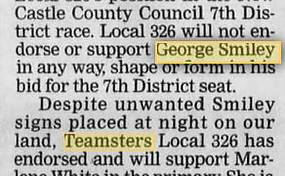
The eleven who voted yes, as the Council’s own record shows, were Council President Monique Williams-Johns and District Council members Brandon Toole, Dee Durham, Janet Kilpatrick, Penrose Hollins, Valerie George, David B. Carter, George Smiley, John Cartier, Timothy Sheldon, and Jea Street.
The increase costs the owner of a median-value home, $378,000, about $102 a year, roughly $8.50 a month. Rounded up, it is the $10 a month some accounts cite. Either way, it is the first non-reassessment property tax increase in New Castle County in eight years.
That $102 on the median home does not arrive in a vacuum. It arrives at the end of an eight-year arc the Truthline Network has documented across multiple investigations. Matt Meyer and Marcus Henry ran on the same calendar, never called themselves a ticket, and operated as one, with Alan Levin and many of the same contributors behind both. Nearly $8,000,000 in named contributions put Matt Meyer in office. $7,976,684.00, itemized, every dollar traceable by name, by entity, by date, on the Department of Elections record, inside a total of $8,284,295.89 across five committees.
Every itemized name carries a contribution. Every contribution carries a date. The developers are in it. The men who build in this county and submit their plans to Land Use are in it. The auto-dealer families, the waterfront landowners, the law firms whose practice is rezoning, the construction-industry PACs tied directly to Executive Order 18, all of them are in it. And $8.28 million is the floor, not the ceiling. More is verified as developer money, or money tied to it, every day, as the parcels enter the pipeline and the plans reach Land Use.
The record does not shrink. It grows. And the man who raised the largest share of it does not sit on the outside. Alan Levin organized the largest of the five vehicles, raised the money, and was appointed to chair the body that certifies whether the state can afford what the contributors are building. The structure that produced the deficit the rainy-day reserve cannot cover is the same structure that produced the campaign that elected the administration that produced the deficit.
The taxpayer pays at both ends of that arc.
It is the largest single rate increase since at least 2009, when County Executive Chris Coons proposed, and Council approved, a 25 percent property tax increase. That was the last and largest of three Coons increases. The first came in the FY2007 budget at 5 percent, raising the average annual County tax bill by $16, from $326 to $342. The second came in the FY2008 budget at 17.5 percent, raising the average bill by $60, to $402. The third, in the FY2010 budget, was the 25 percent increase, raising the average bill by roughly $100, to about $501.
Compounded, the three increases raised the County property tax burden a cumulative 54 percent across four years.
The same FY2010 budget that carried the 25 percent tax increase also carried a 10 percent sewer rate increase, the two landing on the same household in the same year. The FY2011 budget, signed in May 2010, carried a further 4 percent sewer increase. The FY2027 increase, 17.2 percent in one fiscal year, is more than double the 7.5 percent first-year step imposed in 2019 under County Executive Matthew Meyer through Substitute 1 to Ordinance 18-061, and it tops the cumulative 15 percent Meyer spread across FY2019 and FY2020, in a single year, by 2.2 percentage points. The County’s own Exhibit C-2 records the Meyer figures.
The promise of revenue neutrality lasted twelve months. It expired at the first legal moment it could.
This report lays out what was passed, who voted to pass it, what the record shows the architects knew before they passed it, what the County’s own audited statements say about the path now locked in, what residents will pay on top of the tax increase, and what comes next.
What the FY2026 Tax Increase Would Have Been, Stripped of Reserves and Reassessment Cushion
Henry defends the 17.2 percent increase by saying FY2026 was managed without a tax increase and the structural problem only surfaced later. The County’s own audited records do not support that story. The FY2026 Approved Operating Budget closed its gap by drawing $36 million from the Tax Stabilization Reserve and the Real Estate Transfer Tax Reserve combined, not by cutting and not by taxing. And the FY2026 budget came in 5.62 percent higher than FY2025, not lower, even with the federal pandemic dollars known to be running out, as the County’s own Operating Budget Summary shows. There were no FY2026 spending cuts of any consequence. There were reserve draws. That is a different thing entirely.
The reassessment, completed for FY2026 on a public promise of revenue neutrality, gave the County no extra money that year either. The County cut the residential rate from $0.8054 to $0.1575 per $100 of assessed value, and the non-residential rate to $0.2380, precisely to hold FY2026 collections at the FY2025 level. FY2025 actual property tax revenue was $141,940,638, as the FY2025 audited statements record. FY2026 approved property tax revenue was $141,051,550, a hair below it. The reassessment cushion was nothing more than holding the line at FY2025. The County collected the same property tax in FY2026 that it collected in FY2025.
Strip out the $36 million reserve draw, and assume no reassessment cushion, and the FY2026 budget faced a $36 million gap on a property tax base of roughly $141 million. To close that gap with the property tax alone, the County would have had to raise rates about 25.5 percent in FY2026. Run the same math on the FY2027 increase of 17.2 percent, which closes a smaller $42 million gap, and the conclusion is plain: the structural deficit has been visible since FY2026, and Henry’s FY2026 budget hid it by spending reserves as if they were revenue. The 17.2 percent in FY2027 and the 25.5 percent equivalent buried in FY2026 are two readings of the same problem, both written in the County’s own audited records.
"The promise of revenue neutrality lasted twelve months.
It expired at the first legal moment it could."
Video: May 26, 2026, New Castle County Council Meeting, FY2027 Budget Vote, 17.2% Tax Increase

May 26, 2026 FY2027 Budget
II. The Promise That Lasted Exactly One Fiscal Year
In July 2025, the Henry administration finished the first full property reassessment New Castle County had done in 42 years. The one before it was July 1, 1985. For four decades, property sat on the books at 100 percent of its 1983 market value, as the County’s own Exhibit C-1 records.
Alongside the reassessment, the administration put a promise in writing. The County’s FAQ, dated July 29, 2025, said this: "The County is capped by State law on how much additional revenue can be generated from reassessment and the County has committed that the total taxes collected in fiscal year 2026 following the reassessment will not exceed the amount of total taxes collected in fiscal year 2025; this is called 'revenue neutrality.' The County maintains revenue neutrality by reducing tax rates from before reassessment to new rates that maintain revenue levels".
And the County kept it. The FY2026 Approved Operating Budget projected real estate tax revenue of $141,051,550. The FY2025 actual was $141,940,638. The budgeted figure came in below the prior-year actual. The administration kept its word.
For one fiscal year.
The statutory cap on post-reassessment revenue, Title 9, Section 8002(c) of the Delaware Code, is exact. It reads, "When any total reassessment of taxable properties within a county of this State shall have become effective, the county tax rate levied for the immediately ensuing fiscal year shall not be such as to yield county property tax revenues greater than 15 percent in excess of the total of the county property taxes imposed for the fiscal year immediately preceding the fiscal year in which such reassessment shall have become effective" (9 Del. C. § 8002(c)).
The reassessment took effect for FY2026. The "immediately ensuing fiscal year" was FY2026. The 15 percent ceiling applied to FY2026 and to FY2026 only. After that, the cap no longer held the County’s tax-setting hand at all.
FY2027 is the first fiscal year following the reassessment in which the statutory cap does not apply.
And the moment it lifted, the Henry administration’s FY2027 Recommended Operating Budget projected real estate tax revenue of $168,529,434. That is $27,477,884 more than the FY2026 figure. That is a 19.48 percent jump in real estate tax revenue. The residential rate in unincorporated areas rises from 15.75 cents per $100 of assessed value to 18.46 cents. That is the 17.2 percent rate increase, and the County’s own budget book sets out both figures.
The promise of revenue neutrality lasted twelve months. It expired at the first legal moment it could.
A Council that wanted to honor the spirit of revenue neutrality could have phased a smaller increase over several years. A County Executive who wanted to honor it could have come forward with a real plan to reorganize departments, end leftover programs from the prior administration, and find the spending to absorb the federal funding cliff he knew was coming. The Henry administration did none of that. The Council did not make them.
"The FY2026 budget did not avoid a tax increase.
It deferred the tax increase by drawing $36 million from reserves. The mathematical equivalent of that reserve draw, expressed as a property tax rate, was approximately
25.5 percent. Henry presented FY2026 to the public as a year without a tax increase.
The audited records present FY2026 as the year the County borrowed from itself
to avoid asking residents to pay what the structural cost actually was."
III. Without the Reassessment, the Increase Is the Same Size
Some residents have been told the FY2027 increase is somehow softened by the reassessment. The math says no.
In FY2025, before the reassessment, the County collected $141,940,638 in real estate tax at a total direct rate of $0.8054 per $100 of assessed value, on 1983 valuations. In FY2026, after the reassessment, the County collected $141,051,550 at a rate of $0.1575 per $100, on 2025 residential valuations. The assessed values changed enormously. The rate changed enormously. The revenue barely moved. That was the revenue-neutral promise, kept.
In FY2027, the County will collect $168,529,434. That is $27,477,884 more than FY2026, and $26,588,796 more than the FY2025 actual. Set against the pre-reassessment FY2025 baseline, the FY2027 take is 18.73 percent higher. Set against the post-reassessment FY2026 baseline, 19.48 percent higher. The rate move from 15.75 cents to 18.46 cents is 17.2 percent.
The reassessment did not cause the FY2027 tax increase. The reassessment was revenue-neutral, by design and by the County’s own promise. The 17.2 percent sits on top of it, charged at the higher 18.46-cent rate against the new, higher assessed values. A homeowner whose assessment doubled in the reassessment, and whose rate then rose 17.2 percent, is now looking at a County property tax bill that has roughly doubled in real dollars since FY2025, before a single school-district change is added in.
This is why "reassessment plus 17 percent" feels like more than 17 percent. Because for many homeowners, it is.
RETURN TO TABLE OF CONTENTS
IV-A. The Lie of Not Knowing
On March 24, 2026, County Executive Marcus Henry delivered his annual budget address. He proposed the 17 percent property tax increase. He cast it as the answer to a $42 million structural deficit. Asked about the budget conversations he had with his predecessor, now-Governor Matt Meyer, Henry "took a deep breath and laughed. Then he said he didn't know in late 2024 that the deficit was going to be as large as it is today". “I was presented information that showed us in a deficit, but it ended up being much, much larger than what I was shown,” Henry said in March.
That statement is contradicted by the documented record in five distinct ways.
First, by Henry's own service. Marcus Henry served as Director of Development at the Wilmington Housing Authority from 2007 through 2011, working on community revitalization and affordable housing. He then joined the New Castle County Executive Office and served under three successive County Executives across roughly ten years before his own election. From 2011 through 2013, he was General Manager of the Department of Community Services, mostly under County Executive Paul Clark. Clark was never elected to the office. He held it only by elevation, lifted automatically from Council President when Chris Coons resigned on November 15, 2010, to take a seat in the United States Senate. Clark ran for a full term in 2012 and lost the September 11, 2012, Democratic primary to former County Executive Thomas P. Gordon, 46 to 33 percent.
From 2013 through 2017, Henry served as Economic Development and Policy Director under Gordon, who won the November 6, 2012, general election by 64 percent, was sworn in early on November 13, 2012, to finish the brief unexpired Coons-Clark term, and then served his own four-year term through January 3, 2017. From 2017 through December 14, 2021, Henry was back as General Manager of Community Services under County Executive Matt Meyer, whose tenure ran from January 3, 2017, through January 7, 2025. Henry announced his retirement from County employment in October 2021; Meyer nominated Carrie Casey to succeed him on November 17, 2021; Casey took the role on December 15, 2021.
Across all three administrations, Henry was in the executive office. He sat in cabinet meetings. He ran a department covering the Library system, Community Resources, Community Development and Housing, and the Hope Center. He oversaw the absorption of American Rescue Plan Act positions into that department. He was in the room while the Meyer administration spent ARPA dollars on recurring operating costs. He was no stranger to County finance. He was a senior architect of the very trajectory now under examination, embedded in three administrations across ten years before he ever took the top job.
Second, by his own published résumé. On his own LinkedIn profile, Henry lists among his key accomplishments with the County: "Negotiated the purchase of a former Sheraton hotel, utilizing specialized federal funds to create an innovative facility called the Hope Center, which provides integrated services for unhoused people in New Castle County". Henry was the architect of the Hope Center. He led the project. He directed the staff who worked on it. Carrie Casey, then Manager of the Division of Community Development and Housing, worked under him and had her duties assigned by him.
Casey’s later public statements and biographical materials, including her ACLU of Delaware biography, describe her as having "presented the case to New Castle County government to purchase the former Wilmington Sheraton South." That overstates her role. Casey worked under Henry’s direction. The decision authority, the negotiation, and the project leadership were his. The pattern of Casey claiming public credit, including on the County’s own website, for projects she did not lead is a documented feature of her tenure that deserves its own scrutiny in a future report. For the Hope Center, the controlling fact is simple: Henry, in his own résumé, takes personal credit for negotiating the purchase. The Hope Center is now a $2.7 million annual line in the General Fund. It did not exist as a budget line in FY2024. Henry cannot claim authorship of the project and surprise at its cost in the same breath.
Third, by the public and published record. The author of this report announced her candidacy for County Executive on March 21, 2023. Her published campaign platform, posted that year, identified the structural problem directly, warning against what she called the “unfettered use of one-time federal pandemic funds,” and describing an administration that had expanded County government and routed CARES Act and ARPA money toward recurring and state-level purposes rather than the durable infrastructure that would have delivered lasting value. She committed to restoring core services without a tax increase, through financial restraint, Council oversight, and the elimination of long-vacant funded positions. She campaigned on that analysis for a year and a half, at candidate forums and community events across New Castle County.
Across the 2024 primary campaign, she and Marcus Henry appeared together as the two Democratic candidates for County Executive at no fewer than seven documented public candidate forums between March and August 2024. They shared a stage on March 3, 2024, at the 23rd Representative District forum at the Take the Lead Dance Studio in Hockessin; on May 2, 2024, at the 8th and 9th Representative District forum at the MOT Senior Center in Middletown; on June 20, 2024, at the Leadership Delaware forum at CSC Station in Wilmington, moderated by former DelDOT Secretary Jennifer Cohan; on July 16, 2024, at the New Castle County Chamber of Commerce State of the County forum at the University of Delaware’s Clayton Hall; on July 17, 2024, at the New Castle County Board of Realtors candidate forum at Riverfront Events in Wilmington, streamed live to the organization’s membership; on August 19, 2024, at the League of Women Voters of New Castle County webinar; and on August 22, 2024, at the Rotary Club of Wilmington forum in the Gold Ballroom of the Hotel du Pont. Several of these forums centered expressly on the County’s economy, its finances, and its management, including the Chamber’s State of the County program and the Realtors’ policy forum.
At those forums and more, the author raised the structural mismatch between the federal pandemic spending the County had built into its operations, its recurring operating costs, and the recurring revenue base that could not sustain them. The two men who shared those stages with her are now the Governor of Delaware and the County Executive of New Castle County. The federal funding cliff arrived as she described it. The structural deficit followed.
Fourth, by a documented in-person meeting after he took office. In early March 2025, the author of this report met Marcus Henry for lunch at a local restaurant. The campaign was over. The two met as colleagues. The author told him directly and in detail what the County’s finances required: that he restructure the government immediately, pull back the spending the Meyer administration had built on one-time federal pandemic money and never reduced, eliminate the funded-vacant positions, find efficiencies, make real cuts, and end the programs whose federal funding was expiring. She told him there was no new revenue available and no flexibility left in the budget, that the County could not afford the structure it was carrying, and that unless he corrected it at once, the eventual correction would land on homeowners as a property tax increase of 43 to 47 percent. She offered him her help and that of her advisors at any time and for any question. He told her he had good people and that they were working on it. At that same meeting, Henry told the author that he had read her website every day. The remark is recorded here for a single reason: the County Executive, who would later say he had not understood the size of the deficit, was, by his own account, a daily reader of the fiscal analysis that had been describing it.
That meeting took place roughly five months before the County’s own Office of Finance posted the August 31, 2025, General Fund projection that put the FY2027 gap at $47.9 million. The author did not raise the alarm after the County’s own documents surfaced the problem. She raised it before they did. What she told him in March 2025, the County’s own worksheet confirmed in August 2025.
What he did with the warning is a matter of record. Over the fourteen months between that lunch and his budget address, the County did not restructure. The payroll grew. The appointed and exempt ranks grew. The budget grew. The programs built on expiring federal money were not wound down. Then, on March 24, 2026, he told the public he had not known the deficit would be as large as it is. He had been told, in person, by a former Council President who had run against him, and he had been reading her published analysis of it, by his own account, every day. He raised the rate 17.2 percent on May 26, 2026, the first installment of exactly the correction he had been warned was coming.
Fifth, by Henry's own public posture in his budget address. Henry told reporters the County had "been in a budget deficit for several years, but costs were previously covered by one-time federal appropriations that the county received as a result of the COVID pandemic". That is the exact structural problem the author warned him about during the campaign and at their March 2025 meeting. Henry was not surprised by the deficit. He was describing the deficit he had helped build, helped obscure, and now chose to close with a tax on residents who were never told the truth in time to plan for it.
The Documented Awareness Timeline
The chart that follows gathers the documented points at which Henry was exposed to the County’s deteriorating fiscal condition, each with its date, drawn from the public record and from the author’s own record as a former elected official who served alongside and directly with Henry during the relevant years. Every entry is documented elsewhere in this report. Here they sit in chronological order, so the arithmetic of his exposure is visible in one view. Every date in the chart precedes the March 24, 2026, budget address, where Henry said he “didn’t know in late 2024 that the deficit was going to be as large as it is today.”
Henry Did Not Walk Into the Deficit. He Helped Create It.
The framing that Henry was handed the deficit by his predecessor is a partial truth. Henry was handed a County government with a structural mismatch between recurring revenue and recurring expenditures, a reliance on federal pandemic dollars to cover ongoing operating costs, and a Tax Stabilization Reserve headed toward exhaustion. That part is accurate. What the framing leaves out is that Henry, as General Manager of the Department of Community Services from 2017 through December 14, 2021, was the senior department head who prepared and submitted to Council the Community Services operating budget for each of those four full fiscal years. The budgets he authored grew his department’s spending base, added the Hope Center as a new operating facility with a documented federal funding cliff built into its financing, and absorbed American Rescue Plan Act positions onto the County’s recurring payroll. Every one of those decisions was a contributing line in the structural gap Henry now calls a problem handed to him rather than a problem he helped design.
The arithmetic is documented in the Community Services operating budgets Henry signed and submitted. FY2018 was the first full fiscal year of his tenure as General Manager. FY2021 was the last. Across those four fiscal years, the Department of Community Services' operating budget grew. The Hope Center facility, acquired December 1, 2020, with $19.5 million in federal CARES Act funds, was layered onto the department’s operating commitments without a dedicated recurring revenue stream and without Council appropriation of County General Fund dollars to support its operations. The arrangement worked, on paper, only so long as federal pandemic dollars covered the operating costs. The decision to layer the Hope Center onto the department’s operating responsibilities was made on Henry’s watch. The decision to absorb ARPA-funded positions into the department’s recurring payroll was made on Henry’s watch. The decision to grow the department’s operating base while the County’s recurring revenue base remained flat was made on Henry’s watch. When the federal funding cliff arrived as predicted, the structural gap his decisions had contributed to became the deficit he now seeks to close with a 17.2 percent tax increase on residents.
The scale of the one-time money that built this trap is worth stating plainly. New Castle County received $322 million in federal CARES Act Coronavirus Relief Fund dollars in 2020, of which it passed $136 million to the State of Delaware, and approximately $108 million in federal ARPA State and Local Fiscal Recovery Funds delivered in two $54 million tranches in 2021 and 2022. The State of Delaware separately received its own CARES allocation and over $1.74 billion in ARPA funds. That is the universe the Hope Center and the absorbed positions were funded from: hundreds of millions in non-recurring federal money, spent in part on recurring obligations that did not end when the money did. The cliff was not a surprise that befell the County. It was the predictable end of one-time money the County chose to spend on permanent things.
Henry was handed the deficit by Meyer. Henry also helped create the deficit as Meyer’s senior department head and General Manager of the fastest-growing department in the County’s General Fund. Both statements are documented. The second is the one Henry’s public account of the budget address leaves out.
Why Henry’s Publicly Stated Cuts Are Not Really Cuts
In the days after the March 24, 2026 address, the Henry administration called parts of the FY2027 budget “cuts.” Held against what a cut actually means, the record does not support the word. A budget cut is a reduction in the County’s operating commitment below the prior year, for the same function. Moving a position from one department to another, reclassifying an existing position, shifting a funded position between funds, or striking a position that was already vacant and unfunded in practice, none of those is a cut. They are accounting moves. They do not lower the County’s operating commitment. They rearrange the budget book without touching the spending trajectory.
The headline items the administration called cuts were the elimination of 56 positions from the published budget, a 10 percent reduction in library staff, the loss of five parks employees, and the cancellation of Sleep Under the Stars at Carousel Park. The 56 positions had been vacant for long stretches and were not supporting active County operations. Eliminating a position empty for a year or more does not lower current spending. The salary line was not being spent. The benefits line was not being spent. Taken together, these are the kind of position cleanup the Council President tried to legislate back in 2017, the amending ordinance documented in Section VIII. The Henry administration is doing in 2026 what the Council President proposed in 2017 is consistent. Calling it “cuts” instead of overdue housekeeping is not consistent with what those positions actually cost in FY2026, which was nothing.
The 10 percent library cut and the five lost parks jobs were real service reductions in libraries and parks that shifted location from the public-facing side of County government, not on the administrative overhead that grew across the period this report examines. Library staff and parks employees are the County workers residents actually see. Cutting them in public while keeping the layered Executive Assistant appointments documented in Section XII, and while continuing to fund the parallel Hope Center, Inc. operating structure documented in Appendix L, is a choice about who absorbs the cost of the administration’s spending and where those employees quietly move. The visible cuts fall on the public. The structural costs that grew during Henry’s years as General Manager and his first fifteen months as County Executive stay right where they are. The Sleep Under the Stars cancellation is the most visible cut and the smallest dollar item; it is in the “cuts” list mainly to give the framing a community-facing example to point at.
A real cut produces a lower expenditure line next year than last year, for the same function. By that standard, the FY2027 budget Henry proposed, and Council adopted on May 26, 2026, contains no meaningful cuts. The Operating Budget Summary shows an FY2027 General Fund operating budget of $387.6 million, above the FY2026 level. The budget grew. The 17.2 percent tax increase funds the growth. The position cleanup, the library reduction, the parks reduction, and the Sleep Under the Stars cancellation together are a sliver of a spending trajectory the administration sold to residents as discipline. The Tackett and Toole amendments named real cuts the administration could have proposed itself and did not, and the administration opposed them, as Section XXIV documents. The arithmetic of a real cut was available. The administration did not reach for it. What it offered and called cuts is a smaller, more palatable version of what a real reduction would have demanded.
The Department-by-Department Cut Inventory
The specific dollar amounts of the supposed cuts in the adopted FY2027 budget became public on May 28, 2026, two days after the vote, in a breakdown the administration had not fully disclosed at the March 24, 2026 address. The cut inventory, in descending order of size, is as follows.
First, $2.8 million cut from the Community Services Department. That is the department Henry himself ran as General Manager from 2017 through December 14, 2021. It holds Libraries, Community Resources, Community Development, Housing, and the Hope Center. The department whose spending base Henry helped grow across four years of budget submissions is now absorbing the single largest dollar reduction in the FY2027 budget. But the cut does not touch the Hope Center General Fund line, still funded at roughly $2.7 million a year, as Appendix L documents. It falls on the library system and on Community Resources, both of which serve residents directly.
Second, $2.5 million cut from open space and Agricultural Preservation. These programs run mostly on dedicated revenue tied to the Realty Transfer Tax, and they have long been the County’s most visible commitment to keeping land open. Cutting $2.5 million shrinks the County’s ability to preserve farmland and open space at the exact moment development pressure is intensifying, the Project Washington data center proposal documented in adjacent Truthline reporting, and the corridor of warehouse and logistics development pushing through the southern County. This cut outlasts the budget cycle. The land that gets developed because conservation money was pulled cannot be un-developed in a later budget year.
Third, $1 million cut from County special events. This line pays for community programming, public observances, and County-sponsored gatherings, small in dollars, large in how many residents they touch. Cutting $1 million here is a visible community sacrifice that barely dents the structural problem the administration said it was solving.
Fourth, a 10 percent cut to library budgets. For many residents, the library is the most visible County service there is, especially for seniors, parents of school-age kids, and people who depend on it for internet access, job-search resources, and a place to be. A 10 percent cut means shorter hours and libraries closed one day a week. The hit to residents is real and visible. The savings are not, because the County’s collective-bargaining obligations cap them, as the next subsection shows.
Fifth, 56 unfunded positions. The mechanism is exact: the County would “allow 56 unfilled positions to go unfunded.” Read it closely. The positions were unfilled before the FY2027 budget. They will be unfunded under it. The County’s actual operating spending does not move either way, because by definition those positions were not drawing salary or benefits in FY2026.
Housekeeping, presented to residents as discipline. We will likely see them refunded through amendments during the year,
used as a slush fund.
Sixth, higher credit-card fees on sewer bills and land-use permits, plus a 5 percent increase in sewer rates. These are not cuts. They are revenue increases, stacked on residents on top of the 17.2 percent property tax. Calling the FY2027 budget a mix of cuts and tax increases hides the real picture: residents are being hit on several revenue lines at once, while the service reductions land on those same residents.
Seventh, the 17.2 percent property tax increase itself. The new residential rate is 18.46 cents per $100 of assessed value. The new non-residential rate is 27.9 cents. The increase will raise about $23 million a year. For the median owner of a $378,000 home, that is roughly $102 a year, about $8.50 a month, on the County share of the bill. The school share, the larger one, is set by local school districts under State authority, not by the County. New Castle County does not run the schools. The schools sit under the State of Delaware. The County prints the County tax and the State school tax on one statement, mails it, and collects the money, but the two taxes are separate. The 17.2 percent the Council adopted on May 26, 2026 falls on the County line only. Section XXII takes that apart in full.
Councilman David B. Carter, one of the eleven who voted yes, framed the constraint that drove the “cuts” conversation on the record: “I don’t see where there’s anything that can be cut without hurting something else at this point. You can shift things around, but short of massive layoffs, we just can’t do it.” Carter also noted that “the majority of the county’s budget pays for staff salaries, and many of those are negotiated union contracts.” The budget confirms this: salaries, wages, and benefits account for 62 percent of the FY2027 operating budget. Sixty-two percent is locked into union contracts, civil-service positions, and benefits. The discretionary money available to cut is the other 38 percent. Also, Notice Councilman Carter did not mention the exploding number of appointed positions, ARPA rollovers, and other obvious options ripe for cutting. He followed in lockstep with the Executive. Did that help his constituents and their pain? Not a single “Hail Mary” budget amendment did he offer. Only a defeatist quote to add to the theatre of the day, offered as an explanation for failing to try.
Councilman Kevin Caneco of the Twelfth District, one of the two who voted no, named the cause more bluntly. Caneco argued the deficit is the product of the County “kicking the can down the road” and leaning too hard, in past years, on federal COVID money. He told the public-comment audience the vote amounted to telling residents, “you have to foot the bill because we, as a government, were incompetent.” His conclusion: “Eventually this charade has to stop.” Caneco’s charge of governmental incompetence is on the record. It is the same charge the author of this report raised during the 2023 and 2024 candidate forums, when both Henry and Meyer called her a liar for naming the structural deficit.
Two days after the vote, Henry offered yet another version of his “I didn’t know.” He said: “I was presented information that showed us in a deficit, but it ended up being much, much larger than what I was shown.” The framing had shifted. In March, he said he “didn’t know in late 2024 that the deficit was going to be as large as it is today.” By May, he conceded he was shown a deficit but called its size a surprise. The County’s own August 31, 2025, General Fund Financial Projections worksheet, posted publicly to the County’s own ArchiveCenter as Item 3769 and documented in Section X, projected the FY2027 gap at $47.9 million. The deficit Henry announced on March 24, 2026, was $42 million. The County’s own projection, seven months earlier, was $5.9 million larger than the number he announced. Nowhere in the County’s records is there arithmetic that turns the deficit’s size into a surprise.
The Union Contract Reality: Why Library and Parks Cuts Do Not Produce Library and Parks Savings
New Castle County’s workforce is represented by several collective bargaining units, all under AFSCME Delaware Public Employees Council 81, headquartered at 91 Christiana Road in New Castle, with Executive Director Michael A. Begatto and President Faith Morris. Council 81 represents roughly 5,000 public employees across Delaware. The County’s AFSCME units, certified by the Delaware Public Employment Relations Board and documented in the County’s own 2017 Workforce Diversity Report, are organized by job classification, not by department. Local 459 represents skilled and unskilled labor, including County Park Workers and the crews that maintain parks, facilities, and grounds. Local 1607 represents clerical, administrative, and technical employees, which includes Library Specialists, Library Assistants, and the staff who do property assessment and reassessment work. Local 3109 represents professionals, managers, and administrators. Local 3911 represents emergency services employees. Fraternal Order of Police Lodge 5 represents sworn officers. The Sheriff’s Fraternal Order of Police represents Deputy Sheriffs. The International Association of Firefighters represents fire and EMS personnel. Every one of these contracts spells out what happens to bargaining-unit employees when the County curtails operations, closes facilities part-time, or moves workers from one function to another. That detail is the whole point of what follows.
The County’s own Workforce Diversity Report, prepared and posted by the Department of Administrative Services and Human Resources, put the bargaining-unit workforce at 1,443 employees, organized as follows. These are the County’s own figures, from the County’s own published report. Notice that the classifications follow the kind of work done, not the department it is done in. A library worker, a property-assessment technician, and an administrative aide in any department who do clerical, administrative, or technical work are all in AFSCME Local 1607 under the same contract, no matter which department signs their timesheet.
That classification structure is the key to why the FY2027 cuts do not produce the savings the administration claims. Library workers who lose patron-facing hours are in AFSCME Local 1607, the same Local that represents the property-assessment technicians doing the reassessment work. Parks workers reassigned out of Parks are in Local 459, the same Local covering the County’s broader labor workforce. Moving a worker from one function to another inside the same Local renegotiates no contract terms. Same wage scale, same benefits, same protections. The worker stays a County employee on the County payroll. The service the worker performs may change. The budget column may change. The General Fund payroll commitment does not.
How the County actually handles service curtailments and closures inside its union environment is documented in two records. The first is the Delaware Public Employment Relations Act, 19 Del. C. Chapter 13, which requires the County to honor its collective bargaining agreements and to negotiate in good faith over wages, hours, and working conditions. The second is the County’s own history. In April 2010, during the Coons administration’s response to an earlier shortfall, the County reached agreement with AFSCME Local 1607 to continue a 5 percent salary rollback in exchange for an explicit commitment that “there will be no layoffs for AFSCME Local 1607.” It struck parallel no-layoff deals with Local 459, covering parks and maintenance workers. The County’s documented practice in a comparable squeeze has been to negotiate continued pay in exchange for wage or benefit concessions, not to impose layoffs on union workers by fiat.
The contract terms themselves sit in the County’s collective bargaining agreements with AFSCME Council 81 and its Locals, ratified by Council resolution and published on the County’s DocumentCenter. Resolution R20-233, which the author of this report introduced on December 8, 2020, authorized the County Executive to sign the agreement with Council 81 and its affiliate Local 3911, the full text published as Exhibit A. Resolution R21-065, which the same author introduced on April 13, 2021, authorized the parallel agreement with Council 81 and Local 459, covering parks and maintenance workers. The Local 1607 agreement covering library workers and assessment technical staff is likewise ratified and published. The FOP Lodge 5 agreement was ratified by R14-118. Paragraph 31 of the Local 3911 agreement, on Seniority and Reduction in Force, sets the obligation: “The County agrees to seniority by occupational classifications and occupational groupings with respect to layoffs, recall, transfer, and promotion.” Paragraph 35 sets the sequence after a reduction in force: “employees affected will be transferred to other departments within their occupational classification exercising their seniority on a County-wide basis.” The Local 459 and Local 1607 agreements carry materially the same reduction-in-force, transfer, and seniority terms. The contract requires transfer first, displacement of junior by senior within classification second, and layoff only after both are exhausted.
The same is true in Parks, and in other functions taking the announced staff reductions. The five parks employees “lost” under the FY2027 budget, as the County’s public communications put it, are not gone from the payroll. They are reassigned. According to County employees who spoke with the author of this report, the FY2027 Parks function adds three new lead positions to manage the workflow of employees being reassigned to Parks from elsewhere, and reportedly adds three new hires for reasons so bizarre that they deserve a published report of their own. Along with reports of expensive, incorrectly purchased park playground equipment sitting in a warehouse without a home. So the net effect is not a reduction. It is a reorganization that adds management overhead while keeping the underlying payroll for the reassigned line workers.
None of this is in dispute. Delaware Code Title 19 Chapter 13, the Public Employment Relations Act, requires County employers to honor their collective bargaining agreements, and the Public Employment Relations Board can enforce it. So when the County calls reduced library hours a “cut” without mentioning the contract obligation to keep paying the affected workers, the word is incomplete in a way that overstates the savings residents are promised. The reduced library budget would only balance if the library workforce shrank. The County’s own account is that the workers are reassigned, not removed.
The fiscal effect of reassignment without elimination is to move the payroll line from one departmental column to another without changing the County’s total payroll. Residents see shorter library hours. Residents see fewer parks staff on weekends. The General Fund keeps paying the same number of workers. The reductions are visible to residents and invisible to the bottom line. That is the definition of a cut that is not a cut: a service reduction with no spending reduction behind it.
The Executive Assistant Expansion: From Department Heads to Political Workers
For most of the County’s history, under the Charter and across multiple administrations, the Executive Assistant title was reserved for a defined set of senior appointments: department heads like General Managers, the Chief of Police, the Chief Administrative Officer, the Chief of Staff, and a handful of senior policy positions. Executive Assistants were the County Executive’s leadership team. They were not the County Executive’s political operation.
The current administration stretched the title well past that. New Executive Assistant titles appeared that match no traditional department-head job. Position descriptions were written carrying the Executive Assistant label for work that under prior administrations would have gone to lower-graded merit employees, or would not have existed at all. The expansion documented in Section XII, from about 21 Executive Assistants under Thomas P. Gordon, to about 44 under Matt Meyer, to about 48 under Marcus Henry, did not happen because the County’s departments more than doubled. The departments are the same departments. The functions are the same functions. Only the Executive Assistant count more than doubled.
The author of this report, who served as an elected official through Henry’s transition into office and watched his hiring from the post-election period forward, has documented in earlier sections the pattern behind the growth. Executive Assistant titles have been used to put political and campaign workers on the County payroll. Friends of the County Executive and members of his political network have received Executive Assistant appointments. Jobs promised during the campaign in exchange for support, endorsements, or fundraising have been paid off through Executive Assistant placements that match no department-head function. The pattern is documented, and patronage in County hiring is not new across administrations, but the scale of this expansion is the largest in the County’s modern record.
The cost is in Section XII. At an average loaded compensation of roughly $175,000 per Executive Assistant, including the 54.147 percent benefit rate, 48 of them run the County about $8.4 million a year. That is the General Fund cost of a political appointment tier that grew from 21 to 48, while the County’s functions did not. The FY2027 budget that cuts library staff, trims parks, cancels Sleep Under the Stars, and asks residents for 17.2 percent more does not touch the Executive Assistant tier. The political overhead grew while the deficit grew. The political overhead stayed whole when the deficit was “addressed” with cuts and a tax increase. The residents paying the increase are subsidizing the political tier with their property taxes.
The reform that would have produced real discipline was right there. Cutting the Executive Assistant tier from 48 back toward the historical structure, on the order of the roughly 21 of the Gordon baseline, would save about $5 to $6 million a year in the General Fund. That is in the same range as the $6,532,705.49 in annual payroll savings the 2017 amending ordinance would have produced, documented in Section VIII. The reform was as available to Henry as it was to Meyer. Neither proposed it. The Tackett and Toole amendments, in Section XXIV, tried smaller versions of the same argument. The Henry administration opposed them. They were defeated. The 48-position Executive Assistant tier survived the FY2027 budget intact on May 26, 2026.
"The cuts that residents see are real cuts to resident-facing services.
The cuts the County General Fund actually absorbs
are smaller than the headline numbers suggest.
The library workers who lose a day of patron-facing work remain on the payroll.
The parks employees who are reassigned out of parks remain on the payroll.
The 56 unfunded positions were not being paid in the first place.
The political appointment tier that grew during the same period remained intact.
The 17.2 percent property tax increase funds the political appointment tier
that the cuts did not reach."
The Office of Finance Assessment Division: Three Rounds of Reassessment-Related Hiring
While the FY2027 budget calls library reductions, parks losses, and the 56 unfunded positions “cuts,” the same budget adds positions to the Office of Finance, Assessment Division. The Office of Finance has four divisions: Accounting, Assessment, Budget, and Treasury. The Assessment Division prepares and maintains the property assessment data that is the foundation of the County’s property tax revenue. It is also the operating home of the AFSCME Local 1607 reassessment technical staff named in the union subsection above. Those reassessment technicians, alongside the library workers, sit in the 338-employee Local 1607 bargaining unit, per the County’s own 2017 Workforce Diversity Report.
On March 25, 2026, the day of the budget address, it was reported that “the plan dedicates an additional $1 million to the county’s property assessment office to hire 10 more staff positions, building on five posts already approved by County Council in an effort to stabilize and manage the reassessment system.” So the assessment hiring comes down to three numbers: $1 million in new funding, 10 new positions under the FY2027 budget, and 5 positions Council approved earlier. The combined add this cycle is
15 positions.
But those 15 positions are not the first round of reassessment hiring. The record runs three distinct rounds across the past decade. The first came during the author of this report’s tenure as Council President, when Council authorized added reassessment positions to support the work then underway. The second came after Henry took office on January 7, 2025, when more reassessment positions went onto the Office of Finance to handle the workload of the first reassessment in a generation, completed for FY2026. The third is the FY2027 action above, $1 million and 10 positions, on a base that already held the five posts Council approved earlier.
Here are the questions for the Office of Finance, each with a documentary answer it can give in a single response. What is the current total reassessment staffing in the Assessment Division? What is the cumulative FY2025 through FY2027 spending on reassessment positions, including the $1 million in FY2027 and the salary and benefits of the five previously approved posts and the prior-round positions added under Henry? What was the reassessment staffing baseline in FY2024, before any of this? The answers settle whether a budget that calls itself a cuts budget squares with where the County’s payroll dollars are actually going.
The questions are on the record.
The Office of Finance budget book, published each year on the County’s own ArchiveCenter, is where the Assessment Division’s position count and spending sit, line by line. The FY2026 Approved Operating Budget book lays out the Assessment Division within General Government. That is the baseline against which all three rounds of reassessment hiring are measured.
Facebook Video: County Executive Marcus Henry Delivers the FY2027 Budget Address and 17.2% Tax Increase In County Council Chambers
March 24, 2026 | Delaware LIVE News
"To close the budget gap, Henry is proposing a 17.2% increase to the county portion of property taxes, or $102 for the median household. NEW CASTLE — Facing a $42 million structural deficit, New Castle County Executive Marcus Henry on Tuesday unveiled a proposed FY2027 budget that leans on spending cuts, targeted investments, and a tax increase to stabilize county finances while protecting core services. The proposal reflects what Henry described as a business-minded approach to government, prioritizing efficiency, accountability, and long-term sustainability over short-term fixes. “This is not an easy conversation. It’s an honest one,” Henry said in presenting the budget. “I look at every dollar we spend to ensure it’s being used efficiently and effectively.” - Delaware Live News
IV-B. The Tyler Technologies Footprint: Documented Across Six County Functions
The Department of Technology and Administrative Services FY2026 Recommended Budget book, posted as View 58922 on the County’s ArchiveCenter, shows exactly how Tyler Technologies, Inc. became embedded in the County’s operating cost. The book’s Position/Salary Changes and Budget Changes tables together record a Tyler licensing add of $615,800 for FY2026, filed under Contractual Services and described as “Licensing for Tyler Assessment Software.” The footnote on the Budget/Actuals History page reads, word for word: “FY2026 reflects the increase to move Tyler Assessment from Capital to Operating and DTS Software maintenance offset by Deeds Tech Funds. FY2022 reflects the increase for Munis Annual Maintenance.” One footnote, two separate Tyler budget moves, in two separate years, each one adding recurring cost to the department’s operating base.
The $615,800 Tyler Assessment licensing add shows up in the Budget Changes table as a move “from Capital to Operating.” Here is what that means. A cost once carried on the Capital Budget, where one-time and project expenditures live, is now a recurring operating expense that comes back to the General Fund every single year. The reassessment project, which picked Tyler’s iasWorld mass-appraisal platform under Resolution R21-110, introduced June 8, 2021, reviewed by the Admin-Finance Committee, and voted by the full Council, kept the Tyler costs in the Capital Budget during the multi-year build. Now that the reassessment is done, the recurring maintenance has migrated to Operating. Capital-to-Operating is the move that turns a one-time project cost into a permanent commitment.
The Munis maintenance increase in the FY2022 footnote was the same kind of structural add. Munis is Tyler’s financial ERP system, the platform that runs the County’s general ledger, accounts payable, accounts receivable, payroll, purchasing, and vendor management. The County’s own Request for Information RFI 21-002, dated September 24, 2021, states it plainly: “Tyler Munis is our financial ERP platform.” Munis shows up again in the FY2025 single audit findings, where the County Auditor flagged accounting practices tied to the “County’s MUNIS financial system,” documented elsewhere in this report. The FY2022 Munis increase added a recurring cost to the operating base in the same Capital-to-Operating pattern repeated for Tyler Assessment in FY2026.
The County functions that run on Tyler products span six distinct areas of government, documented across the County’s own records:
The aggregate Tyler Technologies financial footprint on the New Castle County operating budget is observable in two composite figures from the FY2026 Tech and Administrative Services budget book. First, the department’s Contractual Services line item, which is the budget category that contains Tyler licensing payments alongside other vendor contracts, grew from $4,788,794 in FY2025 approved to $5,524,594 in FY2026 recommended, an increase of $735,800 or 15.37 percent in a single fiscal year. The $615,800 Tyler Assessment licensing add accounts for the majority of that increase. Second, the department’s total budget, before Operating Transfer Credits, grew from $8,087,700 actuals in FY2020 to $11,554,718 recommended in FY2026, an increase of $3,467,018 or 42.9 percent in six fiscal years. The Tyler Assessment Capital-to-Operating movement in FY2026 and the Munis Annual Maintenance increase in FY2022 are both line items within that six-year 42.9 percent growth trajectory.
The structural feature of the Tyler footprint that warrants attention in the context of the FY2027 17.2 percent property tax increase is that Tyler licensing payments are recurring operating expenses that the County will pay every fiscal year going forward. The $615,800 Tyler Assessment licensing line, once moved from Capital to Operating, returns to the General Fund operating budget in FY2027, in FY2028, in FY2029, and in every subsequent fiscal year for as long as the County continues to use Tyler iasWorld for property assessment. The Munis maintenance line that the County added in FY2022 is on the same recurring footing. The Tyler New World public safety CAD/RMS license has been recurring since 2015. The total Tyler-related recurring operating commitment, when summed across the Assessment, ERP, public safety dispatch, vendor self-service, and land use modules the County has acquired, is a material portion of the contractual services expense that drives the Technology and Administrative Services department’s budget growth and that residents are absorbing through the FY2027 property tax increase.
The Tyler Assessment licensing add of $615,800 in FY2026 arrives at the same time the County is adding 15 reassessment-related positions to the Office of Finance Assessment Division, documented in the Office of Finance Assessment Division subsection of this report (10 new positions in the FY2027 budget plus 5 previously approved positions). The two cost drivers are connected. The reassessment system the County selected requires both the Tyler software platform and the County staff to operate it. The County is paying for both sides of that equation simultaneously. The Tyler licensing cost of $615,800 plus the $1 million the County is appropriating for the 10 new FY2027 reassessment positions plus the salaries and benefits of the 5 previously approved positions plus the recurring cost of the prior round of reassessment hiring during the author of this report’s tenure on Council and the subsequent round added by the Henry administration, together represent the cumulative cost of the reassessment program that has not been presented to residents in a single consolidated figure in any of the FY2027 budget materials.
A separate Truthline report, “Tyler Audit or Illusion: R25-150,” published at karenhartleynagle.com, documents the full Tyler Technologies contract record across New Castle County and the State of Delaware (what could be located as of the date of publishing). That report covers the State-level Tyler footprint, including the Delaware Open Data Portal hosted on Tyler Data and Insights (formerly Socrata, which Tyler acquired in 2018) and the June 24, 2025, Tyler agreement with the Delaware Department of Safety and Homeland Security E-911 division for the NERIS federal reporting transition. The present section addresses only the New Castle County operating budget exposure. The broader State-County integration is in the companion report.
IV-C. The Procurement Bypass: One Tyler Contract Authorized by Council, Six Tyler Footprints Operating Without It
The Tyler footprint raises one clean legal question with a documentary answer. The law is on the books. The procurement authorizations are in the County legislation database. The two should match. They do not.
The controlling authority sits in three statutes.
Title 9, Chapter 15, Subchapter II, Section 1521(c) of the Delaware Code hands County Council the power to purchase or lease “modern and efficient business machines and machine record systems” for County operations. The statute reads, word for word: “The New Castle County Council, in the general supervision of the county offices as enumerated in this section, shall have the power and authority to install, in such of the county offices as it shall consider necessary and desirable, modern and efficient business machines and machine record systems, to the end that all of the county offices shall be administered efficiently and economically. The New Castle County Council shall purchase or lease the necessary and appropriate business machine record systems and business machines to carry out the purposes of this section.” Tyler Munis is a business machine record system. Tyler iasWorld is a business machine record system. Tyler New World CAD/RMS is a business machine record system. The statute gives the purchase-or-lease authority to the Council, not to the County Executive’s administration.
New Castle County Code Section 2.02.004, “Approval of Contracts by County Council,” puts the State statute into operation. It requires that any non-competitively-bid contract exceeding $50,000 in aggregate to one vendor in a single fiscal year be approved by Council resolution. The $50,000 threshold was set by Resolution R20-193, introduced October 13, 2020; the prior $25,000 threshold had stood since at least Resolution R14-123, introduced May 13, 2014. The threshold attaches to total vendor exposure in a fiscal year, which means a string of smaller purchase orders to the same vendor that together top $50,000 needs Council approval exactly as one big contract would. Code Section 2.05.502 governs the competitive-bid procedure and the narrow sole-source and emergency exceptions. And the General Assembly amended 9 Del. C. Section 314 through House Bill 72 in the 152nd General Assembly, signed by Governor Carney on July 21, 2023, aligning county bidding thresholds with State thresholds while keeping Council’s approval role for non-competitively-bid contracts above the line.
The documented operating pattern of the County in complying with Section 2.02.004 is observable in the Council legislation record. When the County renewed a $69,210.71 maintenance agreement for the Cityworks software, used by the Sewer and Stormwater divisions of Public Works, Council passed Resolution R20-167 on August 25, 2020 authorizing the purchase order, with the standard recital that “New Castle County Code § 2.02.004 requires that all contracts involving expenditures of funds in excess of $50,000.00 in aggregate to one vendor in a fiscal year, which are not competitively bid, be approved by Resolution of County Council.” When the County renewed a $58,267.01 cashiering software maintenance agreement with N. Harris Corporation, Council passed Resolution R21-115 on June 22, 2021. These are the documented examples of how the County is supposed to handle recurring software maintenance and licensing under the Code. Software maintenance renewals at every threshold-crossing dollar amount are brought to Council. The Tyler portfolio, however, has not followed that pattern.
The Council legislation record contains exactly one Tyler Technologies authorization. That authorization is Resolution R21-110, introduced June 8, 2021 by Smiley and Cartier, reviewed by the Admin-Finance Committee, and voted on by the full County Council at the subsequent Council meeting under the presidency of the author of this report. R21-110 authorized a Software-as-a-Service and Professional Services Agreement with Tyler Technologies, Inc. to provide and implement a computer-assisted mass appraisal system and conduct the fiscal year 2024 general reassessment. The Resolution states that Tyler was selected as the successful bidder through RFP 21PP-001, that the Chief of Technology and Administrative Services, the Office of Finance Division of Assessment, and the Office of Law negotiated the contract, and that the agreement was attached as Exhibit A. The Resolution recites the Section 2.02.004 approval requirement explicitly. R21-110 is the documented Council authorization for the Tyler iasWorld computer-assisted mass appraisal platform and the associated professional reassessment services. That is the only Tyler authorization in the County legislation database.
The precise scope of what R21-110 authorized is bounded and specific. Read against the attached Tyler Software-as-a-Service and Professional Services Agreement, R21-110 authorized exactly the following products and services for exactly the following dollar amounts: Appraisal Services at a fixed fee of $11,152,888 broken into Project Management ($2,071,294), Public Relations ($100,680), Data Collection ($5,509,168), Valuation Analysis and Production ($767,535), Value Review ($1,516,567), and Assessment Disclosure Notices and Informal Meetings ($1,187,644); SaaS Fees for four specific Tyler products (Data Cloud, CAMA, Inquiry and Appeals Tracking, and SmartFile) totaling $569,430 per year for a 3-year initial term aggregating to $1,708,290, with an optional
5-year extended initial term aggregating to $2,847,150 if Tyler elected Project Schedule Option Number 2; and Implementation Services of $1,489,560. The aggregate total estimated cost authorized was $14,350,738, plus reimbursement for travel expenses and certain hourly costs that might be incurred during performance. The authorizing legislation references Ordinance 21-014, which allocated $26,640,000 from the General Fund Tax Stabilization Reserve Account to the General Fund Reassessment Reserve Account to fund the project, with any remainder to be utilized for subsequent general reassessments. The contract was awarded April 16, 2021, after Tyler submitted its March 10, 2021, proposal to NCC’s January 28, 2021, Request for Proposals Bid Number 21PP-001. The Office of Finance Division of Assessment, the Office of Law, and the then Chief of Technology and Administrative Services Michael Hojnicki, negotiated the final agreement.
R21-110 did not authorize anything else. R21-110 did not authorize Tyler Munis, the County’s financial enterprise resource planning platform. R21-110 did not authorize Tyler New World CAD and RMS, the public safety computer-aided dispatch and records management system used by the Department of Public Safety. R21-110 did not authorize the Tyler Munis Vendor
Self-Service portal at munisselfservice.com. R21-110 did not authorize the DTS deed-tracking system licensing that appeared as a $50,000 addition in the FY2026 Tech and Administrative Services budget. R21-110 did not authorize any Tyler product, module, integration, or service beyond the specific iasWorld CAMA platform and the bounded reassessment services package listed in the Investment Summary attached to the agreement. The four Tyler SaaS products R21-110 did authorize, Data Cloud and CAMA and Inquiry and Appeals Tracking and SmartFile, are the only Tyler SaaS products with a documented Council resolution behind them. Every other Tyler footprint at New Castle County operates without a corresponding authorization in the public Council legislation record.
The mechanism the administration used to expand the Tyler footprint without returning to Council is documented in two specific provisions of the R21-110 agreement itself. Section F.1, titled Term, provides that “Upon expiration of the initial term, the parties may enter into a written amendment to renew this Agreement for additional one (1) year renewal terms at our then-current SaaS Fees, subject to Exhibit B, unless this Agreement or any renewal of this Agreement is terminated in writing by either party at least sixty (60) days prior to the end of the then-current renewal term.” Section H.1, titled Additional Products and Services, provides that “You may purchase additional products and services at our then-current list price, by executing a mutually agreed addendum. The terms of this Agreement will control any such additional purchase(s), unless otherwise specifically provided in the addendum.”
The commercial language permits Tyler and the County’s administration to extend the relationship through renewals and through addenda for additional products. The commercial language does not, however, override NCC Code Section 2.02.004. The Code requires Council approval by resolution for every non-competitively-bid contract that exceeds $50,000 in aggregate to one vendor in a fiscal year. A renewal of an existing contract that exceeds the threshold is a contract for purposes of Section 2.02.004. An addendum that adds product or service exposure exceeding the threshold is a contract for purposes of Section 2.02.004. The contractual permission to renew or to amend is a commercial term between the County and Tyler. The statutory obligation to bring those renewals and amendments to Council is a public law independent of the commercial terms. The two operate in parallel. The administration appears to have used the commercial permission as a substitute for the statutory obligation. That substitution is not authorized by either the State Code or the County Code.
The Capital-to-Operating reclassification of the $615,800 Tyler Assessment licensing in the FY2026 budget book is explainable as a function of the capital project lifecycle, but the explanation reveals rather than resolves the procurement bypass concern. The reassessment project was structured as a capital project during its multi-year implementation, with Tyler iasWorld and the associated professional services charged to the capital budget and funded out of the $26,640,000 General Fund Reassessment Reserve appropriated under Ordinance 21-014. The project milestones documented in the public Chancery Court quarterly reports show the Tyler Enterprise Assessment platform went live on or about July 30, 2024, the new tax roll using the July 1, 2024 base year was certified pursuant to 9 Del. C. Section 1371F(b) on February 19, 2025, the final quarterly Chancery Court report was filed March 31, 2025, and the County’s reassessment obligations under the Court’s 2018 order were fulfilled by the end of fiscal year 2025 on June 30, 2025. With the capital project closed, the recurring SaaS licensing for the Tyler iasWorld platform had no remaining capital project to absorb it. FY2026 is therefore the first fiscal year in which the iasWorld licensing returns to the operating budget where any recurring cost must live absent an active capital project. The Capital-to-Operating reclassification was not a discretionary administrative choice. It was the inevitable consequence of the capital project closing while the recurring contractual commitment to Tyler remained in force.
The procurement bypass concern, however, is whether the recurring commitment that now appears in Operating ever received a Council authorization independent of R21-110. The R21-110 Investment Summary authorized SaaS Fees of $569,430 per year for either a three-year or a five-year initial term. The $615,800 Tyler Assessment licensing line in the FY2026 budget book is $46,370 higher than the maximum annual SaaS Fee authorized under R21-110. The $46,370 difference, applied each fiscal year, is unaccounted for in the public Council legislation record. The difference may reflect the contract’s five percent annual increase cap compounded across renewal years, in which case the underlying renewal amendments should themselves have been brought to Council as separate Section 2.02.004 authorizations. The difference may reflect an addendum that added Tyler products or services not covered by the original Investment Summary, in which case the addendum should have been a separate Council resolution. Either way, the $46,370 annual differential between the R21-110 authorized maximum and the FY2026 line item is a documented gap. The same analysis applies prospectively to FY2027 and FY2028. The annual recurring Tyler Assessment licensing commitment that residents are now funding through the 17.2 percent property tax increase exceeds the authorized commitment in R21-110 by an amount that has not been ratified by any subsequent Council resolution.
The Office of Technology and Administrative Services FY2026 Recommended Budget book documents a Tyler operating footprint that runs well beyond R21-110. The Budget Changes table on page 7 records a $615,800 increase for “Licensing for Tyler Assessment Software” in FY2026, and the Budget/Actuals History footnote on page 9 states that “FY2022 reflects the increase for Munis Annual Maintenance.” Tyler Assessment licensing and Munis maintenance are material recurring operating costs, the Munis piece added to the FY2022 base. The County’s own RFI 21-002, dated September 24, 2021, says it flatly: “Tyler Munis is our financial ERP platform.” Tyler New World CAD and RMS has run in the Department of Public Safety since March 2, 2015. The Tyler Vendor
Self-Service portal at munisselfservice.com is the County’s public-facing procurement and vendor infrastructure. The Tyler iasWorld instance authorized by R21-110 is now in full production as the County’s assessment system. Each of those five operating Tyler footprints generates recurring vendor exposure that clears the Section 2.02.004 $50,000 threshold every single fiscal year.
The reconciliation problem is the gap between one Council authorization (R21-110) and six operational Tyler footprints (iasWorld CAMA, Munis ERP, Tyler New World CAD/RMS, Vendor Self-Service portal, the DTS deed-tracking system flagged in the FY2026 budget changes table as a $50,000 add, and the Munis annual maintenance recurring base added in FY2022). Five of those six footprints do not have a corresponding Council authorization on the public record. The applicable law requires Council approval. The Council legislation database does not contain the approvals. The two possibilities are these. Either the approvals exist in some non-public form, in which case the County is operating contracts that have not been disclosed on the public record where they belong under Section 2.02.004. Or the approvals do not exist, in which case the contracts are operating without the Council authorization that Section 2.02.004 requires. Both possibilities warrant a documentary answer from the Office of Law and the Office of Finance.
A documented timeline of the Tyler footprint at New Castle County, set against the Council legislation record, makes the gap explicit:
The legal architecture is clear. Delaware State Code Title 9 Section 1521(c) assigns the business machine record system purchase authority to the Council. NCC Code Section 2.02.004 requires Council approval by resolution for every non-competitively-bid contract that exceeds $50,000 in aggregate to one vendor in a fiscal year. NCC Code Section 2.05.502 governs the procurement process. The Council legislation database, accessible through the County’s public Legislation Search tool, is the public-record repository for every authorization that Section 2.02.004 requires. The database contains R21-110 and only R21-110 for Tyler Technologies. The database does not contain a Council resolution authorizing the $615,800 Tyler Assessment Capital-to-Operating reclassification in the FY2026 budget. The database does not contain a Council resolution authorizing the FY2022 Munis Annual Maintenance increase. The database does not contain a Council resolution authorizing the Tyler New World CAD and RMS contract that has been in production at the Department of Public Safety since March 2, 2015. The database does not contain a Council resolution authorizing the Tyler Munis financial ERP platform or its vendor self-service portal. The database does not contain a Council resolution authorizing the $50,000 DTS System licensing add in FY2026.
The County Executives whose administrations operated those Tyler footprints are documented in the County’s own organizational record. Tyler New World CAD and RMS went into production on March 2, 2015, during the second term of Thomas P. Gordon as County Executive. The Tyler Munis financial ERP platform was in production during the Gordon administration and through the entire Meyer administration. The original multi-year contract for Tyler iasWorld was negotiated and authorized during the Meyer administration. The Tyler Assessment Capital-to-Operating reclassification and the DTS System licensing add occurred in the FY2026 budget, which was recommended by the Meyer administration before Meyer transitioned to Governor on January 21, 2025, and is being administered by the Henry administration through fiscal year 2026. The Tyler footprint documented above was therefore expanded under two County Executives, Meyer and Henry, spanning a decade of County operations. The Section 2.02.004 compliance question applies to both administrations.
The question with a documentary answer, addressed to the County Executive, the Chief Administrative Officer, the Chief Financial Officer, the Chief of Technology and Administrative Services, and the County Solicitor, is the following. For each of the Tyler footprints documented in the FY2026 budget book beyond the iasWorld CAMA authorized by R21-110, what is the specific Council resolution number that authorized the County to enter into that contract or to expand that vendor exposure above the Section 2.02.004 threshold? If no such Council resolution exists, on what statutory basis did the administration enter into or expand the Tyler contract without the Council authorization that Section 2.02.004 requires? The answer to those two questions establishes whether the Meyer and Henry administrations operated within the procurement authority assigned to the County Executive under the Delaware State Code and the New Castle County Code, or whether the administration bypassed Council to expand the Tyler footprint. The documented record on the public Council legislation database supports the second conclusion as the working hypothesis until the Office of Law produces the authorizations that Section 2.02.004 requires.
The separate Truthline report “Tyler Audit or Illusion: R25-150,” published at karenhartleynagle.com, documents more of the broader Tyler integration across New Castle County and Delaware State government, including the audit posture and the missing standard procurement documentation that should accompany a vendor footprint this large. The procurement bypass in the present subsection is the New Castle County operating budget portion of that wider pattern.
The fiscal consequence of the procurement bypass connects directly to the 17.2 percent property tax increase that took effect on July 1, 2026. The recurring Tyler licensing payments embedded in the Office of Technology and Administrative Services operating budget are now built into the property tax rate residents are paying. The $615,800 Tyler Assessment Software licensing add for FY2026 returns to the operating budget every fiscal year. The Munis Annual Maintenance recurring add from FY2022 returns every fiscal year. The Tyler New World CAD and RMS recurring licensing has been returning every fiscal year since 2015. None of those recurring commitments was presented to Council for the resolution-by-resolution approval that Section 2.02.004 requires. Residents are now paying the property tax that funds those commitments through the FY2027 budget Council adopted on May 26, 2026. The Council that voted 11 to 2 to approve the property tax increase was not the Council that authorized the Tyler footprint that the property tax increase will fund. That authorization was never voted on.
What This Investigation Has Asked
The procurement bypass analysis documented above raises further questions for which the public record requires answers. Three lines of inquiry warrant explicit identification.
First, what happened to the $12,289,262 difference between the $26,640,000 General Fund Reassessment Reserve appropriated under Ordinance 21-014 and the $14,350,738 total estimated cost of the Tyler contract authorized under R21-110? The remainder, per Ordinance 21-014’s own language, was to be “utilized for subsequent general reassessments.” The next general reassessment is statutorily required to occur within five years under recent State legislation. Whether any portion of the remainder has been expended for non-reassessment Tyler activity, including Capital-to-Operating bridging payments to keep the platform funded after the capital project closed, is not addressed in any public document the author of this report has located. The reserve balance reconciliation, year by year from FY2021 through FY2026, is a documentary question the Chief Financial Officer can answer.
Second, the four Tyler SaaS products specifically authorized by R21-110 (Data Cloud, CAMA, Inquiry and Appeals Tracking, and SmartFile) are not the same Tyler products that appear in the current public-facing County operations. The County’s current reassessment landing page describes a Tyler “Enterprise Assessment” platform, characterized in the Chancery Court quarterly reports as “formerly iasWorld.” The product-naming evolution from R21-110’s “CAMA” and “iasWorld” to the current “Enterprise Assessment” may reflect a Tyler product family rebrand, in which case the underlying license terms remain the same. The naming evolution may also reflect a product migration that required a new license, in which case the migration is a separate transaction requiring its own Council authorization under Section 2.02.004. Whether the “Enterprise Assessment” system in current production is contractually the same product as the “CAMA” and “iasWorld” products authorized in R21-110 is a documentary question the Office of Law can answer by producing the governing contract amendments.
Third, the FY2025 Approved Operating Budget sets an objective to “Implement initial phases of the Hansen replacement project to improve operations and continuity of services between land-use and public works.” Hansen has long been the County’s system of record for deed recording, subdivisions and consolidations, permitting, assessor workflows, and assessment tax-roll functions, as the public reassessment quarterly reports document. RFI 21-002, dated September 24, 2021, explicitly sought a Municipal Land Use Solution to replace Hansen, with a requirement that it integrate with Tyler Munis. The Tyler iasWorld build under R21-110 replaced the Hansen assessment workflow as part of its CAMA scope. The rest of Hansen, mainly land use and permitting, is the subject of an ongoing replacement the County has been advancing since FY2024 with no separate Council authorization in the public legislation record. Whether the Hansen replacement is a Tyler expansion contracted under the R21-110 addendum mechanism, or a separate vendor engagement with its own procurement authorization, is a documentary question the public Council record does not answer. The FY2025 budget objective implies expenditure. The expenditure implies a contract. The contract implies a Section 2.02.004 trigger. The trigger implies a Council resolution. No such resolution has been located.
A fourth question the author of this report flags for the documentary record is whether the Tyler renewal amendments and addenda contemplated in R21-110’s Sections F.1 and H.1 were ever drafted, signed, dated, and filed with the Office of Law. If such instruments exist, they are subject to the Delaware Freedom of Information Act and to the document retention obligations the County’s own records management policies impose. Their production, in response to a public records request directed at the Office of Law, would resolve the procurement bypass analysis in one direction or the other. If the instruments exist and were never brought to Council, the bypass is documented. If the instruments do not exist, the recurring expansion of the Tyler footprint operated without even the commercial mechanism the contract itself provided. Either finding is material.
A fifth question, which the author of this report identifies as the broader systemic concern, is whether the Tyler procurement pattern documented in this section is unique to Tyler or whether it is the County’s general operating practice for vendor relationships of this magnitude. If the same pattern applies to other major County vendors, including the Hope Center operations contractor documented elsewhere in this report, the Munis Vendor Self-Service implementation, the Cisco
cloud-hosted phone system migration documented in the FY2024 budget footnote, the Microsoft 365 and Iron Mountain renewal documented in the FY2023 budget footnote, and the legacy Hansen platform that the Tyler suite is progressively replacing, then the Section 2.02.004 compliance concern is not a Tyler-specific concern. It is a structural concern about how the New Castle County administration has operated procurement during the Meyer and Henry years. That broader question warrants the same documentary analysis the Tyler footprint has received.
The Cross-Departmental Vendor Footprint: The Tyler Pattern Is Not a Tyler Pattern
The fifth question identified in the preceding subsection is answered on the public record. The Tyler procurement pattern is not unique to Tyler. The same pattern operates across the broader vendor architecture the County’s own budget books, Council legislation database, and CFO Presentation pages disclose. The administration has bypassed Section 2.02.004 in connection with vendor relationships that span the Office of Technology and Administrative Services, the Department of Public Safety, the Department of Public Works, the Department of Land Use, the Department of Community Services, and the Office of Finance. The pattern is documented inside the four corners of the records the administration itself published. The vendors are named. The dollar figures are on the budget pages. The Council legislation database has been searched for each one. The result is the same result the Tyler subsection documented at greater length. Where a Council resolution exists, it is identified. Where a Council resolution does not exist, the absence is identified. The administration that knew how to bring Cityworks to Council, Infor Public Sector to Council, and N. Harris Corporation to Council during the eighty-four-day window in 2021, did not bring the rest of the vendor footprint to Council across the five fiscal years before and the five fiscal years after.
The vendors documented in this subsection are the vendors named on the public record of New Castle County government as of the date of this report. The list is not exhaustive. The Department of Technology and Administrative Services FY2027 Recommended Budget book, the eleven other department budget books that compose the FY2027 General Fund operating budget, the FY2027 Capital Budget, the County’s vendor master file maintained inside the Tyler Munis financial enterprise resource planning system, and the active Purchase Order register maintained by the Office of Procurement together contain the complete set of vendor relationships at New Castle County. A comprehensive cross-departmental count, vendor by vendor, department by department, of every Section 2.02.004 trigger in active operation across the FY2022 through FY2027 fiscal years is the documentary work the Office of Internal Audit, the Office of the State Auditor, and the County Auditor are statutorily empowered to perform.
The chart that follows opens the record on the vendors already named on the public-facing budget pages and Council disclosures the administration itself has issued. The subsequent comprehensive count, when it is produced, will be added to this chart as additional rows. The structure is built to accommodate the broader audit. The first rows are populated from the existing record.
The chart documents twenty-five named vendor relationships that are visible on the public-facing budget pages, Council legislation database results, and CFO Presentation slides the administration itself has published. Of the twenty-five named relationships, three (Cityworks under R20-167 and R21-113, the bounded N. Harris cashiering software maintenance renewal under R21-115, and the Infor Public Sector Hansen software maintenance renewal under R21-149) reached Council under the Section 2.02.004 process. The Tyler Technologies relationship reached Council once, for the bounded iasWorld CAMA scope, with five additional Tyler footprints operating without authorization. The remaining vendors located on the public record either reached Council through a row-office Technology Fee Account ordinance, which is the parallel disbursement mechanism documented separately in Section IV, or did not reach Council at all. The compliance ratio on the named relationships is three full authorizations against twenty-two absences or partial authorizations. The ratio is not a Tyler ratio. The ratio is a system ratio.
The comprehensive count, when it is produced, will not change the conclusion the named relationships already establish. It will change the magnitude. The County operates an active vendor master file inside the Tyler Munis financial enterprise resource planning system. The vendor master file is the authoritative record of every vendor relationship at New Castle County. The vendor master file is searchable. The Office of Internal Audit has statutory authority over County procurement compliance under the Council Audit function. The County Auditor has statutory authority under 9 Del. C. Chapter 14. The Office of the State Auditor has statutory authority over State spending and has comparable methodology for county-level audit work, as demonstrated in the December 2025 performance audit documented in this report at Section IX. Any of the three offices, working through the vendor master file against the Council legislation database, can produce the comprehensive count in a time frame measured in days, not weeks, given that the records are already in machine-readable form on the County’s own systems. The reason the comprehensive count has not been produced is not that the work is hard. The reason is that the work has not been authorized by the officials with the authority to authorize it. The investigation will produce the count if the audit institutions do not.
The architectural pattern the cross-departmental chart establishes is the same pattern documented elsewhere in this report under three separate names. The Tyler procurement bypass at Section IV is one name. The Row Office Technology Fee Account architecture at Section IV is a second name. The Hope Center, Inc. parallel financial structure documented in Appendix L is a third name. The three architectures share the same underlying mechanism: a County department or row office acquires, expands, or operates a vendor relationship of material magnitude outside the Section 2.02.004 process the New Castle County Code and the Delaware State Code together establish as the public-record approval requirement. The mechanism is not vendor-specific. The mechanism is operational-design specific. The administration has built operational designs in which the Council, the elected legislative body with the statutory appropriation authority, is bypassed by the structure itself rather than by individual unauthorized transactions. The chart above documents that the same operational design is in production across the Office of Technology and Administrative Services, the Department of Public Safety, the Department of Public Works, the Department of Land Use, the Department of Community Services, the Office of the Recorder of Deeds, and the Office of the Clerk of the Peace. The architecture is the architecture. The vendors are the visible surface of the architecture. The fiscal consequence is the property tax increase residents are now paying.
"The administration knew the rule. It followed the rule for Cityworks. It followed the rule for the N. Harris cashiering renewal. It followed the rule for the Infor Hansen maintenance contract. It followed the rule for the bounded Tyler reassessment scope. Then it stopped. Tyler Munis, Tyler New World CAD, the Vendor Self-Service portal, the DTS deed-tracking add, the $46,370 annual differential, the Trimble Unity Maintain implementation, the Timmons Groupservices, the Harris CIS Sewer and Tax Billing build, Capricorn, Paymentus, Cisco cloud phone, Microsoft 365, Iron Mountain, the $2,237,222 Axon contractincrease, Avolve Software, SeeClickFix, ForceMetrics, Live911, RAVE, the Rosegate camera licenses, the PeopleSoft replacement, the bill/print/mail
vendor, the Vendor Access platform transition, and the Hope Center operating contract. Different vendors. Different departments. Same bypass. The pattern is
not a Tyler pattern. The pattern is the pattern."
IV-D The Axon Crossover: Where the Vendor Bypass Meets the Row Office Architecture, on One Page, in the Administration’s Own Budget Book
The cross-departmental vendor chart documents twenty-five separate Section 2.02.004 questions. One row on that chart deserves separate analysis because it documents the moment the procurement bypass architecture and the row office Technology Fee Account architecture cease to be two parallel mechanisms and become a single integrated mechanism. That row is the Axon Enterprise, Inc. contract increase for fiscal year 2027.
The contract itself was authorized. On December 9, 2025, County Council adopted Resolution 25-203, sponsored by Toole and Caneco and requested by Public Safety, authorizing the County Executive to execute a ten-year Axon Enterprise agreement for body-worn cameras, tasers, drones, a Real-Time Information Center, in-car cameras, evidence storage, and Automatic License Plate Readers, effective January 1, 2026 through June 30, 2035. The same night, Council adopted Ordinance 25-158 appropriating the first payment, and County Executive Marcus Henry signed it on December 15, 2025. The ten-year contract carries a total cost of roughly $50.57 million, the figure Councilman Toole stated on the record from the committee summary at the December 9 meeting, after a documented $21 million reduction from a higher initial figure. Because the contract replaces a prior seven-year Axon agreement, a County finance official explained on the record that the net new cost, the difference between the new contract and what the County was already paying, averages about $1.78 million more each year across the decade. Resolution 25-203 passed 11 to 1 with one member absent, Councilman Jea Street the lone no vote.
Here the County’s own documents diverge, and the divergence is the finding. Ordinance 25-158, the legally operative appropriation, states on its face that the first payment is drawn “from the Realty Transfer Tax Reserve.” The title, the operative language, and the fiscal note all name the Realty Transfer Tax Reserve, and the fiscal note sets the fiscal impact at $750,000 in FY2026, $2,237,323 in FY2027, $500,000 in FY2028, and $2,045,200.66 in FY2029, level thereafter through FY2035. The FY2027 Approved Operating Budget book, by contrast, in the Department of Public Safety Budget Highlights on the page Council adopted May 26, 2026, describes the same money in the administration’s own words as “$2,237,222 Axon Contract Increase offset by Register of Wills Technology Funds.” Two County documents name two different funding sources for the same contract. One says the Realty Transfer Tax Reserve. The other says Register of Wills Technology Funds. The figures differ too: the ordinance fiscal note reading $2,237,323 and the budget book reading $2,237,222, the same $101 discrepancy this report documents elsewhere between the November 2025 fiscal note and the March 2026 budget books. The County has not reconciled which source is correct. A third County record, the Open Finance checkbook, names a third source still, the General Fund, on every Axon payment it itemizes, as this report documents below.
Axon Enterprise, Inc.: The Authorization Timeline, From the County’s Own Instruments
Source: Ordinance 25-158 and Resolution 25-203 (introduced November 25, 2025; adopted December 9, 2025; ordinance signed December 15, 2025); CFO fiscal-note acknowledgments dated November 6 and November 14, 2025; FY2027 Approved Operating Budget, Department of Public Safety, Budget Highlights; December 9, 2025 Council meeting record.
The chart above is the authorization record, what the County legislated, when, and by which instrument. The County’s own checkbook is a different record, and it deepens the question. New Castle County publishes its vendor disbursements through its Open Finance portal, and that record shows the County has paid Axon Enterprise, Inc. $5,136,234.19 across twenty-three transactions, every one of them booked to the Department of Public Safety. These are not new payments.
The earliest in the published record is $641,301.87 on August 12, 2022, the disbursement under Resolution R21-153, which Council adopted on August 31, 2021, authorizing an Axon contract for the Division of Police in the amount of $641,902.99. A payment of $1,061,687.03 cleared on December 21, 2023. A payment of $1,189,919.08 cleared on August 16, 2024.
The County was paying Axon more than a million dollars a year for years before the ten-year renegotiation Council authorized in December 2025. The disbursement record names the instruments, and it names four of them by number. The October 31, 2022 payment of $31,395.00 and the November 4, 2022 payment of $26,821.00 carry the number 20220313639, which the checkbook labels a tracking number on the first payment and a contract number on the second. The August 16, 2024 payments of $1,189,919.08, $565.88, and $53,912.91 are booked to Axon Contract #20230714284, a 2023 agreement. The $1,262,677.58 payment dated October 1, 2025, is booked to Axon Contract #20220713960, a 2022 agreement. The June 18, 2026 payments of $635,555.06 and $102,430.00 are booked to Axon Contract #20250716566, a 2025 agreement. Four separate contract or tracking instruments, each named by number in the County’s own checkbook.
The record carries something else worth reading in the County’s own words. The $1,061,687.03 payment of December 21, 2023 is labeled, on the County’s payment detail, “AXON 10 YEAR CONTRACT - YR #1,” and the $31,587.50 payment of January 20, 2023 is labeled “AXON KITE EQUIPMENT/YEAR 1.” The County was booking Axon purchases as Year 1 of a ten-year arrangement two years before the December 2025 renegotiation it would later present as the start. The renegotiation was not the beginning of the Axon relationship. It was an increase layered on a vendor the County had already been paying at scale, across four contract or tracking instruments, since 2022. The checkbook’s own item descriptions name what the money bought: body cameras, tasers, side arms, Skydio drones, an Axon virtual reality license, an Input Ace forensic-video dongle, and investigative-operator training, billed across the General Fund and the Grants fund. This was not a single procurement. It was a department-wide, multi-year buildout of Axon hardware, software, and training, recorded purchase by purchase in the County’s own disbursement ledger.
Axon Enterprise, Inc.: The Disbursement Record, From the County’s Open Finance Checkbook
Source: New Castle County Open Finance, Checkbook, Vendor: Axon Enterprise, Inc., All Years (retrieved June 30, 2026). The Contract / Item Detail column reproduces the identifier the checkbook displays on each payment’s detail panel, which is a contract or tracking number on some payments and an item description on others. The General Fund designation is shown as the checkbook displays it on each payment.
Axon Enterprise, Inc.: The Second Vendor Record, From the County’s Open Finance Checkbook
The disbursement record examined above is filed in the County’s Open Finance portal under the vendor name AXON ENTERPRISE INC, singular. The portal carries a second vendor record under a different spelling, AXON ENTERPRISES INC, plural, and it is a separate file the singular record does not include. It holds eighteen payments totaling $954,023.43, every one of them booked to the Department of Public Safety, and it carries the County’s Axon relationship back well before the singular record begins. The earliest payment in the singular record is dated August 12, 2022. The earliest payment in this second record is dated May 23, 2017, more than five years earlier. Read together, the two records document a County relationship with Axon that runs from May 2017 to June 2026, across two vendor spellings and at least four funds: the General Fund, Grants, the federal COPS Hiring grant line, and Capital Projects.
Source: New Castle County Open Finance, Checkbook, Vendor: Axon Enterprises, Inc., All Years (downloaded June 30, 2026). Division names are shortened from the County’s booking labels. Two payment numbers in this record, 709928 and 743548, each appear on two rows; a split booking the checkbook itemizes separately, and this table preserves as itemized.
Set the two vendor records together, and the full scale of the County’s Axon relationship comes into view. The singular record holds twenty-three payments totaling $5,136,234.19. The plural record holds eighteen payments totaling $954,023.43. Together, in the County’s own checkbook, New Castle County has paid Axon $6,090,257.62 across forty-one transactions, every one of them booked to the Department of Public Safety, spanning May 2017 through June 2026. When the County renegotiated the Axon contract in December 2025 and presented it as a forward step, it was extending a vendor relationship its own checkbook had already recorded for more than eight years and more than six million dollars.
The Funding Architecture: What the County Borrowed For, and What It Did Not
The question of where the Axon dollars come from opens onto a larger one. The County funds its public-safety purchases through three separate channels, and the FY2027 budget instruments show which purchases travel through which channel. The first channel is borrowing. The FY2027 Capital Bond Ordinance, 26-036, sponsored by the Administrative-Finance Committee co-chairs and adopted with the budget package, authorizes a maximum aggregate principal amount of $59,730,230 in general obligation bonds to finance projects in the FY2027 capital budget. Within that authorization, the ordinance sets a Public Safety category of $14,485,230. The second channel is the operating budget. Ordinance 26-038, the FY2027 operating budget, appropriates $155,050,401 to the Department of Public Safety, and inside that total sits an Equipment line of $3,899,005. The third channel is reserves. Ordinance 26-038 states, in its operative language, that the budget is balanced by revenue measures “together with any reserves and available cash balances,” and its fiscal note records that the ordinance legislates the amounts within the County’s reserve accounts. Three channels: bonds, operating appropriations, and reserves.
The Axon contract travels through the operating-and-reserve channel, not the bond channel. The renegotiated contract’s FY2027 cost of $2,237,323 was appropriated by Ordinance 25-158 from the Realty Transfer Tax Reserve, and it lands in the Department of Public Safety Equipment line, where it consumes more than half of the entire $3,899,005 equipment appropriation. It is not bonded. The Capital Bond Ordinance names no Axon line. When the County itemizes the public-safety capital projects that share the Axon funding pattern, the capital book shows them funded entirely from the category it labels Other, with zero in the Bonds column.
The FY2027 Approved Capital Book itemizes the funding source for each Department of Public Safety capital project. The pattern is consistent, and it is the County’s own.
Source: New Castle County FY2027 Approved Capital Book, Project Profiles, Department of Public Safety; FY2027 Capital Bond Ordinance 26-036. Funding-source percentages are stated as the capital book states them, net of obligations as of February 28, 2026.
The single largest Public Safety capital commitment in the FY2027 book is the Public Safety Southern Facility, project C202620, a new public-safety building at Boyd’s Corner in Middletown. The capital book funds it at $18,377,640, every dollar of it from bonds, with $50,000 appropriated in FY2027 for design and $18,327,640 scheduled in FY2028 for construction. It carries no federal share, no state share, and no other-source share. It is new general obligation debt in its entirety.
The timing is the County’s own. The $18,327,640 construction borrowing is scheduled for FY2028. The County’s August 31, 2025 General Fund Financial Projections worksheet, posted to the County’s ArchiveCenter as Item 3769 and examined in Section X of this report, projected the Tax Stabilization Reserve reaching negative $63.2 million by the end of FY2028. The County is scheduling its largest single public-safety construction borrowing for the same fiscal year its own finance office projected the stabilization reserve underwater, inside the same budget cycle that carries a 17.2 percent property tax increase and a structural deficit the administration placed at $42 million.
The capital book describes the Southern Facility as design and construction. It does not describe it as land acquisition. Other projects in the same book are described, in the County’s own project profiles, as “land acquisition, design and construction,” and they carry acquisition costs in their funding schedules. The Southern Facility carries none. The project profile budgets no money to acquire the site, because the County does not need to buy it. The County already holds the land. The same project is in active
land-use review as the Southern New Castle County Public Safety Center, application 2025-0610-S, an 18,500 square-foot public safety center at the southeasterly corner of Pole Bridge Road and DuPont Parkway in southern New Castle County, Council District 12, listed on the Department of Land Use Active Plans record. The County is not buying land for this building. It is preparing to borrow more than eighteen million dollars to construct it on ground it already owns.
Read together, the three channels describe a single pattern in the County’s own instruments. The capital the County borrows for the Southern Facility and the 800MHz radio system, is long-lived infrastructure whose financing appears on the bond ledger, where bond counsel and rating agencies review it. The recurring equipment, the tasers, the cameras, the technology, and the Axon contract that consumes more than half the Public Safety equipment line, runs through operating appropriations and reserves, in the category the capital book labels Other and the budget book once named Register of Wills Technology Funds. A multi-year vendor contract paid from one-time reserves is the same practice the independent reviewers in Section X flagged against the Government Finance Officers Association guidance, which restricts reserve use to one-time expenditures rather than recurring operating costs. The County has the documents to reconcile all of this on a single page. It has not published that page.
Set the three County records side by side, and the contradiction sharpens rather than resolves. The appropriating ordinance,
25-158, names the Realty Transfer Tax Reserve. The FY2027 budget book names Register of Wills Technology Funds. The Open Finance checkbook, on every payment it itemizes, names the General Fund. Three official County records, each describing where the same Axon dollars come from, and each giving a different answer. The County has reconciled none of them on the public record. The checkbook’s General Fund label may reflect nothing more than the operating account a payment clears before a restricted offset posts at year-end, and the County is free to show that reconciliation. But the County has not shown it. What stands on the public record is three of the County’s own documents naming three different sources for one contract, and no entry anywhere that ties them together. The Office of the County Auditor has statutory authority under 9 Del. C. Chapter 14 to pull the disbursement detail and state, from the County’s own books, which account funded the Axon contract and whether any restricted transfer occurred within statutory scope. Until that reconciliation exists, the residents paying the 17.2 percent property tax increase are funding a contract whose funding source the County itself has described three different ways.
If the budget book is correct, a legal question follows. Title 12 of the Delaware Code, Section 2510(c), authorizes the Register of Wills to collect technology fees and provides that the fees shall be expended for technology improvements within the Office of the Register of Wills. An Axon public-safety contract for the Division of Police is, on its face, not a technology improvement within the Office of the Register of Wills. So if the budget book’s “offset by Register of Wills Technology Funds” description reflects what actually happened, the statutory question is whether restricted Register of Wills technology revenue may be applied to a Public Safety vendor contract at all under Section 2510(c). If the appropriating ordinance is correct, and the money came from the Realty Transfer Tax Reserve, that specific Section 2510(c) question does not arise, but the unreconciled contradiction between two County documents on the public record remains its own accountability problem.
On the procurement question, the contract did receive Council authorization: Resolution 25-203 authorized the agreement and Ordinance 25-158 appropriated the first payment, satisfying the requirement that the vendor agreement come to Council. What no document on the public record resolves is the offset described in the budget book. If Register of Wills technology funds were in fact used to offset the Axon cost, no separate ordinance authorizing that transfer from the Register of Wills account appears in the Council legislation database. The Office of the County Auditor has statutory authority under 9 Del. C. Chapter 14 to audit the County’s accounts, including both the Realty Transfer Tax Reserve and the Register of Wills Technology Fee Account, and to determine which source actually funded the contract and whether any transfer was within statutory scope. The administration’s own budget book and appropriating ordinance document two different answers. The administration has not reconciled them on the public record.
The structural significance of the budget book line, if its description is accurate, is that it would be the first documented instance in the County’s budget books in which a row office Technology Fee Account is described as offsetting not technology infrastructure within County departments under the conventional reading of Section 2510(c) and 9 Del. C. Section 9617, but the operational vendor contract of a separate department. Axon drones, body cameras, and evidence-management cloud services are operational tools of the Division of Police. They are not infrastructure of the Office of the Register of Wills or of any constitutional row office. Whether the budget book’s description or the appropriating ordinance’s Realty Transfer Tax Reserve language governs is the question the County has left unanswered. Either way, the residents paying the 17.2 percent property tax increase are funding a contract whose total ten-year cost is roughly $50.57 million.
The April 16, 2026 CFO Presentation to County Council documents three additional Department of Public Safety capital projects that share characteristics of the Axon mechanism: Public Safety Equipment 2027, Project C202707, $367,705 in FY2027 funded entirely from Other (non-Bond, non-Federal, non-State) sources rising to a total project value of $1,243,705 through Future Years; Public Safety Vest Protection Program 2027, Project C202709, $397,726 in FY2027 funded entirely from Other sources rising to a total project value of $1,794,526 through Future Years; and 800MgHZ Communications Equipment 2026-2027, Project C202629, $400,000 per year recurring through fiscal year 2032 for a total project value of $3,200,000. The CFO Presentation identifies the funding category as Other but does not disclose, on its face, which Technology Fee Account or other off-General-Fund mechanism the Other category draws from. The reader of the CFO Presentation cannot tell from the funding column alone whether the Other category is a row office Technology Fee Account, an impact fee, a private contribution, an escheat fund, or another off-General-Fund disbursement vehicle. The CFO Presentation discloses the dollar amounts and the project names. The CFO Presentation does not disclose the funding source by name.
The Axon line item in the FY2027 Approved Operating Budget book is therefore not a one-off. It is the disclosed example of a disbursement mechanism the administration has built across the Department of Public Safety capital architecture. The Department of Public Safety is operating, in fiscal year 2027, on a combined operating-and-capital footing that draws several million dollars from off-General-Fund sources whose statutory scope, Council authorization, and audit documentation are not consolidated on a single public-facing page of any FY2027 budget document. The Truthline Network identifies the consolidated disclosure of all such Other funding sources, by row office or other special-fund account name and by vendor recipient, as the natural next step the Office of the County Auditor, the Office of Internal Audit, and the Office of the State Auditor are statutorily empowered to perform.
"Roughly fifty million five hundred sixty-six thousand dollars over ten years. Department of Public Safety. Axon Enterprise. Authorized by Resolution 25-203
and Ordinance 25-158 on December 9, 2025. And then two County documents
that cannot agree on who paid: the appropriating ordinance says the Realty
Transfer Tax Reserve, the budget book says Register of Wills Technology Funds.
No Office of Law opinion on whether 12 Del. C. Section 2510(c) would even
permit the Register of Wills version. No County Auditor report reconciling the
two. The administration disclosed both numbers and never reconciled them.
Council adopted the budget that contained the contradiction. The residents
paying the 17.2 percent property tax increase are funding it."
IV-E. The Legal Standard the Council President Knew: No Authorization, No Spending. No Exceptions.
The author of this report served as President of New Castle County Council for eight years. The procurement rules were not a matter of interpretation. They were the operating discipline of a Council that voted on every contract that crossed the statutory threshold, every fiscal year, on the public record. The legal question the documentary evidence raises in this report is whether that operating discipline applied to the Tyler footprint as the law required, or whether the administration treated Tyler as exempt from rules that applied to every other vendor of comparable scale. The answer, tested against the Delaware State Code and the New Castle County Code as a top-tier Delaware practitioner would test it, is that the rules did apply, the administration did not follow them, and the operating pattern documented above is not legally defensible under any exception the codes recognize.
The reason the rules exist is not a matter of administrative theory. The rules exist because New Castle County government was reformed in the wake of documented federal corruption prosecutions of County officials. Mel Slawik, then County Executive, was convicted in 1976 of three counts of perjury for false declarations under oath before a federal grand jury investigating county government. United States v. Slawik, 408 F. Supp. 190 (D. Del. 1976). The Governor removed him from office three days later. The Third Circuit reversed the perjury convictions on procedural grounds in 1977, but Slawik had already pleaded guilty to obstruction of justice for impeding the same federal investigation. United States v. Slawik, 427 F. Supp. 824 (D. Del. 1977). His co-defendants in the federal obstruction case included Mario Capano. Slawik was convicted again in 1993 in connection with a scheme to bribe a County Councilman to secure a favorable rezoning vote and was sentenced to 21 months in federal prison. Councilmember Ronald J. Aiello was arrested in May 1989 in an FBI sting on charges of selling rezoning votes for $100,000 over a two-year period to developer Louis J. Capano, who was cooperating with the federal investigation. The provisions of Title 9 of the Delaware Code that govern Council appropriation authority, executive appointment with advice and consent, depository control, and procurement are the statutory architecture those federal prosecutions made necessary. The Hope Center, Inc. arrangement and the Tyler procurement footprint documented elsewhere in this report both operate inside that statutory architecture without having satisfied its provisions. The architecture exists because the alternative is documented federal-court history.
The structural reform that produced modern New Castle County government is the same structural reform that other major American counties have adopted after their own federal corruption prosecutions. Cuyahoga County, Ohio, adopted by voter referendum in November 2009, effective January 2011, the County Executive plus County Council form of government that New Castle County had adopted in 1965, in the wake of a federal corruption investigation that produced more than fifty convictions including those of County Commissioner Jimmy Dimora, sentenced to 28 years in federal prison on July 31, 2012, and County Auditor Frank Russo, sentenced to over twenty years. The Cuyahoga County voters adopted the County Executive plus Council structure specifically to break the concentration of authority that produced the federal corruption convictions. New Castle County had the same governance structure in place when the architecture this report documents was constructed. The Hope Center, Inc. arrangement and the Tyler procurement footprint operate inside the very governance structure other major American counties adopted specifically to prevent the kind of executive-branch bypass they represent.
The legal framework rests on three statutory provisions that operate together. Each provision is mandatory in its language. None of the three contains an administrative-discretion exception that would permit the executive branch of County government to acquire, expand, or renew vendor commitments above the statutory threshold without Council authorization.
The first provision is 9 Del. C. Section 1521(c), the Delaware State Code section quoted in the preceding subsection of this report. The operative language reads: “The New Castle County Council shall purchase or lease the necessary and appropriate business machine record systems and business machines to carry out the purposes of this section.” In Delaware statutory construction, “shall” is mandatory, not permissive. The Delaware Supreme Court has consistently held in cases such as Eliason v. Englehart that statutory language using “shall” creates a mandatory duty rather than discretionary authority, particularly when the statute assigns the duty to a specific body. The legislature’s choice to assign the business machine record system purchase or lease authority to the County Council, by name, is a deliberate allocation of that authority to the legislative branch of County government rather than to the executive. Tyler iasWorld, Tyler Munis, Tyler New World CAD and RMS, and the Vendor Self-Service portal are all business machine record systems within the meaning of the statute. The State Code assigns their acquisition to the Council. The administration cannot lawfully acquire them in the Council’s name without the Council’s vote.
The second provision is NCC Code Section 2.02.004, the County operational rule. The operative language, quoted verbatim from the standard Section 2.02.004 recital that appears in every Council resolution approving a vendor contract: “New Castle County Code Section 2.02.004 requires that all contracts involving expenditures of funds in excess of $50,000.00 in aggregate to one vendor in a fiscal year, which are not competitively bid, be approved by Resolution of County Council.” The language has three operative elements. First, “all contracts” means the rule has no carve-out for software, no carve-out for technology, no carve-out for sole-source vendors, no carve-out for renewals, and no carve-out for addenda. Second, “in aggregate to one vendor in a fiscal year” means the threshold is measured by cumulative annual vendor exposure, not individual transaction size. A vendor receiving four $15,000 purchase orders in a single fiscal year has crossed the threshold and triggered the Council approval requirement just as a vendor receiving a single $60,000 contract has. Third, “which are not competitively bid” means the rule applies to non-competitively-bid contracts, while contracts that have been through the competitive bidding process under Section 2.05.502 are governed by that section’s separate procedural requirements.
The third provision is NCC Code Section 2.05.502, the County’s “Purchasing of Supplies and Contractual Services” section. The provision governs the competitive bid process that the County is required to use for procurements above the statutory threshold. The County standard bid documents themselves cite Section 2.05.502 alongside 29 Del. C. Chapter 69 as the controlling authority for every competitive procurement. The County recognizes two principal alternatives to full competitive bidding under Section 2.05.502 and the related provisions: cooperative purchasing through other governments and cooperative purchasing agreements, and sole-source procurement under limited and documented circumstances. Even the alternatives, however, do not eliminate the Section 2.02.004 Council approval requirement for non-competitively bid contracts above the threshold. Both alternatives have to live within the threshold rule. Both require Council approval if the aggregate exposure crosses $50,000 per vendor per fiscal year.
Tested against this three-part framework, the procurement pattern documented above produces a discrete legal conclusion. The R21-110 reassessment contract followed the law. The County issued Bid Number 21PP-001 on January 28, 2021. Tyler submitted its proposal on March 10, 2021. The County awarded Tyler the contract on April 16, 2021. The Office of Finance Division of Assessment, the Office of Law, and the Chief of Technology and Administrative Services negotiated the final agreement. The agreement was introduced as Resolution R21-110 by Smiley and Cartier on June 8, 2021. The Admin-Finance Committee reviewed the resolution. The full Council voted on the resolution at the subsequent Council meeting under the presidency of the author of this report. The resolution itself recites Section 2.02.004 and Section 2.05.502 as the governing authority. Every procedural element required by both code sections was satisfied. R21-110 is the worked example of how a County software procurement is supposed to work.
No other Tyler-related transaction in the documented footprint follows that pattern. Tyler Munis, in production as the County’s financial ERP platform before September 24, 2021, has no public RFP in the County procurement record and no Council resolution authorizing its purchase. Tyler New World CAD and RMS, in production since March 2, 2015, has no public RFP and no Council resolution authorizing either the original New World Systems purchase or the administrative assignment of that contract to Tyler upon corporate acquisition in November 2015. The Vendor Self-Service portal at munisselfservice.com has no separate authorization. The DTS deed-tracking system $50,000 addition in FY2026 has no separate authorization. The $46,370 differential between the $615,800 FY2026 Tyler Assessment licensing line and the $569,430 maximum annual SaaS Fee authorized in R21-110 has no separate authorization. And the broader Hansen replacement work that the Tyler suite is progressively completing has no separate authorization, although Bid 26PP-204, an RFP titled “Government Enterprise Software for Land Use Management” issued by the County’s Purchasing Division in the fall of 2025, suggests that the administration may now be initiating the competitive process for the work that has been progressing administratively for several fiscal years.
The comparative record reveals how out of pattern the Tyler footprint is. Within an eighty-four-day window in 2021, the County Council, under the same Council President, considered three software vendor contracts. Resolution R21-110 on June 8, 2021, authorized the $14,350,738 Tyler reassessment contract through the full RFP and Council approval process. Resolution R21-113 on June 22, 2021, authorized a Cityworks software (Azteca Systems Holdings LLC) license and support contract for the Office of Technology and Administrative Services through the Section 2.02.004 process. Resolution R21-115 on June 22, 2021, authorized an N. Harris Corporation cashiering software maintenance renewal of $58,267.01 through the Section 2.02.004 process. Resolution R21-149 on August 31, 2021, authorized an Infor Public Sector, Inc. annual technical services agreement for the legacy Hansen software supporting Land Use and Public Works through the Section 2.02.004 process. The Hansen maintenance contract was brought to Council by resolution. The Cityworks contract was brought to Council by resolution. The N. Harris cashiering software was brought to Council by resolution. The Tyler contract for the bounded reassessment scope was brought to Council by resolution. The Tyler Munis platform in production during the same period was not. The Tyler New World CAD and RMS in production during the same period was not. The Tyler Vendor Self-Service portal in production during the same period was not. The administration’s likely defenses, anticipated and tested in turn, do not survive scrutiny under the codes.
Defense one: the renewals are authorized under the original R21-110 contract Section F.1. This defense fails on its own terms. Section F.1 provides commercial permission for the parties to renew. The commercial permission is the terms between the County and Tyler. The Section 2.02.004 obligation is a separate public-law obligation that runs between the County administration and the County Council. A contract’s renewal terms cannot override a statutory Council approval requirement, because no contract between two parties can lawfully modify the third party’s statutory obligations. Section H.11 of the R21-110 contract itself confirms this: “This Agreement may only be modified by a written amendment signed by an authorized representative of each party.” The contract’s own four-corners rule provides for written amendments. Written amendments above the threshold trigger Section 2.02.004. The two operate together: the County may amend commercially with Tyler, but every amendment that crosses the threshold must also be ratified by Council resolution.
Defense two: the addenda for additional products are authorized under R21-110 Section H.1. This defense fails for the same reason. Section H.1 is a commercial permission between the contracting parties. It is not a waiver of the public-law obligation to bring threshold-crossing contracts to Council. Reading Section H.1 as a blanket waiver of Section 2.02.004 would mean that any vendor with an existing Council-approved contract could be administratively expanded without limit, bypassing Council’s procurement oversight indefinitely. That reading would render Section 2.02.004 a nullity and would be inconsistent with the rule of statutory construction that requires every provision of an ordinance be given operative effect.
Defense three: the Tyler products are sole-source acquisitions because no other vendor offers the integrated suite the County needs. This defense, even if factually supported, does not eliminate the Section 2.02.004 obligation. The County Code recognizes sole-source procurement as an alternative to competitive bidding under Section 2.05.502 and related authority under 29 Del. C. Chapter 69. Sole-source procurement requires documented justification in writing. Sole-source procurement above the $50,000 threshold requires Council approval by resolution under Section 2.02.004 just as competitively-bid contracts do above the threshold. The 2007 County procurement audit (New Castle County Office of the County Auditor, 2007) confirms this operating understanding: the Code “in general, ensure(s) the Manual is consistent with the recent changes made to Chapter 2, Article 5, Section 2.05.502, ‘Purchasing of Supplies and Contractual Services’; Chapter 2, Article 5, Section 2.05.303, ‘Purchasing of Contract Construction’; and Chapter 2, Article 2, Section 2.02.004, ‘Approval of Contracts by County Council.’” The three Code sections operate together. None of them admits a sole-source-without-Council-approval pathway.
Defense four: the Tyler products are acquired through cooperative purchasing arrangements with other governments. This defense, even if factually supported, also does not eliminate the Section 2.02.004 obligation. Cooperative purchasing under both 29 Del. C. Chapter 69 and the County Code permits the County to ride on contracts negotiated by other governmental units. Cooperative purchasing is a sourcing mechanism, not a Council approval waiver. The County’s own standard procurement language in current RFPs acknowledges this: “Pursuant to County Code, New Castle County reserves the right to purchase goods, contractual, and professional services from other governments and cooperative purchasing agreements when it is determined by the Office of Technology and Administrative Services to be in the best interest of the County.” The reservation of rights to use cooperative purchasing is a sourcing right. The threshold-crossing aggregate vendor commitment that results still has to be ratified by Council resolution under Section 2.02.004 because Section 2.02.004 applies to all contracts in excess of $50,000 in aggregate to one vendor in a fiscal year, regardless of the sourcing mechanism that produced the contract.
Defense five: the original Tyler contracts pre-date the current $50,000 threshold or the current administration. This defense is partly correct as to timing, but does not cure the going-forward problem. The $50,000 threshold was set by Resolution R20-193, introduced October 13, 2020. The predecessor $25,000 threshold has been in effect since at least R14-123, introduced May 13, 2014. The Tyler New World contract that went live March 2, 2015, originated under the $25,000 threshold. Even at that lower threshold, the aggregate vendor exposure for a county-wide CAD and RMS platform would have triggered the Council approval requirement. The Tyler Munis platform in production before September 2021 had a similar threshold-crossing exposure profile. Regardless of when the original contracts originated, every fiscal year since then has involved aggregate vendor exposure exceeding the then-applicable threshold, and every fiscal year since then has therefore required Council ratification of the recurring commitment under Section 2.02.004. The historical origins do not excuse the ongoing non-compliance.
The conclusion a top-tier Delaware practitioner would reach on the documentary record is the conclusion the author of this report reached as a former Council President. The Delaware State Code assigns the business machine record system purchase or lease authority to the New Castle County Council, not to the administration. The New Castle County Code Section 2.02.004 requires Council approval by resolution for every contract exceeding $50,000 in aggregate to one vendor in a fiscal year that is not competitively bid. The New Castle County Code Section 2.05.502 governs the competitive bid procedure. None of the three provisions contains an administrative exception. None of the recognized alternatives, including sole-source and cooperative purchasing, eliminates the Section 2.02.004 approval requirement.
The documented County operating practice during the same period for non-Tyler software vendors (Infor, Azteca, N. Harris, Cityworks) confirms that when the administration is doing what the Code requires, every threshold-crossing contract comes to Council. The documented Tyler footprint does not follow that pattern. For Tyler Munis, Tyler New World CAD and RMS, the Vendor Self-Service portal, the DTS deed-tracking system, the $46,370 annual differential above the R21-110 authorized maximum, and the Hansen replacement work that has been progressing administratively, the documentary record contains no Council authorization. The administration has spent and continues to spend money on those Tyler-related commitments. The Council that the Code assigns the approval authority to has not voted on them. The author of this report’s understanding of the law, formed over eight years as Council President, is legally correct: every purchase, contract, agreement, change, addition, and expansion above the statutory threshold must come to Council for a vote on the public record. Tyler is not exempt from that rule. The administration treated Tyler as though it were.
This is not a close call. This is not a gray area. This is not a matter of interpretation. The Delaware State Code assigns the authority to purchase business machine record systems to the New Castle County Council. The New Castle County Code requires Council approval of every threshold-crossing vendor contract by resolution on the public record. The administration knows the rule. R21-110 proves the administration knows the rule, because the administration followed the rule for R21-110. R21-113, R21-115, and R21-149 prove the administration knows the rule, because the administration followed the rule for the Cityworks contract, the N. Harris cashiering software, and the Infor Hansen software maintenance during the same eighty-four-day window in 2021. The administration knows how to bring a software vendor contract to Council. The administration did not do it for the Tyler footprint beyond the bounded R21-110 scope, and the administration has not done it for the $46,370 differential, the recurring Tyler Munis commitment, the recurring Tyler New World CAD and RMS commitment, the Vendor Self-Service portal, or the DTS deed-tracking system. The pattern is consistent. The pattern is documented. The pattern is the administration spending public money on Tyler products that the elected legislative body of New Castle County has not authorized and has not voted on. The Council that the Code assigns the spending approval to is being bypassed. That bypass is the act. The act is unlawful.
The Legal Name for What They Are Doing
The conduct documented above has names in the law. The names are not new. The names are not theoretical. They are the terms courts use, prosecutors charge, and state auditors apply when this pattern of administrative spending without legislative authorization appears in the public record.
The first name is circumvention of competitive bidding. The term appears in the New Jersey Office of the State Comptroller press release captioned “City of Newark circumvented competitive bidding process, awarded $5.4 million no-bid contract to renovate public ice rink, State Comptroller investigation finds,” published September 1, 2021. The term appears in the December 4, 2025, New Jersey Appellate Division ruling in the Hudson County prison services case, where the three-judge panel unanimously held that the County “circumvented transparency and public bidding requirements” in awarding a $13.5 million contract. Circumvention is the legal description for what happens when a government entity acquires goods or services in a manner that bypasses the statutory procurement framework, regardless of whether the procurement framework is the formal RFP requirement or the threshold-crossing Council approval requirement that operates in parallel.
The second name is structuring. Delaware criminal law defines structuring as the deliberate fragmentation of payments or transactions to keep each piece below a statutory threshold that would otherwise trigger oversight or approval. The concept appears in Delaware Superior Court decisions addressing fragmented payments under state procurement law, and the analytic framework applies equally to the County $50,000 aggregate vendor threshold under NCC Code Section 2.02.004. The threshold is measured by aggregate annual vendor exposure. A vendor receiving four $15,000 purchase orders in a fiscal year, none of which individually crosses the threshold but which together exceed $50,000, has had a structured procurement. The administrative purchase orders avoid the Council approval requirement by individual size. The aggregate commitment crosses the threshold the Code sets. The Code controls.
The third name is piecemealing. The Pennsylvania municipal procurement code addresses piecemealing directly: “There are criminal penalties in the law as well as the possibility of surcharges for making purchases piecemeal to avoid competitive bidding.” Piecemealing is structuring applied across multiple transactions over time. A government entity that decomposes what should be a single procurement into a series of smaller acquisitions to evade competitive bidding requirements has piecemealed the procurement. The Tyler footprint expansion fits the legal definition: an initial Council-approved acquisition of a bounded scope (R21-110), followed by a series of administrative additions (the recurring Munis maintenance, the Tyler New World recurring licensing, the Vendor Self-Service portal, the DTS system $50,000 add, the $46,370 differential above the authorized maximum), each of which avoids the competitive bidding process Section 2.05.502 requires by being characterized as an extension or addendum to the underlying R21-110 contract.
The fourth name is no-bid contracting. The term appears in every Delaware procurement statute as the disfavored category requiring documented justification and, above the threshold, Council approval by resolution. The recurring Tyler commitments beyond R21-110 are no-bid contracts under every meaningful definition. They have not been put out to competitive bidding. They have not been subjected to the sole-source documentation requirement. They have not been brought to Council for the resolution-by-resolution authorization the Code requires for non-competitively-bid contracts above the threshold.
The fifth name is bid evasion through addendum. This is the particular variant the R21-110 contract enables through its Section H.1 “Additional Products and Services” clause. The administrative practice of using the R21-110 addendum mechanism to acquire Tyler products not covered by the R21-110 competitive bid is bid evasion in operation. The competitive bid that produced R21-110, Bid 21PP-001, was scoped to a computer-assisted mass appraisal system and the FY2024 general reassessment. The Bid 21PP-001 competitive process did not solicit proposals for Tyler Munis, for Tyler New World CAD and RMS, for Vendor Self-Service, for DTS, or for any other Tyler product family. Treating Bid 21PP-001’s award to Tyler as cover for the entire subsequent Tyler footprint expansion is a use of one competitive bid as a substitute for the multiple separate competitive bids the law would otherwise require.
These five terms describe overlapping aspects of the same underlying conduct. The conduct is the acquisition and recurring funding of government goods and services in a manner that evades the procurement framework the elected legislative body of the jurisdiction has enacted. The Delaware State Code, the New Castle County Code, and the parallel codes of every state in the region treat this conduct as a violation of public procurement law. The documented Tyler footprint at New Castle County is the worked example of the conduct in operation, with the administration using each of the five mechanisms in different combinations depending on the specific Tyler product family at issue.
What Happens When Other Governments Do This
The pattern documented in this report is not unique to New Castle County. Other governments have engaged in the same conduct. Other governments have faced the consequences. The consequences are a matter of public record in three jurisdictions in the region.
In Upland Borough, Delaware County, Pennsylvania, the Council President was charged in 2014 with conspiring to bypass bidding procedures to install nearly $1 million worth of surveillance equipment in Borough offices. The Delaware County District Attorney’s office, in announcing the charges, described the scheme: the Council President and the vendor “allegedly kept individual invoices under $10,000 to avoid scrutiny.” That is the classic piecemealing pattern, with the threshold-evasion mechanism made explicit on the indictment. The Council President allegedly received over $88,000 in kickbacks in exchange for directing the work to the favored vendor at inflated prices, beginning in 2009 when he became Council President. The kickbacks were processed through a check-cashing agency. The Council President was led from the Delaware County Courthouse in handcuffs. The Borough’s former Police Chief had been ordered not to investigate so the Borough “would not look bad.” The District Attorney described the underlying scheme as “disgusting.” The case demonstrates how a piecemealed procurement pattern, sustained over multiple years, becomes the substrate for every additional layer of public corruption that builds on top of it.
In Orange Township, New Jersey, a $350,000 emergency no-bid contract for computer networking installation at the Municipal Court and Police Department complex became the subject of a federal corruption indictment. The Town Council passed a resolution awarding the contract without competitive bidding in September 2015. The vendor was subsequently charged with offering and giving corrupt cash payments to a public official to arrange and facilitate the no-bid award. The case illustrates the proposition that even when a no-bid contract is technically blessed by a council resolution, the underlying procurement bypass remains the mechanism through which corruption operates. The Orange Township pattern, transposed to the New Castle County Tyler footprint, raises the parallel question: when an administration acquires a multi-million-dollar vendor commitment over a decade without competitive bidding and without Council approval, what is the underlying selection process, who is making the vendor selection decisions, and what is the basis for those decisions?
In Hudson County, New Jersey, the Appellate Division of the Superior Court ruled unanimously on December 4, 2025, that the County had violated the law in awarding a $13.5 million prison services contract. The three-judge panel held that the County “repeatedly improperly bypassed public bidding and competitive contracting rules” by failing to provide adequate notice, restricting competition to select vendors, and entering private negotiations with the preferred vendor. The New Jersey Office of the State Comptroller had directed the County not to proceed in November 2023. The County defied the directive and awarded the contract in 2024. The Office of the State Comptroller sued to enforce its directive. The County appealed. The County lost. Acting State Comptroller Kevin Walsh said in the press release announcing the Appellate Division’s ruling: “These are fundamental protections for taxpayers and essential safeguards against favoritism, cronyism, and misuse of public funds.” The Hudson County ruling establishes that even after a contract has been awarded and the procurement bypass has been completed, the courts will enforce the underlying procurement law and require corrective action. The bypass does not become lawful through the passage of time.
In the City of Newark, New Jersey, the State Comptroller found in September 2021 that the City had circumvented the competitive bidding process and awarded a $5.4 million no-bid contract for the renovation of a public ice rink. The Comptroller’s investigation was published in a press release captioned with that exact characterization. The Newark case is procedurally similar to the documented Tyler footprint pattern: a vendor relationship grew administratively to a scale that should have been competitively bid, and the City’s administration treated the underlying relationship as a justification for the no-bid character of the expansion rather than as a reason to put the work out to bid.
The repercussions across these four cases include criminal prosecution of the elected official who participated in piecemealing the procurement (Upland Borough), federal corruption charges against the vendor and the public official (Orange Township), reversal by the appellate courts of the contract award (Hudson County), and formal investigatory findings published by the State Comptroller (Newark). Delaware has its own Office of the State Auditor with similar audit authority over State spending. The Delaware Attorney General has prosecutorial authority over violations of the Delaware procurement code. The Delaware Public Integrity Commission has jurisdiction over conflicts of interest in public procurement. The New Castle County Office of Internal Audit, the County Auditor, has authority over County procurement compliance under the Council Audit function. Every layer of oversight that operated in the New Jersey and Pennsylvania cases has an analogous Delaware institution with comparable authority. The institutional mechanisms exist. The question is whether they will be used.
Delaware Code Title 29, Section 5805(g), provides that “any contract entered into by any state agency in violation of this subchapter shall be voidable by appropriate court action.” The provision applies directly to State agencies and operates as the general remedy framework for procurement violations by public bodies in Delaware. The County Code does not contain an identical voidability provision, but the underlying principle that unauthorized public contracts may be voided or otherwise reformed by appropriate court action is a well-established feature of municipal procurement law across the region. The New Jersey Hudson County Appellate Division ruling is the most recent precedent in the immediate jurisdiction, demonstrating how that principle operates in practice.
A New Castle County resident, a Council Member, the Office of Internal Audit, the Office of the State Auditor, the Attorney General, the Public Integrity Commission, or any other party with standing has the institutional capacity to pursue the analysis the present report documents to its logical conclusion. The procurement law remedies that applied in Upland Borough, Orange Township, Hudson County, and Newark apply, in their analogous Delaware forms, to the documented Tyler footprint in New Castle County. The remedies are available. The factual predicate exists on the public record. The legal conclusion follows from the documentary evidence.
IV-F. The Row Office Technology Fee Accounts: What the Law Requires, What the County Did When It Followed the Law, and What It Did When It Stopped
The fees a constitutional row officer collects are not the row officer’s money. They are the County’s money. Delaware law is uniform and unambiguous on the point. At the State level, 12 Del. C. § 2510(c), as amended by 1979 House Bill 153 (Chapter 19 of Volume 62, Laws of Delaware), provides that the fees of the Register of Wills in New Castle County shall be established by ordinance of the governing body of New Castle County. The parallel architecture for the Recorder of Deeds is at 9 Del. C. § 9617, which assigns Recorder of Deeds fee authority to County Council. The Clerk of the Peace operates under a similar Council-controlled fee architecture. Across all three constitutional row offices, the rule is the same: the fee is established by Council ordinance, the revenue belongs to the County, and the disbursement of that revenue requires Council appropriation by ordinance. 9 Del. C. § 1101 reserves the appropriation power to the legislative branch. NCC Code Section 2.02.004 requires Council approval for every non-competitively-bid contract exceeding $50,000 in aggregate to one vendor in a fiscal year, and NCC Code Section 2.05.502 governs the procurement process. The row officer has no unilateral disbursement authority. He collects fees on the schedule Council sets, deposits the revenue into accounts the County maintains, and may spend it only as Council appropriates by ordinance. That is the rule. Every fact that follows in this section is measured against it.
The County knows the rule, because the County has followed it for twenty years. On April 12, 2005, Councilwoman Karen Venezky introduced Ordinance 05-032, an act to amend Section 2.03.004 of the New Castle County Code to change the fees for the Recorder of Deeds. Council adopted it on April 26, 2005. County Executive Christopher Coons approved it on May 4, 2005. The ordinance added, in new underlined language, a technology fee of one dollar per document to be applied to each document recorded with the Recorder of Deeds, effective July 1, 2005. The fiscal note, signed by the Chief Financial Officer, estimated the fee change would generate between $1.2 million and $1.5 million annually. That is the birth certificate of the row office technology fee. The same County Executive whose three property tax increases open this report signed the instrument that created the first technology fee account, and the County’s own fiscal note projected it would raise well over a million dollars a year from the start. The architecture this section documents did not begin in obscurity. It began with a signature, a dollar figure, and a public ordinance.
The same year, the County demonstrated that it knew how to spend money the lawful way. Resolution 05-032, introduced by Councilwoman Venezky and adopted February 22, 2005, authorized the execution of three purchase orders totaling $268,501 under Section 2.02.004: a $100,000 workers’ compensation legal services contract with Marshall Dennehey, a $105,000 blanket legal services purchase order with Sutherland Asbill for the Wilmington Hospitality litigation, and $63,501 for twenty refurbished police laptops from Amrel Systems. Each contract exceeded fifty thousand dollars. Each was non-competitively bid. Each came to Council by resolution, with a requisition justification sheet stating what the contract was for, why it was needed, and why it was exempt from bidding. That is the rule working. Three contracts, properly brought, properly approved, on the public record, in 2005. The County has understood Section 2.02.004 and obeyed it since at least the year it created the technology fee. Hold that standard in view, because the rest of this section documents the moment the same County stopped meeting it.
The Breach: A Restricted Probate Fee Pays for a Police Drone Fleet
The clearest documented funding-source contradiction is the FY2027 Axon transaction, analyzed in full in the Axon Crossover subsection of Section IV above. The short statement of it is this. The FY2027 Approved Operating Budget book, in the Department of Public Safety Budget Highlights, on the page Council adopted May 26, 2026, states in the administration’s own words: “$2,237,222 Axon Contract Increase offset by Register of Wills Technology Funds.” The appropriating legislation says something different. Ordinance 25-158, adopted December 9, 2025 and signed by the County Executive on December 15, 2025, appropriates the first payment “from the Realty Transfer Tax Reserve,” not from Register of Wills funds. If the budget book’s description is accurate, it raises a direct statutory problem, because the enabling ordinance for the Register of Wills fee, Ordinance 18-060, Section 3, commands that the first available funds in the escrow account shall be applied to the technology needs of the Register of Wills, and a police technology contract for the Division of Police is not a technology need of the Register of Wills. The contract itself was authorized: Resolution 25-203, adopted December 9, 2025, by a vote of 11 to 1 with one member absent and Councilman Jea Street the lone no vote, authorized the agreement, and Ordinance 25-158 appropriated the first payment. What no document on the public record resolves is which funding source actually paid for it, or, if Register of Wills funds were used, what authorized drawing a restricted row office escrow to do so. The County’s own two documents give two answers. The administration has not reconciled them.
That is the breach. The rest of this section documents the machine that made it possible, the pattern that shows it was not an accident, and the legal consequence the breach carries.
The Machine: How a System Was Built That Lets Restricted Money Move Without Council Deciding Anything
The Technology Fee Account architecture did not arrive through a single initiative. It emerged sequentially, each row officer building an account modeled on the one before. The model originated in 2005 with the Recorder of Deeds. Michael Kozikowski, who has held the office continuously since November 18, 2002, was the sitting Recorder when Ordinance 05-032 created the
one-dollar-per-document technology fee that Coons signed into law. Kozikowski built the first technology fee, and he built it a full decade before the mechanism became a routine appropriations engine. The other offices followed his example.
Then-Clerk of the Peace Ken Boulden constructed a parallel account at his own office; the Clerk of the Peace, the County’s marriage license and clergy registration office, processes a high volume of small-dollar transactions and can absorb a surcharge without conspicuous public attention. The first appropriation that appears in the Council legislation database is Boulden’s: Ordinance 15-064, introduced June 9, 2015 by Bell and Street, adopted June 23, 2015 under the presidency of Christopher Bullock, appropriating $52,653 to the CloudView Project for a Department of Public Safety drone. That drone was the demonstration disbursement, the working illustration of what the model could do, but it was not the origin of the model. The origin was Kozikowski in 2005.
Kozikowski operates two named Recorder of Deeds accounts, the New Castle County Technology Fee Account within the Office of the Recorder of Deeds and the separately named Recorder of Deeds Technology Fee Account, both documented as active funding sources in the appropriation record and appearing together in compound ordinances such as Ordinance 18-014. The New Castle County Technology Fee Account generated its first documented appropriation, Ordinance 16-003, in January 2016, appropriating $13,000 to the Department of Public Safety Crime Fighting Platform for a LEADS Online subscription.
Then, Register of Wills Ciro Poppiti, encouraged by and following Kozikowski’s example, established the Register of Wills Technology Fee Account, first documented appropriation Ordinance 19-100 in October 2019, $43,335 to Public Works Security. Poppiti has held the office continuously since 2010.
The Sheriff established no account. The four-office system became a three-officer architecture, one officer holding two accounts, the others one each. By 2025 it was a routine feature of County operations, with multiple appropriations per fiscal year flowing into capital and operating projects across the government.
What that sequence looks like from inside is not a matter of inference. The Recorder of Deeds described the machine to the author of this report personally, during her tenure as President of New Castle County Council from November 2016 through November 2024. The Recorder told the author, in his own words, that he had constructed his Technology Fee scheme to give himself leverage with the County Executive, with the administration, with department heads, and with Council members. He told her the leverage was his alone, that no other officeholder possessed a comparable resource, and that the scheme distinguished him from other row officers, department heads, and elected officials. He periodically informed her of the current balance in his account or accounts, identified by name the parties to whom he was offering disbursements, and described what those parties were doing for him in return.
He offered to provide account funds to the author for any Council technology need she might identify, and instructed her to tell him when she would prefer he disburse to other parties (she did not). He identified specific benefits the administration had provided him in appreciation for the disbursements he directed: the administration repainted and recarpeted his offices and outfitted his conference room with technology exceeding what was available in the Council conference room at the time, a room he periodically reminded her was available for her use. He further told her the scheme had become successful enough as a leverage mechanism that he had advised Register of Wills Poppiti to establish a parallel arrangement, and that Poppiti had taken the advice and set up a comparable account. The author records these statements as the direct firsthand testimony of a Council President who served alongside the Recorder during eight of the years the scheme was in active operation, offered under her own byline, and she stands on it.
The machine has a procedural gear, and its name is the Smiley pattern. The Council legislation record, searched for “technology fee account” from January 2001 through April 2026, returns sixty-five matching legislative items. The overwhelming majority, beginning in early 2018 and running through the most recent appropriation in April 2026, share a single prime sponsor: Councilman George Smiley (according to Kozikowski, Smiley would do whatever he wanted), with John Cartier as cosponsor on most. Bell and Street introduced the earliest Clerk of the Peace and Recorder of Deeds legislation found through the County Website Legislation Search tool, in 2015 and 2016. By February 2018, the Smiley-Cartier pattern was established. By 2021, it was uniform: Smiley introduced essentially every Technology Fee Account appropriation that came before Council. The pattern continued under Henry. The April 14, 2026 Ordinance 26-043, the most recent documented appropriation, follows the same sponsorship pattern that has governed the legislation for nearly a decade.
The significance is the question it raises about who actually decides. The Recorder, by his own account, did not draft legislation. He identified the recipient and the amount. The legislation that reached Council, with Smiley as prime sponsor, was the procedural envelope inside which the Recorder’s prior decision moved. The Recorder selected the recipient. The Recorder selected the amount. The Recorder told Smiley what the legislation should provide. Smiley introduced it. Council adopted it in the ordinary course, and the procedural requirements of NCC Code Section 2.05.502 and 9 Del. C. § 9617 were satisfied as a matter of form. The substantive decision was made before the legislation reached Smiley’s desk, by the row officer alone. The form was Council’s. The substance was the row officer’s. The leverage operated through that gap.
The Full Disbursement Record
The disbursements collectively run into the millions across all four accounts. The following is drawn from the legislation database for “technology fee account,” June 2015 through April 2026.
From the Clerk of the Peace Technology Fee Account, under then-Clerk Ken Boulden through 2020 and subsequent leadership: O15-064 (June 2015, $52,653, UAV/CloudView, Bell-Street); R15-113 (June 2015, $52,653, CloudView/UAV, Bell-Street); O15-087 (September 2015, $6,000, Clerk of the Peace technology consultation, Bell-Street); O17-082 (September 2017, $23,506, CloudView/UAV expansion, Bell-Street); R17-182 (September 2017, $23,506, same project, Bell-Street); O18-014 (February 2018, $25,000 portion of $216,939.36 compound appropriation to Information Systems Expansion II, Smiley-Cartier); R18-042 (March 2018, $25,000 portion of compound appropriation, Smiley-Cartier); O19-094 (September 2019, $15,000 for clergy registration system, DEFEATED); O19-102 (November 2019, $10,000 for clergy registration system, TABLED); O20-128 (November 2020, $25,000 for program modifications required by SB194, Smiley).
From the New Castle County Technology Fee Account within the Office of the Recorder of Deeds, under Recorder Michael Kozikowski: O16-003 (January 2016, $13,000, LEADS Online subscription, Bell-Street); R16-025 (January 2016, $13,000, same project, Bell-Street); O16-086 (August 2016, $81,282 jointly with Recorder of Deeds Technology Fee Account, Information Systems Expansion); R16-152 (September 2016, $81,282 same compound, Bell-Street); O17-002 (January 2017, $50,000, Local DNA Database Program); O18-014 (February 2018, $100,000 portion of $216,939.36 compound appropriation, Smiley-Cartier); R18-042 (March 2018, $100,000 portion of compound, Smiley-Cartier); O18-101 (October 2018, $64,000, Information Systems Expansion II); R18-175 (October 2018, $64,000, same, Smiley-Cartier); O19-093 (September 2019, $54,000, NCC Council Contractual Services FY2020);
O20-068 (June 2020, up to $70,000 portion of compound, Smiley-Cartier); R20-136 (June 2020, up to $70,000 same compound, Smiley-Cartier); O21-001 (January 2021, $90,290, Land Use Geographic Information Systems, Smiley-Cartier); O21-052 (April 2021, $7,240, Community Services Community Resources Division, Smiley-Cartier); O21-105 (September 2021, $75,000 portion of compound appropriation, Smiley-Cartier); O21-137 (December 2021, $18,600, Community Services Division of Community,
Smiley-Cartier); O22-070 (May 2022, $54,801 portion of compound, Smiley-Cartier); O23-140 (October 2023, $8,000, Office of Finance Contractual Service, Smiley-Cartier); O24-066 (April 2024, $67,900 portion of compound, Smiley-Cartier); O24-135 (August 2024, portion of compound for Department of Administration Office, Smiley-Cartier); O24-168 (November 2024, portion of compound for Emergency Medical Services Handtevy purchase, Smiley-Cartier); O25-096 (July 2025, video production refresh, Smiley-Cartier); O26-043 (April 2026, Department of Public Safety Division, Smiley-Cartier).
From the Recorder of Deeds Technology Fee Account, the second Kozikowski account: R16-024 (January 2016, $23,000, EMS PulsePoint Capital Project, Bell-Street); O16-004 (January 2016, $23,000, PulsePoint same project, Bell-Street); R16-159 (September 2016, $125,000, Row Office System Expansion, Smiley); O16-089 (September 2016, $125,000, same Row Office Expansion, Smiley); O17-072 (June 2017, $18,000, Recorder of Deeds Contractual Services); O17-114 (December 2017, $73,780, Information Systems Expansion II); R18-020 (January 2018, $73,780, same, Smiley-Cartier); O18-014 (February 2018, $91,939.36 portion of compound appropriation, Smiley-Cartier); R18-042 (March 2018, $91,939.36 portion of compound, Smiley-Cartier); O18-098 (September 2018, $71,700, Information Systems Expansion II, Smiley-Cartier); R18-165 (October 2018, $71,700, same project labeled as “Recorder of Deeds Office Technology Fee Account,” Smiley-Cartier); O19-052 (May 2019, up to $156,000, Information Systems Expansion II, supporting five technological initiatives, Smiley-Cartier); R19-092 (May 2019, up to $156,000, same, Smiley-Cartier); O19-095 (September 2019, $108,512, Public Works Security Capital Project, Smiley-Cartier); R19-186 (October 2019, $108,512, same, Smiley-Cartier); R19-169 (September 2019, $8,051, Information Systems Expansion II); O20-103 (September 2020, $71,899, Land Use Geographic Information Systems Equipment); O21-087 (July 2021, $50,000, Recorder of Deeds HOA Portal Capital Project,
Smiley-Cartier); R21-139 (July 2021, $50,000, same HOA Portal, Smiley-Cartier); O21-101 (August 2021, $15,423, Recorder of Deeds Equipment for plot/printer scanner, Smiley-Cartier); O21-102 (August 2021, $20,000, Recorder of Deeds Equipment for ALERT ME software, Smiley-Cartier); O21-105 (September 2021, $100,000 portion of compound, Smiley-Cartier); O21-126 (October 2021, $19,870, Police Equipment, Smiley-Cartier); O22-070 (May 2022, $106,226 portion of compound, Smiley-Cartier); O22-151 (November 2022, $31,500, Recorder of Deeds HOA Portal, Smiley-Cartier); O23-026 (February 2023, $200,000, Human Resources Scanning Capital Project, Smiley-Cartier); O23-081 (June 2023, $9,000 to Recorder of Deeds HOA Portal plus $66,210 to another project compound, Smiley-Cartier); O23-120 (August 2023, $16,000, Emergency Communications Contractual Services, Smiley-Cartier); O23-139 (October 2023, $129,000, Recorder of Deeds HOA Portal Capital Project, Smiley-Cartier); O24-066 (April 2024, $67,900 portion of compound, Smiley-Cartier); O24-135 (August 2024, portion of compound, Smiley-Cartier); O24-168 (November 2024, portion of compound, Smiley-Cartier); O25-054 (May 2025, Office of Recorder of Deeds to update information videos, Smiley-Cartier); O26-043 (April 2026, Department of Public Safety Division, Smiley-Cartier).
From the Register of Wills Technology Fee Account, under Register of Wills Ciro Poppiti: O19-100 (October 2019, $43,335, Public Works Security Capital Project, Smiley-Cartier); R19-211 (November 2019, $43,335, same project, Smiley-Cartier); O21-088 (July 2021, $50,000, Register of Wills System Capital Project, Smiley-Cartier); R21-140 (July 2021, $50,000, same project, Smiley-Cartier); O23-166 (December 2023, $250,000, Register of Wills System Capital Project, Smiley-Cartier).
The database returns sixty-five total matches across all four accounts. The sample above is drawn from the listings the author has reviewed directly. The pattern is unambiguous: the accounts moved through Council appropriation ordinances, in the procedural form the Code requires, with Smiley the consistent prime sponsor across the period the architecture became entrenched. The procedural compliance is documented. The leverage pattern the Recorder described sits beneath it, and is the substantive question Council has not answered.
The Pattern: The Breach Is Not a One-Off
Two further records show the Axon breach is a practice rather than an aberration. The first is the Henry $2.2 million attribution. On March 24, 2026, in the FY2027 budget address, County Executive Marcus Henry said, verbatim: “I want to give a special thanks to Register of Wills, Ciro Poppiti, for working closely with our budget team to make available $2.2 million to help fund the technology needed to keep our residents and our police officers safe.” The phrase is “to make available,” and the credit is personal, to Poppiti by name, language implying the Register of Wills supplied the funds. The County’s own appropriation record says otherwise. The $2.2 million Henry named is the FY2027 cost of the renegotiated Axon Enterprise public-safety technology contract, and the County’s own legislation documents where that money comes from. Ordinance 25-158, adopted December 9, 2025, appropriated the first payment of $750,000 from the Realty Transfer Tax Reserve, not from any Register of Wills account. Its companion, Resolution 25-203, adopted the same day, authorized the contract and laid out its cost year by year: $750,000 in FY2026, $2,237,323 in FY2027, $500,000 in FY2028, and $2,045,200.66 in FY2029, level through FY2035. The $2,237,323 FY2027 figure is the $2.2 million Henry named. It is an Axon contract payment drawn from the Realty Transfer Tax Reserve. It is not a Register of Wills disbursement (FY2027 Register of Wills budget book), and no Register of Wills ordinance authorizes it. The County Executive credited a row officer, by name, for funds the County’s own appropriation ordinance drew from a different reserve entirely. The Office of Finance, the County Auditor, and the Office of Law can each confirm the source from the adopted legislation. The record already does.
The second record is the off-Code disbursement that needs no thank-you to find. The Henry administration’s FY2026 budget book, in the Office of Technology and Administrative Services Budget Changes table, carries a footnote reading, verbatim: “FY2026 reflects the increase to move Tyler Assessment from Capital to Operating and DTS Software maintenance offset by Deeds Tech Funds.” The same table identifies a $50,000 line item, “Licensing for DTS System offset with Deeds Technology Funds.” Read together, they document the use of Recorder of Deeds Technology Fee Account funds to offset a $50,000 software licensing cost in the FY2026 Operating Budget. The author searched the legislation database for an ordinance authorizing that use. There is none. The lawful pattern that governed every documented Recorder of Deeds disbursement above was abandoned for the FY2026 DTS offset. The disbursement appears in a budget book footnote, characterized as an “offset,” without the ordinance the prior pattern required. The disbursement is documented. The ordinance is not. Taken together, the Smiley channel provides procedural cover for substantive decisions the row officers make, and the off-Code mechanism dispenses with even the cover. The pattern is not that the row officers bypass Council on every transaction. It is that they use Council’s procedural form as a vehicle for decisions Council is not actually making, and on some transactions bypass Council altogether, and the practice has continued for over a decade without correction.
The Document the Administration Points To, and What It Does Not Authorize
The fiscal note on essentially every Technology Fee Account ordinance carries a single sentence of boilerplate: “The appropriation of funding from the Technology Fee Account is within the adopted Key Financial Policies.” It has been deployed so often that it now functions in County practice as if it were a grant of authority. It is not. The Key Financial Policies are a County policy framework, adopted annually with the budget, that governs six budgetary disciplines: a 24-month sunset on capital projects, a recommended debt-service-to-revenue ratio, limits on mid-year operating budget amendments, three-year operating budget impact analysis, quarterly capital project review, and monthly capital cash forecasting with quarterly variance analysis. Those six are the entire substantive content. None concerns disbursement authority from row office Technology Fee Accounts. None addresses recipient selection. None addresses whether a row officer can functionally direct a disbursement Council then ratifies. The boilerplate is technically accurate and substantively empty. The appropriations are “within the Key Financial Policies” because the Key Financial Policies do not regulate this kind of appropriation. Pointing to them as justification is pointing to the wrong document.
The Key Financial Policies are themselves legal as a budgetary discipline framework. Council has authority under 9 Del. C. § 1101 and the County’s home rule powers to adopt policies governing capital projects, debt service, reserves, and operating expenditures. What is not legal is using that framework as a substitute for the statutory disbursement authority the State Code reserves to Council. The Key Financial Policies cannot grant disbursement authority because they are not a grant of authority. The authority to disburse comes from 9 Del. C. § 9617 for special funds, 9 Del. C. § 1101 for general appropriation, and 12 Del. C. § 2510(c) for Register of Wills fees. A County policy framework cannot modify or override a Delaware State statute; the two sit on different levels of legal hierarchy. Compliance with the Key Financial Policies is necessary but not sufficient. The disbursement must also satisfy the statutory requirement that a Council ordinance authorize the particular use of the row officer’s fee revenue. The boilerplate documents budgetary-discipline compliance, which is not the disbursement-authority question.
The Consequence: What the Law Calls This
The report has named the rule, shown the rule obeyed, shown it broken, and traced the machine and the pattern. The remaining question is the one a prosecutor never leaves unstated: what does the law call it. When public funds are restricted by statute and by the County’s own ordinance to a defined purpose, and they are spent outside that restriction, the expenditure is ultra vires, beyond the legal power of the officials who directed it. An appropriation made without the statutory authority the State Code requires is subject to being held void. Officials who direct the expenditure of public funds without lawful authority expose themselves to surcharge, the legal mechanism by which an official is held personally liable to restore misspent public money. The conduct is reviewable by the New Castle County Ethics Commission under the County’s Code of Conduct and, where the documentary record warrants, by the Delaware Attorney General under the State criminal statutes governing the misuse of public office. These are not rhetorical escalations. They are the names the law assigns to spending restricted public money outside its restriction. The Axon funding-source contradiction, the $2.2 million Henry credited to Poppiti, and the FY2026 DTS offset each present the question whether restricted row office revenue was spent without the ordinance the law requires. In the Axon case, the question is unresolved on the County’s own record, because the appropriating ordinance names the Realty Transfer Tax Reserve while the budget book names Register of Wills Technology Funds. The administration’s own budget books document the transactions. The administration has not documented the authority.
The Institutional Checks, and the One That Refused
The architecture for checking conduct of this kind is more limited than is commonly assumed. The County Auditor, established under 9 Del. C. Chapter 14, is appointed by Council and removable only by a two-thirds vote; the current Auditor is Robert Wasserbach, and the office has authority to audit County accounts including the Technology Fee Accounts and to report findings to Council and the public. The New Castle County Ethics Commission, established under NCC Code Sections 2.03.100 et seq. and 2.04.100 et seq. and adopted in April 1990, consists of seven bipartisan members and may investigate and sanction unethical conduct by County officials including the row officers. The Delaware Attorney General holds criminal prosecutorial authority over violations of State law by County officials. Council itself, as the body that adopts the fee schedules and authorizes the appropriations, holds direct oversight authority as a function of its appropriation power. Several bodies sometimes invoked have narrower jurisdiction than assumed: the Delaware State Auditor audits State resources, not County accounts directly, and the State Public Integrity Commission applies its standards to local governments only where the locality has not adopted its own Code of Conduct, which New Castle County has. Primary ethical-conduct jurisdiction therefore sits with the County Ethics Commission, not the State commission. The bodies with authority to investigate, audit, sanction, or prosecute the conduct documented here are the County Auditor, the County Ethics Commission, the Council, and the Attorney General.
The statutory authority of those bodies is one thing; the documented exercise of it is another, and the record qualifies the practical check residents are entitled to rely on. The Audit Reckoning Series published by The Truthline Network (Reports One, Two, Three through Four, September 25, 2025 through November 8, 2025) documents that during the period the FY2027 tax increase was structured, the Audit Committee operated below its statutory five-member minimum under 9 Del. C. § 1404(b)(1) (four members currently; three for the period covering the Hope Center off-book account, the FY2022 federal qualified opinions, and the FY2025 Significant Deficiency), operated below its quarterly meeting requirement under 9 Del. C. § 1404(b)(2) with a documented 1,036-day gap between January 26, 2021 and November 28, 2023, did not furnish the Quality Assurance Review required every three years under 9 Del. C. § 1410(d) across the entire eight-year tenure of the former Council President or through the Henry administration to date, and did not post the annual audit plan required by 9 Del. C. § 1407(a), the only accessible plan being the FY2019 first-half plan.
The County Auditor’s November 28, 2023 CARES Act CRF Audit Report characterized the FY2020 and FY2021 Single Audits as very positive news for the Office of Finance, the Office of Law, the Executive Office, the County Auditor’s Office, and the County as a whole, while the FY2022 Single Audit dated eight months earlier on March 27, 2023 had already documented material weaknesses and qualified federal opinions on two programs. The August 27, 2025 Audit Committee minutes document the Auditor’s statement that the County maintained revenue neutrality during the Tyler reassessment, meaning total tax revenue did not increase from the prior fiscal year, a statement the FY2027 Recommended Operating Budget contradicts with a $27,477,884 increase, 19.48 percent, in real estate tax revenue. The same minutes document the Auditor’s admission that audit work was performed on the row offices, the Recorder of Deeds, construction procurement, Light Tax and Crossing Guards, and the Clerk of the Peace, without a decision on whether to issue formal reports.
The office has been documented operating in tension with the bright-line non-partisanship provision of 9 Del. C. § 1401(d) on the public record dating to 2015. The cumulative record qualifies the check the County Auditor exercises on this architecture. Council itself, exercising the appropriation authority 9 Del. C. § 1101 reserves to it, is the only institutional check documented operating at full statutory strength during the period the FY2027 increase was structured.
And then there is the Sheriff. Three constitutional row officers built Technology Fee Accounts. The fourth did not. The Sheriff is an elected constitutional row officer with the same access to a fee-bearing office and the same opportunity to construct the same mechanism, and the Sheriff declined to build it. That refusal is the control group for this entire section. It is the documentary evidence that the architecture was a choice and not a structural inevitability, because one officer with the same tools made the opposite choice. The Sheriff’s absence from the scheme is the contemporaneous judgment of a peer who saw what the other three were doing and would not do it. When the question is whether the row office Technology Fee architecture was an ordinary feature of County government or a departure from it, the most direct answer in the record is the one row officer who looked at the same opportunity and walked away.
Coda: The Remedy the Code Authorizes
The most direct remedy lies with Council, the body that has been the procedural vehicle through which the disbursements moved. Exercising the appropriation authority the State Code reserves to it, Council can require that every proposed Technology Fee Account disbursement be examined on its substantive merits rather than waved through as routine; can require that prime sponsorship be diversified beyond a single member; can require that decisional control rest with Council rather than the row officer who collects the fees; and can consolidate the four accounts into a single County Technology Fund, deposited in the General Fund, appropriated through the ordinary budget process, and administered by the Office of Finance.
In specific steps: First, adopt a resolution or ordinance requiring that every Technology Fee Account appropriation be introduced by a Finance Committee Co-Chair other than the current consistent prime sponsor and reviewed by the full Administrative-Finance Committee on the merits before introduction. Second, request a comprehensive County Auditor audit of all four accounts, with full disbursement history, a recipient-by-recipient table, the documentary basis for each recipient selection, and a row-officer-by-row-officer reconciliation of revenue collected against revenue disbursed. Third, request a County Solicitor opinion on the statutory authority under which the accounts have operated, with particular attention to the $2.2 million Henry credited to Poppiti and to any disbursement made without a separate ordinance, including the FY2026 DTS offset. Fourth, refer the documentary findings to the County Ethics Commission under NCC Code Sections 2.03.103 and 2.04.101 and related provisions. Fifth, if the record warrants, refer the matter to the Delaware Attorney General under the State criminal statutes governing misuse of public office. Sixth, adopt the consolidation ordinance. The six steps restore the appropriation framework the State Code and County Code require, and they dismantle the leverage architecture the Recorder described to the author as the operative function of his scheme. Both are the institutional response the documentary record now compels.
The Public Works Budget Inconsistencies
The Department of Public Works FY2026 Approved Operating Budget, published on the County’s ArchiveCenter as
View 285, documents 389 authorized positions across two funds: 157.3 in the General Fund and 231.7 in the Sewer Fund. The total department appropriation is $87,136,403, with 26 percent ($22,958,330) drawn from the General Fund and 74 percent ($64,178,073) drawn from the Sewer Fund. A line-by-line review of the published budget book against the position narrative and the year-over-year tables documents ten inconsistencies in the department’s presentation of its FY2026 figures.
First, the Administration Division reports 14.5 authorized positions and zero net position changes for FY2026, while the same division’s Position Highlights table documents eight discrete classification changes: four deletions (Assistant County Attorney I, Program Analyst, Account Clerk III, Administrative Aide) and four additions (Senior Assistant County Attorney, Training Administrator, Budget and Procedures Analyst, Accountant I). The net effect is zero positions added or removed. The gross effect is eight classification churn events on a 14.5-person team, a 55 percent classification turnover presented in the published budget as “no changes.” The reader is not told that more than half the division’s positions are being restructured. The reader is told the column reconciles to zero.
Second, the Administration Division’s classification swap of one Assistant County Attorney I for one Senior Assistant County Attorney is an upward reclassification. The Senior Assistant County Attorney is a higher pay grade than the Assistant County Attorney I. The two positions are not interchangeable in cost or in role. The published budget characterizes the swap as a “reallocation of Job Classes to address operational needs” without acknowledging that the reallocation is upward and therefore increases the salary expense embedded in the unchanged headcount. The same dynamic applies to the Program Analyst-to-Budget and Procedures Analyst swap and to the Account Clerk III-to-Accountant I swap. The position count is preserved. The cost basis is not.
Third, the Parks Division reports 76.0 positions for the FY2025 and FY2026 budget, while the same division’s expenditure table shows 71.0 positions in FY2024 actual. Parks added 5 positions between FY2024 and FY2025 with no narrative explanation in the FY2026 budget book of where those positions came from, what their classifications are, or what operational change required the increase. The FY2026 narrative reads simply “FY2026 reflects no changes in positions.” The five-position FY2025 add to Parks is the same magnitude as the five Parks employee “loss” the administration characterized as a cut in the FY2027 budget. The Parks position count was raised in FY2025 and partially lowered in FY2027, with the net effect on the Parks payroll being smaller than either change considered in isolation. The FY2026 book does not explain the FY2025 add. The FY2027 communications do not acknowledge the FY2025 add as context for the FY2027 “cut.”
Fourth, the department-level Operating Transfer Credits projection for FY2027 ($8,191,426) does not reconcile with the Fleet and Facility Division’s Operating Transfer Credits projection for FY2027 ($7,637,536). The Fleet and Facility Division carries the entirety of the department’s Operating Transfer Credits in the published structure. The two figures should match. They do not. The discrepancy is $553,890 in FY2027 alone, and the same pattern produces a discrepancy in FY2028. The published budget book does not reconcile the difference and does not flag the variance.
Fifth, the Engineering Division’s Budget Highlights narrative begins with the sentence “The FY2026 budget represents an increase of $429,610 or 17.49% over the FY2025 authorization” and continues immediately with the sentence “The decrease is due to:” followed by a list of four budget increases. The published budget book describes a 17.49 percent budget increase as a decrease. The four bullet items listed below the “decrease” framing are all increases. This is a published narrative error in the FY2026 Approved Operating Budget book on a department line item that is, in fact, the largest percentage increase in the entire Public Works department.
Sixth, the Engineering Division’s Position Highlights table documents the deletion of one Sewer Management Engineer (allocated 0.90 to Sewer Fund and 0.10 to Capital Fund) and the addition of one Executive Assistant II (allocated 0.90 to Sewer Fund and 0.10 to Capital Fund). The position count is preserved at 32.00. The capability of the division is substantively changed. An engineering management position is replaced with an executive administrative position. The Sewer Fund infrastructure for which the Engineering Division is responsible (the Christina River Force Main Rehabilitation, the Southern Sewer Service Area Wastewater Treatment Plant Expansion, the National Pollutant Discharge Elimination System permit, the asset management AI initiative) requires engineering management capacity, not administrative assistance. The substitution is not flagged. It is presented as a “reallocation of Job Classes to address operational needs.”
Seventh, the Sewer Operations Administration Division reports zero net position changes on a 178.7-position unit while the same division’s Position Highlights table documents ten discrete reallocations. The reallocations include two pairs of opposite trades (one Motor Equipment Operator III deleted and one Motor Equipment Operator II added; one Motor Equipment Operator III added and one Motor Equipment Operator II deleted), which net to zero but represent four position movements rather than zero. The reallocations also include the deletion of one Wastewater Treatment Plant Operator Trainee, the deletion of one Radio Communicator, and the addition of one Public Information Specialist. Two skill categories are removed from the rolls entirely. One communications-and-public-relations position is added. The published narrative reads “FY2026 reflects the reallocation of Job Classes to address operational needs.” The departure of plant operator training capacity and radio communications capacity is not acknowledged.
Eighth, the Stormwater and Environmental Programs Division’s Position Highlights document the addition of two Environmental Program Manager I positions and the deletion of one Assistant Land Use Administrator and one Customer Information and Assistance Coordinator. The net position count is zero. The gross reallocation is four positions on a 21-person division, a 19 percent classification turnover within a single fiscal year. The Stormwater Division is absorbing land-use coordination work (the Assistant Land Use Administrator position was transferred from Land Use) while shedding customer-facing capacity (the Customer Information and Assistance Coordinator). The consolidation pattern is documented in the position tables. It is not characterized in the narrative.
Ninth, the Fleet and Facility Division’s budget is offset by Operating Transfer Credits of $7,876,371 for FY2026 ($7,140,243 actual in FY2024 and $7,030,268 estimated in FY2025). This offset is the mechanism by which Fleet and Facility’s gross expenditures are netted down to the reported figure of $9,517,843. The $7,876,371 in Operating Transfer Credits represents charges levied by Fleet against other County departments for fleet and facility services consumed by those departments. The narrative does not disclose which departments are absorbing this $7.9 million in cross-charges, what the methodology is for allocating the charges, or how the FY2026 charge compares to FY2025 ($846,103 higher) and FY2024 ($736,128 higher). The cross-charge mechanism inflates Fleet and Facility’s apparent self-sufficiency while increasing the cost of every department that consumes fleet services. The cost-shifting is not transparent in the published narrative.
Tenth, the Public Works budget book applies a benefit rate adjustment of 56.365 percent for full-time positions and 9.200 percent for part-time positions in the FY2026 budget calculations. The Stormwater and Engineering sections use a comma between the full-time and part-time rates while the other four sections use a semicolon, a typographical inconsistency in a published budget document. The substantive concern is the magnitude of the 56.365 percent FY2026 rate itself, which is applied to every full-time County position and which drives a significant portion of the Public Works department’s 4.17 percent overall budget growth without being flagged in the narrative as the driver.
These ten inconsistencies in the published Public Works FY2026 budget book are not isolated errors.
They are a pattern: substantive position reshuffling shown as “no changes,” increases shown as decreases, cost-shifting shown as transparent budgeting, operational capacity quietly traded for administrative capacity inside unchanged headcounts. The reader sees reconciled totals. The reader does not see the composition changes underneath them. The same pattern that runs through an $87.1 million department budget runs through the $387.6 million General Fund budget Council adopted on May 26, 2026. Henry’s own words in his March 2026 budget address closed the loop. He said, "This is not an easy conversation; it's an honest one. That's our obligation to one another". The word "honest" returned to the County Executive’s vocabulary the day he announced the largest tax increase in more than 16 years. It had been missing from the official record before that.
IV-G. The Lie of Not Knowing
The Complete Chart: Statements Contradicted by the Records, Statements That Concealed Counterfacts, Facts Not Disclosed, and the Attack on the Truth-Teller, in One Place
Every prior section of this report documents a discrete instance of County Executive Marcus Henry telling the public, or telling Council, or telling reporters, one thing while the documentary record shows another. The instances are scattered across the report by topic, chronologically, by section. The chart below consolidates them into a single view, organized by date, with each instance characterized under one of four categories: a statement contradicted by the County’s own records, a statement that concealed a material counterfact, a material fact the administration did not disclose, or a statement attacking those who were telling the truth. The categories are defined by what the documentary record establishes, not by what the speaker can dispute. Each entry references the section of this report where the documentary backup is found.
The chart is not exhaustive in the sense that every individual public utterance of the County Executive across the relevant fifteen-month window has been catalogued. The chart is exhaustive in the sense that every documented instance the report identifies, where Henry’s public statement is contradicted by the documentary record, by the County’s own audited financial statements, by the Office of Finance’s own projections, by the County Auditor’s formal memoranda, by federal court filings, by the budget book itself, or by Henry’s own published résumé, is included. The reader can verify each entry against the cited section.
Definitions used in this chart.
-
A statement CONTRADICTED BY RECORDS is a public statement contradicted by the County’s own audited records, the Office of Finance’s own posted projections, the budget book itself, the historical record of County legislation, or other documentary evidence available to the administration at the time the statement was made.
-
A statement that CONCEALED A COUNTERFACT is a statement true in one respect that, by its framing, prevents the listener from learning a material counterfact the speaker was in a position to disclose, including statements that confess part of the truth in a manner calculated to conceal the rest.
-
A FACT NOT DISCLOSED is a material fact that the administration was in a position to disclose and did not, including facts buried in technical exhibits where the public would not encounter them, facts known to senior administrators but not communicated to Council in time for action, and facts that should have been the subject of a press release but were not.
-
ATTACKING TRUTH-TELLERS is a public statement characterizing as false the statements of a person whose statements the documentary record subsequently established as true.
RETURN TO TABLE OF CONTENTS
IV-H. Sixty-Four Documented Incidents Are A Pattern
"Sixty-four documented instances. One administration. One fiscal year. The County Executive told residents he didn’t know. The County’s own records show he did. The County Executive told residents the cuts were significant. The budget grew. The County Executive told residents the AAA ratings were a vote of confidence. The technical reports were a warning. The pattern is the pattern. The arithmetic is on the page."
The sixty-four entries above are not isolated incidents. They follow a pattern. The administration has repeatedly characterized the County’s fiscal condition in one way to the public, in another way to Council, and in a third way through the technical disclosures buried in budget exhibits, ordinance fiscal notes, and ACFR transmittal letters. The characterizations are not consistent. Each individual entry could be explained by oversight, by political calibration, or by the standard rhetorical license of any executive briefing. The pattern across all sixty-four entries cannot be.
The pattern matters because the 17.2 percent property tax increase residents began paying on July 1, 2026, was sold to the public based on the public characterizations above. Residents were told the administration did not know the deficit would be this large. They knew at least two years before the FY2027 Budget Address that arrived with a 17.2% tax hike. The public numbers could not be misconstrued. The documentary record shows the administration’s own Office of Finance posted the magnitude of the gap to a public website nearly seven months before the budget address. Residents were told the FY2027 budget contains significant cuts. The FY2027 General Fund operating budget is higher than FY2026. Residents were told the historical context is one increase since 2011. The historical context is six increases in twenty years. Residents were told the AAA ratings are a vote of confidence. The technical reports underlying the ratings document every downgrade trigger now moving in the wrong direction.
The chart consolidates the documentary case. Residents who absorb the 17.2 percent property tax increase, the 5 percent sewer rate increase, the school district tax increases that arrive on the same envelope, and every other line item documented in the stacking section of this report are the ones who paid for the pattern. The Truthline Network publishes this chart so the pattern is no longer scattered across thirty pages. It is in one place. The County Executive, the Chief Administrative Officer, the Chief Financial Officer, the County Attorney, the County Solicitor, the General Manager of Community Services, and every Council member who voted yes on the FY2027 budget are in a position to respond to the chart entry by entry. The public is entitled to that response.
V. The Motto Quietly Dropped
"The administration’s case is whatever the administration chooses to make it.
The documentary case is whatever the records show. Where the two diverge,
the records are the record. Sixty-four divergences in eighteen months is not a
series of misunderstandings. It is the pattern by which a 17.2 percent property
tax increase was sold to people who were not told what they were buying."
The FY2024 Annual Comprehensive Financial Report transmittal letter, signed by County Executive Matt Meyer and Chief Financial Officer Michael Smith on December 18, 2024, lists the County’s three stated values at the bottom of page VI. They read, in capital letters across the page: "HONESTY TRANSPARENCY EFFICIENCY".
The FY2025 Annual Comprehensive Financial Report transmittal letter, signed by County Executive Marcus Henry and Chief Financial Officer David Del Grande on December 17, 2025, lists the County’s three stated values at the bottom of the same page. They read: "COLLABORATION INNOVATION DEDICATION".
In the year between the two transmittal letters, the word "Honesty" disappeared from the County government's stated values. So did "Transparency." So did "Efficiency."
In their place came three words that mean almost nothing. "Collaboration" is what an administration says when it wants to share blame. "Innovation" is what an administration says when it wants credit for nothing in particular. "Dedication" is what an administration says when it has run out of substantive things to say.
The motto change is small. It is symbolic. But the symbolism lands, because eighteen months later the same County Executive who struck "Honesty" from his administration’s stated values stood before the public, told reporters he did not know the deficit was as large as it is, and asked the residents of New Castle County to pay a 17.2 percent property tax increase to cover for something he had known about for at least four years.
VI. The Cast of Named Officials
The decisions documented in this report were made by named individuals. The Truthline Network publishes their names because public officials are accountable to the public they serve.
The Henry Administration (Currently Accountable)
County Executive Marcus Henry. Chief Administrative Officer Mona Parikh. Chief Financial Officer David Del Grande. County Attorney Aaron Goldstein. County Solicitor Karen Sullivan. Acting Chief of Technology and Administrative Services Jon Yearly. Public Works General Manager Cleon Cauley. Land Use General Manager David Culver. Community Services General Manager Carrie Casey. Chief of Police Colonel James (Jamie) J. Leonard III. Director of Public Safety Elmer Setting. Acting Coordinator of Emergency Management Chris Hodgden. Executive Assistant to the CFO Eileen Michelinie.
Carrie Casey, the current Community Services General Manager, was appointed by Meyer on November 17, 2021, and took the role on December 15, 2021, succeeding Marcus Henry, who left to run for office. Casey has held it throughout the Henry administration. Before her promotion, she was Manager of the Division of Community Development and Housing under Henry, when he was the Community Services General Manager. The Hope Center project was led by Henry, not Casey. He directed the negotiation. Casey, then his subordinate, was assigned duties by him. Her later statements casting herself as the architect of the Hope Center, including on the County’s own website and in her ACLU of Delaware bio, overstate her role at the time the decisions were made. The pattern of overstated credit is worth noting in the larger question of how this County government tells the public who is responsible for what.
Public Works General Manager Cleon Cauley was appointed by County Executive Marcus Henry. Public Works under Cauley runs the County’s sewer system, its parks, its fleet, and its stormwater and environmental programs. It carries the largest operational footprint of any line department by capital spending, with $39.9 million of the FY2027 Capital Budget going to sewer and stormwater under Cauley’s authority. Section XII documents County employee reports that Cauley keeps roughly four Executive Assistants under his direct supervision, one of them working as his driver.
The Meyer Administration (Architects of the Trajectory)
Former County Executive Matt Meyer, now Governor of Delaware. Former Chief Financial Officer Michael Smith. Former Chief Administrative Officer Vanessa Phillips. Former County Attorney Wilson Davis. Former Public Safety Director Vaughn Bond. Former Land Use General Manager Charuni Patibanda. Former Public Works Acting General Manager Yvonne Gordon. Former Community Services General Manager Marcus Henry, succeeded by Carrie Casey effective December 15, 2021.
Karen Hartley-Nagle, this report's author, served as President of New Castle County Council from November 2016 through November 2024. Her name appears in the FY2024 Annual Comprehensive Financial Report on the List of Principal Officials as of June 30, 2024.
County Council (Currently Seated)
Council President Monique Williams-Johns. First District Brandon Toole. Second District Dee Durham. Third District Janet Kilpatrick. Fourth District Penrose Hollins. Fifth District Valerie George. Sixth District David B. Carter. Seventh District George Smiley. Eighth District John J. Cartier. Ninth District Timothy P. Sheldon. Tenth District Jea P. Street. Eleventh District David L. Tackett. Twelfth District Kevin Caneco, who succeeded former Council Vice President J. William Bell of the prior Council term.
Video: New Castle County Executive Marcus Henry Proposes 17.2% Tax Increase
"New Castle County: will your property tax bill go up? County Executive Marcus Henry proposed a 17% tax hike as part of the Fiscal Year 2027 budget.
In our latest video, reporter Brianna Hill has the details on planned budget cuts, funding pushes for public safety, and how the county plans to balance its budget – which sits at a $42 million deficit the tax increase will only partially offset." - March 23, 2026, Spotlight Delaware
The County Council passed the New Castle County FY2027 budget on May 26, 2026. The $387 million budget, which included a 17.2% property tax increase to address a budget deficit, went into effect on July 1, 2026. You can review the complete budget documents and public hearing information on the New Castle County Budgets Portal.
VII. What Meyer Built and Henry Absorbed
The financial trajectory documented in the County's audited statements tells a clear story.
In the FY2024 Annual Comprehensive Financial Report, the County’s General Fund balance was $176.9 million on June 30, 2024. Total revenues for the year were $234.9 million. Total expenditures were $245.8 million. Expenditures exceeded revenues by
$10.9 million. The General Fund balance dropped by $9.5 million. The combined governmental funds balance was $218.4 million, down $26.7 million from FY2023.
This was Meyer's penultimate fiscal year. The County was already spending more than it was earning. The General Fund balance was already declining.
The FY2025 Annual Comprehensive Financial Report covers the year that began July 1, 2024 under Meyer and ended June 30, 2025 under Henry. The General Fund balance was $178.2 million on June 30, 2025, up $1.2 million from FY2024. On its face that is an improvement. Beneath the surface it is not.
The unassigned General Fund balance, the cleanest measure of free cash available to absorb a shock, fell from $11.6 million on June 30, 2024 to $5.1 million on June 30, 2025. That is a 56 percent drop in one year. The Grants Fund went from a positive $2.3 million to a deficit of $0.8 million. The combined governmental funds balance fell from $218.4 million to $193.3 million, down $25.1 million.
The fund balance composition was changing fast. The reserves looked stable. The free cash was running out.
ARPA Expenditures and Position Migration
The American Rescue Plan Act spending tells the parallel story. In FY2024, the County spent $30.17 million in ARPA State and Local Fiscal Recovery Funds. In FY2025 it spent another $34.80 million. That is $64.97 million in ARPA spending across two fiscal years, plus another $3.98 million in Capital Projects Fund spending over the same period. The ARPA obligation deadline was December 31, 2024. The ARPA expenditure deadline is December 31, 2026.
Ordinance 22-012, adopted under Meyer, added ten Executive Assistant positions for ARPA Grant operations. Those positions were ARPA-funded when adopted. As the federal window closed, the FY2027 Recommended Operating Budget shows them migrating, over and over, from the ARPA Grant Fund to the General Fund. The Hope Center Assistant Manager (Executive Assistant IV), the Readers Cafe Chef (Executive Assistant II), the Small Business Enterprise Coordinator (Executive Assistant IV), and the three Project Seed positions (one Executive Assistant III and two Executive Assistant IIs) all moved from ARPA-funded to General Fund-funded during FY2025 and the years right after.
A Word Before the Documentation, in My Own Voice
For eight years on the New Castle County Council, I supported services for people experiencing homelessness, with my votes and with my work, and by working directly with the people helping the homeless on the front lines: on the streets, in the woods, in the parks, in motels I walked through myself that were infested with rats and bugs, and in dwellings you would never enter, let alone call home. They show up every day, with help, food, and supplies, in all weather, year-round, rarely named and never celebrated.
No one paid to film them. No one produced a documentary about their work. No one handed them an Emmy.
The County did make a film. It was about the Hope Center, the County paid a private production company to shoot it over the facility’s first year, and Matt Meyer, the County Executive who ran the County, was named its executive producer. It won a Mid-Atlantic Emmy in 2022. Meyer announced his campaign for Governor and ran on it, and as Governor he cites it still. The people carrying food into the woods got none of that.
I believed in that mission then, and I believe in it now. Some of the help at the Hope Center is real and should be said plainly: clinical partners such as ChristianaCare and the State’s behavioral health providers deliver genuine care to people who need it. Nothing in the pages that follow is a quarrel with sheltering and healing the people who have the least. This report exists because of that commitment, not against it.
The question is narrower and harder. When the public appropriates money to help the homeless, does the money reach the homeless, and does it reach them at the scale the funding should buy. The documented record raises that question and does not answer it in the public’s favor. The County bought the former Sheraton for $19.5 million and stood up the shelter with federal pandemic relief. It then routed the arrangement through a separately incorporated nonprofit and an outside operator, and what the public can actually see of the money narrows at exactly that point. In April 2024 the County took over operations after its own audit found the operator, Hersha Hospitality, had not properly reported what its funding paid for and had not invoiced the federal and state agencies that were supposed to be billed for services. In September 2024 the County sued that operator in Superior Court. Separately, the City of Wilmington sued another Hope Center contractor, the Delaware Center for Homeless Veterans, and its executive director, alleging in a Superior Court filing that the organization diverted at least $338,762 in relief money meant for monitors and mentors at the Hope Center into the salaries of the director and other administrators, and that the diversion left the shelter without sufficient staff for months, depriving homeless residents of the very services the money was meant to buy.
Hold those two cases together. They are not this report’s accusations. They are the County’s own lawsuit and the City’s own lawsuit, on the public docket, against two different organizations that handled Hope Center money. In both, the allegation is the same shape: funds appropriated for the homeless did not reach the homeless as intended, while those administering the money were positioned to benefit. That is the pattern this section examines. The promise is housing and food and care, and the cameras and press releases record it. The question the record forces is one of scale and of destination: for the volume of public and federal money this facility has consumed, the number of people stably helped is smaller than the funding should produce, and the path the money travels has been kept, by design, where the public cannot easily follow it.
The Hope Center Trajectory
The Hope Center, a facility run under the Department of Community Services and not a separate department, did not exist as a budget line in FY2024. It appeared in FY2025 at $1,995,897. It grew to $2,649,610 in FY2026, a 32.75 percent jump. The FY2027 budget allocates $2,718,831 in operating plus $300,000 in capital. As of June 30, 2025, the County had assigned $1.4 million in fund balance specifically to the Hope Center.
The Hope Center is a homeless shelter run by the Department of Community Services. It houses roughly 300 to 350 people, about half of them children. It opened December 15, 2020, fifteen days after the County closed on the former Wilmington Sheraton South on Airport Road off Interstate 95 for $19.5 million, paid from the County’s share of federal CARES Act funding. The purchase came at the start of the pandemic, when the U.S. Treasury was pushing one-time CARES Act relief out to counties. Homelessness services and emergency shelter funding fall mainly to the State of Delaware, through the Delaware State Housing Authority, the Department of Health and Social Services, and the Department of Services for Children, Youth and Their Families. The Meyer administration did not pursue State funding for the Hope Center’s operating costs at acquisition. Federal COVID support for ongoing operations largely expired on October 1, 2022. The County took the reins. The General Fund absorbed the recurring cost. The funding cliff arrived as predicted. The structural problem is now visible in plain numbers.
The Hope Center: Total Known Dollars to Date
The Truthline Network has compiled the publicly documented dollar commitments to the Hope Center, federal, State, County, and private, so residents can see in one place what the facility has actually cost. The figures are anchored to public records. Some streams overlap, the federal SIPPRA grant, for instance, routes through the County as fiscal agent, so individual items are documented separately and then consolidated in the master summary table in Appendix L, which assembles every documented dollar, federal, State, county, and private, that could be found, into a documented total cost that runs from $70 million to $73 million through FY2027 and higher, with a confirmed floor of $58,886,551 inside it. The figures below are the headline streams. The full accounting, including the operating-cost reconstruction and the contractor detail, is in that appendix.
Federal dollars to the Hope Center, documented. First, the $19.5 million purchase price of the former Wilmington Sheraton South in December 2020, paid from the County’s CARES Act allocation. Second, $750,000 in federal appropriations secured in June 2023 by U.S. Senators Tom Carper and Chris Coons and Congresswoman Lisa Blunt Rochester for roof replacement and resident transportation. Third, the $11 million U.S. Treasury Social Impact Partnerships to Pay for Results Act (SIPPRA) grant awarded in 2025 for the Family Hope Project, which provides extended stays, case management, and rental assistance for families at the Hope Center. Fourth, the $1.4 million Federal Home Loan Bank of Pittsburgh grant Council approved in April 2026 for renovation of forty-one third-floor units. These are the headline federal commitments. They are consolidated, together with the State, County, and private streams and the multi-year operating cost, in the Appendix L master summary.
State of Delaware dollars to the Hope Center. The State of Delaware did not fund the acquisition, and as of this report’s publication has not provided documented recurring operating support anywhere near the facility’s annual cost. Emergency motel-voucher use through the Delaware State Housing Authority has at times routed State residents to the Hope Center at the $50-per-night rate the County charges other shelter providers, but that is payment for services rendered, not a State capital or operating contribution. The pattern is plain: the County took on a capital and operating obligation that, under Delaware’s division of responsibility for homelessness services, belongs mainly to the State. The State got the benefit of the Hope Center without carrying the cost. The Meyer administration bought and ran the facility through the federal pandemic window. When the federal dollars expired, the recurring cost slid onto the County General Fund.
New Castle County dollars to the Hope Center, recurring. The County General Fund allocation to the Hope Center grew from $1,995,897 in FY2025 to $2,649,610 in FY2026, a 32.75 percent increase, then to $2,718,831 in FY2027 with another $300,000 in capital. The County has assigned $1.4 million in General Fund balance specifically to the Hope Center as of June 30, 2025. On September 9, 2025, Council appropriated another $250,000 from the New Castle County Housing Trust Fund for security improvements under Ordinance 25-110. The facility’s operating cost, as Community Services General Manager Carrie Casey stated publicly in 2024, runs between $4 million and $4.5 million a year, about $80 per night per resident, covering shuttle transportation, security, building costs, staffing, engineering, maintenance, case management, and pet care. The County General Fund operating allocations alone total $16,051,756 across the six fiscal years FY2022 through FY2027, as Appendix L documents, and that figure is before the assigned fund balance, the Housing Trust appropriations, the capital additions, and the contractor and repair costs the County has carried. The County-source total is a major and growing share of the consolidated floor documented in that appendix.
Private and partnership dollars. The Hope Center receives in-kind and donated support from roughly 145 community partner organizations and volunteer groups, including Fair Chance, Family Promise of Northern New Castle County, ChristianaCare (1,035 documented patient visits), Delaware Center for Homeless Veterans, King’s Table, and Faithful Friends. These contributions do not show up in the County’s audited statements, but they reduce the cost the County would otherwise carry. They also make the central point: a facility this size needs sustained, layered, multi-source funding. The Meyer administration bought it with one-time federal pandemic dollars and, before leaving office, never locked in a recurring State commitment to match the recurring operating obligation. The Henry administration has carried that same gap forward.
"The Meyer administration purchased the Hope Center with one-time federal
pandemic dollars when the federal pandemic dollars were flowing. The Meyer administration did not lock in a recurring State of Delaware funding
commitment for homelessness services, even though homelessness funding falls principally under State authority. The State benefited from a 192-room shelter that
did not come out of its budget. The County now absorbs the recurring cost.
The residents of New Castle County now pay for it through their property taxes."
The Public Statement that the County Pays Nothing for the Hope Center
Community Services General Manager Carrie Casey has said repeatedly, in Council meetings and in Henry administration Town Hall budget sessions, that the County does not pay anything for the Hope Center, and when pressed, that whatever the County does spend will be paid back. The Truthline Network checked the public record for any payback. The answer in the County’s own audited records: the County has paid for the Hope Center every fiscal year since acquisition, the General Fund allocation has grown 264 percent between FY2022 and FY2027, and no payback to the County appears anywhere in the published Community Services FY2027 budget book or in the County Auditor’s April 10, 2025 memorandum on Hope Center finances.
There is one more fact, and it is the reason this section is not history. The model documented on these pages, the off-book account, the families comped beyond the State maximum, the federal repayment demand, the governance structure that put County money where the County says it has no liability, is the model the State of Delaware has now chosen to replicate. In its FY2027 budget request to the Office of Management and Budget, the Delaware State Housing Authority sought funding to build Hope Centers in Kent and Sussex Counties expressly modeled on the New Castle County facility, its director telling budget officials the State hoped to improve on the model and deliver the same wraparound services, case management, housing navigation, and healthcare. On June 11, 2026, the Governor announced the first of them: a Kent County Hope Center in a former Delaware State University residence hall on North DuPont Highway in Dover, an $11.243 million acquisition by the State Housing Authority, as announced. The Governor making that announcement is Matt Meyer, who ran New Castle County as County Executive while the structure this section documents was built, and under whom Marcus Henry ran the Community Services department at the center of it. The County model is not being audited into retirement. It is being funded into expansion, with public money, statewide, by the same principals. This report does not predict the outcome in Dover. It documents the record in New Castle County, and it notes, for the public now paying for the second one, that the first one is the blueprint.
What the Community Services Budget Book Documents
The FY2027 Recommended Budget Book for the Department of Community Services, published by the Office of Finance and presented to Council, documents the Hope Center as a discrete budget line. The line items, taken straight from page 14 of that book, are as follows:
Two of the six fiscal years required emergency appropriations in addition to the original budget allocation. Ordinance
24-060 appropriated an additional $2,426,115 to fund Hope Center operations in FY2024. Ordinance 24-102 appropriated an additional $2,291,389 to fund Hope Center operations in FY2025. Both appropriations are documented in the Community Services Budget Book, page 16, under the heading “Budget / Actuals History - Excluding Salaries/Benefits.” Together, these two emergency appropriations represent $4.7 million in additional County General Fund spending on the Hope Center beyond what was originally budgeted. No equivalent documented payback has been published.
What the County Auditor Found
On April 10, 2025, New Castle County Auditor Robert B. Wasserbach issued a memorandum to General Manager Carrie Casey, with copies to County Executive Marcus Henry, Chief Administrative Officer Mona Parikh, County Attorney Aaron Goldstein, Chief Financial Officer Jill Floore, County Solicitor Karen Sullivan, and the full County Council. The memorandum addressed Hope Center finances after the County terminated its property management agreement with Hersha Hospitality Management in April 2024. The Auditor documented three findings of consequence to the public record on Hope Center costs.
First, that between FY2021 and FY2024, Hersha Hospitality Management had submitted “Capex Invoice Reimbursement” requests to the County totaling $520,970.51 ($67,104.02 in FY2021, $281,096.37 in FY2022, $136,474.80 in FY2023, and $36,295.92 in FY2024). These were invoices Hersha had paid with its own funds and for which the County reimbursed Hersha. The direction of the dollars is the opposite of payback to the County: it is payment from the County to a contractor.
Second, that until January or February of 2023, the Office of Finance had been paying the entire amount of these Hersha invoices and classifying them as Contractual Services expense in the County’s MUNIS financial system rather than capitalizing items that should have been capitalized as fixed assets. The Auditor recommended adjustments to prior-year fixed asset records. Management responded that the Accounting Department had determined the County would not restate prior years’ financial statements.
Third, that the Hope Center, Inc. 501(c)(3) nonprofit established in May 2021 with CARES Coronavirus Relief Fund dollars had not been operating in compliance with its own corporate bylaws. The Auditor found that the bylaws required a President, Vice President, Secretary, and Treasurer, but that at the time of the audit the Board had no Vice President or Treasurer. The bylaws required bi-monthly meetings, but as of September 2023 only one Board meeting had occurred. The bylaws required checks to be signed by the Treasurer and countersigned by the President, but at the time of the audit the President was the only authorized signer. The Auditor specifically noted that the nonprofit had funding in its account “with minimal expenditures due to the nonprofit not having a board and/or dedicated staff”. Management responded that a Chair and Treasurer had been appointed in the fourth quarter of 2024, three and a half years after the nonprofit was established. The nonprofit has not, in any year, generated documented payback to the County General Fund.
What the Room Rentals Actually Cover
The Community Services Budget Book lists Hope Center Room Rentals as a revenue source of about $1.8 million a year beginning in FY2022. This is the revenue General Manager Casey has cited in public meetings as a payback or offset. The arithmetic does not hold. The Hope Center operating cost, as Casey herself disclosed in a September 2024 interview, runs about $4 to $4.5 million a year, an $80-per-night total cost per resident against the $50-per-night charge to State motel-voucher recipients. The room-rental revenue recovers, at best, 40 to 45 percent of the operating cost. The County General Fund covers the rest. The $1.8 million is not a payback to the County. It is a partial recovery of the County’s own cost from State and federal motel-voucher payments that case managers route through shelters. The operating cost net of room-rental revenue is exactly what shows up in the budget book as the Hope Center General Fund line of $2.7 million and climbing.
What a Real Payback Would Look Like
A documented payback to the County would consist of one or more of the following: a State of Delaware appropriation specifically designated to repay the County for Hope Center operating costs; a federal grant specifically designated to repay the County (as distinct from a grant that funds new programming, such as the SIPPRA Family Hope Project); or a sale of the Hope Center property with proceeds returned to the General Fund. None of these has occurred. None has been formally proposed. The Truthline Network has been unable to locate any documented payback mechanism in the County’s audited records, the Community Services Budget Book, the County Auditor’s memorandum, or in publicly available State of Delaware budget documents.
"The Community Services General Manager has said publicly that the County does not pay for the Hope Center. The Community Services Budget Book documents County General Fund payments of $16 million across six fiscal years. The statement does
not match the audit. The audit is the record."
The full FY2027 Recommended Community Services Budget Book, published by the New Castle County Office of Finance and from which all figures in this subsection are drawn, is available at the County’s budget portal newcastlede.gov/192/Budgets and is being attached as a companion document to this report so residents can verify the numbers themselves. The County Auditor’s April 10, 2025 memorandum on Hope Center finances is available at newcastlede.gov in the Document Center and is also referenced in the References section of this report.
Marcus Henry was the architect of the Hope Center. He directed the negotiation. He led the project. He has taken personal credit for it on his own LinkedIn profile. Carrie Casey, then Manager of the Division of Community Development and Housing, worked under Henry's direction and was assigned duties by him in connection with the project. The Hope Center was Henry's department under Henry's leadership using ARPA funds on Henry's watch as the senior Community Services official. He cannot now claim the structural deficit it created came as a surprise. The deficit Henry announced in March 2026 includes a facility he created, in a building he negotiated to acquire, staffed with positions he absorbed onto the General Fund. Meyer presided. Henry executed. Casey worked under Henry. Neither administration identified a recurring revenue stream to sustain the new spending. Both administrations spent ARPA monies on recurring operating costs. Both absorbed ARPA-funded positions into the General Fund as the federal window closed.
"The structural deficit Henry announced in March 2026 is not a mystery.
It is the cumulative arithmetic of the choices he himself helped to make as
a senior department head under his predecessor."
RETURN TO TABLE OF CONTENTS
VIII. A Different Path Was Available: The 2017 Vacant Positions Legislation
The Henry administration’s FY2027 budget points to 56 unfunded positions across the General Fund and Sewer Fund as proof of fiscal discipline. The Truthline Network publishes here, for the first time anywhere, the documented story of how the County could have eliminated dozens of vacant positions nine years ago, before the federal pandemic windfall, before the structural deficit, before the tax increase now landing on residents.
The story begins on April 6, 2017.
The Documented Timeline
April 6, 2017. James Boyle, then Policy Director for New Castle County Council, sent an email to Kathleen Jennings, then Chief Administrative Officer of New Castle County, requesting a complete list of vacant positions in the County government. The request was made on behalf of then-Council President Karen Hartley-Nagle.
April 8, 2017. Jennings replied confirming the request and crediting Finance Director Brian Maxwell with the work of preparing the data.
April 10, 2017. Boyle expanded the request, asking that the report also include the length of time each position had been vacant.
April 11, 2017. The report was delivered, titled FY2018 Vacancies as of 04/01/2017, prepared by Finance Director Brian Maxwell and transmitted by Chief Administrative Officer Jennings to Policy Director Boyle. It documented 126 total vacant funded positions across six County departments and constitutional offices. The breakdown: 18 in Administration, 42 in Special Services, 18 in Community Services, 12 in Land Use, 28 in Public Safety, and 8 across the Register of Wills and Recorder of Deeds. Of the 28 Public Safety positions, 14 had annualized salary computed by the Finance Department, and 14 were entered at hourly rates only (seven EMS Paramedics at $18.947 per hour and seven Emergency Communications Telecommunicators at $18.044 per hour). The total annual payroll for the 112 positions with annualized salary, documented at the bottom of page six, was $4,768,732.00 in salary, $2,698,148.57 in benefits, and $7,466,880.57 combined. Every vacant position was listed by Title, annual salary, benefits, Grade, and Department.
May 6, 2017. Boyle forwarded the completed vacancy report to Council President Karen Hartley-Nagle by email at 11:21 a.m., with the message: “Per our conversation yesterday, attached is the report that illustrates the salary and benefit numbers associated with the funded vacancies.” The attached file, vac1A.pdf, contained the complete six-page listing of vacant positions by Title, Department, Grade, Salary, Benefits, and Total compensation.
April 12, 2017. Michael Migliore, Counsel to New Castle County Council, sent the Council President a draft of vacancy legislation he had prepared, by email at 5:36 p.m. The draft would amend New Castle County Code Section 26.03.503 ("Method of Filling Vacancies") to require that any vacant position unfilled for more than one year be eliminated. The draft header listed the Council President as the introduced-by name and stamped May 9, 2017 as the intended introduction date. Migliore’s email asked the Council President for factual detail he could weave into the WHEREAS clauses. He also noted that because the legislation edited Chapter 26 of the Human Resources Code, it had to go to the Human Resources Advisory Board, which had up to 30 days to comment.
April 30, 2017. The author prepared the legislation as a budget amendment, with revised ordaining language specifying the purpose (eliminating positions unfilled for 12 months or more), a stipulation that the eliminations would not touch safety or health, and a synopsis listing each vacant position by Title, savings amount, date vacated, and Department.
The Positions Protected from Elimination
Upon receiving the vacancy report on May 6, 2017, the Council President reviewed the listing position by position and identified positions she would protect from elimination because they were actively being filled or were positions the County was working to fill. Her markings on the source document, preserved in the documentary record, show two categories of protected positions: strikethrough cross-outs on 13 specific positions, and yellow highlighting on 14 additional positions paid on hourly rates.
The 13 strikethrough positions, with their documented annual cost from the source listing, were the following. In Administration, the Insurance and Loss Control Manager position in Risk Management at $114,600.90 total annual cost. In Special Services Engineering, seven positions: the Assistant County Engineer at $114,600.90; the Right-of-Way Agent at $60,771.83; the Public Works Inspector at $57,878.23; the Construction Inspection Supervisor at $67,000.58; the Landscape Architect at $85,516.17; the Special Services Development Planner at $94,281.52; and the Drafting Technician II at $45,348.70. These were engineering and infrastructure-design positions the County needed filled to support capital project execution and stormwater compliance work, and the Council President preserved them because the active recruitment for those roles was ongoing.
In Community Services, four positions in Community Development and Housing: one Account Clerk III at $55,120.86, two Housing Rehabilitation Specialist I positions at $63,028.15 each, and one Housing Program Assistant at $57,878.23. These were the operational staff who administered federal Community Development Block Grant programs, federal HOME Investment Partnerships funds, and the Section 8 Housing Choice Voucher program, and the Council President preserved them because the County’s capacity to draw down federal housing dollars depended on those positions being filled. In Land Use, the Permit Process Technician in the Licensing division at $55,120.86, the front-line position that processed building permit applications for residents and developers. The combined annual cost of the 13 strikethrough positions was $596,612.00 in salary, $337,563.08 in benefits, and $934,175.08 in total cost.
The 14 yellow-highlighted positions, all in Public Safety, were the following. Seven EMS Paramedics at an hourly rate of $18.947 and seven Emergency Communications Telecommunicators at an hourly rate of $18.044, four of whom answered Fire and Medical calls and three of whom answered Police calls. The Council President preserved these 14 positions because the County was actively recruiting Paramedics and 911 Telecommunicators, both of which are front-line lifesaving roles that the County could not afford to eliminate. The 14 hourly positions were not assigned annualized salary figures on the vacancy report because the Finance Department tracked their cost on an hourly basis. Their annualized cost is therefore not included in the $7,466,880.57 listed total at the bottom of the source document.
Adding the 13 strikethrough positions and the 14 yellow-highlighted positions together, the Council President protected 27 of the 126 documented vacant funded positions from elimination under the amending ordinance she was preparing. The remaining 99 positions, all with annualized salary figures, constituted the documented target list for elimination. The total annual payroll cost of those 99 positions, computed by subtracting the strikethrough cluster cost of $934,175.08 from the source document total of $7,466,880.57, was $6,532,705.49.
The arithmetic of the amending ordinance can therefore be summarized in three tiers. Tier One: the total cost of all 112 annualized vacant funded positions on the source list was $7,466,880.57. Tier Two: after removing the 13 strikethrough positions the Council President protected because the County was actively filling them, the remaining cost basis was $6,532,705.49 across 99 positions. Tier Three: after removing the additional 14 yellow-highlighted Public Safety hourly positions the Council President also protected, the target list contained 99 positions with a documented annual cost of $6,532,705.49. The County Executive’s public characterization on March 28, 2017, commissioning a performance review and an intensive hiring review, did not commit to elimination of any specific number of positions. The Council President’s amending ordinance, drafted with specific position-by-position documentation, would have committed to elimination of 99 documented positions producing $6,532,705.49 in annualized payroll savings.
The Legislation Itself
The draft ordinance, marked Ordinance No. 17-[number never assigned], was titled: "TO AMEND NEW CASTLE COUNTY CODE SECTION 26.03.503 ('METHOD OF FILLING VACANCIES') REGARDING ELIMINATION OF VACANT POSITIONS." The WHEREAS clauses stated: "eliminating redundancies and waste in government is the fiduciary obligation of all New Castle County government and must be a primary focus"; "there are currently 58 funded and 6 unfunded vacant positions" (referring to positions vacant 12 months or more); "employee positions that remain unfilled beyond one year are indicative that such positions are unnecessary." The operative section would add the following language to Section 26.03.503: "Any vacant position that has remained unfilled for more than (1) one year from the inception of the vacancy shall be eliminated."
The Outcome
The legislation was never assigned an ordinance number. It never came to a vote. It never needed to.
Per the author's personal knowledge as the legislator who drafted it: the legislation was an ordinance. It was drafted to amend New Castle County Code Section 26.03.503 to require automatic elimination of any funded vacant position unfilled for more than one year. Because it was prepared to amend the County’s pending FY2018 operating budget ordinance, the standard legislative procedure at the budget vote was for the amending ordinance to be brought forward as a floor amendment to the operating budget ordinance. A floor amendment is voted on separately first. If the floor amendment is adopted, it is incorporated into the parent operating budget ordinance, and the Council then votes on the parent ordinance “as amended by” the floor amendment, as one combined ordinance. The Council President’s amending ordinance was the floor amendment she was prepared to introduce at the FY2018 budget vote on May 9, 2017, the date stamped on the draft Migliore had transmitted. County Executive Meyer was initially unwilling to defund the vacant positions. Once Meyer became aware the ordinance was ready to be introduced as the floor amendment at the FY2018 budget vote, his choice was either to allow the Council President to introduce it and receive public credit for the cuts, or to incorporate the cuts into his own budget recommendation and receive that credit. Meyer chose the latter. In the Council President’s discussions with him at the time, Meyer told her directly that he would eliminate the documented vacant funded positions identified in the amending ordinance. The documented target list contained 99 positions with annualized salary and benefits totaling $6,532,705.49, after the Council President’s exclusions for positions the County was actively working to fill. As the author has stated: "If I had not had it ready to go as a budget amendment, Meyer would not have eliminated it and would have most likely used it as a slush fund."
The legislation never passed because Meyer asked for the chance to fold the cuts into his own budget. Whether the cuts actually happened, in full, is a question the public record has not yet answered. On March 29, 2017, Meyer was reported to be “looking to cut vacant positions, but says he needs more information on their functions before making decisions. That’s why he’s commissioning a performance review of all county government functions next month.” The same day, his FY2018 budget was confirmed to propose only “An intensive hiring review of all vacant positions, including all recruiting and interviewing currently underway.” The public action was a review, not an elimination. The private commitment to the Council President was the elimination of the documented vacant funded positions, specifically the 99 positions on the documented target list with annualized payroll cost of $6,532,705.49. The Truthline Audit Reckoning Series will document, when the arithmetic is complete, how many of the 99 target positions were actually eliminated under the FY2018 budget, how many stayed funded, and how many were quietly restored to funded status in later years.
The Counterfactual That Now Matters
The 2017 episode establishes several facts the public has not previously had access to. The first is that the County has, on at least one prior occasion in the modern era, addressed vacant funded positions before they became permanent budget items. The second is that doing so required active legislative engagement from a Council President willing to introduce the ordinance. The third is that the cuts existed and were available; only the political will was contingent.
The Henry administration's FY2027 budget identifies 56 "unfunded positions" totaling $4,769,161 in savings. These are not eliminations. They remain on the books. They can be re-funded in any future budget cycle or before by simple administrative decision. The mechanism replaces the FY2026 "Attrition Contingency" line item of negative $9,549,800, which has now disappeared from the FY2027 budget entirely. The slush mechanism has changed. The slush practice has not.
The question for residents is whether a Council that was willing to enact such ordinance-driven cuts in 2017, before the federal pandemic windfall, is willing to demand similar action now, after the windfall has expired and the tax increase has been imposed. The 2017 record demonstrates that the cuts existed when an engaged legislator made them politically expensive to delay. The 2026 record demonstrates that without that pressure, vacant positions remain as a budget management tool rather than as a structural reform.
There was a different path available. It was taken before. It can be taken again.
"The Council President drafted the floor amendment. The County Executive promised to make the cuts himself if she would hold the amendment back. She held the amendment back. The County Executive then went to the podium and announced a performance review. The legislation that would have eliminated 99 documented vacant funded positions and produced $6,532,705.49 in annual payroll savings was never voted on, because the County Executive had given his word that the cuts would be made. Apparently, he lied."
RETURN TO TABLE OF CONTENTS
IX. The Single Audit Deterioration: The Latest Chapter in a Documented Series
The author of this report has been documenting the County’s audit and oversight failures since March 2025. The Truthline Network’s Audit Reckoning Series has produced four published reports to date, each grounded in the County’s own audited statements and the federally required Single Audits performed by CliftonLarsonAllen LLP. The FY2023, FY2024, and FY2025 reports are forthcoming. This section sets the FY2025 audit deterioration against the multi-year record the series has already established.
The Audit Reckoning Series, Published Record
Report 1: "When the Watchdog Sleeps: Oversight Fails, Taxpayers Lose," published September 25, 2025. The report documented that New Castle County's Audit Committee, legally required by 9 Del. C. § 1404 to consist of five members meeting at least quarterly, operated with only three members and went 1,036 days without recorded minutes between January 26, 2021, and November 28, 2023. The County's mandatory triennial Quality Assurance Review under § 1410 was never furnished to Council during the author's eight years as Council President. The Auditor's promised "Audit Plan PDF" link on the County website resolved to a 404 error. The watchdog was not watching.
Report 2: "When Compliance Came Second: The FY2020 Single Audit," published October 5, 2025. The report examined New Castle County's first pandemic-era federal compliance test and documented systemic compliance failures across federal program oversight as the County absorbed CARES Act and early ARPA funds.
Report 3: "The Clean Report That Wasn't: The FY2021 Single Audit," published in 2025. The report examined the FY2021 audit, which on its face reported no findings against $298 million in federal funds, and documented the structural oversight gaps that allowed the appearance of cleanliness to obscure the underlying control failures. The numbers balanced. The accountability did not.
Report 4: "The Million-Dollar Omission: How a Hidden Bank Account Exposed a Culture of Evasion in New Castle County, The FY2022 Single Audit Report," published in 2025. The report documented the Hope Center bank account that excluded $1,090,633 in revenue from the County's records during FY2021, surfaced in the FY2023 Single Audit as a prior-year finding. The Hope Center, then a new County department, had a checking account established in the County's name where balance and related revenue were not properly identified and reported to Finance.
The forthcoming Reports 5 and 6 will address the FY2023 and FY2024 Single Audits, both of which contained additional findings now part of the public record. The FY2025 Single Audit, which is the subject of the discussion below, will be the focus of a forthcoming Report 7. This Section IX previews what that report will document.
The FY2024 Audit and What Henry Took On
CliftonLarsonAllen LLP is the independent certified public accounting firm that has audited New Castle County's financial statements for years. CLA issues a Single Audit Report each fiscal year, evaluating the County's internal controls over financial reporting and over major federal programs.
The Single Audit Report for the fiscal year ended June 30, 2024, signed by CLA in Baltimore on December 18, 2024, identified no material weaknesses and no significant deficiencies in internal control over financial reporting. The significant underlying issues will be covered in the next Single Audit Report.
That was the audit of Meyer's final full fiscal year.
It is worth noting whose books were being audited. Marcus Henry was a senior official in the Meyer administration during FY2020-FY2023. He was the Community Services General Manager. His former department's expenditures, the Hope Center he had personally negotiated to acquire, and the positions his department had absorbed onto the General Fund as ARPA wound down were all part of the audited record. The FY2020, FY2021, FY2022, FY2023 audits reflect the period when Henry was in the room. The deficiency that follows arrived after he became County Executive.
The FY2025 Audit and the Deterioration
The Single Audit Report for the fiscal year ended June 30, 2025, signed by CLA in Baltimore on March 3, 2026, tells a different story. It identified no material weaknesses, but it did identify a significant deficiency in internal control over financial reporting.
The deficiency is documented as Finding 2025-001, Financial Close and Reporting. CLA identified $3,142,837 in Grants Fund receivables and $1,177,066 in General Fund receivables that were not collected within the County's availability period under GASB 65. The financial statements omitted the required amounts for unavailable revenue. The financial statements for the fiscal year ended June 30, 2025, were misstated. Audit adjustment entries were provided to management.
The cause was identified as follows: "The accounting division did not identify and record unavailable revenue related to receivable balances that were not collected during the availability period."
The deficiency surfaced during the transition fiscal year that included Meyer's final six months in office, from July through December 2024, and Henry's first six months in office, from January through June 2025. The fiscal close was performed under the Henry administration's Chief Financial Officer, David Del Grande, in the late summer and fall of 2025.
This is not a violation. This is not a finding of fraud. This is a documented deterioration in internal control over financial reporting, issued by the same auditor using the same methodology and the same standards as the prior year. The transition between administrations coincided with the first significant deficiency the auditor identified in the County's records since Henry became County Executive.
When the auditor signed Meyer's last audit on December 18, 2024, the FY2025 fiscal year was already six months old. The accounting deficiencies that emerged during that fiscal year occurred while Henry was the County Executive. The misstatement was in his books. The audit adjustment was on his administration's watch.
The Pattern Across the Series
Read alongside the four published Audit Reckoning reports, the FY2025 significant deficiency is not an isolated event. It is the latest data point in a multi-year trend. The Audit Committee that should have caught the FY2021 Hope Center reporting failure was not meeting. The Quality Assurance Reviews that should have validated the Auditor's methods were not posted. The annual audit plans that should have prioritized high-risk areas were broken links on the County website. The federal program oversight that should have flagged compliance gaps as they emerged operated, for years, in the dark.
The FY2025 finding is what happens when the watchdog has been asleep for half a decade. The deficiency CLA documented in March 2026 is the visible tip of an iceberg the author of this report has been mapping since 2025. The administration that was handed the iceberg and was warned about it has chosen instead to ask residents to pay a 17.2 percent property tax increase. The auditor has told the public what the books show. The public has not been told what the books mean.
This matters because the political claim of fiscal stewardship now requires more than a transmittal letter. The County's own auditor has documented that the books closed with a misstatement requiring correction. The trend line of internal controls moved in the wrong direction during the administration that is now asking residents to trust its judgment on a 17.2 percent tax increase. The same administration that says "trust us with more revenue" has not yet demonstrated that it can manage the revenue it already collects without a documented compliance deficiency.
X. The October 14 Checkbook: How the Administration Used August Numbers to Tell Council a November Story That Was Already Worse
Five months before County Executive Marcus Henry told a reporter that he “didn’t know in late 2024 that the deficit was going to be as large as it is today,” his administration sat in front of the New Castle County Council Administrative-Finance Committee and showed it a fiscal picture the County’s own internal spreadsheet had already documented was understating the problem.
The meeting was the Administrative-Finance Committee meeting of October 14, 2025, at 5:00 PM, held by Zoom webinar and in person at the Louis L. Redding City/County Building, 800 N. French Street, Wilmington. The committee is co-chaired by Council members George Smiley of the Seventh District and John J. Cartier of the Eighth District, the same two who have introduced every general obligation bond ordinance from at least 2017 through Ordinance 26-036 in April 2026. The agenda was posted seven days earlier, on October 7, 2025, in compliance with 29 Del. C. Section 10004(e)(2). Agenda Item F, the Expense and Revenue Round Table, held one sub-item: “Checkbook Update.”
The Document the Administration Brought
The County maintains a public Checkbook Projections page at https://www.newcastlede.gov/1887/Checkbook-Projections, which links to monthly General Fund Financial Projections worksheets. The worksheet that was the most recent public posting on October 14, 2025, was the one dated “As of 8/31/2025.” That spreadsheet, available on the County’s own ArchiveCenter at Item 3769, is a one-page document. It is not buried. It is not redacted. It is forty-one numbered lines of arithmetic. The Truthline Network publishes the operative lines below, as the County itself published them.
Line 2, Tax Stabilization Reserve, July 1: FY2025 $72.2 million. FY2026 $69.8 million. FY2027 $35.0 million. FY2028 negative $13.0 million. The reserve does not just decline. It goes negative in the fourth column.
Line 22, Revenues over (under) Expenditures: FY2025 negative $3.4 million. FY2026 negative $5.6 million. FY2027 negative $47.9 million. FY2028 negative $49.2 million.
Line 29, Tax Stabilization Reserve, June 30: FY2025 $69.8 million. FY2026 $35.0 million. FY2027 negative $13.0 million. FY2028 negative $63.2 million.
The Tax Stabilization Reserve, the second-largest reserve the County publicly cites as evidence of fiscal strength, was projected by the County itself, in the County’s own internal worksheet, to be negative $63.2 million by the end of fiscal year 2028. The annual operating gap between revenues and expenditures was projected to reach $47.9 million by fiscal year 2027 and $49.2 million by fiscal year 2028. These are not external estimates. These are not advocacy figures. These are the Office of Finance’s own projections, signed off internally and posted publicly to the County’s ArchiveCenter as Item 3769.
There is now a second set of the County’s own numbers, and they close the argument the August worksheet opened. On May 13, 2026, thirteen days before Council voted on the tax increase, the Office of Finance posted its updated financial projections to the same public website, the General Fund and Sewer Fund status reports as of March 31, 2026. These are the most current official figures the County has produced. They were available to every Council member and to the public before the May 26 vote. And they tell the same story the August worksheet told, only now with the tax increase built into them.
Read the General Fund projection forward. The Tax Stabilization Reserve, which stood at $81.1 million at the start of FY2025, is shown at $32.6 million entering FY2027, a cushion that has already lost roughly sixty percent of its value in two years. From there it keeps falling. The County’s own projection carries the reserve to negative $4.5 million by June 30, 2028, and to negative $26.6 million by June 30, 2029. This is after the 17.2 percent increase. The administration raised the property tax by the largest single-year margin in recent memory, and its own finance office still projects the reserve the County points to as proof of strength going underwater within two years. The operating gap does not close either. The same projection shows revenues falling short of expenditures by $19.4 million in FY2028 and $21.0 million in FY2029. The structural deficit the tax increase was sold to fix is still there in the County’s own arithmetic, one year after the increase takes effect.
The sewer side carries the same signature. The Sewer Rate Stabilization Reserve, $11.8 million entering FY2027, is projected to fall to $3.3 million by FY2028 and to negative $6.4 million by FY2029, which is the documented companion to the 5 percent sewer rate increase imposed in the same budget. And in the General Fund revenue detail, the Office of Finance lists among its tracking items, in its own words, a Hersha Settlement, the County’s own books acknowledging the settlement at the center of the Hope Center litigation this report documents.
Set the two worksheets side by side and the pattern is unmistakable. In August, before the budget, the County’s own numbers showed the reserve collapsing. The administration carried those numbers into an October Checkbook Update presented as an Expense and Revenue Round Table, where, as this report documents, the disclosures that would have shown how deep the hole ran were not made. Seven months later, after the tax increase passed, the updated numbers still show the reserve going negative. The increase did not solve the structural gap. It slowed the rate of collapse and asked residents to pay for the slowing. The County’s own finance office, twice, on two public worksheets seven months apart, projected the same outcome. The only thing that changed between them is that residents are now paying 17.2 percent more to arrive at it.
The August worksheet was not a single bad snapshot. It was one frame in a sequence the County produced month after month, and the sequence runs in one direction. The Office of Finance’s own General Fund projections, posted through the fall and winter of 2025, show the structural gap widening and the reserve collapsing on a fixed trajectory. The October 31, 2025 projection, stamped UNAUDITED, put revenues under expenditures at negative $60.1 million for FY2027 and negative $61.8 million for FY2028, with the Tax Stabilization Reserve reaching negative $35.8 million by the end of FY2027 and negative $98.7 million by FY2028. The December 31, 2025 projection showed the same shape, a structural gap of $57.5 million in FY2027 and $59.1 million in FY2028, with the reserve going to negative $22.0 million and then negative $82.3 million. These were the County’s own numbers, produced weeks before the spring budget process, and they carried a plain implication. A structural gap approaching sixty million dollars a year cannot be closed by a property tax increase that raises a fraction of that. The administration possessed this arithmetic, on its own worksheets, through the entire period leading to the budget vote. It proposed a 17.2 percent increase, and its own projections, before and after, still showed the reserve going negative. The increase was never going to close the gap the County had already measured. The County’s own books said so, month after month, the whole way in.
The Story the Administration Told
The Checkbook Update presented to the Administrative-Finance Committee on October 14, 2025 used the August 31, 2025 worksheet as its underlying dataset. The meeting agenda labeled the item as Agenda Item F, Expense and Revenue Round Table, Checkbook Update. The cadence at which the Office of Finance presents substantive General Fund projections to County Council, as distinct from routine committee business, is not documented in any published policy the Truthline Network has been able to locate. The County’s online Agenda Center carries County Council items through 2021 only; current Council agendas are maintained on a separate CivicClerk portal. Reconstructing the historical frequency of formal Finance Department presentations to Council prior to FY2026 is therefore not feasible from public records alone. There was no press release announcing a structural deficit. There was no urgent communication to Council members that the County’s own internal worksheet showed the Tax Stabilization Reserve heading toward negative $63.2 million within three fiscal years. There was no contemporaneous public statement from County Executive Henry, Chief Administrative Officer Mona Parikh, or Chief Financial Officer David Del Grande acknowledging that the Office of Finance’s own projections showed an operating gap approaching $50 million per year by FY2027.
What is documented is the agenda title: Expense and Revenue Round Table, Checkbook Update. What is documented is that the meeting took place. What is documented is that the County’s own August 31, 2025 worksheet, posted at ArchiveCenter Item 3769, projected an FY2027 operating gap of $47.9 million and a Tax Stabilization Reserve heading to negative $63.2 million by the end of FY2028. What is not in the public record is any contemporaneous press release, public statement, or written briefing to County Council members from the Office of Finance characterizing the magnitude of the structural deficit those worksheet projections documented. The slides used at the meeting, the talking points prepared for the presentation, and the minutes of the discussion are records the Council and the Office of Finance maintain. Until those records are released, the disclosure failure is established by what the County did not put on the public record, not by what was or was not said in the room.
The October 14 meeting was held nearly seven months before March 24, 2026, the date County Executive Henry stood before reporters at his budget address, proposed a 17.2 percent property tax increase, and said he had not known in late 2024 that the deficit would be this large. The County’s own spreadsheet had documented the size of the deficit in August 2025, before the October 14 meeting. The administration had the spreadsheet. The administration presented from the spreadsheet. The administration did not describe the spreadsheet’s implications to Council in October 2025 the way it would later describe them to reporters in March 2026.
The Document That Came Six Weeks Later
The Office of Finance posted its next General Fund Financial Projections worksheet as of November 30, 2025, six weeks after the October 14 Checkbook Update. That worksheet, also available on the County’s ArchiveCenter, this time as Item 3903, is the same one-page format with the same forty-one numbered lines. The numbers, however, are materially worse than the August 31 worksheet that had been the working document on October 14.
The November 30 worksheet shows Personnel Costs in FY2026 rising from the August 31 projection of $199.4 million to $210.9 million, an increase of $11.5 million in a single quarter on the same line. Total Expenditures for FY2026 rose from $273.8 million to $286.8 million. The FY2026 operating deficit deteriorated from negative $5.6 million to negative $18.1 million. The FY2027 operating deficit deteriorated from negative $47.9 million to negative $60.8 million. The FY2028 operating deficit deteriorated from negative $49.2 million to negative $62.5 million. The Tax Stabilization Reserve projection for June 30, 2028, deteriorated from negative $63.2 million to negative $100.1 million, a $36.9 million worsening in one quarter on a single line.
The November 30 worksheet was the County’s own next-quarter disclosure on the same spreadsheet, on the same template, on the same ArchiveCenter. It documents that the August numbers used in the October 14 presentation were not just unflattering at the time. They were optimistic at the time. The administration had pitched the August projections as the operating reality. The November update, posted by the same Office of Finance using the same methodology, made it documentary that the August projections had understated the trajectory by tens of millions of dollars in a single quarter.
The September and October Worksheets That Council Never Got
Between the August 31 worksheet posted to Item 3769 and the November 30 worksheet posted to Item 3903, no September 30 worksheet was posted. No October 31 worksheet was posted. The County’s Office of Finance had been maintaining a monthly cadence on the General Fund Financial Projections worksheets through earlier fiscal years. For the two months immediately preceding the October 14 Finance Committee meeting, and the two months immediately following it, the public-facing monthly worksheet did not appear on the ArchiveCenter. The worksheet that did appear was the November 30 version, posted only after the meeting had passed and the August data had served its purpose as the basis for the Checkbook Update presentation.
An administration that genuinely intended to keep Council informed on a structural deficit would have prepared and posted the September 30 worksheet in early October, in time for the October 14 Finance Committee meeting. An administration that wanted to present a Checkbook Update using the most current internal data would have used the September 30 figures. The administration did not. It used the August 31 figures. It presented those August 31 figures to the Finance Committee on October 14. It posted the November 30 figures six weeks after the meeting was over. The September 30 and October 31 worksheets, as of the publication of this report, are not posted on the public ArchiveCenter.
What Council Saw Versus What the Books Said
Side by side, the two worksheets the County itself posted on its own ArchiveCenter establish the gap between what Council was shown on October 14 and what the Office of Finance had projected by the end of November.
Sources: New Castle County, General Fund Financial Projections as of 8/31/2025, ArchiveCenter Item 3769; New Castle County, General Fund Financial Projections as of 11/30/2025, ArchiveCenter Item 3903. Both worksheets are publicly accessible at https://www.newcastlede.gov/1887/Checkbook-Projections.
"On October 14, 2025, the administration showed Council an August worksheet.
By November 30, the same administration’s own next worksheet showed the
FY2028 reserve hole was $36.9 million deeper than what Council had been shown
six weeks earlier. The September and October worksheets that would have made
that trajectory visible to Council in real time were never posted. Five months later,
the County Executive told reporters he did not know the deficit was this large."
The State Context the County Did Not Mention
Seventeen days after the October 14 Finance Committee meeting, on October 31, 2025, Governor Matt Meyer issued a formal Proclamation of Extraordinary Session of the Delaware General Assembly, citing a Delaware Economic and Financial Advisory Council projection of a $400 million revenue shortfall over three years caused by federal tax law changes in H.R. 1, the One Big Beautiful Bill Act (Governor of Delaware, 2025). The Proclamation set the General Assembly to return to Legislative Hall on Thursday, November 13, 2025, at noon. The Delaware Economic and Financial Advisory Council had not posted public meeting minutes between June 16, 2025, and that proclamation, a five-month gap on the schedule of the body responsible for the State’s public revenue forecasts.
The October 14 Finance Committee Checkbook Update was delivered seventeen days before the State’s own Governor publicly conceded a structural revenue problem at the State level. State Representative Danny Short, a member of the Joint Finance Committee, observed on the floor of the General Assembly that the Meyer administration had presented JFC projections earlier in the year showing “slowing state revenue growth and significantly higher outlays outpacing that growth,” predicting Delaware would “entirely burn through our $469 million reserve budget smoothing fund” and face a “budget deficit of nearly $408 million by FY 2028.” The number Meyer would later cite in his October 31 Proclamation as a shortfall caused by federal tax cuts, $400 million, was the same number his own administration’s JFC projections had already shown, with no reference to federal tax cuts at all.
None of this State-level fiscal context was disclosed to New Castle County Council at the October 14 Finance Committee meeting.
The County’s own administration, headed by the County Executive who had served as a senior official under Meyer through three administrations, did not characterize the State’s deteriorating revenue trajectory as a relevant factor in the County’s Checkbook Update presentation. The State’s structural deficit, which would directly affect the County’s grant pass-throughs, state aid, and tax-base assumptions, was simply not mentioned.
What an Honest Checkbook Update Would Have Said
An honest Checkbook Update presented to Council on October 14, 2025, would have made five disclosures.
First, the August 31 General Fund Financial Projections worksheet, the working document of the presentation, projected the Tax Stabilization Reserve at negative $63.2 million by June 30, 2028.
Second, the same worksheet projected operating gaps of approximately $48 million in FY2027 and approximately $49 million in FY2028, each gap larger than the cumulative revenue from the entire Realty Transfer Tax line.
Third, the September 30 update worksheet was not posted to the public ArchiveCenter and was therefore not available to inform the October 14 discussion, an omission that could have been corrected by the Office of Finance with one document upload.
Fourth, the State of Delaware was already, as of the October 14 meeting date, less than three weeks away from a Gubernatorial Proclamation of an Extraordinary Session of the General Assembly to address its own structural revenue shortfall.
Fifth, the County’s administration had not yet publicly stated, but the County’s own internal arithmetic established, that closing the projected FY2027 deficit through property tax increases alone would require a rate increase substantially larger than the 15 percent the County had imposed under Meyer in FY2019.
None of those five disclosures was made on October 14, 2025. The Council members present heard an Expense and Revenue Round Table. They heard a Checkbook Update. They did not hear that the County’s own published General Fund worksheet was projecting an FY2028 reserve approaching negative $63.2 million. They did not hear that the September 30 worksheet was overdue. They did not hear that the State’s revenue trajectory was about to be publicly acknowledged. They did not hear the words
“structural deficit.” They heard the kind of meeting that ends with adjournment and a thank-you to the co-chairs.
What Henry Said Five Months Later
On March 24, 2026, County Executive Marcus Henry delivered his FY2027 budget address. He proposed the 17.2 percent property tax increase. He framed it as the response to a $42 million structural deficit the administration had identified. Asked about his budget conversations with his predecessor, now-Governor Matt Meyer, Henry said he did not know in late 2024 that the deficit was going to be as large as it is today. That statement is documented in Section IV as one of five contradictions on the public record. The October 14, 2025 Checkbook Update is the sixth.
The County’s own General Fund Financial Projections worksheet dated August 31, 2025, posted to the County’s own ArchiveCenter as Item 3769, projected an FY2027 operating gap of $47.9 million. That worksheet was the working document for the October 14 Finance Committee Checkbook Update. The deficit Henry announced on March 25, 2026, was $42 million. The deficit the County’s own worksheet had projected for FY2027 five and a half months earlier was $47.9 million. The administration knew the magnitude of the projected gap because the administration’s own Office of Finance had posted the magnitude of the projected gap to the County’s own public website. Whether the deficit Henry announced was understated, fairly stated, or rounded down for political palatability is a question the Office of Finance could answer in a single sentence. The Office of Finance has not, as of the publication of this report, addressed the discrepancy.
"The County’s own spreadsheet projected the deficit five months before the
County Executive said he didn’t know about it. The spreadsheet was posted to the County’s own website. The administration used the spreadsheet to brief Council.
The Council members were not told what the spreadsheet meant.
The County Executive was not asked, before March 25, 2026, to explain it.
The disclosure failure is not a question of access. It is a question of choice."
How the Presentation Played With the Numbers: Reserves Counted as Revenue
A line-by-line reading of the August 31, 2025 General Fund Financial Projections worksheet, the working document for the October 14 Checkbook Update, reveals the accounting technique that allowed the Office of Finance to present an FY2026 operating gap of negative $5.6 million when the underlying recurring imbalance was substantially larger. The technique is documented on the County’s own worksheet. It is not hidden. It is also not flagged for what it is.
The Revenues section of the worksheet runs from Line 4 through Line 13. Line 5 is Property Tax Revenue at $141.1 million for FY2026. Line 8 is Net Realty Transfer Tax at $37.9 million. Line 12 is Other Revenues at $53.1 million. Those three lines, summing to $232.1 million, are the County’s actual recurring operating revenues for FY2026.
Sitting alongside those three lines, between Line 8 and Line 12, are three additional entries that the Office of Finance also adds into the Total Revenues calculation on Line 13. Line 9, Realty Transfer Tax Reserve, $12.0 million. Line 10, Tax Stabilization Reserve, $24.2 million. Line 11, Hope Center Reserve, $0.0 million. These three lines are not operating revenue. They are draws from reserves the County had previously accumulated, transferred into the operating budget to plug the gap between recurring revenue and recurring expenditures. The August worksheet adds them on the revenue side of the page so the Total Revenues figure on Line 13 reads $268.2 million instead of the $232.1 million in actual recurring revenue.
The mechanical effect is that Line 22, Revenues over (under) Expenditures, reads negative $5.6 million for FY2026. The structural effect is that the true gap between recurring revenue and recurring expenditures for FY2026 is $232.1 million minus $273.8 million, or negative $41.7 million. The $36.2 million that closes the gap on paper is a reserve drawdown counted on the revenue side of the worksheet. The Office of Finance did not invent the technique. Governmental accounting permits the entries in the form shown. What the Office of Finance did not do is explain to the Administrative-Finance Committee on October 14, 2025, that the $5.6 million headline number was carrying a $36.2 million reserve transfer inside it.
The same mechanism appears in FY2027 and FY2028 in different magnitudes. In FY2027, Lines 9 and 10 of the August worksheet are zero. The County had projected that the reserves available to backfill operations would be effectively exhausted by the start of FY2027. That is why Line 22 of the August worksheet showed negative $47.9 million for FY2027. The gap was no longer being papered over with reserve transfers because, on the August projection, there were no reserves left to transfer. The same is true for FY2028, where Line 22 shows negative $49.2 million.
The structural reality the worksheet documents is that the County’s recurring expenditures exceeded its recurring revenues by approximately $41.7 million in FY2026, by approximately $47.9 million in FY2027, and by approximately $49.2 million in FY2028. The FY2026 gap was concealed by reserve transfers. The FY2027 and FY2028 gaps had no concealment mechanism available because the reserves that had concealed FY2026 were projected to be empty. That is the trajectory the Office of Finance had projected before it walked into the October 14 Finance Committee meeting and presented the Checkbook Update
"The Total Revenues line on the August worksheet reads $268.2 million. The actual recurring operating revenues add up to $232.1 million. The $36.2 million gap is reserve drawdowns counted on the revenue side of the page. The County Council was shown the $268.2 million figure. The County Council was not shown the composition."
What the FY2024 ACFR Already Documented
The reserve-as-revenue mechanism on the August 31, 2025 worksheet did not come from nowhere. The County’s own audited statements for the year ended June 30, 2024 had already documented the underlying structural condition. The Henry administration was handed it. The Henry administration did not disclose it to Council in those terms.
The FY2024 Annual Comprehensive Financial Report, signed by County Executive Matt Meyer and Chief Financial Officer Michael Smith on December 18, 2024, and audited by CliftonLarsonAllen LLP with an unmodified opinion, reports a total net position of $308.4 million as of June 30, 2024. The composition is the part that matters. Net investment in capital assets: $335.95 million. Restricted net position: $23.86 million. Unrestricted net position: negative $51.4 million. The governmental activities unrestricted balance is negative $70.3 million, partly offset by a positive $18.9 million on the business-type side. The County’s discretionary resources, the part of net position not locked up by debt service or restricted purposes, are in deficit by $51.4 million on the audited books.
The long-term obligations that drive the unrestricted net position deficit are on the same financial statement. Net pension liability as of June 30, 2024, is $215.5 million. Net OPEB liability is $69.3 million. The combined long-term obligation for retiree compensation and benefits, before any bonded debt, is $284.8 million. The County’s total bonded debt outstanding as of June 30, 2024 is $528.9 million.
The result the Meyer administration reported on the FY2024 ACFR transmittal letter was an increase in net position of $7.2 million across governmental and business-type activities. On its face, a positive year. Look at the composition and the story changes. Of the $14.7 million in unrestricted investment earnings on the Statement of Activities, $4.2 million was an unrealized gain from bond-spread tightening, not from operations. Real estate tax revenue fell $4.4 million from the prior year on a five percent residential tax credit. Realty Transfer Tax revenue dropped $12.1 million, a 38.2 percent decline, on the slowing real estate market. The County’s reported FY2024 result was, in substantial part, a financial-market outcome, not an operating one. The same markets that lifted FY2024 net position can sink future years. The audited statements documented the dependence. The Office of Finance, in the year that followed, did not explain to Council that the County’s reported strength rested on it.
The General Fund balance composition tells the same story in a different vocabulary. On June 30, 2024, the General Fund balance was $176.9 million. Of that, $45.3 million was committed to the Budget Reserve, $72.2 million to the Tax Stabilization Reserve, $37.1 million to the Transfer Tax Proceeds Reserve, and $7.0 million to the Reassessment Reserve. The remaining $15.3 million was nonspendable, assigned, or unassigned. The unassigned portion was $11.6 million. The Meyer administration ended its penultimate full fiscal year with $11.6 million in unassigned General Fund balance, against operating expenditures of $245.8 million. The ratio of unassigned balance to operating expenditures was 4.7 percent. The Henry administration was handed that ratio. By the close of FY2025, as the next year’s ACFR documents, the unassigned balance had fallen to $5.1 million. The ratio had fallen to 2.1 percent. The deterioration the August 31, 2025 worksheet projected was not a forecast. It was the continuation of a trend the FY2024 audited statements had already documented.
"The FY2024 audited statements documented an unrestricted net position
deficit of $51.4 million, a $215.5 million net pension liability, a $69.3 million net
OPEB liability, and a $528.9 million total bonded debt. The fiscal trajectory the
August 31, 2025 worksheet projected was already on the County’s books in audited
form eight months before the worksheet was posted. The public had access to it.
The administration that asked Council to sit through a Checkbook Update
did not connect the audited record to the worksheet projections."
The Pay-Plan Ordinances That Council Adopted While the Checkbook Showed Stability
The October 14, 2025 Administrative-Finance Committee meeting did not stop at a Checkbook Update. The same agenda carried two compensation items the Henry administration had brought forward for Council recommendation. Ordinance 25-119, sponsored by Council Member Monique Williams-Johns, was titled “Amend the Pay Plan and Rates of Pay for Non-Union Classified Service Employees and Adopt the Revised Class Specification of Payroll Supervisor for the Department of Administration, Division of Finance.” Resolution R25-180, on the same agenda, revised the class specification for Assistant County Attorney II in the Department of Law. Both sat before the same committee, on the same night, that had just been shown a Checkbook Update built on the August 31, 2025 worksheet.
The substance of Ordinance 25-119 is on the public record. The Human Resources Advisory Board minutes of August 6, 2025 show David Del Grande, then Acting Chief Financial Officer, presenting the recommendation to upgrade the Payroll Supervisor classification from Pay Grade 29, with a salary band of $65,869 to $107,293, to Pay Grade 30, with a band of $69,161 to $112,657. The HRAB minutes of June 5, 2025 show a separate recommendation by Jane Rattenni, Director of Policy for New Castle County, to upgrade the Public Safety Director position from Pay Grade 40, with a band of $112,658 to $183,507, to Pay Grade 41, with a band of $137,997 to $224,782. The Public Safety Director upgrade alone, at the top of the band, lifts that single position’s maximum salary by more than $41,000.
And these were not the only compensation actions Council took while the Checkbook was projecting an FY2027 operating gap of $47.9 million. Ordinance 24-056, signed April 9, 2024, raised the Chief of Police salary 10 percent effective July 1, 2024, with parallel adjustments to the Police Executive Staff Pay Plan, the Non-Union Unclassified Service Employees Pay Plan, and the classifications governing executive police pay. Those three instruments alone reach the senior executive tier, where every pay-grade upgrade compounds across salary, pension contributions, and OPEB obligations for the life of the position.
The structural problem these ordinances document is that the County was raising the floor and the ceiling on senior management compensation in the same fiscal window during which the Office of Finance’s own General Fund worksheet was projecting that the Tax Stabilization Reserve would go negative within three fiscal years. The Public Safety Director upgrade was recommended at the June 5, 2025 HRAB meeting. The Payroll Supervisor upgrade was recommended at the August 6, 2025 HRAB meeting. The August 31, 2025 worksheet was posted three weeks later, projecting a Tax Stabilization Reserve of negative $63.2 million by the end of FY2028. The October 14, 2025 Finance Committee agenda carried both compensation items and the Checkbook Update on the same meeting. The compensation ordinances and the deficit projections were moving through the same committee, in the same fiscal cycle, with no documented public discussion of how the compensation actions related to the structural trajectory the worksheet was projecting.
The FY2027 Recommended Operating Budget that the Henry administration introduced six months later allocates $90.1 million to the Department of Public Safety for personnel costs, against a total Public Safety budget of approximately $155 million. Salaries and benefits in Public Safety, including the FY2024 Chief of Police adjustment and the projected upgrade to the Public Safety Director position, are 80 percent or more of the Public Safety departmental budget. Personnel cost decisions made in 2024 and 2025 are now baked into the recurring expenditure base the FY2027 17.2 percent property tax increase will partially fund.
"On the same night, the administration showed Council a Checkbook Update
built on a worksheet projecting a Tax Stabilization Reserve of negative
$63.2 million by FY2028, the same committee took up ordinances upgrading
the Payroll Supervisor and, two months earlier, the Public Safety Director.
The reserves were heading toward collapse. The pay grades were heading
the other way."
The Expert Reviews That Reached the Same Conclusion
The author of this report shared the August 31, 2025 General Fund Financial Projections worksheet with three independent experts in public finance. Each reviewed the worksheet. Each reached the same structural conclusion: that closing the projected FY2027 through FY2029 operating gap through property tax increases alone would require cumulative rate increases substantially larger than the 15 percent maximum the County had imposed under Meyer in FY2019, and substantially larger than the 17.2 percent the Henry administration would later propose for FY2027 alone. Each declined to be identified in this report. Each cited concern about retaliation. The Truthline Network honors their request and identifies none of them.
One of the experts projected that closing the structural gap documented on the August worksheet would require cumulative property tax increases of approximately 47 percent between the FY2027 and FY2028 budget cycles. The arithmetic worked as follows. The FY2027 projected gap of $47.9 million, set against an FY2027 property tax revenue base of $142.5 million on the August projection, would require a 33.6 percent property tax increase to close with property tax alone in FY2027. The administration’s 17.2 percent FY2027 increase, even with reserve drawdowns of $18.4 million layered on top, covered less than half of the projected gap on a recurring basis. The remaining gap, plus the FY2028 incremental personnel cost growth of approximately 3 percent on a $205 million personnel base, plus the absence of the one-time reserve cushion available in FY2027, would require additional property tax increases approaching another 30 percent in FY2028. Compounded against the FY2026 base, the cumulative rate increase across FY2027 and FY2028 reaches approximately 47 percent.
A second expert projected the cumulative figure would land at no less than 50 percent. The framing was that the August worksheet’s personnel cost projection of $199.4 million for FY2026, growing to $205.4 million for FY2027 and $211.6 million for FY2028, understated the trajectory because it assumed the Henry administration would restrain Executive Assistant hiring and would not continue absorbing American Rescue Plan Act-funded positions onto the General Fund. The historical comparison is documented elsewhere in this report and bears repeating in this context. Former County Executive Thomas P. Gordon operated with approximately 21 Executive Assistants and confidential assistants. Former County Executive Matt Meyer operated with approximately 44. The Henry administration’s documented count is approximately 48. The personnel cost line had been growing faster than the August worksheet assumed and would continue to grow faster than the worksheet projected, pushing the cumulative property tax increase required to balance the budget over the FY2027 through FY2029 horizon to at least 50 percent.
A third expert sent the author of this report a written critique of the October 14 Checkbook Update presentation by email. The critique flagged two specific concerns. First, that the County’s Office of Finance had counted the reserve transfers on Lines 9 and 10 of the August worksheet as operating revenue, mechanically reducing the apparent operating gap by approximately $36 million in a single fiscal year. The critique characterized this as “using reserves as revenue,” a fiscal practice that violates the Government Finance Officers Association Best Practice on Fund Balance Guidelines (GFOA, 2015), which restricts reserve use to one-time expenditures and revenue stabilization, not recurring operating costs. Second, the critique flagged that the administration was framing the FY2026 operating picture using a presentation that did not disclose the reserve transfer mechanism, allowing Council members and the public to read the headline operating gap of negative $5.6 million as the operative reality, when the underlying recurring gap was approximately $41.7 million.
The Truthline Network does not name the three experts in this report because they have asked not to be named. The Truthline Network instead anchors the analysis to the County’s own worksheet arithmetic, which is available to any reader at https://www.newcastlede.gov/1887/Checkbook-Projections and which produces the same structural conclusion the three experts reached. The County’s own General Fund Financial Projections worksheet, properly read, documents an operating structure that cannot be closed by a single property tax increase of 17.2 percent without recurring further increases of comparable magnitude within two to three fiscal years. That conclusion is the County’s arithmetic. The three experts’ conclusions corroborate the County’s arithmetic. The County’s arithmetic does not require their names to carry it.
The Prediction the Truthline Network Published in November 2025
In November 2025, three weeks after the October 14 Finance Committee meeting and two weeks after Governor Meyer’s Proclamation of an Extraordinary Session of the General Assembly, the author of this report published two analytical pieces on The Truthline Network. The first, “The Checkbook Illusion: What the County Told You, And What the Numbers Actually Say,” laid out the October 14 Checkbook Update’s omissions and the reserve-as-income mechanism on the August 31 worksheet. The second, “The New Castle County Tax Hike No One Wants to Say Out Loud, Yet,” predicted the administration would propose a property tax increase in the spring 2026 budget cycle, would frame it as a one-time correction, and would be back for more, because the August worksheet documented a structural gap a single 15 percent increase could not close. The piece predicted that the cumulative increase needed to stabilize the General Fund across FY2027 through FY2029 would land in the 40 to 50 percent range, in line with the independent analyses above.
The November 2025 prediction was based on the County’s own August worksheet, the County’s own Checkbook Projections page, and three independent fiscal reviewers’ analyses of those documents. The prediction was published before the County’s November 30 worksheet was posted to the public ArchiveCenter. The prediction was published before the March 25, 2026 budget address in which County Executive Henry would propose a 17.2 percent property tax increase. The prediction was published before Ordinance 26-036 was introduced on April 14, 2026. The prediction was published before the May 26, 2026 Council vote that enacted the 17.2 percent increase and authorized the FY2027 bond issuance on the same night. Each subsequent fiscal disclosure by the County has been consistent with the November 2025 prediction. None has contradicted it.
The Vindication: What the February 28, 2026 Worksheet Documented
The Office of Finance posted its next General Fund Financial Projections worksheet, as of February 28, 2026, to the County’s ArchiveCenter as Item 3960. It went up after Henry’s March 24, 2026 budget address proposing the 17.2 percent increase. The fiscal-year columns had shifted forward a year, now FY2026 through FY2029 instead of FY2025 through FY2028. Set against the prediction the Truthline Network had published four months earlier, the February numbers show the prediction was right.
The February worksheet shows FY2027 Property Tax Revenue at $168.5 million, up from the FY2027 projection of $142.5 million on the August worksheet. That $26.0 million increase, plotted against the FY2027 base, is the 17.2 percent rate increase converting into projected revenue. The FY2027 operating gap on Line 22 of the February worksheet reads $0.0 million. The 17.2 percent increase closes the FY2027 gap on paper. That is the engineering of the budget Henry proposed on March 25, 2026, and Council adopted on May 26, 2026.
What the February worksheet documents that the March budget address did not, is the trajectory beyond FY2027. Line 22 of the February worksheet shows FY2028 Revenues over (under) Expenditures at negative $19.4 million. FY2029 at negative $21.0 million. Line 30, Tax Stabilization Reserve, June 30, deteriorates from a projected $16.9 million at the end of FY2027 to negative $4.6 million at the end of FY2028 to negative $26.8 million at the end of FY2029. The 17.2 percent property tax increase Council adopted on May 26, 2026 plugs FY2027 on paper. It does not plug FY2028. It does not plug FY2029. The structural gap reopens after one year of cosmetic balance and continues widening.
The arithmetic of the cumulative property tax increase required to close the FY2028 and FY2029 gaps is straightforward. The FY2028 gap of $19.4 million, against an FY2028 property tax revenue base of $170.2 million, would require an additional 11.4 percent property tax increase to close. The FY2029 gap of $21.0 million, against an FY2029 base of $171.9 million, would require an additional 12.2 percent increase. Compounded with the 17.2 percent already imposed for FY2027, the cumulative rate increase from FY2026 to FY2029 reaches approximately 46.5 percent. That is the County’s own projection arithmetic, posted to the County’s own ArchiveCenter as Item 3960, in February 2026. It is within one percentage point of the approximately 47 percent figure described above. It is within four percentage points of the at least 50 percent figure described above.
"The Truthline Network published the prediction in November 2025. The County’s own February 2026 worksheet confirms the prediction within one percentage point. The 17.2 percent property tax increase the Council adopted on May 26, 2026 covers one fiscal year. The Office of Finance’s own arithmetic, posted on the County’s own website, documents that the remaining 30 percent will come due over the next two budget cycles, unless the County does something it has not yet demonstrated the willingness to do: cut spending faster than the personnel base is growing."
XI. The Three Rating Agencies, Read Closely
On July 8, 2025, County Executive Marcus Henry issued a press release announcing the County had earned AAA ratings from all three major agencies. Moody’s Investors Service, Fitch Ratings, and S&P Global Ratings each affirmed their top tier. Henry’s quoted statement: “This is a strong vote of confidence in New Castle County’s financial management and commitment to fiscal responsibility.” That is the headline. The full reports tell a more complicated story. The administration quoted the headline. Eight months later, Henry announced the largest non-reassessment property tax increase since at least 2009.
The three rating agency reports, read closely, were not the vote of confidence the press release described. They were warnings telegraphed in technical language to investors and obscured in plain language to the public.
Before reading the warnings, residents deserve a plain answer to a plain question: what does a credit rating actually measure? Think of it as the County’s credit score. When the County borrows to build parks, sewers, and libraries, it sells bonds, and the rating tells lenders how safe the loan is. A triple-A means the County borrows at the lowest interest rates, which saves taxpayers real money. Only about fifty of the more than three thousand counties in America carry the top grade from all three agencies, and New Castle County is one of them. It has been since October 2002, when the third of the three agencies joined the first two. That part of the story is true, and it matters. So does the part the press releases leave out: who earned the rating, and who has been spending against it ever since.
But the agencies are not grading whether your government spends wisely, budgets honestly, or treats taxpayers fairly. They are grading one question: will the bondholders get paid? And a county gets paid two ways. It can manage its money well. Or it can sit on a large savings account and hold broad legal power to raise your property taxes when it needs to. Read the three 2025 reports, and the answer to which of those pillars carries New Castle County’s grade is written on their own scorecards.
Moody’s: The Scorecard Said Aa2
Moody’s published a Credit Opinion dated July 8, 2025. The rating was Aaa stable. But buried in the technical scorecard methodology, on page 6 of the report, was this disclosure:
“Scorecard-Indicated Outcome: Aa2. Assigned Rating: Aaa.”
In plain language: Moody’s scorecard, run by the standard methodology, would have rated New Castle County at Aa2, two notches below Aaa. Moody’s assigned the higher rating only because of qualitative factors the scorecard does not capture, specifically “regional significance of the local economy” and “various minimum reserve and general budgeting policies.”
Moody’s documented the downgrade triggers explicitly. The rating would be at risk of downgrade if any of the following occur: “Sustained declines in fund balance and cash reserves to below 40 percent of revenue. Increases in leverage to around 325 percent of revenue. Contraction of the local economy”.
The County’s available fund balance ratio in FY2024 was 53.4 percent of revenue. The downgrade trigger is 40 percent. The County’s long-term liabilities ratio in FY2024 was 278.1 percent of revenue. The downgrade trigger is 325 percent. Both metrics are moving the wrong way. Moody’s saw it coming, writing on page 1 that “the county does expect to utilize built-up reserves through fiscal 2026 to balance its budget,” and on page 3 that “Continued sizable draws from general fund reserves will weigh negatively on the county’s credit profile.”
The County’s adjusted fixed-costs ratio, debt service plus pension contributions plus OPEB as a share of revenue, was 18.7 percent in FY2024. The Moody’s Aaa peer median is 7.5 percent. New Castle County’s fixed-costs ratio is more than double the Aaa peer median.
The same Moody’s report itemized the savings drawdown in dollars. The County held $72.2 million committed in its general fund as a tax stabilization reserve at the end of fiscal 2024, money set aside to balance the annual operating budget when revenues fall short. Moody’s recorded an estimated $4.8 million draw from that reserve in fiscal 2025. It recorded that the fiscal 2026 operating budget, which grew 5.6 percent over the prior year, driven mainly by salaries and benefits, draws another $24.2 million. The warning about continued sizable draws was not abstract. It was attached to a ledger.
"Henry's July 2025 'strong vote of confidence' quote was a press release.
The technical reports were a warning."
Moody’s four-year indicator table puts the trajectory in one place. The fixed-costs line is the share of every dollar residents send the County that is already spoken for, on debt, pensions, and retiree health care, before a single service is delivered.
Fitch: The Plus-One Notch That Bridges the Gap
Fitch Ratings published an issuer report dated July 7, 2025. The rating was AAA stable. But the Fitch report disclosed something important about how that rating was reached:
“New Castle County Model Implied Rating: AAA (Numerical Value: 10.65). Metric Profile: AA+ (Numerical Value: 9.65). Net Additional Analytical Factor Notching: +1.0. Individual Additional Analytical Notching Factors: Economic and Institutional Strength: +1.0”.
In plain language: Fitch’s metric profile, run by the standard methodology, would have rated New Castle County at AA+, one notch below AAA. Fitch assigned the AAA only because of a one-notch upward adjustment for “Economic and Institutional Strength,” which Fitch ties to the County’s standing as the primary employment center in Delaware.
Fitch documented two downgrade triggers. The first is “a sustained 60 percent increase in long-term liability metrics due to additional debt, growth in net pension liability, or fixed carrying costs, absent matching increases in personal income or governmental resources.” The second is “ongoing budget imbalances that lead Fitch to expect available general fund reserve levels will be maintained below 10 percent of spending”.
The 10 percent reserve floor is the critical number. The County’s unassigned General Fund balance fell from $11.6 million to $5.1 million in FY2025. As a share of FY2025 total General Fund expenditures of approximately $242 million, the unassigned balance is approximately 2.1 percent of spending. The unrestricted fund balance, including assigned and committed reserves, remains well above 10 percent. But the trajectory is clear. If structural deficits persist and reserves are continually drawn down to balance operating budgets, the 10 percent floor becomes a live risk.
Two more Fitch findings belong in the record. First, Fitch scored the County’s carrying costs, at an analyst-adjusted 18.1 percent of governmental expenditures, at the 28th percentile of every local government Fitch rates. Bottom third of the class, on the bills already owed. Fitch also assessed the County’s population trend as “Weak,” at the 26th percentile of its portfolio.
Second, Fitch’s model holds the County’s institutional memory. Its revenue history reaches back to 2005, and the worst stretch it finds is the three years ending fiscal 2009: a 6.3 percent revenue decline, against a portfolio median decline of 4.7 percent. That was the housing crash, when the real estate transfer tax collapsed, and the County answered with the three Coons-era property tax increases documented earlier in this report, a cumulative 54 percent across four years, not counting the two sewer rate increases of 14% that landed in the same window. The pattern that governs County budgeting to this day was set in that period: spend the savings in the good years, raise the rate when they run out, and cite the rating both times.
S&P: The Reserves Praised on the Way Out
S&P Global Ratings affirmed AAA in July 2025, citing “New Castle County’s history of solid financial performance, substantial reserves, and its robust local economic base that serves as an economic hub within the larger Philadelphia-Camden-Wilmington region.” “Substantial reserves” was the operative phrase.
Eight months later, the County announced it would draw down $18.4 million of those reserves to balance the FY2027 budget. The administration’s own published projection assumes operating revenue growth of 3.0 percent a year after FY2026, against rising personnel costs and the absorption of formerly ARPA-funded positions onto the General Fund.
The S&P research update, dated June 30, 2025, contains the most damaging trend line in any of the three documents, and it deserves to be read one year at a time. It is the County’s operating result, the simple question of whether the government took in more than it spent. In fiscal 2022, the County ran a surplus equal to 11.3 percent of revenues. In fiscal 2023, the surplus nearly vanished: 0.7 percent. In fiscal 2024, the County spent $9,487,000 more than it took in, a deficit of 4.0 percent of revenues, which S&P attributed to declining property and real estate transfer taxes coupled with increasing expenditures.
From plus 11.3, to plus 0.7, to minus 4.0, in three fiscal years. That is not a bad year. That is a government whose everyday costs grew past its everyday income, right on schedule, while the press releases talked about fiscal responsibility.
S&P also recorded two facts the County disclosed to the agency directly. First, the County is planning to fully draw down its tax stabilization reserve by the end of fiscal 2027. The reserve Moody’s measured at $72.2 million in fiscal 2024 goes to zero within two budget cycles, on the County’s own stated plan. Second, S&P noted the County has historically held at least 40 percent of revenue in available reserves, and framed its stable outlook around management’s “demonstrated willingness to make necessary budgetary adjustments.” The 17.2 percent tax increase adopted on May 26, 2026, is what that adjustment looks like when the reserves run out. S&P’s published downgrade scenario is material reserve use to bridge budgetary gaps “without a substantive replenishment plan.” The honest reading is uncomfortable but simple: the tax increase is the replenishment plan. The rating was preserved by transferring the cost of a decade of reserve-funded budgets onto property owners.
The 2025 ratings were a snapshot. The 2026 trajectory is a different picture. The next bond sale is scheduled for the County’s general obligation issuance program in subsequent fiscal years. The rating agencies will look again at the same metrics. If the FY2025 unassigned fund balance erosion continues at the FY2026 rate, the questions become specific. Two of the three agencies are already rating the County above its scorecard-indicated outcome. The room for additional erosion before a downgrade becomes a real risk is finite, and the trajectory has not been reversed by the FY2027 budget. The reserve drawdown continues. The fixed-cost ratio remains elevated. The structural deficit closure is partial.
"Henry’s July 2025 “strong vote of confidence” quote was a press release.
The technical reports were a warning."
The Rating Gordon Won, and Everyone After Him Spent
The triple-A did not always exist, and residents deserve to know exactly when it arrived and under whom. Under County Executive Dennis Greenhouse and into the first Gordon years, New Castle County carried strong but second-tier grades; Standard and Poor’s rated the County AA. Then, during the administration of County Executive Thomas Gordon, the County ran the table. On February 2, 2001, Standard and Poor’s upgraded New Castle County from AA to AAA. On October 2, 2002, Fitch Ratings upgraded the County to AAA. Six days later, on October 8, 2002, Moody’s Investors Service announced the County had earned its Triple-A. The County’s own FY2008 Capital Program and Budget book records all three dates in its Debt Management section, under the heading “Rating Upgrade.” The triple-A every subsequent administration has claimed as a vote of confidence is a Gordon-era achievement, now roughly a quarter century old. Every County Executive since has been living on it.
The Coons administration, 2005 through 2010, supplied the first stress test, and the record of how it was met is documented earlier in this report: three property tax increases, 5 percent in the FY2007 budget, 17.5 percent in FY2008, and 25 percent in FY2010, a cumulative 54 percent across four years, with a 10 percent sewer rate increase landing in the same FY2010 budget and a further 4 percent sewer increase the following year. Fitch’s own model marks the same period as the worst revenue stretch in the County’s record: a 6.3 percent three-year decline ending fiscal 2009, the transfer tax collapsing with the housing market. The rating held. The residents paid for the holding.
The Clark interim and the second Gordon administration, 2010 through 2016, raised the County property tax rate not once. Fitch’s January 2015 report, issued for a $187 million bond sale, preserved the period precisely: general fund deficits of $157,371 in fiscal 2013 and $340,967 in fiscal 2014, each under 1 percent of spending, property taxes supplying 77 percent of fiscal 2014 revenues, and total carrying costs, debt plus pensions plus retiree health, already at 19 percent of governmental spending. The fixed-cost burden the agencies score at the bottom third of their portfolios today is not new. It was documented in writing a decade ago, while it was forming, and no administration confronted it.
The Meyer administration, 2017 through 2024, raised the rate once and then coasted on one-time money. Through Substitute 1 to Ordinance 18-061, Meyer imposed a cumulative 15 percent property tax increase spread across FY2019 and FY2020, a 7.5 percent first-year step followed by the full 15 percent, figures the County’s own Exhibit C-2 records, with a sewer rate increase adopted in the same period. After that, no rate increases for the remainder of his two terms. The 2025 agency reports show how that stretch was financed. Moody’s documents that the general fund balance grew roughly 12 percent since fiscal 2021, driven by strong collections “paired with allowable revenue replacement tied to federal coronavirus aid.” Federal pandemic money helped make the books look their best in exactly the years the surpluses were celebrated.
When the federal money and the hot housing market receded together, S&P’s trend line recorded what was underneath: plus 11.3 percent, plus 0.7 percent, minus 4.0 percent. The Meyer administration handed its successor a $9.5 million operating deficit, a court-ordered reassessment in progress under the May 2020 Chancery Court ruling, and a tax stabilization reserve about to become the next budget’s primary funding source.
Which brings the record to the Henry administration, and to the confession. Henry’s first budget, FY2026, grew 5.6 percent and drew $24.2 million from the tax stabilization reserve. His second, proposed at the March 24, 2026 budget address, carried the 17.2 percent property tax increase, the first County rate increase since 2019, topping the cumulative 15 percent Meyer spread across two fiscal years by 2.2 percentage points in a single year, alongside the $18.4 million in reserve draws. And in presenting it, Henry said what no County Executive had said out loud since the Coons increases: that the County’s once strong reserves are falling below what a county this size should maintain, that the triple-A rating could be in jeopardy if the reserve draws continue, that the 2024 police compensation increases were funded with draws from the tax stabilization reserve, that without the reserve draws a 30 percent increase would have been required, and that responsible government should not fund permanent costs with one-time money.
That last sentence is an accurate description of how this County was budgeted for the better part of a decade. The confession is welcome. It is also late. And it arrived stapled to the largest non-reassessment property tax increase since at least 2009, which is to say, it arrived addressed to the residents.
The Statutory Ceiling the Rating Never Mentions
One legal constraint belongs in this section because it explains both the timing and the size of the FY2027 increase. The one power the rating agencies prize most is the County’s broad authority to raise the property tax rate; Fitch cites it as a core credit strength. But under Title 9, Section 8002 of the Delaware Code, when a total reassessment takes effect, the first post-reassessment levy may not yield property tax revenues more than 15 percent above the prior year’s. The first countywide reassessment since 1983, compelled by the May 2020 Chancery Court ruling, took effect for fiscal 2026 and moved the tax base to a projected $120 billion. The unlimited flexibility the agencies graded ran into a statutory ceiling in the very budget cycle that needed it. The room the law allowed is the room the County took.
Consolidated Summary: Every Rating-Agency Warning, in One Place
Read together, the three agency reports document a consistent set of warnings. The table below gathers every documented negative statement, scorecard adjustment, and downgrade trigger across the three agencies in one place. It is the three reports read as a single body of evidence.
Set this table against the administration’s July 8, 2025 press release and against the language of the FY2027 Recommended Operating Budget transmittal letter. The press release called the three AAA ratings “a strong vote of confidence in New Castle County’s financial management.” The technical reports underneath those ratings documented every metric that, if it keeps moving the way the County’s own projections show, produces a downgrade by one or more agencies within the next two rating cycles. Both characterizations cannot be true. The record favors the technical reports.
When the Next Reports Arrive, and What to Watch
As of this writing, July 11, 2026, none of the three agencies has published a 2026 rating action on New Castle County. The operative reports remain the June 30 through July 8, 2025 trio issued for the Series 2025 bond sale. The calendar from here runs on three clocks.
Moody’s: Moody’s publishes an annual Update to Credit Analysis on the County; the last was dated July 8, 2025. On that cycle, the next Moody’s report is due on or about now, in the summer of 2026. It will be the first agency document written after the 17.2 percent increase, the continued reserve draws, and the County Executive’s own March 2026 admission that the rating is at risk. Watch the outlook line. Stable is a sentence that can change in one review.
Standard &Poor's and Fitch: Both agencies run continuous surveillance and issue full new reports when the County next borrows. S&P noted no additional near-term county debt plans during its two-year outlook horizon, and the County’s borrowing rhythm in the modern record points to the next full three-agency review arriving with a bond sale in the 2027 timeframe, sooner if the County accelerates borrowing.
The document to watch first: the County’s FY2026 Annual Comprehensive Financial Report, the audit covering the fiscal year that ended June 30, 2026, typically released in the fall. The FY2025 audit already recorded the erosion, the unassigned General Fund balance falling 56 percent to $5.1 million. The FY2026 audit will record the $24.2 million tax stabilization draw in audited form and set the baseline the agencies grade next. Every downgrade trigger in this section is measured against audited numbers, not press releases. The agencies will grade the audit. Residents can read the same document, and this publication will report what it says the day it posts.
There are two tests residents can apply for themselves, no finance degree required. First, whether the FY2027 and FY2028 budgets show true structural balance, meaning everyday revenues covering everyday costs with no reserve draws. Section X of this report documents the FY2027 operating gap at $47.9 million; that is the number structural balance has to close. Second, whether the new money from the 17.2 percent increase rebuilds the savings account or simply disappears into the spending base. The answer to those two questions, not the letter grade, is the truth about the County’s finances.
XII. The Appointed Workforce: Three Executives, One Payroll, and the Jobs No Voter Chose
Every four years, the people of New Castle County elect one person to run their government. They do not elect the rest. The chief administrative officer, the deputy chiefs, the department general managers, the finance officers, the police commanders, the lawyers in the Office of Law, and the long bench of executive assistants and confidential assistants who fill the suites around the County Executive serve at his pleasure. They can be hired without a competitive examination, kept without a union contract, and paid out of the same property tax that went up 17.2 percent this year.
The record sits in the budget books the County publishes every year. Read three of them side by side, one for each County Executive who authored it, and the growth is arithmetic, not opinion. Thomas Gordon’s last authored budget funded roughly fifty appointed positions. Matthew Meyer’s last authored budget funded ninety-one. Marcus Henry’s first authored budget, FY2026, funded about ninety-one, and his second, FY2027, funds nearly ninety-four. The appointed payroll did not creep. It nearly doubled, and then it kept climbing.
Within that workforce sits the executive assistant and confidential assistant tier, the support staff in the appointed suites, and it tells the same story in miniature. Under Gordon that tier numbered twenty-one. By Meyer’s last budget it had reached forty-four. Under Henry, the FY2027 budget book funds nearly forty-six, and current administration employees with access to the live payroll system count forty-eight assistants on the books today. The two figures belong together: the budget book is the snapshot taken when Council adopts it, and the live payroll reflects every adjustment made since, including one Executive Assistant II the FY2027 book itself documents was reclassified into the Office of Law mid-cycle, and two part-time engineering positions that a payroll system counts as two whole people. The same workforce, viewed from two honest vantage points, lands within a position or two either way. Across all three administrations, the most expensive grade, Executive Assistant IV, multiplied more than fivefold, from three positions under Gordon to nearly seventeen under Henry.
The cost is not hidden once the positions are counted. The Henry assistant tier alone carries salary lines of $4,700,009 before benefits in FY2027, up from Gordon’s $1,243,053, and at a loaded compensation rate, the full appointed workforce is a multimillion-dollar annual commitment that grew in the same years the administration said it could not balance the budget without a tax increase. Reducing the appointed tier toward the levels Gordon and Meyer operated under is within the County Executive’s own authority. It requires no Council action, no ordinance change, only the will to do it.
The full forensic accounting, the senior tier and the assistant tier measured class by class across each executive’s own authored budget, with exact funded-position counts and approved salary lines for Gordon’s FY2016, Meyer’s FY2018 and FY2025, and Henry’s FY2026 and FY2027 budgets, appears in the companion report, The Appointed Workforce: Three Executives, One Payroll, and the Jobs No Voter Chose. The conclusion it documents is plain: residents are being asked to pay more so the County Executive can keep an appointed payroll that grew from roughly 50 positions to nearly 94 in a decade, built one quiet appointment at a time.
The Count Is a Floor: How a Title Hides a Confidential Hire
The appointed workforce is counted by title. Executive Assistant, Confidential Assistant, the titles that mark the non-merit tier in the budget books. That count assumes the titles mean what they say. Ordinance 26-078, requested by the administration and recommended by the Chief Human Resources Officer, shows why the assumption cannot hold. It takes a single non-union classified position, Insurance Claims Assistant, long a technical claims-handling job at Pay Grade 17, and rewrites its class specification almost in full: the old duties struck through, and in their place a new role providing, in the document’s own words, high-level administrative, analytical, and confidential support to Risk Management leadership, handling sensitive information, confidential correspondence, and personnel-related records, requiring exceptional discretion.
The position is moved three full pay grades, from 17 to 20, the same grade the County assigns to its Confidential Assistants. The revision is still marked DRAFT in the specification itself. One filled position carries the title, and the document records the cost of reclassifying the person in it: nothing in FY2026, then $4,708 in FY2027 and $9,858 in FY2028 as the new grade phases in.
Read the maneuver for what it is. A classified title was hollowed out and refilled with the duties of a confidential aide, at a confidential aide’s pay grade, without ever using a confidential aide’s title. It will never appear in any count of Executive or Confidential Assistants, because on paper it remains an Insurance Claims Assistant. That is the problem with counting the confidential tier by title. The titles can be rewritten. Every figure this report and the budget books offer for the size of that workforce is therefore a floor beneath an unknown number, because a position can be converted to confidential leadership support, at the corresponding grade, while keeping a classified name no count will flag. And the timing is its own disclosure.
The FY2027 budget was adopted on May 26, 2026. This ordinance was introduced on June 9, two weeks later, with a first-year cost the fiscal note puts at zero, absorbed into a budget already closed. The new grade’s cost was never in front of the public when the public was told a 17.2 percent tax increase left no choice. The Council President’s name appears as sponsor because State Code requires her to carry pay plan ordinances; the substance was the administration’s. The County drew this line in red ink once, on the record, after the vote. The honest question is how many times it has been drawn where no ordinance showed the cut.


Image Slider: The Freeze That Kept Hiring
The County announced a hiring pause in February 2026, claimed it as an accomplished cut at the March 24 budget address, and kept posting jobs on its own Facebook page the whole time. The screenshots below are the County talking to itself.
Read the dates on these posts, then read the calendar they sit inside. In mid-February 2026, County Executive Marcus Henry announced a temporary pause on filling vacant positions across county government, effective immediately, with exceptions only for positions critical to essential services and core operations. The County had 156 full-time vacancies at that moment. On March 24, 2026, at the FY2027 budget address, the administration claimed the pause as part of $18.5 million in reductions already made, and counted 56 unfilled positions, worth $5.7 million, toward the case for a 17.2 percent property tax increase. And through it all, before the pause, during the pause, and after the address, the County government’s own Facebook page kept doing what these screenshots show it doing: posting jobs. The same budget that froze hiring added fifteen positions to the assessment office and left the 48-position Executive Assistant tier, roughly $8.4 million a year, untouched. The defense will be that every posted job was essential. Hold that answer against this feed. When every position survives the freeze, the freeze is not a policy. It is a press release. The posts carry their own dates. The dates carry the verdict.
XIII. Henry Did Not Cut. He Shifted.
In his March 2026 budget address, Marcus Henry described his FY2027 budget as containing significant cuts. Coverage of the May 26, 2026 adoption said the County "cut funds from nearly every department." The reality, documented in the budget itself, is different.
Department-by-Department Reality
The FY2026 Approved Operating Budget totaled $371,253,586. The FY2027 Recommended Operating Budget totals $387,613,138. That is an increase of $16,359,552, or 4.41 percent. The budget grew. The total spending grew. The headline "cuts to nearly every department" is at minimum misleading.
The department-by-department comparison from page 6 of the FY2027 budget reveals the actual pattern. Seven departments saw budget reductions in FY2027. Six saw budget increases. The increases were larger than the cuts.
Public Safety grew by $9,504,788, an increase of 6.53 percent. This is the largest dollar increase of any department in the budget. Public Safety is the department that operates the police force and emergency services. The FY2027 increase includes 729 full-time positions, unchanged from FY2026.
Administration grew by $2,969,146, an increase of 9.98 percent. This is the largest percentage increase of any department in the budget. Administration is the department that includes the County Executive's office support, Finance, Law, and Risk Management. The FY2027 budget added nine positions to Administration, growing the headcount from 168 to 177. This is the only department in the budget where the position count materially increased.
The County Executive's own office budget grew by $97,654, an increase of 2.36 percent. The Office of the County Executive added zero new positions, but its salaries and benefits line grew.
Register of Wills grew by $17,521. Ethics Commission grew by $9,525. Debt Service grew by $575,808, a 1.20 percent increase as scheduled bond payments rise.
By contrast, Community Services was cut by $1,821,951, a reduction of 5.89 percent. This is the department that operates Libraries, the Hope Center, and Community Development and Housing. The cut produced the 10 percent reduction in library staff and the cancellation of programs.
Public Works was cut by $1,659,356, a reduction of 1.90 percent. This is the department that operates Parks, Sewer Operations, and Stormwater Programs. The cut produced the loss of five parks employees.
Land Use was cut by $526,139, a reduction of 3.09 percent. Recorder of Deeds, Sheriff, Clerk of Peace, and Council Contingency all saw smaller reductions. County Council's own budget went down 0.32 percent, an amount so small it suggests political symbolism rather than fiscal action.
The Aggregate Math
The total of all FY2026 to FY2027 increases across departments and contingencies is approximately $12.6 million. The total of all FY2026 to FY2027 reductions across departments is approximately $4.2 million. The net increase in departmental spending is approximately $8.4 million. The remainder of the $16.4 million total budget growth is explained by the elimination of the Attrition Contingency line (which had been a negative $9.55 million in FY2026 and is zero in FY2027), partially offset by the elimination of the Benefits Contingency line and other changes.
"Henry did not cut the budget. He shifted spending while raising taxes. The cuts
to libraries and parks paid for the increases to Administration and Public Safety.
The 17.2 percent tax increase paid for the rest."
The Specific Service Cuts
The reporting on the May 26 vote did document real service-level cuts residents will feel. The library system loses 10 percent of its staff. The parks system loses five positions. Sleep Under the Stars at Carousel Park is cancelled. Land preservation funding was cut. Fees on certain transactions went up. And the 5 percent sewer rate increase, the first since 2019, takes effect alongside the property tax increase.
These are the visible service cuts. The total cost savings from these cuts is approximately $4.2 million across departments. The total new revenue from the tax increase is approximately $23 million. The net direction of the budget is upward, not downward. The cuts are real to the residents who used the cancelled programs. The cuts are not large enough to materially change the County's spending trajectory.
RETURN TO TABLE OF CONTENTS
XIV. The Council's Own Budget
The body that voted 11-2 to enact a 17.2 percent property tax increase on New Castle County residents is the same body that maintained its own budget at full strength through the FY2027 process.
The County Council Department budget for FY2026 was $5,271,733. The FY2027 Recommended Budget for County Council is $5,255,075. That is a reduction of $16,658, or 0.32 percent. To express the proportionality plainly: the Council reduced its own budget by approximately one-third of one percent, while raising the property tax rate by 17.2 percent.
The Council’s full-time position count for FY2027 is 35. The same count as FY2026. The same count as FY2025. The same count as FY2024. Four budgets, one number, unmoved. Three of those positions are funded but vacant, salary lines carried for seats no one fills. Without an increase in workload, a brand new position was created, and an employee was quietly added to support the Council to Counsel, who stated for eight years to the former Council President that he did not need additional support. A Council employee has remained on paid status for more than a year without performing the work of the position, the salary paid, and the seat held while the matter surrounding that employee remained unresolved, and the associated legal costs are rising. And there is more. The residents are kept in the dark while paying for the cost of the dysfunction, with Councilmembers Kilpatrick and Smiley at the root.
During that same period, a member of Council has functioned without the aide support the position is meant to provide. That employee has now filed suit against the County Council, a matter the Council has taken up in executive session. Council has also moved on its own staffing through ordinary legislation, with a pay plan ordinance revising the rates and classification of Council’s unclassified staff before it during this budget cycle. And when the cutting was done elsewhere, no Council position was eliminated, none was made unfunded, none was restructured, and not one was placed on the unfunded list that absorbed 43 General Fund positions elsewhere in County government. The branch with the power to amend any line in the budget moved positions, pay, and people within its own office while leaving its own headcount, alone among the County’s, untouched.
The Council's Legislation sub-budget, which covers core legislative operations, was $4,653,427 in FY2026. The FY2027 figure is $4,615,521, a reduction of $37,906, or 0.81 percent. This change is composed of $5,690 in merit increases, a $50,099 reduction in the benefits rate adjustment, and $25,000 reallocated from Council Contingency to a Youth Employment Contribution Increase. The Council reduced its operating budget by less than 1 percent in a year when it asked residents to absorb a 17.2 percent property tax rate increase.
The Council Contingency line was reduced from $250,000 to $225,000, a 10 percent reduction of a relatively small reserve. This is the largest proportional cut in the Council's overall structure.
The Council's own salaries and wages line increased from $2,708,793 to $2,730,491, an increase of $21,698. The benefits line decreased from $1,525,869 to $1,477,914, reflecting the benefit rate adjustment. The Grants and Fixed Charges line increased from $439,991 to $469,732.
Eleven of the thirteen Council members who voted yes on the FY2027 budget voted for a budget that maintains every Council position, increases Council salaries, and reduces Council operations by less than 1 percent. They voted for a property tax increase that takes effect July 1, 2026, and a 5 percent sewer rate increase that takes effect alongside it. Whether the Council's own structural restraint was proportional to the burden imposed on residents is a question the voters of the eleven yes-voting districts will be asked to evaluate in their next election cycles.
XV. The Tackett and Caneco No Votes
Two members of New Castle County Council voted no on the FY2027 budget. The Truthline Network publishes their reasoning in their own words.
Councilman Kevin Caneco, Twelfth District: "Eventually this character is going to find itself with the bill. You have to foot the bill because we as a government were incompetent". Caneco argued the deficit comes from the County "kicking the can down the road" and leaning too hard on federal COVID relief dollars. He joined Tackett in voting against the budget, saying on the record that while the problems grew under former County Executive-turned-Governor Matt Meyer, "this budget" continues the same pattern.
Councilman David L. Tackett, Eleventh District, has served on Council across multiple administrations and budget cycles. His no vote on May 26, 2026, is the contemporaneous warning from an experienced legislator who has seen prior fiscal trajectories and is rejecting this one.
The steeper cuts that were available came from amendments proposed by Councilmen Brandon Toole and David Tackett, documented in Section XXIV. The record is plain: two council members proposed amendments to Henry’s budget that would have made steeper cuts, and none were adopted. The eleven who voted yes voted both to enact the tax increase and to reject the amendments that would have shrunk it. Tackett and Caneco then cast the two votes against the budget itself.
The specific amendment language, the dollar amount each amendment would have saved, and the precise vote counts on each amendment are matters of public record in the Council's May 26, 2026, meeting minutes. The Council Office is the custodian of those records. As of the publication of this report, the meeting minutes are pending public release. When the official record is published, the Truthline Network will update this section with the precise figures.
What is on the record now is that two members proposed steeper cuts, neither amendment was adopted, and the budget passed substantially as the Henry administration proposed. The cuts that could have reduced the tax increase were available. The political will to enact them was not.
One additional feature of the historical record is worth noting. Each of the Coons-era property tax increases between 2006 and 2009 was approved by a majority of New Castle County Council. The FY2019 Meyer increase, first proposed as 15 percent in a single fiscal year, was rejected by Council under the leadership of then-Council President Karen Hartley-Nagle. The final negotiated outcome, a 15 percent increase phased over two fiscal years at 7.5 percent in FY2019 and 7.5 percent in FY2020 under Substitute 1 to Ordinance 18-061, was approved by a divided Council. Council President Hartley-Nagle voted against the final version. The FY2027 Henry increase was approved by Council. In every documented instance over the past twenty years, when a County Executive proposed a property tax increase, the Council majority ratified it. The Tackett and Caneco no votes on May 26, 2026 are historically notable against that pattern. Two members took a position the County’s own twenty-year record marks as unusual. Eleven members took the historically dominant one.
XVI. The Reserves Are Not What They Appear
The Henry administration keeps citing the County’s reserve balances as proof of strong financial management. The transmittal letter to the FY2025 ACFR says the General Fund Budget Reserve, the rainy-day fund, holds $46.9 million, the Tax Stabilization Reserve holds $81.1 million, and the Transfer Tax Proceeds Reserve holds $38.1 million.
These figures are accurate. They are also incomplete.
The complete picture of the General Fund's fund balance composition, as documented in Exhibit B-3 of the FY2025 ACFR, reveals a trajectory in three reserves that the administration does not highlight.
The Reassessment Reserve, committed in the General Fund to cover the costs of the property reassessment process, stood at $7.0 million as of June 30, 2024. It stood at $2.0 million as of June 30, 2025. That is a $5.0 million drawdown in a single fiscal year, a 71 percent reduction. The reassessment process is now complete. The reserve is now substantially depleted.
The unassigned General Fund balance, as previously documented, fell from $11.6 million to $5.1 million in a single fiscal year. A 56 percent reduction.
The Grants Fund went into deficit. As of June 30, 2025, the Grants Fund balance was negative $0.8 million, a $3.1 million decline from the prior year. All other governmental funds combined held $15.1 million in fund balance, a decrease of $26.4 million from FY2024's $41.5 million.
The FY2026 Approved Operating Budget then drew $40.8 million from Uses of Available Cash Balances to balance, a 27 percent increase over the FY2025 figure.
The FY2027 Recommended Operating Budget reduces Uses of Available Cash Balances to $19.8 million, a 51 percent reduction. The reduction is not the result of fiscal discipline. It is the arithmetic consequence of the 19.48 percent property tax revenue increase. Without the tax increase, the reserve draw would have been roughly $43 million higher.
County Executive Henry acknowledged this on the record. He stated publicly that without drawing down the reserves, the County would have had to seek a 30 percent property tax increase.
What Best Practices Say About Reserves
The Government Finance Officers Association (GFOA) Best Practice on Fund Balance Guidelines for the General Fund recommends that general-purpose governments maintain an unrestricted fund balance of no less than two months of regular General Fund operating revenues or operating expenditures (GFOA, 2015). For New Castle County, two months of FY2026 operating expenditures would be approximately $43.8 million. The County's current unassigned fund balance of $5.1 million is far below that threshold. The total assigned, committed, and unassigned reserves of approximately $174 million remain well above the GFOA minimum.
GFOA Best Practice further specifies that reserves should be used for: (1) cash flow needs, (2) one-time extraordinary expenditures, and (3) revenue stabilization during economic downturns. Reserves should not be used to fund recurring operating expenses or to defer structural budget decisions (GFOA, 2015).
The Henry administration's use of $18.4 million from reserves in FY2027, on top of the $40.8 million drawn in FY2026, fails the GFOA criteria on two counts. First, the draws do not address one-time expenses or revenue stabilization during an economic downturn; they are funding recurring operating expenses that exceed recurring revenues. Second, the draws defer the structural budget reform that the County will eventually need to undertake.
The County's own published Key Financial Policy Number 6 establishes a minimum fund balance reserve of 10 percent of operating revenues. With the FY2027 budget's reserve drawdowns, the County remains compliant with this policy at the aggregate level. But the trajectory is what matters. If FY2028 requires similar drawdowns and similar tax increases, the floor will be approached. Henry's own 30 percent admission is the disclosure that the floor is not the eventual stopping point.
If the structural deficit persists into FY2028 at the same magnitude, the residents of New Castle County will face the choice of further cuts to libraries and parks and public safety, or a tax increase larger than the one just enacted. The forecast Henry just admitted is the forecast the public has not yet been told to expect.
XVII. The Realty Transfer Tax: A Pro-Cyclical Cushion Running Out
The County's second-largest General Fund revenue source, after real estate property taxes, is the Realty Transfer Tax. The RTT is a tax on the transfer of real property within the County, paid at the time of sale. It is highly correlated with the volume and price of property transactions, which in turn are highly correlated with mortgage interest rates and broader housing market conditions. When the housing market is hot, RTT collections rise quickly. When the market cools, RTT collections fall just as quickly.
-
The FY2027 budget projects $42,682,500 in RTT revenue, up from $37,891,700 in FY2026, an increase of $4,790,800, or 12.64 percent. This is an aggressive projection.
-
Through the first nine months of FY2026 (July 2025 through March 2026), the County collected $33,283,272 in Realty Transfer Tax.
-
The full-year FY2026 projection of $37,891,700 implies $4,608,428 in collections across April, May, and June 2026.
Historical RTT collections demonstrate the volatility of this revenue source. RTT collections were $24.8 million in FY2016, $34.7 million in FY2017, $42.7 million in FY2018, $39.7 million in FY2019, $33.6 million in FY2020, $50.2 million in FY2021, $52.9 million in FY2022, $36.5 million in FY2023, and $40.6 million in FY2024. The standard deviation across these ten years is significant. The peak collection in FY2022 was $52.9 million. The trough in FY2020, the early COVID period, was $33.6 million. The range is more than $19 million in either direction from the budget projection.
The County has historically managed this volatility by depositing excess RTT collections into the Transfer Tax Proceeds Reserve, which stood at $38.1 million as of June 30, 2025. The reserve can be drawn down in years when collections fall short. The reserve has not been materially used in recent years because collections have generally met or exceeded budget projections.
The FY2027 projection of $42.7 million assumes housing market conditions that will support the highest collections since FY2022. If mortgage interest rates remain elevated, if buyer demand softens further, or if a recession occurs, the projection will fall short. A shortfall of $5 million in RTT collections in FY2027 would equate to approximately 3 percent of the property tax revenue increase. A shortfall of $10 million would equate to approximately 36 percent of the tax increase. Both outcomes are within the historical range of RTT volatility.
The structural problem with using RTT to balance an operating budget is that RTT is the most procyclical revenue source the County has. When the broader economy is strong, RTT generates surpluses that can fund increased spending. When the broader economy weakens, RTT falls precisely at the moment when the County's needs increase. Building the operating budget on aggressive RTT projections during an extended period of housing market uncertainty is a risk the Henry administration's published projections do not adequately address.
Delaware Has the Highest Foreclosure Rate in the Country
The risk to RTT revenue is not theoretical. ATTOM Data Solutions, the property data provider whose foreclosure market reports are widely cited by federal agencies and financial institutions, documented in its Q1 2026 U.S. Foreclosure Market Report that Delaware had the highest foreclosure rate of any state in the nation, with one in every 1,612 housing units in foreclosure (ATTOM, 2026a; Innago, 2026). The rate represented a 29 percent increase from the prior quarter. The April 2026 ATTOM monthly report placed Delaware and South Carolina at the top of the foreclosure-rate ranking nationwide (ATTOM, 2026b; Mecklenburg Times, 2026).
Total U.S. foreclosure activity in April 2026 was 18 percent higher than the prior year, with completed foreclosures up 42 percent year over year.
Delaware’s position at the top of the national foreclosure ranking is a direct headwind to RTT collections. A foreclosed property does not generate transfer-tax revenue until it sells, and distressed sales typically clear at lower prices than market sales, which means lower transfer tax per transaction even when the transaction occurs. The cumulative effect of an elevated foreclosure rate on the County’s RTT projection is to push more risk to the downside than the County’s published $42,682,500 FY2027 RTT projection acknowledges. The Henry administration’s budget assumption that the housing market will support the highest RTT collections since FY2022 is the most aggressive position any reasonable analyst could take in light of the documented foreclosure trajectory. If the County collects less RTT than projected in FY2027, the operating gap the 17.2 percent property tax increase was structured to close will reopen mid-fiscal-year, with no remaining reserve buffer documented to absorb the shortfall (see Sections XVI and X of this report).
XVIII. The Historical Comparison Henry Misstated
In his public statements, County Executive Henry has characterized the FY2027 increase as "the first non-reassessment property tax increase for New Castle County residents since a 15% increase was approved in 2019, and just the second since 2011".
The 2019 figure does not match the County's own audited record.
Exhibit C-2 of the FY2024 Annual Comprehensive Financial Report, "Property Tax Rates Direct and All Overlapping Governments," documents the total direct rate per $100 of assessed value for unincorporated areas of New Castle County. The FY2018 rate was $0.7006. The FY2019 rate was $0.8057. The nominal rate increase was 15.0 percent.
Footnote 7 to that same exhibit states the operative truth: "Per Substitute 1 to Ordinance 18-061, property owners were provided a one-time credit which resulted in a net effective tax rate increase of 7.5% for 2019 (effectively resulting in a rate of $.7531)".
The County’s audited record and the public record together tell the full story. Meyer first proposed a 15 percent property tax increase for FY2019 alone, in his March 27, 2018 budget address, paired with a 12 percent sewer fee hike that would have hit the same residents in the same cycle. The pairing followed the same Coons-era pattern documented in this section: a property-tax increase alongside a sewer-rate increase, both ratified by Council, both landing on the same households. Council members spoke out against it the day Meyer announced it. Then-Council President Karen Hartley-Nagle was quoted publicly: “I do not support tax increases. I believe we can do this without raising taxes, but we have to be a little more creative than we’re being right now. Let’s see if we can do that.”
Councilman Tim Sheldon proposed an alternative he said would recoup close to $4 million without raising taxes. Council rejected Meyer’s 15-percent-in-one-year proposal. The final outcome was a 15 percent increase phased over two years, 7.5 percent in FY2019 and 7.5 percent in FY2020, structured through a one-time residential credit in FY2019 that lapsed in FY2020 under Substitute 1 to Ordinance 18-061. The cumulative increase was still 15 percent. The phasing was the concession Council won. Council also negotiated the sewer-fee piece in the same process, holding the final sewer increase below the 12 percent Meyer first sought. Council President Hartley-Nagle voted against the final version.
The FY2027 rate increase from 15.75 cents to 18.46 cents is 17.2 percent in a single fiscal year. It exceeds the 7.5 percent FY2019 first-year increment by more than double. It exceeds the 7.5 percent FY2020 second-year increment by more than double. It exceeds the cumulative 15 percent Meyer imposed across two fiscal years by 2.2 percentage points, in one fiscal year instead of two. Whichever measure is used, the FY2027 increase is the largest single-year property tax rate increase in New Castle County in the modern era documented in the County's audited records.
The earlier history sharpens the picture further. Between 2006 and 2009, then-County Executive Chris Coons proposed and Council approved three separate property tax increases. The first, in 2006, was 5 percent, raising the average annual bill by $16 to $342. The second, in 2007, was 17.5 percent, raising it $60 to $402. The third, in 2009, was 25 percent, raising it $100 to about $501. Across the three, the cumulative increase in the County property tax burden was 54 percent. The 2011 increase Henry cited as the prior precedent was the tail of that run, completed under Paul Clark, who rose from Council President to County Executive when Coons left for the U.S. Senate in November 2010.
And the Coons-era property tax increases did not arrive alone. Sewer rate increases came alongside them, in the same fiscal cycles, with the same Council ratification. On May 26, 2009, the same Council session that adopted the 25 percent property tax increase voted unanimously to adopt a 10 percent sewer rate increase, projected to raise an additional $5 million a year for sewer infrastructure and to bring the County’s aging wastewater system into compliance with federal EPA guidelines. The average residential sewer bill rose from $240 to $264 a year.
One year later, on March 16, 2010, in his FY2011 budget address, Coons proposed a 4 percent sewer increase that would lift the average residential bill from $269 to $279, another $10 a year. He presented it in a budget with no property tax increase that year, an arrangement framed as shared sacrifice. The framing does not survive the County’s own records. The FY2011 budget proposed eliminating personnel costs of $2,143,668 through the layoff of 75 to 100 employees across the board, including public safety. That layoff line was then zeroed out in the approved budget, the reduction recorded at zero dollars.
What the County’s audited Comprehensive Annual Financial Report documents in its place is quieter and lands on the whole workforce: a five percent salary rollback, a soft hiring freeze, unfunded positions, and employee givebacks negotiated through the unions, healthcare surcharges and workplace rule changes, for $2.3 million in savings. The sequence is its own record. The administration raised the prospect of mass layoffs, including police, and then secured a workforce-wide pay rollback and union concessions. Residents had absorbed the prior year’s 25 percent property tax increase. Employees now absorbed a pay cut and a hiring freeze. The same audited report shows the County paid between $1.5 and $2.5 million in severance every year from 2001 through 2010, to between 82 and 115 people annually, a standing attrition cost running underneath the public talk of sacrifice.
The pattern is the pattern. Coons paired property-tax increases with sewer-rate increases in the same legislative window, and pressed the workforce to cover the difference. Council ratified all of it. Residents and employees paid. The FY2027 Henry budget runs the same play, a 17.2 percent property tax increase and a 5 percent sewer rate increase taking effect on the same day, July 1, 2026, as documented in Sections I and XXI.
Henry's characterization of the FY2027 increase as "just the second since 2011" understates the historical record. The County imposed three property tax increases under Coons between 2006 and 2009. Meyer imposed a fourth and fifth increase, consecutively, in FY2019 and FY2020 as the phased components of his 15 percent cumulative increase. The FY2027 Henry increase is the sixth in twenty years. The pattern that should concern residents is not the rarity of the event. The pattern that should concern residents is the consistency of it, and the consistency of its pairing with sewer rate increases adopted in the same fiscal cycle, by the same Council, under the same County Executive.
XIX. The Borrowing the Public Has Never Been Told About
Property taxes are not the only way New Castle County collects from its residents. The County also borrows. Every general obligation bond it issues is a claim on future tax revenue. Every dollar of principal must eventually be repaid by the residents, with interest. The Henry administration’s FY2027 budget allocates $48,468,303 to debt service, more than 12 percent of the entire operating budget. That figure is the recurring cost of decisions made by prior administrations, multiplied by the new debt the Henry administration has added and is preparing to add more of.
The County's own Debt Service schedule, Schedule #1 of the FY2026 Operating Budget, lists every general obligation bond currently outstanding, the original issue amount, the outstanding balance as of July 1, 2025, and the debt service for FY2026. The Truthline Network presents below, for the first time in a single integrated public account, the bond issuance history of New Castle County across the past sixteen years, identified by the County Executive in office at the time of each issuance.
2010B RZEDB General Obligation: $50,910,000 (Coons Era)
The 2010B series Recovery Zone Economic Development Bonds were issued under the federal American Recovery and Reinvestment Act of 2009 program. New Castle County’s ARRA allocation was $50,910,000 in Recovery Zone Economic Development Bonds for governmental projects, plus another $76,365,000 in Recovery Zone Facility Bonds for private activity projects. The County Council, then under County Executive Chris Coons, defined recovery zones under Substitute No. 1 to Resolution No. 09-123 on July 29, 2009. The $50.91 million issuance split $7.5 million to the General Fund and $43.41 million to the Sewer Fund. As of July 1, 2025, the County still owes $41.92 million on this fifteen-year-old debt. The 2010B RZEDB bonds carry federal interest subsidies, which means the federal government has been covering a portion of the interest for fifteen years.
2015 General Obligation: $189,690,000 (Gordon Era)
The 2015 series totaled $189.69 million, split $63.395 million to the General Fund and $126.295 million to the Sewer Fund. It was the largest single bond issuance in County history up to that date, later exceeded by the Meyer administration’s 2021B series in 2021. As of July 1, 2025, only $11.20 million of the original $189.69 million remains outstanding. That near-total paydown in ten years, combined with the October 2021 refunding transaction that further reduced this series, indicates that the 2015 issuance functioned substantially as a refunding of existing County debt rather than as new borrowing for new projects.
2017 General Obligation: $110,760,000 (Meyer Era, Year One)
Six months after Matt Meyer was sworn in as County Executive on January 3, 2017, the first major bond issuance of his administration was authorized. The 2017 series totaled $110.76 million, split $39.64 million to the General Fund and $71.12 million to the Sewer Fund. The bonds financed FY2018 capital projects. Marcus Henry was the General Manager of Community Services at this time. Outstanding balance as of July 1, 2025: $82.12 million.
2019 General Obligation: $77,760,000 (Meyer Era)
The 2019 series was issued in the same fiscal year as Substitute 1 to Ordinance 18-061, the property tax increase under Meyer that imposed 7.5 percent in FY2019 and 7.5 percent in FY2020 for a cumulative 15 percent increase across the two fiscal years. The series totaled $77.76 million, split $28.04 million to the General Fund and $49.72 million to the Sewer Fund. Outstanding balance as of July 1, 2025: $63.05 million. The pattern Meyer established was that tax increases and bond issuances arrived in the same fiscal cycle, with the bond proceeds financing the capital projects the tax increase had just made political space for.
2021A General Obligation: $92,950,000 (Meyer Era)
The 2021A series, authorized by Ordinance 21-039 on April 13, 2021, was introduced by Council members George Smiley and John J. Cartier, both of whom remain on Council and both of whom voted yes on the FY2027 tax increase. The series totaled $92.95 million, split $36.15 million to the General Fund and $56.80 million to the Sewer Fund. Outstanding balance as of July 1, 2025: $85.91 million.
2021B General Obligation: $205,475,000 (Meyer Era, LARGEST)
The single largest bond issuance in New Castle County history was authorized by Resolution R21-156, introduced by Smiley and Cartier in August 2021 and sold in October 2021. The total was $205.475 million, split $57.45 million to the General Fund and $148.025 million to the Sewer Fund. The $148.025 million Sewer Fund portion alone was larger than any prior single-fund issuance in County history. Half of the issuance was new money for capital projects, and half was a refunding of prior debt to take advantage of lower interest rates. Outstanding balance as of July 1, 2025: $190.98 million. This single issuance represents 34 percent of all outstanding County general obligation debt as of mid-2025.
The 2021B issuance is significant in another respect. It was the issuance that fully extended the County's debt obligations into the late 2040s. The County's debt service schedule shows total debt payments running through fiscal 2047. Most of that long tail is the 2021B Sewer Fund portion. The decision to issue $205 million in a single transaction during the Meyer administration committed the residents of New Castle County to debt service payments through the lifetimes of children who had not yet been born when the bonds were sold.
2023 General Obligation: $52,286,724 Authorized (Meyer Era)
Ordinance 23-041, introduced by Smiley and Cartier on April 11, 2023, authorized the issuance of bonds up to $52,286,724 to finance FY2024 capital projects. This authorization is noted in the County's public record but does not appear as a separate line in the FY2026 debt service schedule, suggesting that the bonds may have been refunded or combined with later issuances.
2025 General Obligation: $76,060,000 (Henry Era, July 22, 2025)
Six months after Marcus Henry was sworn in as County Executive on January 7, 2025, his administration completed the first major bond issuance of his tenure. The 2025 series totaled $76.06 million, splitting $56.62 million to the General Fund and $19.44 million to the Sewer Fund. The transaction was authorized in two pieces. Ordinance 25-050 authorized issuance of $71,906,000 in new money for FY2026 capital projects. Resolution 25-106 authorized the sale of up to $82 million in general obligation bonds, allowing the County Executive discretion on competitive or negotiated sale. Both passed Council 13 to 0 on May 27, 2025. The bonds were sold competitively on July 22, 2025. The 2025 issuance financed over 70 different capital projects, including park improvements at Southern Regional Park, Carousel Park, Rockwood Park, Bechtel Park, and Glasgow Regional Park, among others.
Henry's July 8, 2025, press release celebrating the AAA ratings was issued in advance of this bond sale. Every Council member, including Tackett and Caneco, voted yes on the bond authorizations that preceded the FY2026 tax-stable budget and the FY2027 tax-increase budget. The unanimous yes votes on the bonds are the documented record of universal support for the borrowing that the dissenting Council members later opposed when the tax increase arrived to pay for it.
The 2026 General Obligation Bond Issuance: Ordinance 26-036, Adopted the Same Night as the Tax Increase (Henry Era)
The 2025 bond issuance is not the end of the Henry administration’s borrowing. It is the prologue.
The FY2027 Recommended Capital Budget the Council adopted on May 26, 2026, totals $75,702,105. That money does not exist in the operating budget. It is not coming from reserves. It is not coming from the tax increase that took effect on July 1, 2026. It is coming from Ordinance No. 26-036, the FY2027 capital bond authorization, sponsored by Council members George Smiley and John J. Cartier, introduced April 14, 2026, and adopted by County Council by supermajority on May 26, 2026, the same night Council voted 11 to 2 to enact the 17.2 percent property tax increase. The Chief Financial Officer David Del Grande acknowledged the Fiscal Note on March 31, 2026. County Executive Marcus Henry signed the ordinance on May 28, 2026.
The ordinance commits the residents of New Castle County to twenty years of debt service on a maximum aggregate net principal of $59,790,230, the figure stated in Section 1 and the synopsis. The six purpose-specific line items in the schedule total $59,790,230. The displayed TOTAL BOND AUTHORIZATIONS line at the bottom of the same schedule reads $59,730,230, an arithmetic error of $60,000. The Fiscal Note Exhibit A then computes the Proposed Net Authorizations off the typo’d total of $59,730,230, not off the correct sum. The total debt service figure of $84,816,927 in Exhibit A is therefore arithmetically tethered to the wrong principal amount. That error was on the face of the ordinance when the Chief Financial Officer acknowledged it on March 31, 2026. It was on the face of the ordinance when Council adopted it by supermajority on May 26, 2026. It was on the face of the ordinance when the County Executive signed it on May 28, 2026. No one disclosed the discrepancy to the public. The Truthline Network publishes it here.
The composition of the bond authorization is the disclosure the public has not yet been asked to see in plain terms. Section 1 of Ordinance 26-036 sets out the schedule. Sanitary Facilities and Stormwater consume $34,220,000 of the bond authorization, the single largest purpose, at 57.3 percent of the issuance. Public Safety consumes $14,485,230, of which $13,720,000 is the Police Range and Emergency Vehicle Operations Course. Parks consumes $5,315,000. Administration consumes $3,090,000. Facilities and Equipment consume $1,800,000. Community Services, the department that operates the Hope Center, the libraries that just lost
10 percent of their staff, and the Department of Community Development and Housing, consume $880,000, the smallest line in the entire ordinance, at 1.47 percent of the issuance. The Police Range alone is 22.97 percent of the bond authorization. It is the single largest discretionary new capital project the County will bond-finance in FY2027, and it is more than fifteen times the amount the County will borrow to fund community services in the same fiscal year.
The interest on $13.72 million of twenty-year general obligation debt at the rates available in the 2026 municipal market, even in a triple-A scorecard environment, ranges from $5 to $6 million over the life of the bonds. The residents of New Castle County will pay not only for the construction. They will pay for the financing of the construction. And they will pay for the financing on top of a 17.2 percent property tax increase adopted by the same Council, on the same night, in the same set of votes.
The County also has unspent authorization available beyond Ordinance 26-036. Exhibit A of Ordinance 26-036, the Fiscal Note acknowledged by the Chief Financial Officer on March 31, 2026, documents $145,155,304 in previously authorized but unissued general obligation bond principal as of February 28, 2026. That figure is the running balance of Council-approved borrowing capacity that has not yet been converted into sold bonds. It is borrowing power sitting on the shelf, separate from the $59,730,230 the FY2027 ordinance itself adds to the stack. The FY2026 Operating Budget Debt Service section, page 239, documented the comparable July 1, 2025 figure at $223,692,679, broken down by purpose as $103,237,247 for Sewer and Stormwater, $45,573,294 for Parks, $28,640,600 for Buildings and Facilities, $24,435,000 for Community Services, $11,705,989 for Public Safety, $9,340,549 for Administration, and $760,000 for the County Executive. The reduction from $223.69 million to $145.16 million across eight months is the documented evidence of how fast the County converts authorized capacity into outstanding debt. The 2025 bond sale absorbed part of it. The 2026 sale under Ordinance 26-036 will absorb more.
"The same Council that voted 11 to 2 to raise residential property taxes by
17.2 percent on May 26, 2026, voted by supermajority the same night to
borrow another $59,790,230 on the residents’ behalf. The schedule in the
ordinance carries an arithmetic error of $60,000 between the sum of its
line items and the displayed total. The Fiscal Note then computes the debt
service off the wrong number. The Chief Financial Officer acknowledged
the document anyway. The County Executive signed it anyway."
The cumulative pro forma effect of Ordinance 26-036, as documented in its Exhibit A and acknowledged by the Chief Financial Officer on March 31, 2026, brings the Total Previous Authorizations plus the Proposed Net Authorizations to $722,550,534 in principal and $256,673,067 in interest. The combined obligation, principal plus interest, comes to $979,223,601. That figure does not include the State Revolving Fund and WIFIA loans, which carry a separate $210,680,629 in principal-plus-interest obligation per the same Exhibit A. Counting both stacks together, the County’s total locked-in long-term obligation as of February 28, 2026, after Ordinance 26-036 is applied, is $1,189,904,230. The County has crossed the one-billion-dollar threshold during the Henry administration. The crossing was not announced in a press release.
The disclosure is buried in Exhibit A of a bond ordinance whose schedule does not sum to the principal figure stated in its operative language. The County government has just borrowed close to one billion two hundred million dollars, principal and interest combined, with a documented arithmetic error of $60,000 on the face of the authorizing instrument, and asked residents to pay a 17.2 percent property tax increase to start servicing the debt. The numbers are not classified. They are simply not summarized for the residents who will pay them.
The Debt Service Trajectory: What the County’s Own Schedules Say Out Loud
The County’s FY2026 Operating Budget contains a nine-schedule disclosure of every debt service requirement attached to every outstanding bond and loan. The schedules are public. They are not hidden. They are also not summarized for the residents who pay them. The Truthline Network publishes the operative numbers below.
The FY2026 debt service budget, as appropriated, is $47,892,496. That is $2,114,069 more than the FY2025 appropriation. The General Fund contribution is $21,068,040. The Sewer Fund contribution is $26,824,456, of which $2,681,146 is State Revolving Loan payments. The FY2026 figure documented on Schedule #1 of the same Operating Budget, which captures principal and interest by issue, is $48,651,202. The reconciliation between the appropriated and the scheduled figures is the difference between budget arithmetic and contractual obligation, both of which are the County’s commitments.
The 2025 series bonds, sold July 22, 2025, are now in the debt service rotation for the first time in FY2026. Schedule #1 documents the FY2026 contribution from the 2025 series: $1,769,369 in interest on the General Fund portion and $614,338 in interest on the Sewer Fund portion, for a combined $2,383,707 in the first fiscal year. No principal payments yet. The principal amortization on the 2025 series begins in subsequent fiscal years and runs through approximately 2046, the standard twenty-year amortization profile. The 2025 series contributes nothing to debt service before July 22, 2025, and approximately $2.4 million to it in the partial first year. The fully amortizing run-rate cost of the 2025 series, once principal begins, runs in the range of $5 to $6 million per year of general obligation debt service across the next two decades.
The FY2027 total debt service requirement, per Schedule #2, is $50,807,276. That is $2,156,074 more than FY2026. By FY2028, the figure rises to $52,674,585. By FY2029 it falls modestly to $48,189,195 as some 2010-era debt rolls off. By FY2035 the figure is $43,652,214 against existing debt alone. The County’s own projection of $478.4 million in new debt offerings across FY2026 through FY2035 then adds a parallel layer of proposed debt service on top of the existing schedule. By FY2027, the proposed debt service is layered on. By FY2035, the existing-plus-proposed total drives debt service to roughly 15.8 percent of operating revenue. The Henry administration’s projection acknowledges this trajectory. It does not advertise it.
The General Fund debt service as a percentage of General Fund operating revenue stood at 9.0 percent in FY2026, against a Key Financial Policy ceiling of 10.0 percent. That is below the policy threshold by 1.0 percentage point. As the proposed debt service from the next decade of borrowing is layered onto General Fund obligations, the cushion against the 10.0 percent ceiling shrinks. The County has not published the General Fund debt service ratio for FY2030 or beyond in the form that residents can read. The arithmetic is not classified. It is simply not disclosed in plain language.
The Sewer Fund debt service ratios are worse. The FY2026 Sewer Fund debt service to operating revenue for general obligation bonds alone is 25.2 percent. The Sewer Fund debt service to operating revenue including State Revolving and WIFIA loans is 28.2 percent. The Key Financial Policy ceiling for the Sewer Fund is 20.0 percent. The County exceeds its own policy by 5.2 percentage points on general obligation debt alone, and by 8.2 percentage points when all sewer debt is counted. This is the policy violation documented in Section XIX of this report. The numbers come directly from the County’s own Operating Budget. The administration has not publicly acknowledged the violation. The auditor has noted the elevated fixed-cost ratio in the credit rating reports. The voters have not been told that their sewer rates rise on July 1, 2026, partly to honor debt service obligations that themselves exceed the County’s own published policy threshold.
There is one further disclosure embedded in the County’s debt service schedules that deserves to be brought into daylight. Schedule #2 of the FY2026 Operating Budget documents the total debt service requirement on existing debt, including SRF and WIFIA loans, across fiscal years 2026 through 2064. The total principal across that 39-year horizon is $676,915,767. The total interest is $252,292,015. The total debt service over the life of currently outstanding obligations, principal plus interest, is $929,207,782. That figure is the bill already on the County’s books. It is the bill the children of current residents will be paying long after the current County Executive, the current Council, and the current Chief Financial Officer have retired from public life. The 2026 issuance adds to that figure. The 2027 issuance will add to it again. Each subsequent issuance through FY2035 adds another twenty-year layer.
"The administration that asks residents to trust its fiscal judgment is operating
a Sewer Fund that exceeds the County’s own debt service policy by more than
8 percentage points, has $929 million in existing debt service already on the
books through 2064, and is preparing to borrow $478 million more across the
next decade. The bond the residents will pay for in 2026 is not the last one.
It is the next one."
State Revolving Loans and WIFIA: $123,454,770 (Multi-Administration)
In addition to general obligation bonds, the County maintains outstanding loans with the State of Delaware's Water Pollution Control Revolving Fund and the federal Water Infrastructure Finance and Innovation Act program. As of July 1, 2025, the total outstanding under these programs is $123.45 million. Approximately $62.78 million in State Revolving Loans are in the process of being drawn down and have not yet entered repayment. The WIFIA loan of $40 million is also being drawn down.
The Aggregate Borrowing Position
The cumulative original issue amount of all general obligation bonds currently outstanding, plus all SRF and WIFIA loans, is $927.06 million. Outstanding as of July 1, 2025, after years of principal amortization: $554.89 million. The County's FY2026 debt service is $48.65 million. The FY2027 debt service is projected at $50.81 million. Projected new debt offerings between FY2026 and FY2035 total an additional $478.4 million.
Translated into plain English: the County owes more than half a billion dollars in long-term debt today, will pay more than $48 million per year to service that debt for the foreseeable future, and intends to borrow approximately another half-billion dollars over the next decade. Every dollar of that debt service is a fixed cost that competes with libraries, parks, public safety, and every other operating priority. The Henry administration's structural deficit is, in significant part, the cost of the Meyer administration's borrowing decisions, particularly the $205 million 2021B series and the additional bonds piled onto it across multiple fiscal years.
Council's Universal Yes on Borrowing
Every general obligation bond ordinance and every sale resolution since at least 2017 has been adopted by a vote of substantially the entire Council. The 2025 issuance was 13-0. The 2021B issuance was overwhelmingly supported. The Council members who later cast dissenting votes on the FY2027 tax increase were near-universal in their support of the borrowing that the tax increase is now structured, in part, to repay. The political record establishes that tax-increase opposition and bond-authorization opposition are not the same thing. The members who oppose the cost rarely oppose the borrowing that creates the cost. That gap, between what Council votes for at the front end and what it votes against at the back end, is one of the structural problems in how the County's fiscal trajectory has been governed.
The Sewer Fund Debt Service Limit Violation
The County's Key Financial Policy Number 2 states that annual debt service requirements shall not exceed 20 percent of operating revenues for the Sewer Fund. The FY2026 Sewer Fund debt service as a percentage of operating revenue is 25.2 percent for general obligation bonds alone, and 28.2 percent when SRF and WIFIA loans are included. The County is in violation of its own published policy. The administration has not publicly acknowledged this violation. The rating agencies have noted the elevated fixed-cost ratio in their reports. The voters have not been told that the policy threshold has been exceeded.
The 2021B Meyer-era issuance is the largest single contributor to this violation. The decision to issue $148 million in Sewer Fund debt in a single 2021 transaction, eight months after Henry left the Community Services General Manager role, locked in debt service obligations that now consume more than a quarter of every dollar collected in sewer fees. Residents who see their sewer rates rise 5 percent in FY2027 are paying for a decision made four years earlier, by an administration in which the now-current County Executive served, while a Council that voted unanimously to authorize it now governs over the consequences.
XX. The Capital Budget Tells You Where the Priorities Actually Lie
Operating budgets reveal what an administration funds. Capital budgets reveal where it places its bets.
The FY2026 Approved Capital Budget under the Henry administration totaled $84,374,248. Sewer and Stormwater consumed 65.7 percent, at $55,454,768. Facilities and Equipment took 16.5 percent, at $13,956,032. Parks were $6,850,000 (8.1 percent). Administration was $5,250,000 (6.2 percent). Public Safety was $1,388,448 (1.6 percent). Community Services was $800,000 (0.9 percent). County Executive was $675,000 (0.8 percent).
The FY2027 Recommended Capital Budget totals $75,702,105, a $8.67 million decrease, or a 10.3 percent reduction. The administration has pulled back on overall capital investment to manage debt service pressure on the operating budget.
Within that reduced total, the line that grew the most is Public Safety capital. It rose from $1,388,448 in FY2026 to $15,250,661 in FY2027. That is nearly eleven times higher. One project drives the bulk of it: the Police Range and Emergency Vehicle Operations Course (EVOC), at $13,720,000.
The Police Range/EVOC project alone consumes more than half of the $23 million in new property tax revenue the FY2027 increase generates. The residents of New Castle County have just been asked to pay $102 more per year per median home so the County can build a police range and emergency vehicle operations course, while libraries lose 10 percent of their staff, parks lose five employees, the Sleep Under the Stars program at Carousel Park is cut, and 56 positions across the County government go unfunded.
The Hope Center receives $300,000 in capital allocation in FY2027, on top of its $2,718,831 in operating expenditures, on top of the $1.4 million in assigned fund balance already committed to it.
The Sewer and Stormwater capital budget falls from $55.5 million to $39.9 million, a 28 percent reduction. The crane crisis, dredging deferrals, and aging sewer infrastructure documented in prior Truthline reporting on the Port of Wilmington are not made better by this reduction. They are made measurably worse.
The Council members who voted for this budget voted for that allocation. They voted to take more from residents while delivering less in core services. They voted to prioritize a police facility over library hours. That choice is now on the record under each of their names.
 |  |  |  |
|---|---|---|---|
 |  |  |  |
 |  |  |  |
 |  |  |  |
 |  |  |  |
 |  |  |  |
 |  |
XXI. The Capital Book Tells the Truth the Operating Book Hides
The operating budget book is the book that gets the press conference. It carries the headline figures, the 17.2 percent property tax rate, the $387.6 million General Fund total, the named cuts, the Sleep Under the Stars cancellation, and the rhetorical framing the administration delivers to the public. The Capital Program and Budget Book is the book that does not get the press conference. It is 179 pages. It was prepared by the Office of Finance under Title 9 of the Delaware Code, signed off by the County Executive on March 24, 2026, and distributed to County Council the same day. The Capital Book carries the obligations the operating book does not name.
The Capital Book is also, on close reading, a confession. The same award-winning document that carries the County’s 36th consecutive Distinguished Budget Presentation Award from the Government Finance Officers Association documents, on its own pages, a violation of the County’s published Key Financial Policy on Sewer Fund debt service, a $22.3 million funding shortfall on the County’s flagship library project, a $1.45 million pool of executive capital contingency authority the Council did not separately approve, a $951 million Christina River Force Main total project cost funded almost entirely by future bond issuance, a 61 percent single-year collapse in Sewer Fund capital expenditure, and a $13.72 million Police Range and K9 facility located in the Council district of the only Twelfth District Councilman who voted no on the budget. The findings are the Capital Book’s own numbers. The page citations below are the page numbers in the book the County distributed.
What follows is a forensic read of the documentary record the County itself just published. Six findings. Each finding ends with the question that should be asked of the eleven Council members who voted yes.
"Thirty-six years of awards do not buy thirty-six years of solvency.
A budget book that wins prizes for presentation can still document,
on its own pages, the violation of the policies it presents."
Finding 1: The Sewer Fund Is in Violation of the County’s Own Debt Service Policy
Key Financial Policy Number 2 is on page 6 of the FY2027 Capital Book. It is the second of seven quantitative financial policies the County publishes as part of every annual budget. The policy is unambiguous in the County’s own words: the recommended percentage of debt service to operating revenue is 10 percent for the General Fund and 20 percent for the Sewer Fund. The rationale stated on the same page is direct. Growing debt service payments as a percentage of operating revenue must be limited to maintain the financial flexibility of the County.
Six pages later, on page 12, the Capital Book publishes a compliance table titled Debt Service as a Percentage of the Operating Revenue, showing the FY2027 figures against the KFP Number 2 maximums. The table is the County’s own. Reproduced below in three columns:
The County published the violation in its own award-winning budget book. The figures are not contested. The figures are not interpretive. The figures are the County’s. The Sewer Fund debt service is 3.5 percentage points over the policy ceiling when only general obligation bonds are counted, and 7.3 percentage points over when state revolving loans and WIFIA loans are added. Page 12 of the FY2027 Capital Book is the documentary evidence of a violation the administration has not publicly acknowledged, has not asked Council to ratify, and has not asked residents to absorb in any framing other than the 5 percent sewer rate increase that takes effect July 1, 2026.
The same Capital Book, two pages earlier, brags about the AAA bond rating the County earned in July 2025 from all three rating agencies. The rating, the book states on page 11, reflects the County’s strong financial management and planning capabilities and the quality of its elected and administrative leadership. The rating agencies will read page 12. The rating agencies always read page 12. Strong financial management does not include exceeding the County’s own published debt service ceiling on the fund that finances the largest construction project in County history.
This finding is consistent with the Sewer Fund Debt Service Limit Violation documented in Section XIX of this report against FY2026 numbers. The FY2027 Capital Book confirms the violation continues, and the County’s own forward number is published in the same month as the tax increase that funds it. The violation is not a historical artifact. The violation is the operating posture.
"On page 11, the County brags about the AAA rating.
On page 12, the County prints the violation that puts the AAA at risk.
The book is the record of both. The residents pay for both."
Finding 2: The Single Largest New Capital Line Is a Police Range and K9 Facility, in the District of the Councilman Who Voted No on the Budget
The FY2027 Capital Budget totals $75,702,105. Of that total, $13,720,000, which is 18.1 percent of every new capital dollar, goes to a single Public Safety project: the Police Range and Emergency Vehicle Operations Course, Project Number C201306, identified on page 55 of the Capital Book as located in Council District 12. The administration is bond-funding the full $13.72 million addition. Total project authorization to date is $26,819,670, of which $17,370,000 is County bonds, $9,149,670 is State of Delaware funding, and $300,000 is from Other sources. The County is taking on more debt for this single Public Safety facility in FY2027 than the entire FY2027 Community Services capital budget of $1,507,640 multiplied by nine.
Council District 12 is represented by Councilman Kevin Caneco. Caneco is one of the two Council members who voted against the FY2027 operating budget on May 26, 2026. The other was Councilman David Tackett of the Eleventh District. Tackett’s budget amendment to fund the FY2027 budget without the 17.2 percent property tax increase, documented in Section XXIV of this report, was rejected. The administration is bond-funding a $13.72 million Public Safety capital project in the district of the Councilman whose vote it could not get on the operating budget. That is a documented sequence. What it means depends on which reader assembles the timeline.
The FY2027 Capital Book describes the Phase II scope on page 55 in the County’s own words. Phase II includes construction of K9 kennels, K9 Prop building, K9 officer offices, conference room, restrooms, recovery pavilion, and classroom building. That is the work product the $13.72 million in new bonds will deliver. The book reports an Operating Budget Impact of $30,184 per year once Phase II is complete. The Operating Budget Impact line is the only forward-looking accountability the book provides for the cost of running the facility once it is built. A facility with K9 kennels, classroom space, a conference room, restrooms, and a recovery pavilion will cost the operating budget materially more than $30,184 per year to staff, heat, cool, clean, secure, and maintain. The number reported is the County’s number. It is also unreliable on its face.
The 17.2 percent property tax increase will generate approximately $23 million in additional annual revenue. The Police Range and EVOC Phase II construction alone consumes the equivalent of 60 percent of one year of that increase. Every other dollar of the new tax revenue is committed elsewhere. A reader who wants to know what the 17.2 percent increase actually funds, in capital terms, can read the answer in one line: K9 kennels in Middletown.
"The administration could not get Councilman Caneco’s vote on the operating budget. The administration is bond-funding $13.72 million of capital in his district.
The book does not explain that sequence. The book documents it."
Finding 3: The Newark Library Has a $22.3 Million Funding Hole
The Newark Library is identified on page 36 of the FY2027 Capital Book as Project C402301: Land Acquisition, design and construction of a community library in Newark, located in Council District 5, represented by Councilwoman Valerie George. The total project authorization is $44,800,000, of which $23,600,000 is bonds, $20,200,000 is State of Delaware, and $1,000,000 is Other. The County has, on its books, committed the residents of New Castle County to a $44.8 million library project.
On the same page, in the same funding schedule, the County reports the following two lines as of February 28, 2026:
The Available Funding line is the County’s own accounting for what cash the project actually has against what cash the project actually owes. The negative $22,291,166 figure means the Newark Library, as of February 28, 2026, is overdrawn against its own funded balance by $22.3 million. The project’s Future Activity, per the same page, is described as Complete construction of a new 40,000 square foot regional library in Newark, with an anticipated completion in Fall 2026. The library will be built. The library is, in practical terms, already partially built. The library is approximately $22.3 million underfunded against its own authorized cost.
There is no FY2027 appropriation for Newark Library. There is no FY2028, FY2029, FY2030, FY2031, or FY2032 appropriation for Newark Library.
The Future Years column is blank. The County is saying, on page 36, that the funding shortfall exists, that the project will be completed in Fall 2026, and that there is no plan in the six-year capital program to address the gap. The library will get built. The gap will be absorbed somewhere. Somewhere is almost certainly the General Fund operating budget or additional bond issuance not yet authorized.
A library is a contribution to the residents who pay taxes to fund it. The Newark Library is a contribution Council authorized in earlier fiscal years. The completion of that contribution should not require a $22.3 million silent absorption that the public has not been told about. The residents who absorbed the 17.2 percent property tax increase are the same residents who will absorb the silent transfer. The book documents the gap. The book does not document the plan to close it.
Finding 4: The County Executive Holds $1.45 Million in Discretionary Capital Contingency Funds the Council Did Not Vote On
Pages 44 and 45 of the FY2027 Capital Book document two projects under the Department of the County Executive: Executive GF Capital Contingency, Project C118933, and Executive SF Capital Contingency, Project C112301. The descriptions are identical in structure. Each contingency is allocated by the County Executive for increased costs of an authorized project, not to exceed 10 percent of original authorization, or as the County Executive deems necessary.
The General Fund contingency reports Available Authorizations of $750,000 as of February 28, 2026. The Sewer Fund contingency reports Available Authorizations of $702,590. Combined, the County Executive controls $1,452,590 in capital contingency authority that does not require an individual Council vote on each disbursement. The 10 percent ceiling on any single project is a self-limit. The phrase or as the County Executive deems necessary is the override. The override is published. The override is the policy.
While the administration was telling residents in March 2026 that the FY2027 operating budget required a 17.2 percent property tax increase to fund essential County functions, the County Executive was holding $1.45 million in capital contingency authority that could have been redeployed under existing legal authority, without a new Council vote, to cover project cost overruns the operating budget would have otherwise absorbed. The contingency was not depleted to ease the tax increase. The contingency sits on pages 44 and 45 of the Capital Book. It will sit there in FY2027 and beyond unless the Executive draws on it for project purposes.
This is the same architecture documented in Section IV of this report on the Tyler Technologies procurement bypass: spending authority that operates through executive discretion rather than through the ordinance process. The legal name for what the County Code calls the County Executive deems necessary is unbudgeted executive discretion. The operating side of the same problem is the off-Code spending Section IV addresses. The capital side is on pages 44 and 45 of the Capital Book.
"The administration could not find $1.45 million to ease the tax increase.
The administration was holding $1.45 million in capital contingency
authority on pages 44 and 45 of the book it published the same week."
Finding 5: The Christina River Force Main Carries a $951 Million Total Project Cost and a $700 Million Bill After FY2032
The Christina River Force Main, Project C300705, is described on page 72 of the FY2027 Capital Book in the County’s own words as the most critical wastewater asset owned by New Castle County. The companion description in the FY2026 Operating Budget characterizes the current construction phase as the largest single construction project in County history. The Capital Book provides the arithmetic the operating book referenced.
The total is $950,804,005. That is the County’s own number, as printed on page 72 of the FY2027 Capital Book. The Available Funding line for this project, as of February 28, 2026, is negative $4,012,102. The largest construction project in County history is, today, already $4 million overdrawn against its own balance, and the six-year capital program contemplates a further $101.4 million in bond issuance to keep it moving, on top of $700 million in bond issuance committed beyond the six-year window. The Future Years line is the most consequential single number in the entire 179-page Capital Book. It commits the residents of New Castle County, through bond debt service that will compound over the life of each issuance, to most of a billion dollars they have not yet been asked to ratify.
All future Christina River Force Main funding is shown as Bond. No Federal. No State. No Other. The State of Delaware contributed $66.5 million during the prior authorization period. The State of Delaware is not in the future schedule. The federal Environmental Protection Agency authorized $40 million in WIFIA loan capacity, which is referenced on page 12 of the book but is not in the project’s own funding schedule on page 72. The arithmetic of the project, as the book publishes it, is a County problem the County is funding alone, beginning the moment the State stops contributing.
This is the same Sewer Fund that is already 7.3 percentage points over its KFP Number 2 debt service ceiling as documented in Finding 1 above. Each new bond issuance for the Christina River Force Main compounds the existing violation. The book documents the obligation on page 72. The book documents the violation on page 12. The two pages do not reference each other. They are two pages of the same book published in the same month.
Finding 6: The Sewer Fund Capital Expenditure Collapsed by 61 Percent in One Year
Page 173 of the FY2027 Capital Book publishes a five-year Capital Expenditure Activity chart, separating actual annual capital spending by fund. The Sewer Fund line tells a story the operating side of the report has not yet addressed. The chart’s numbers, in millions, are these:
The Sewer Fund actual capital expenditure dropped from $30.1 million in FY2025 to $11.8 million estimated for FY2026. That is a 61 percent reduction in a single fiscal year. The Sewer Fund did not lack authorized money. The Sewer Fund did not lack identified projects. The Sewer Fund did not lack staff with assigned project responsibility. The Sewer Fund spent less because the Sewer Fund cannot afford to spend more without driving the KFP Number 2 debt service ratio further past the policy ceiling it has already breached.
The Sewer Fund is in a stall. The largest construction project in County history is in the queue. The state and federal contributions that historically eased the Sewer Fund capital burden are tapering. The Sewer Fund is approaching what utility finance practitioners call the rate cliff: the point at which user fees must rise materially because debt service has consumed the operational headroom. The 5 percent sewer consumption rate increase taking effect July 1, 2026 is, on this reading, not the policy correction. The 5 percent increase is the first installment of a sustained rate trajectory that the Capital Book’s own expenditure chart predicts.
"The Sewer Fund cut its capital spending in half because it cannot afford
to spend more. The Sewer Fund will raise sewer rates because it must.
The Capital Book documents both. The press release does neither."
The Small Betrayal at Carousel Park
The Sleep Under the Stars program at Carousel Park was eliminated in the FY2027 operating budget. The program, documented in the coverage of the budget cuts, was a family camping event run in prior fiscal years and is among the four specific cuts the administration cited as evidence of fiscal discipline.
Page 32 of the FY2027 Capital Book authorizes $180,000 in new bond funding for the Carousel Park Outdoor Arena Footing, Project C402720, located in Council District 9, represented by Councilman Timothy Sheldon. The scope of work is described on the same page in the County’s own words. The project will include the complete releveling of the outdoor arena footing base and the replacement of the existing footing material with a modern, water-free, dust-free surface. The new footing system is designed to be safe and low maintenance, providing consistent stability, traction, cushioning, energy rebound, and long-term durability. The project is for equestrian arena footing material.
The administration is eliminating the family camping program at the same park where it is bonding $180,000 for equestrian arena footing. The two decisions are line items on adjacent pages of two books published in the same month by the same administration. The arithmetic of the choice is: zero dollars for residents to camp under the stars, one hundred eighty thousand dollars for cushioning and energy rebound under the hooves of horses.
"Sleep Under the Stars is cancelled. Cushioning, traction, and
energy rebound are funded. Both decisions are the administration’s.
Both decisions land on the same residents."
The Number the Press Release Did Not Say: $2.4 Billion
Page 174 of the FY2027 Capital Book publishes the Capital Budget and Program Funding Summary, a single page that totals every project the County has authorized, every dollar yet to be appropriated through FY2032, and every dollar still to be raised after FY2032. The total, in the book’s own column, is:
Two billion four hundred and four million nine hundred thousand dollars. That is the cumulative obligation the County has authorized and programmed, through the lifecycle of every active capital project, as of the same Capital Book that imposed the 17.2 percent operating tax increase. The Balance to Complete column, the $930.9 million figure for work programmed after FY2032, is dominated by the Christina River Force Main’s $700 million bonds-only future-years line documented in Finding 5 above. The other $230.9 million is spread across continuing Public Works, Sewer/Stormwater, and Facilities projects whose six-year programmed funding will not cover their completion.
The same page documents that of the $2.404 billion total, $1.999 billion is funded by bonds. Federal funding is $1.5 million. State funding is $164.5 million. Other (which is largely impact fees, grants, and trust accounts) is $239.4 million. The County is funding 83 percent of its multi-decade capital program through borrowing. Every bond issuance compounds the existing KFP Number 2 debt service violation documented in Finding 1 above. The book contains both numbers. The book does not reconcile them.
The Ten Sunsets and What the Administration Chose to Let Expire
The Capital Book identifies, on page 6, ten projects scheduled to sunset on July 1, 2026 under KFP Number 1. Sunset means each project’s 24-month authorization expires unless Council resolution extends it. The ten sunsets the FY2027 Capital Book names are: General Parkland Improvements, Project C300509; Fleet Equipment 2023, Project C302303; DelDOT Coordination Project II, Project C301303; Market Street System Rehabilitation Bridge 9, Project C302301; Information Systems Expansion II, Project C121606; Firewall Replacement, Project C122501; Network Infrastructure Rearchitect and Upgrade, Project C122612; Absalom Jones Senior Center Kiln, Project C402401; Appoquinimink Library Maker Space HVAC, Project C402610; and Carousel Park Indoor Arena Footing, Project C402620.
Eight of the ten sunsets are in departments and functions serving residents directly: parkland improvements, fleet equipment, transportation coordination, network and firewall infrastructure that supports County workers and the public, a senior center kiln at Absalom Jones, a library maker space HVAC system, and a Carousel Park indoor arena footing. The County is letting these projects expire while authorizing $13.72 million in new bonds for the K9 facility documented in Finding 2 above, and $180,000 in new bonds for the outdoor arena footing at the same Carousel Park where the indoor arena footing project is being allowed to sunset. The reader can compare the projects the administration deemed expendable against the projects the administration deemed essential. The comparison is on page 6 of the book on one side and on pages 32 and 55 on the other.
Closing: What the Book Does Not Say
The FY2027 Capital Book does not say that the County violates KFP Number 2. The book prints the violation; the book does not call it a violation. The book does not say that the Newark Library is $22.3 million underfunded. The book prints the negative funding line; the book does not flag the gap. The book does not say that the Police Range and EVOC project alone consumes most of one year of the new operating tax revenue. The book prints the $13.72 million bond add; the book does not place it in the context of the operating-side tax increase. The book does not say that the Sewer Fund cut its capital spending by 61 percent because it cannot afford more. The book publishes the chart; the book does not analyze the trend. The book does not say that the Christina River Force Main carries a $700 million post-FY2032 obligation funded entirely by bonds the County has not yet sold. The book prints the number; the book does not narrate the consequence.
The book’s job, under Title 9, is to disclose. The book disclosed. The Council’s job, under the same Title 9, is to read. The eleven Council members who voted yes on the FY2027 operating budget on May 26, 2026, signed off on the capital obligations the book documents. The two Council members who voted no, Tackett and Caneco, did not. Both votes were public. Both votes are on the record. Both votes will be remembered when the residents who absorbed the 17.2 percent operating increase realize that the Capital Book contained the rest of the answer.
"The press release said 17.2 percent. The Capital Book said $2.4 billion.
Both are the administration’s numbers. Only one made it to the public."
XXII-A. The Squeeze Year: How the County Added Its Weight to a Household Already at the Ceiling
There is a name for what happened to New Castle County households between the summer of 2025 and the fall of 2026, and the name is The Squeeze Year. It is a fifteen-month window, July 2025 through October 2026, in which cost after cost after cost landed on the same families, on the same envelopes, in the same compressed stretch, with no raise to match and no reserve to draw from. Inside that window sits a mechanism this report calls The Stacking: not one bill going up, but a dozen bills going up at once, each one landing on top of the last, until the household is not absorbing a price increase but absorbing a pile. The Squeeze Year is the calendar. The Stacking is the weight. Say both names out loud, because the people who built the budget are counting on you having no word for what you are feeling.
Picture a household in Wilmington on a January morning in 2026. The kitchen table has the mail on it. There is the reassessed property tax bill that came in November, the one that did not look like any property tax bill this family had ever opened before, because the assessed value was new and the rate was new and nothing on it could be compared against last year. There is the Delmarva envelope, because the electricity supply price is climbing. There is the notice that the marketplace health premium jumped when the federal subsidy expired at the end of December. There is the water bill from a private utility that just won a rate case. There is the note from the school district about next year. None of these arrived by accident of timing. They arrived together because the calendar made them arrive together, and the family at that table does not experience them as separate public-policy events. The family experiences them as a single question: how do we pay all of this in the same month.
"The reassessment was the structural shock. Everything after it lands on
residents whose finances have already been disrupted. The County did not
cause the federal cuts, the rate cases, or the inflation. The County chose to
add its own 17.2 percent on the same envelope, in the same fiscal year,
on residents already trying to absorb the reset."
The Reassessment as Trigger: What Made the Subsequent Hits Land Harder
Three properties of the reassessment compounded everything that came after it.
First, the reassessment produced sticker shock. A homeowner who has paid the same property tax bill, adjusted only by small annual rate changes, for the prior 41 years opens a November 2025 envelope and discovers that the bill is materially different. For some households, the difference is favorable. For many, it is not. The household has not budgeted for the change. The household has no time to adjust the household budget before the bill is due. The General Assembly’s emergency extension of the payment deadline to December 31, 2025 was a recognition of exactly this problem. The County’s payment plan provisions, codified in House Bill 247, were the same recognition (Delaware General Assembly, 2025, HB 247). The reassessment did not give households the runway to plan. It arrived as a bill that came due in real time.
Second, the reassessment broke the public’s frame of reference. For 41 years, a New Castle County homeowner could compare this year’s property tax bill against last year’s property tax bill and understand the change. After the reassessment, the comparison is no longer apples-to-apples. The assessed value is different. The rate is different. The line items on the bill are different. The school district portion may be calibrated differently because of split residential and non-residential rates under House Bill 242. The household cannot easily verify whether the new bill is correct, whether the assessed value is accurate, or whether an appeal is warranted. The 5,200 formal appeals filed by October 2025 are evidence of how widely the verification failed. The 3,900 still pending in that same month are evidence of how slowly the County could process them. Many residents paid bills they did not fully understand, on a schedule that the General Assembly had to extend, with a verification mechanism that the County could not staff to keep up.
Third, the reassessment was the last moment at which the County could have absorbed its own structural deficit without a tax rate increase. The County’s published commitment was revenue neutrality for FY2026. The 15 percent post-reassessment statutory cap under 9 Del. C. Section 8002(c) applied only to FY2026. After FY2026, the statutory cap no longer constrained the County’s
tax-setting authority (Section II of this report). The Henry administration, as Section IV documents, knew the FY2027 operating gap was projected at $47.9 million in the Office of Finance’s August 31, 2025 worksheet. The administration could have used the FY2026 reassessment cushion to restructure operations and avoid the FY2027 rate increase. The administration did not. The administration honored the revenue-neutral commitment for FY2026 and then imposed a 17.2 percent rate increase in FY2027, the first fiscal year in which it was legally free to do so. The reassessment did not cause the FY2027 increase. The reassessment exposed it. And the reassessment, by redrawing the value and the rate of every property in the County, ensured that the 17.2 percent FY2027 increase would land on residents already absorbing a redistributed tax burden they had not asked for and could not predict.
"The family at the kitchen table is not bad with money. The family at the kitchen
table is being asked to absorb a decade of deferred decisions in a single fiscal year.
That is not a budgeting problem. That is a governing problem."
This section documents every line in The Stacking, dated, sourced, and itemized. It shows what the County controls and what it does not. But make no mistake about the heart of it, because this is what the entire report is about: the County did not need to add its two lines to the pile at all. The 17.2 percent property tax increase was not required. It was not forced by the federal cuts, which the County did not cause, or by the reassessment, or by the utility rate cases. It was the product of a spending problem the County built and keeps feeding, and it could have been avoided in full by the ordinary fiscal discipline documented throughout this report and detailed in Section XXV. The County did not cause the federal cuts, the utility rate cases, or the grocery inflation. What it did was raise a tax it never had to raise, and drop it onto the same households in the same window everything else was landing. The tax was a choice. It was the wrong one. And it was avoidable.
"Here is the fact the administration does not want in one sentence: Henry did
not need to raise your taxes. Not by 17.2 percent, not by any percent. The deficit
is not a storm that blew in from Washington. It is the predictable result of an administration that will not stop spending, that doubled a payroll no voter approved, that spent one-time money on permanent jobs, and that reached for your wallet
because your wallet was easier to open than its own budget was to cut.
The tax was avoidable. They chose it anyway."
The Trigger: The Reassessment That Opened the Window
The Squeeze Year has a single trigger and a series of compounders. The trigger is the property reassessment. The compounders are the rate cases, the legislative actions, the federal policy changes, and the contract renewals that fell into the same window. Understanding the trigger and the rest of the sequence stops looking like bad luck and starts looking like what it is.
The reassessment was completed in July 2025. It was the first full property reassessment New Castle County had conducted in forty-two years. The previous one was July 1, 1985. For four decades, the County assessed real property at 100 percent of its 1983 market value. The 2025 reassessment, conducted under court order in the wake of the Delawareans for Educational Opportunity v. Carney litigation and executed by Tyler Technologies under the contract documented in Section IV, replaced the 1983 valuations with 2025 valuations. Property values across the County had risen materially over four decades, but not evenly, and that unevenness is the whole story. Some properties saw modest changes. Some saw assessed values double or triple.
Hilltop, in Wilmington, saw median tax bills nearly triple, adding more than $800 in new taxes to homeowners. Centreville, where median home values approach $1 million, saw median tax bills drop nearly $250. This was not a pattern discovered after the fact. The author of this report identified it in real time as President of New Castle County Council, from the volume and the geography of the resident calls that came in as the new values landed, working households in Wilmington’s lower-income neighborhoods reporting tax bills that had leapt while wealthier areas reported relief, and raised it publicly, in council session, before it was reported anywhere else. The resident calls were the early warning. The numbers that followed confirmed what the calls had already made plain. Read those two sentences together. The neighborhood with the least absorbed the most. The neighborhood with the most absorbed the least.
"A reassessment does not have a conscience. But the people who waited forty-two
years to run one, and the people who chose the year after to raise the rate,
made choices that a reassessment cannot make for them."
The reassessment was supposed to be revenue-neutral, and at the aggregate level it was. The County’s published commitment, dated July 29, 2025, stated that total taxes collected in FY2026 following the reassessment would not exceed the amount collected in FY2025, as documented in Section II. The County did not collect more in FY2026 than it collected in FY2025. But revenue neutrality at the aggregate level is not revenue neutrality at the kitchen table. The revenue stayed flat because the rate dropped from $0.8054 to $0.1575 per $100 of assessed value while assessed values rose. The aggregate balanced. The individual bills did not. Households whose assessed values rose by more than the rate fell saw their tax bills go up. Households whose values rose by less saw their bills go down. The reassessment did not raise the County’s revenue. The reassessment redrew who pays. And it redrew it hardest on Black, brown, and lower-income neighborhoods of Wilmington, the parts of the County least able to absorb it. This is the regressive core of The Squeeze Year, and it is present before the County adds a single line of its own.
Then the school districts acted. Under State law, Delaware school districts can impose automatic tax rate increases of up to 10 percent following a reassessment without a referendum. Five New Castle County school districts, Appoquinimink, Christina, Capital, Indian River, and others, took the full 10 percent at July 2025 board meetings. Brandywine first announced 1.7 percent, then shifted in August to lower residential rates and raise commercial rates. The 10 percent auto-increases landed on top of the reassessment redistribution. For households whose reassessment had already raised their bill, the auto-increase made it larger still. For some homeowners, post-reassessment tax bills doubled.
"The reassessment was the structural shock. Everything after it lands on residents
whose finances have already been disrupted. The County did not cause the federal
cuts, the rate cases, or the inflation. The County chose to add its own 17.2 percent
on the same envelope, in the same fiscal year, on residents already
trying to absorb the reset."
The process itself was politically managed. The County mailed tentative property valuations after the November 2024 election, not before. The County did not have sufficient staff to handle the appeals. As of October 2025, 3,900 of the 5,200 formal appeals filed remained pending (Delaware House Republicans, 2026). Many property owners did not know what they actually owed when bills were mailed at the end of November 2025. A lawsuit went to the Delaware Supreme Court. The General Assembly passed emergency legislation. House Bill 242, signed by Governor Meyer on August 13, 2025, allowed school districts in New Castle County to revise tax rates and set separate residential and non-residential rates for the 2025-2026 school year. The General Assembly also extended the New Castle County property tax payment deadline to December 31, 2025, suspended late-payment penalties for residents on a payment plan, and reduced other late penalties from 5 percent to 1 percent (Delaware News, 2025).
In June 2026, the General Assembly went further, advancing House Bill 461 to let New Castle County school districts reset 2026-2027 rates after appeals and quality-control reviews are finalized, while barring districts from using the recalculation to raise revenue, and House Bill 462 to continue split residential and non-residential rates but lower the multiplier cap from twice the residential rate to 1.85 times (House Bills 461 and 462, 152nd General Assembly, June 2026). The reassessment was the central political and fiscal event of the second half of 2025 in New Castle County, and its aftershocks are still moving through Dover a year later.
The Vendor Nobody Held Accountable, and the Homeowners Still Paying for It
The reassessment was not just late by four decades. It was done badly, by a private vendor the County paid and then refused to hold to account, and the residents are still paying for both failures a year later. New Castle County hired Tyler Technologies to value all 214,788 parcels, the same vendor Kent and Sussex used. Kent and Sussex finished their reassessments and moved on. New Castle County became the one embroiled in controversy, turmoil, and a special session of the General Assembly, because the work was flawed and the County’s handling of it was worse.
Consider what the vendor’s own numbers admit. Tyler Technologies told a legislative committee that of the roughly 11,500 New Castle County property owners who filed informal appeals, it found inconsistencies in 55 percent of them. Read that number slowly. More than half of the homeowners who were organized enough, informed enough, and persistent enough to challenge their valuations were found to have wrong valuations. And that is only the people who appealed. As one legislator asked on the record, what about the tens of thousands who did not appeal, who did not know how, who trusted the number on the envelope? If the error rate among the challengers was 55 percent, the County has no answer for how many uncontested valuations across more than 200,000 parcels are simply wrong and being paid anyway.
"Fifty-five percent. More than half the homeowners who fought back were right
that the number was wrong. That is not a rounding error. That is a broken product,
sold to the County, paid for by the County, and billed to the residents who
never got the chance to argue."
Now watch what the reassessment did to who pays. Amazon, on Boxwood Road in Newport, saw its overall property tax bill fall from about $3.5 million to about $1 million, a $2.5 million cut, including a 66.8 percent reduction on the County portion alone. In the same reassessment, lawmakers found the process “erred on the side of giving breaks to the biggest corporations and overassessing the poorest communities.” The City of Wilmington’s lower-income neighborhoods, the same Hilltop and adjacent blocks documented above as absorbing tripled tax bills, were overassessed while a single corporate warehouse had half a million dollars in County tax lifted off its books. That is the reassessment’s signature: a break for the largest taxpayer in the room and a bigger bill for the family that could least afford the shock.
And when the moment came to hold the vendor accountable, the County did not. When lawmakers asked whether New Castle County was even trying to recover money paid to Tyler Technologies for the flawed work, the County Attorney declined to answer. When a resolution came before County Council to order an official audit of Tyler’s methodology, the direction the County gave it, the appeals process, and the fairness of the outcome, the Council voted it down, seven to six. The public still cannot see the work, because Tyler owns the data it used to set the values, and the County agreed to that arrangement. A homeowner told his valuation is correct cannot see the comparable sales, the adjustments, or the model that produced it. As one senator put it, every schoolchild is told to show their work, and here the vendor will not, the County will not make them, and the resident pays the bill in the dark.
The cost of this failure did not stay with Tyler. It moved onto the County’s own budget and onto the residents’ time. The County added positions to its assessment office, ten more in the FY2027 budget alone at a cost near $1 million, bringing the office toward thirty-nine positions, to process the appeals a cleaner reassessment would not have generated. Over 5,000 parcels remain under appeal. Homeowners are spending months, and in many cases hiring Delaware-licensed appraisers at their own expense, to correct a number a vendor got wrong and the County will not audit. Some will get relief. Many will not, because the appeals process itself has been described in the public record as one where most challenges are denied or barely adjusted. The resident carries the cost of the vendor’s error, the cost of the County’s refusal to audit it, and the cost of an appeals system that fails more often than it fixes. Meyer’s administration launched it, and Henry’s administration is still mismanaging the cleanup, and neither has made Tyler pay a dollar back.
"They hired the vendor. They took the flawed product. They refused to audit it.
They refused to make it pay. And then they handed the bill, and the appeal forms,
and the appraiser’s fee, to the homeowner. That is not governing. That is passing
the failure downhill to the people with the least power to refuse it."
The County Controlled Every Step, and Chose to Do Nothing at Each One
Let no one say this was outside the County’s hands. It was in the County’s hands from the first day to this one. The County selected Tyler Technologies. The County negotiated and signed the contract. The County set the deliverables, approved the payments, managed the calendar, and held, at every stage, the client’s power to withhold money, demand corrections, and refuse to accept substandard work until the vendor leveled up. Best practice for any government hiring a mass-appraisal contractor is to build that oversight into the contract and then use it: sample the valuations as they come in, require ratio studies against actual sales, insist on quality-control review before the numbers go out, and hold payment against performance. New Castle County had every one of those levers. It pulled none of them.
Meyer’s administration launched the contract and let the vendor run. Henry’s administration took the handoff and let the vendor keep running. Two administrations, one vendor, and not a single checkpoint where either County Executive forced Tyler to fix the work before it landed on a homeowner.
The most telling County decision of all came after the flaws were undeniable. When Tyler admitted a 55 percent inconsistency rate to a legislative committee, the County still declined to order its own audit, still declined to say whether it was seeking a dollar back, and still let Tyler keep the data behind a wall the public cannot see. A client that controlled nothing could be forgiven for a bad outcome. A client that controlled everything and chose to protect the vendor instead of the resident cannot. New Castle County was the second kind of client.
"They picked the vendor. They wrote the contract. They held the money, the
deadlines, and the power to say this is not good enough, do it again. At every
one of those moments, across two administrations, they chose the vendor’s
convenience over the homeowner’s bill. Control was never the question.
The question is what they did with it, and the answer is nothing."
The Vendor Delaware Trusted Was Already on Trial Across the Country
And here is what makes the County’s passivity indefensible rather than merely unfortunate: Tyler Technologies’ reassessment failures were not a secret and were not new. The company was already being sued and investigated across the country for precisely the kind of botched mass appraisal New Castle County went on to accept. In Jackson County, Missouri, the second-most populous county in that state, Tyler’s 2023 reassessment drove some homeowners’ tax assessments up by as much as 83 percent, with one mobile home revalued from about $40,000 to $202,000. The Missouri Attorney General sued. A court found the assessments “failed the citizens,” were “inaccurate,” and reflected a “lack in leadership and preparation.” A class action followed seeking refunds for every homeowner hit with more than a 15 percent increase in 2023 and 2024, and the plaintiffs subpoenaed Tyler’s liability insurance, a policy carrying up to $25 million in umbrella coverage, as a possible source of taxpayer refunds. That litigation was public and active while New Castle County was accepting Tyler’s Delaware work.
Missouri was not the only warning. In Lubbock County, Texas, a Tyler contract produced data-transition failures so severe that obtaining legal discovery and public records became a documented problem. In Alameda County, California, and Shelby County, Tennessee, failures in Tyler software systems contributed to individuals being wrongfully jailed. The pattern that shows up again and again in the public record, late data, valuations the vendor could not or would not fully explain, methodologies it declined to share, and appeals systems that failed the people using them, is the same pattern that surfaced in New Castle County. A County exercising ordinary diligence would have known what it was buying. The warning signs were in the news, in the courts, and in the experience of other governments, and they were available to both Meyer and Henry before and during the Delaware reassessment.
"This was not a vendor with a spotless record who stumbled once in Delaware.
This was a company already in court in Missouri, already failing in Texas,
California, and Tennessee, for the same kind of work. New Castle County
hired the risk, ignored the record, and then, when the same failures arrived
on schedule, protected the company instead of the people paying the bill."
The residents of New Castle County were not the victims of an unforeseeable failure. They were the victims of a foreseeable one, hired by a County that had every reason to know better and every tool to demand better, and led by two County Executives who used none of them. The homeowner in Hilltop whose bill tripled, the chicken grower whose valuation was corrected for him but not for his neighbors with identical properties, the Wilmington family in a low-income block overassessed while a corporate warehouse had half a million dollars in County tax lifted away, all of them are paying, in dollars and in months of their lives, for a failure the County chose not to prevent, chose not to audit, and chose not to make the vendor fix.
"Forty-one years between reassessments. Then one fiscal year that did the work
of forty-one. Then a 17.2 percent rate increase in the very next fiscal year, the
first year the cap no longer applied. The County did not stumble into this sequence."
The County set it up.
The SNAP changes arrive on two separate clocks, and both matter. On October 1, 2026, the federal eligibility restriction takes effect, cutting refugees, asylees, and humanitarian parolees off from food assistance. That is the immediate 2026 hit, and it lands on some of the most vulnerable households in the County. The larger fiscal blow comes next: the federal cost-share shifts onto the states, with the administrative share moving in 2027 and the benefit share in 2028. When it lands, Delaware absorbs tens of millions in new annual cost to keep feeding roughly 124,000 SNAP recipients, and every dollar the State spends backfilling that gap is a dollar it cannot send to the County. The eligibility cut reaches the family in 2026. The cost-share reaches the State budget in 2027 and 2028. Both are on the calendar, and both are coming.
"The renter absorbs the property tax. The pet owner absorbs the vet bill.
The commuter absorbs the toll and the fuel. The small business owner absorbs
the input costs and passes them through on every invoice. The County did not
invent these lines. The County, however, added its own line to a stack that
was already at the ceiling."
Count the lines. More than two dozen dated cost events in one thirteen-month window. The County controls exactly two of them, the 17.2 percent property tax rate increase and the 5 percent sewer rate increase. The County does not control the school district auto-increases, the federal ACA cliff, the federal Medicaid and SNAP changes, the utility rate cases, the tolls, or the grocery and fuel inflation. The reassessment is a different matter, and it belongs on the County’s side of the ledger, not the outside world’s.
The County chose Tyler Technologies. The County signed the contract. The County managed the timeline, approved the deliverables, and controlled every checkpoint where a competent client would have forced the vendor to fix the work. The reassessment did not happen to the County. The County ran it, and ran it badly. And the County did not need to add its two lines at all. Not phased, not smaller, not later. The 17.2 percent increase was avoidable in full, because the gap it claims to close was built by the County’s own spending and could have been closed by cutting that spending.
The administration had the FY2026 reassessment cushion. It had a payroll of political appointees it had nearly doubled and could have reset to the level a prior County Executive ran the entire County on. It had pandemic positions it should have ended and instead made permanent. It had the $710,839 in specific, costed Tackett and Toole amendments documented in Section XXIV, and it voted every one of them down. The tools to avoid this tax were on the table, in writing, with fiscal notes attached. The administration pushed them aside and reached for the taxpayer instead.
Eleven Council members voted yes on the budget that imposed the full 17.2 percent in a single year, a tax that never had to be levied, and that full increase landed on residents already carrying everything else on the calendar.
"The County looked at a household already buried and decided to add a tax it
did not need to add. Not because the money could not be found somewhere else.
Because finding it somewhere else meant cutting its own spending, and billing
you was easier. That is the choice. That is the whole report."
XXII-B. Forty-Nine Cost Increases. Thirteen Months. One Envelope.
The complete, sourced chart of every documented cost increase hitting New Castle County households from July 2025 through July 2026, the increases already signed into law and scheduled to follow, and the two lines the County chose to add to the stack.
Read the chart top to bottom. Every line is one bill, one rate order, one federal action, or one contract renewal landing on the same New Castle County household inside the thirteen-month window running from July 2025 through July 2026, or already signed into law and scheduled to land on it next. Forty-nine lines. The County wrote two of them. The County controlled the calendar for both.
The reassessment was the trigger. The first full reassessment in forty-two years redrew every parcel in the County in July 2025.
Everything after it landed on families already knocked off balance. The school districts took their automatic 10 percent the same month, no referendum required. The tolls rose in August. The document fee rose in October. The reassessment bills arrived in November. The federal health subsidies expired in December. The electricity supply auction hit in June. And on July 1, 2026, the first fiscal year the statutory cap no longer applied, the County added its 17.2 percent, adopted eleven to two on May 26, 2026, on top of a 5 percent sewer increase, on the same envelope.
"Households can absorb five hundred dollars in a year. They were handed
five thousand in thirteen months."
The Laws, the Rate Orders, and the Bench That Decides
Senate Bill 326 cleared both chambers on June 30, 2026, the final day of session, and Governor Meyer signed it on July 13, 2026. The law caps what a utility can collect through interim rates at 50 percent of its request before the Public Service Commission rules, limits recovery of non-mandatory infrastructure spending, and expands audit authority over regulated utilities.
The Public Service Commission applied that 50 percent cap to Delmarva Power on July 1, 2026. The interim electric increase that took effect July 9, 2026, was cut to $34.3 million against the $67.8 million request, adding roughly 67 cents to $3 per month to the average bill on an interim basis, subject to refund if the final award comes in lower. If the Commission does not issue a final order by December 9, 2026, the interim collection rises to 75 percent under the statute. That is a scheduled mid-winter escalation that requires no new vote by anyone. The Commission deferred signing its own written order at its July 15, 2026 meeting after commissioners and counsel disagreed over whether the body holds authority to revise or refuse interim rates at all. Delmarva has formally reserved its objections, arguing the law cannot apply retroactively to a case filed in December 2025. The fight over the second half of the $67.8 million runs through late 2026.
Now look at who sits on that Commission. Governor Meyer announced four new nominees on May 8, 2026, replacing every commissioner but one. The Delaware State Senate confirmed all five on May 19, 2026, and Meyer designated Harold Gray as Chair. The body that cast the July 1 vote, took the July 9 effective date, and could not agree on July 15 whether it holds the authority it had just exercised had been seated for six weeks. Its first contested case is the largest electric rate request in Delmarva Power’s Delaware history. Its decision clock runs out on December 9, in the middle of the heating season.
Start with the Chair. Harold Gray was appointed to the Commission by Governor Jack Markell in June 2014, from the same Markell administration whose economic development director, Alan Levin, now chairs the Delaware Economic and Financial Advisory Council under Governor Meyer. Gray has held the seat ever since. Every Delmarva Power rate increase approved in Delaware since June 2014 was approved by a Commission Gray sat on: the 2020 increase, the 2022 increase, the $17.7 million electric increase in 2021, the $42.25 million electric increase in 2024, and the gas increases alongside them, roughly $125 million in approved increases in the recent cycle alone. Across that same tenure, per the Division of the Public Advocate’s own historical review, Delmarva’s electric delivery rates, the portion the Commission directly controls, rose approximately 59 percent, from about 2.9 cents to 4.6 cents per kilowatt hour, more than double the rate of inflation.
In May 2025, Meyer reappointed Gray. In May 2026, Meyer made him Chair, praising his “deep understanding of the complexities of rate cases.” The record shows exactly what that understanding approved. The Governor did not elevate a reformer. The Governor elevated the one commissioner who voted through the last twelve years of the rates the Governor now denounces.
Now the second seat. Dr. Anthony DePrima was the founding executive director of the Delaware Sustainable Energy Utility, hired in 2011 while State Senator Harris McDowell sat on the SEU board, and he ran it for more than a decade. The SEU is the quasi-public nonprofit McDowell and Dr. John Byrne created in 2007 and then chaired their own oversight board for, the entity whose $30 million bond cap was stripped through budget epilogue language so it could issue $72.5 million in bonds, and whose flagship bond project the State Auditor found in 2015 was unlikely to ever cover its own repayment costs, with taxpayers covering the shortfall.
The SEU structure did one more thing: it took the State’s energy efficiency mandate off Delmarva Power’s shoulders. When the SEU missed the statutory 15 percent demand reduction target, Delmarva paid no penalty and kept the higher sales. And in 2018, Delmarva Power awarded Energize Delaware $4 million, the utility funding the entity that had absorbed its mandate. That entity’s longtime director now sits on the Commission judging that utility’s largest rate case.
The rest of the bench completes the pattern. Regina Iorii spent more than 30 years as the deputy attorney general representing this same Commission; she now sits on the body that spent July 15 disputing with its own counsel over the reach of its own authority. Michael Richard is a former two-term utility commissioner and past state energy administration director whose regulatory career covered territory where Delmarva also operates under Exelon. Robert Wheatley is a Sussex County land use and real estate consultant from the Planning and Zoning Commission. On June 16, 2026, Governor Meyer issued a press release demanding a rate freeze and “immediate action to protect Delaware ratepayers.” On July 13, he signed SB 326. And the bench he built to deliver that protection is Markell’s twelve-year commissioner in the chair and McDowell’s SEU director beside him.
The press releases say fight. The appointments say continuity. When the December 9 deadline arrives, and the interim collection rises to 75 percent in the middle of winter, remember who chose this bench, and when, and what each of them spent the prior decade approving. Follow the appointments.
On July 20, 2026, Governor Meyer signed House Bill 468, raising the monthly 911 surcharge on every covered phone line from 60 cents to 90 cents effective October 1, 2026. It is the first adjustment since 2001. It passed both chambers unanimously. It applies to prepaid lines. It is projected to raise approximately $3.375 million in FY2027 and $4.5 million annually thereafter to fund the Next Generation 911 transition. For a household carrying three or four lines, it is $10.80 to $14.40 per year, landing in the same October 2026 quarter as the federal SNAP changes. It is a small line. It is one more line.
The natural gas supply pass-throughs sit alongside the delivery increases. On August 28 and September 2, 2025, Delmarva Power and Chesapeake Utilities filed to raise their gas supply rates by approximately 43 percent and 30 percent, respectively, effective November 1, 2025. Delmarva estimated the impact at $11.33 per month, or 13 percent of the typical gas bill. Chesapeake estimated $16.51 per month, or 18.6 percent. Because these are pass-through costs, the Public Advocate has stated there is limited ability to challenge them. The gas-heating household absorbed these increases through the coldest months of the winter, before the reassessment appeals were resolved.
The water dockets carry the governing figures. Artesian Water, in PSC Docket 25-0346 filed April 4, 2025, seeks 12.41 percent, or 10.75 percent incremental on billed rates, raising the average residential bill from $52.94 to $59.76, roughly $82 per year. Artesian’s prior case, filed in 2023, settled at 15 percent in June 2024. Veolia Water Delaware, in Docket 25-0037, seeks 44.51 percent over existing base rates. The chart carries the docket figures.
The Master Chart: The Stacking, July 2025 Through July 2026, and What Is Already Scheduled
Each line is verifiable from the sources cited at right. Forty-nine documented cost increases representing the floor for Delawareans, not the ceiling, as range expands and costs rise. Households absorb different combinations of these lines depending on service territory, tenure, household composition, and federal benefit status. Read it the way the household experiences it: one envelope at a time.
"The County controls two of the forty-four lines. The County controlled
the calendar for both."
What the Chart Proves
The County did not create most of these lines. No county sets the price of beef, the PJM capacity auction, or the terms of a federal reconciliation bill. But the two lines the County does control were added by choice, in this window, on this envelope. The administration knew the FY2027 gap was projected at $47.9 million on the Office of Finance worksheet dated August 31, 2025. The administration honored revenue neutrality for FY2026, the one year the statutory cap required it, and then imposed the full 17.2 percent in FY2027, the first year it was legally free to do so. The phasing options existed. The amendments naming them were opposed. Eleven members voted yes. The chart is the context those eleven votes were cast into.
This is not a bad year. It is a synchronized financial event. The synchronization is the burden. The County’s choice was to add to it.
XXII-C. A Household Already at the Ceiling
Category One: Housing, Property, and Insurance
The FY2027 County increase adds approximately $102 per year to the median home property tax bill, about $8.50 a month. For homeowners with above-median assessed values, the dollar increase is proportionally higher. That County increase does not arrive alone. As Section III documents, two separate events landed on the same envelope within 18 months: the FY2026 reassessment increased the assessed value of a house, and the FY2027 rate increase raised the levy on top of it. For the homeowners whose assessed value rose most, the two together have pushed the residential property tax bill to roughly double what it was in FY2025, before a single school-district change is added in. And as this section documents further on, the increases did not fall evenly: in Wilmington neighborhoods like Hilltop, median tax bills nearly tripled, while in Centreville, where homes approach a million dollars, median bills fell. The neighborhood with the least absorbed the most. That is the headline the County’s $102 figure hides inside.
And the County’s portion is not the largest. The school district portion is. The State of Delaware sets school tax rates through the districts. New Castle County is the billing administrator. The districts imposed their own automatic 10 percent increases in July 2025 following the reassessment. Brandywine took 1.7 percent in July, then revised to lower residential and raise commercial rates in August. Christina, Appoquinimink, and Capital kept the extra revenue their 10 percent increases produced. The school auto-increases stacked on the reassessment redistribution. The County’s 17.2 percent stacked on both. By the time the FY2027 County bill arrives July 1, 2026, the typical homeowner is absorbing three sequential property-tax hits in eighteen months.
One Envelope, Two Taxes, Two Governments: The Billing Structure Gordon Split and Coons Restored
Start with a fact the property tax bill is built to obscure. New Castle County does not run the schools. The schools sit under the State of Delaware, and the rates are set by the local school districts. The County does one thing on the school tax line. It prints the County property tax and the State school tax onto a single billing statement, mails that statement, and receives the payment. On the school line, the County collects and forwards. Nothing more.
It was not always built this way, and the history matters, because it shows the single-bill design is a choice the County made and can unmake. For a stretch of New Castle County’s history, residents received two separate tax bills in the mail, one for County taxes and one for school taxes, so that every household could see, in black and white, exactly what it paid to the County and exactly what it paid to the schools. That separation was the work of Thomas Gordon, who took office as County Executive in January 1997 and, in his first term, split the combined bill in two precisely so taxpayers would understand the difference between the two levies landing on their homes. Transparency was the point. A resident holding two envelopes knew which government to call and which number to question.
Christopher Coons, who took office as County Executive in January 2005, reversed it. During his tenure, the County folded the school tax and the County tax back onto one combined statement, the single bill residents receive today, with the County again collecting for both and mailing one envelope. The County’s own current guidance confirms the arrangement in plain language: County property taxes and State school taxes are combined into one billing statement, and the County collects the school taxes and passes them to the districts. That is the design in force now, and it is the design that lets a County tax increase ride into a household hidden inside a bill residents have been trained to blame on the schools.
"When residents held two bills, they knew exactly what the County charged them
and what the schools charged them. One County Executive gave them that clarity
on purpose. Another took it away. The single bill in the mailbox today is not an
accident of administration. It is a decision that keeps the County’s own number
in the shadow of a larger one."
This history is not a footnote for the Council President who spent eight years fielding the confusion the combined bill creates.
Residents call the County, again and again, believing the entire number on the statement is the County’s to raise or lower, when the majority of it is school tax the County only collects. The County employee who answers has to explain that the school portion is not the County’s to set, not the County’s to forgive, and not the County’s to reduce. Counties cannot alter a school tax bill, cannot forgive it, cannot raise a school rate a board has not authorized, and cannot lower one a board has set. The County does not own the school policy or the school rate. It mails the bill, receives the check, and forwards the school portion to the district that levied it.
But the envelope is exactly where the County’s own increase hides. The FY2027 County tax increase of 17.2 percent is the County’s number, set by County Council, and it arrives on the same combined statement that carries the far larger school figure. A resident who has spent years believing the bill is “the school taxes” sees the total climb and rarely separates the County’s share from the district’s. The combined bill Coons restored is the instrument that lets that happen, and no County Executive since has moved to give residents back the two-envelope clarity Gordon built.
Everything a resident sees on that statement points to the County. The return address, the billing phone number, the website at the top. So when the bill climbs, the resident calls the County, and the employee who answers has to explain that the largest number on the page is not the County’s to set, lower, or defend. The County is the mailman. The school district is the landlord. The resident has been calling the wrong office ever since the two bills were folded back into one.
That single bill was never built to deliver a repair, an answer, or accountability. It was built to move a number, and it has been operationally convenient for the County, which has done nothing to change it since Coons combined the two bills. When the school portion rises, the County lets the school district absorb the call volume and the headlines, and lets the County’s own line item move quietly under cover of the larger combined number. When the County portion rises, the County hides the increase inside a bill residents have been trained for two decades to associate with the school system. The 17.2 percent County increase effective July 1, 2026 lands on exactly that kind of statement. The County did not invent the confusion. The County has chosen, every July since the bills were recombined, not to dispel it.
On March 24, 2026, in the FY2027 budget address, County Executive Marcus Henry told the public the County wants the General Assembly to shift school tax billing and collections back to the school districts. The request is on the record. It has not moved an inch in Dover since. The County now wants out of the arrangement that has shielded its own tax increases from scrutiny for two decades, and it wants out precisely because the cover is failing. The November 2025 statements arrived. The lawsuit went to the Supreme Court. The bills were reissued. The deadline was extended to December 31, 2025. The arrangement that was easy for two decades became, in one fiscal year, a liability the County now wants to hand back. The reader should ask why the County wants out now.
Hold three facts together when the FY2027 bill arrives. The County does not run the schools; the State does. The County combines the billing and handles the mailing and the receiving; the taxes themselves are separate. And the County portion is set by County Council, which by an eleven-to-two vote on May 26, 2026, raised that portion 17.2 percent effective July 1, 2026. That increase is the County’s own number. It is not a school number. It is not a State number. It belongs to the eleven members who voted yes, by name, and the public should call those eleven by name when the bill lands.
School District Tax Increases: The Line That Dwarfs the County Line
School district property taxes account for the majority of the typical Delaware property tax bill. Multiple New Castle County districts have telegraphed the need for referendums as federal ESSER funds expire, special education costs surge, and HVAC and infrastructure needs accumulate. In coverage of the FY2027 vote, Councilmember John Cartier argued the County increase “only affects 19 percent of residents’ property tax bill” because the rest goes to school districts. That argument cuts both ways. If school taxes also rise, the cumulative property tax burden rises faster than the County increase alone suggests.
The 10 percent automatic increase is the rate districts can impose without a referendum after a reassessment. Five New Castle County districts implemented some version in July 2025. Appoquinimink, Christina, Capital, and Indian River took the full 10 percent at July 2025 board meetings. Brandywine announced 1.7 percent in July, then revised in August to lower residential and raise commercial rates, citing concerns about the future of federal education dollars. Christina, Appoquinimink, and Capital kept the extra revenue. The automatic increases landed on top of the reassessment, before the County’s FY2027 increase was even proposed.
Voter-approved referendums were stacking too. The Brandywine School District’s 2024 operational referendum, approved by 76.3 percent of voters on February 13, 2024, added $181.75 per year to the average Brandywine homeowner’s bill effective July 1, 2024, then another $145.40 per year effective July 1, 2025, and continuing every year after. The Red Clay Consolidated School District’s 2024 referendum added $404 over three years to the average Red Clay bill, including $242 in FY2025, $81 in FY2026, and $81 more in FY2027. Colonial School District passed a referendum in the same cycle. Additional referendums are anticipated in FY2027 and FY2028 as ESSER funds expire and special-education costs rise. The next round will land on the same envelopes that already absorbed the reassessment, the auto-increases, the continuing Red Clay and Brandywine referendum costs, and the County’s 17.2 percent.
The Truthline anticipates additional school district tax increases and referendums and called this last year in the December 5, 2025, Truthline Investigative Report, "The Night The Masks Dropped, Delaware's Hidden Fiscal Crisis". (ESSER cliff; rising district costs; pending district-specific actions).
Rent: The Majority of Wilmington Households, Absorbing It All Indirectly
The property tax, reassessment, mortgage escrow, and homeowner’s insurance lines land on the homeowner. They do not land directly on the renter. But the renter is not insulated. The landlord absorbs the property tax increase, the reassessment redistribution, the insurance escalation, the escrow recalculation, and every utility and operating-cost line in this section, and then prices the rent accordingly. Approximately 55 percent of Wilmington households are renter-occupied, per Yardi Matrix and U.S. Census Bureau data. Rent is the housing-cost line for more than half of Wilmington (RentCafe, 2026; Point2Homes, 2026).
As of April 2026, the average rent for a Wilmington City apartment was $1,964 per month, a 3.19 percent increase from $1,904 a year earlier. The countywide average across the broader Wilmington market was $1,683, up 1.72 percent from $1,655. Studios in Wilmington City averaged $1,530, one-bedrooms $1,767, two-bedrooms $2,503, three-bedrooms $2,999 (RentCafe, 2026). Apartments.com shows a 2.3 percent year-over-year increase as of August 2025; Point2Homes documents 2.4 percent. The consensus is rent inflation of 1.7 to 3.2 percent year over year in the relevant period. For the median Wilmington renter at $1,683 per month, a 2.4 percent increase is about $485 per year. For the Wilmington City renter at $1,964, a 3.19 percent increase is about $752 per year. These increases recur, and the renter builds no equity to offset them.
Rent is also the channel through which the property tax increase reaches the 55 percent of Wilmington households that rent. When a landlord’s reassessment doubles the property tax on a rental building, the rent rises within the next lease cycle. The renter gets no separate tax bill. The renter absorbs it on renewal. The County’s 17.2 percent increase, effective July 1, 2026, will work through the rental market across the following twelve to twenty-four months. The renter absorbs the same increase as the homeowner, just later, on a different envelope, with no itemization.
Mortgage Escrow, Homeowner's Insurance, and the Older Home
Many Delaware homeowners pay taxes and insurance through escrow accounts attached to their mortgages. Lenders adjust monthly escrow contributions when tax and insurance costs change. The reassessment-driven tax increase, combined with the insurance increase and the 17.2 percent County increase, triggers escrow recalculations that raise monthly mortgage payments with no change to the loan terms. For homeowners on fixed incomes, that escrow shock is material. On insurance itself, a 2025 Federal Reserve Bank of Philadelphia analysis found average Delaware homeowner’s insurance premiums rose 25.4 percent on an inflation-adjusted basis between December 2021 and June 2025 (Philadelphia Fed, 2025). New Jersey rose 26.1 percent, Pennsylvania 28.9 percent. A Delaware homeowner paying $1,400 in 2021 faces an inflation-adjusted 2025 cost approaching $1,750.
Then there is the older home itself. New Castle County’s housing stock skews old, with significant portions of Wilmington and the inner-ring suburbs built before 1960. Pearl’s 2026 Home Maintenance Cost Annual Report documents average annual home maintenance costs rising 42 percent over five years, from $6,200 in 2020 to $8,808 in 2025, with the largest single-year jump of 9.2 percent in 2022 (Pearl, 2026). The Verisk Repair and Remodeling Index found home repair and remodeling costs up 3.4 percent year over year in the second quarter of 2025, outpacing 2.7 percent general inflation, and now roughly 62 percent higher than a decade ago; a new 50 percent import tax on kitchen cabinets and bathroom vanities took effect in late 2025 (Verisk, 2025; Yahoo Finance, 2025). The DaBella 2026 forecast projects exterior remodeling materials up 4 to 6 percent and labor up 6 to 8 percent on workforce scarcity (DaBella, 2026; NestApple, 2026). On a median home of $378,000, the recommended 1 to 4 percent annual maintenance budget is roughly $3,780 to $15,120; the 42 percent five-year increase means a household that budgeted $5,000 in 2020 now needs about $7,100 for the same program, adding roughly $1,500 to $2,500 per year. And deferred maintenance compounds: a roof not replaced in 2024 at a $15,000 quote becomes an $18,000 roof in 2026 with water damage. The household that absorbs the tax, the insurance, the fuel, and the tolls has less left for the repair the older home actually needs.
"A reassessment can double the value of a house on paper. It cannot fix the roof.
And the family that just absorbed the doubled bill is the same family that
now cannot afford the roof."
Category Two: Utilities and Trash
The 5 percent County sewer consumption rate increase took effect July 1, 2026, alongside the property tax increase, and it is the first sewer increase since 2019. For an average residential customer, it adds roughly $4 to $6 per month. That is the County’s second owned line. Everything else in this category is a private utility or another government, but it lands on the same bill-paying household.
On water, three private and municipal rate cases converge. Veolia Water Delaware, the private utility serving roughly 39,600 customers and more than 100,000 people across northern New Castle County, including parts of Wilmington, Newark, Bear, St. Georges, and Delaware City, filed a 42.8 percent rate increase with the Public Service Commission in January 2025, raising the average monthly bill about $19, from the $40 range to nearly $60, roughly $228 more per year. The main driver is a $42.5 million upgrade to Veolia’s Stanton Water Treatment Plant to meet new federal PFAS drinking-water standards the EPA moved to regulate in April 2024, plus about $5 million a year in ongoing operating costs; the PSC approved a $2.5 million interim increase pending full review. Artesian Water, headquartered near Newark and serving roughly 90,000 customers statewide, filed a 23.84 percent increase, its first request in nine years, seeking about $17.54 million in annual revenue and citing $158 million in system improvements over nine years. And the City of Wilmington water and sewer utility, serving roughly 39,000 customers, has raised rates 5.7 percent a year since FY2024 under a six-year plan; compounded across FY2024 through FY2027, that is about 25 percent.
A city customer using 4,000 gallons pays about $41.90; the same customer outside the city pays about $63.45, reflecting Wilmington’s roughly 50 percent non-city surcharge. The University of Delaware’s Water Resources Center documents rates now about four times what they were 20 years ago. For households in private water territories, the combined water side can add $200 to $400 per year on top of the County sewer increase.
On electricity, Delmarva Power serves roughly 344,000 Delaware customers, and two increases hit in 2026. The annual Standard Offer Service supply auction produced an 18 to 20 percent supply increase that took effect June 1, 2026, translating to about a 9 percent increase on the overall bill, roughly $11 to $14.64 per month for a typical residential customer using about 811 kilowatt-hours (Delmarva Power Standard Offer Service filing, Delaware Public Service Commission, effective June 1, 2026). Separately, Delmarva filed a $67.8 million base-rate case on December 9, 2025, seeking a 4.13 percent bill increase, about $6.42 a month, with interim rates that may take effect as early as July 9, 2026. Combined, the two 2026 increases would raise the average residential electricity bill about 13 percent, roughly $21 a month, beginning this summer. The historical context is starker: per the Division of the Public Advocate, residential summer electricity rates in Delaware have risen 114.1 percent since 2021, winter rates 92.4 percent, and transmission rates 93.5 percent since 2020 (DPA, 2026).
On natural gas, Chesapeake Utilities home-heating customers absorbed a 6 percent increase effective June 2025, approved by the Public Service Commission; non-heating customers absorbed 6.5 percent. Delmarva gas distribution customers absorbed roughly $22 in additional charges over the past year through interim delivery increases effective April 2025 and a January 2026 settlement.
Heating Oil and Propane: The 31.9 Percent Increase on the Oldest Housing Stock
About 12 percent of Delaware homes use heating oil as the primary heating fuel and another 5 percent use propane (Heat Fleet, 2026). For those households, the 2025-2026 winter was substantially more expensive. As of May 2026, average Delaware home heating oil was $5.20 per gallon for a 150-gallon order, ranging to $5.91 depending on delivery address, company, order size, and payment method; a 150-gallon delivery cost between $780 and $886. The HomeHeat index documented Delaware heating oil up an average of 31.9 percent across counties as of April 2026 against the prior winter (HomeHeat, 2026; Heat Fleet, 2026). A household taking three to four 150-gallon deliveries a season pays roughly $2,340 to $3,544 a year, and the 31.9 percent increase adds about $560 to $850 per year. These prices track the global crude market, not Delaware policy, but they land on Delaware households, and heating-oil use is concentrated in older housing stock, including Hilltop, the same Wilmington neighborhood that absorbed the steepest reassessment increase.
The same household absorbing the reassessment shock is absorbing the heating-oil increase in the same fiscal year. Propane tracks the same move. The heating-oil-and-propane subset is roughly 17 percent of New Castle County households, and for that 17 percent, heating fuel is one of the larger single annual lines in The Stacking.
Trash and Recycling: The Private Hauler Pass-Through
New Castle County does not collect residential trash. Curbside collection is handled by private haulers under contract with individual households or homeowners associations, chiefly Republic Services, Waste Management, Blue Hen Disposal, Evergreen, and Casella. The Delaware Solid Waste Authority sets statewide standards under the Universal Recycling Law of 2010 but does not collect residential waste; residents pay their hauler directly (DSWA, 2026; Blue Hen Disposal, 2026; Republic Services, 2026).
Republic Services, the largest publicly traded hauler operating in the County, reported in its first-quarter 2026 disclosure that residential collection yield rose 4.7 percent year over year, the pricing component separate from volume, with landfill tipping fees up 4.9 percent in the same disclosure. Applied to a typical household paying $30 to $40 per month for weekly trash and biweekly recycling, that is roughly $17 to $22 per year more, higher with yard-waste or bulk add-ons (Waste Today Magazine, 2026). The increase is driven by diesel, truck maintenance, labor, tipping fees, and fleet insurance, every input that recurs across this section.
In some Delaware municipalities, including Fenwick Island and Townsend, trash is a line item on the annual property tax bill rather than a separate subscription; Fenwick Island’s FY2025-2026 fee is $300 per year, and in those communities the trash cost is one more line the reassessment redistribution flows through (Fenwick Island, 2026).
Category Three: Transportation
DelDOT implemented new tolls on Delaware’s three toll roads effective August 15, 2025. I-95 in Newark rose from $4.00 to $5.00. Route 1 at Biddles Corner and Dover saw Delaware E-ZPass weekday rates rise from $1.00 to $1.50 and weekend rates from $2.50 to $4.00, with out-of-state E-ZPass and cash payers at $2.50 weekday and $6.00 weekend. US 301 E-ZPass rose from $4.00 to $5.00 and Toll-by-Plate from $5.60 to $7.00. These increases generate about $107 million a year for DelDOT. The Delaware River Joint Toll Bridge Commission raised Class 1 E-ZPass tolls from $1.50 to $2.00, and Toll-by-Plate from $3.00 to $5.00 across eight bridges effective January 1, 2026 (DRJTBC, 2025), and the New Jersey Turnpike Authority imposed an automatic 3 percent increase the same day.
The commuter case is worth naming directly, because the toll is not discretionary for the worker who must reach the worksite. A daily I-95 commuter crossing the Newark plaza twice each weekday absorbs an extra $10 per week, about $520 per year, against pre-August 2025 rates. A daily Route 1 commuter at Biddles Corner absorbs an extra $1 per round trip, about $250 per year on weekdays alone. A Delaware River commuter absorbs $0.50 to $2.00 more per crossing, and a New Jersey Turnpike commuter absorbs the automatic 3 percent. The out-of-state E-ZPass or cash payer absorbs more still: the Route 1 out-of-state weekday rate is $2.50, the weekend rate $6.00, and the US 301 Toll-by-Plate rate rose to $7.00. A resident with an out-of-state plate from a recent move, or a contractor with a vehicle registered in Pennsylvania or Maryland, pays the higher rate on every crossing. And the DMV document fee increase, effective October 1, 2025, raises the cost of switching to Delaware registration in the first place. Two State actions compound on the same resident: the higher toll for not having Delaware E-ZPass, and the higher fee for completing the Delaware registration.
"The commuter is not choosing between paying the toll and skipping it. The
commuter is choosing between paying the toll and not earning the paycheck.
That is not a discretionary cost. That is the price of showing up for work."
The fuel is the other cost to reach the worksite. Wilmington-Newark average regular gasoline was $3.961 per gallon in early April 2026, against $3.124 a year earlier, a 26.8 percent year-over-year increase (AAA, 2026). A commuter driving a 25-mile-per-gallon vehicle 30 miles round trip each workday spends about $1,200 a year at $3.96, against about $937 the year before, roughly $263 more, on top of the toll increase on the same trips. Diesel is up more: Wilmington-Newark diesel was $5.882 per gallon in April 2026 against $3.653 a year earlier, about 61 percent, which passes directly into every trades invoice, plumbing call, and appliance delivery. For a two-earner, two-vehicle household, the fuel stacking is roughly $400 to $600 per year in 2026 dollars over the FY2025 baseline. The County does not set the price of gasoline, but the cost lands on the household nonetheless, and it is non-discretionary for the wage-earner, the carpool parent, and the trades worker whose vehicle is the worksite.
The Delaware Division of Motor Vehicles (DMV) document fee itself functions as a vehicle purchase tax in a state with no sales tax. Effective October 1, 2025, House Bill 164 raised it from 4.25 percent to 5.25 percent of the vehicle’s purchase price, or NADA book value if higher: an extra $250 on a $25,000 vehicle, $350 on a $35,000 vehicle, applied to anyone buying new or used or transferring a registration into Delaware (Delaware Division of Motor Vehicles, 2025; Cape Gazette, 2025). HB 164 also imposed new annual EV and hybrid fees, raised dealership license and application fees, established specialty-plate creation fees, and increased driver’s license fees effective October 10, 2025. The Transportation Trust Fund, which pays for DelDOT operations and road work, was projected to fall from $334.5 million to $210 million in FY2026 absent the new fees (Cape Gazette, 2025).
Vehicle maintenance is the recurring transportation line. Independent repair-shop labor in the Mid-Atlantic, including New Castle County, runs roughly $130 to $180 per hour in 2026, against $95 to $130 three years earlier; dealership rates run $150 to $220. A brake job that cost $400 three years ago runs $550 to $650; a transmission service that cost $250 runs $350 to $400; an emergency tow now exceeds $200 in most County service areas (AAA, 2026; trade publications). Tires, the largest recurring item, have seen double-digit inflation since 2021 on rubber commodity prices, freight, and tariffs; a set of four for a midsize sedan that cost $600 to $800 four years ago now runs $900 to $1,200 installed, roughly $75 to $150 per year annualized. A typical household with one or two vehicles absorbs about $400 to $1,200 per year in maintenance, up roughly 8 to 15 percent across the window, and the household that cannot afford the tire replacement absorbs the safety risk instead.
On financing, more than 80 percent of new-car buyers borrow: the average auto loan was 7.04 percent for a 60-month new-car loan as of May 2026, with used-car rates 11 to 12 percent for average credit and 16 percent or higher for subprime (Bankrate, 2026; U.S. News, 2026; Upstart, 2026).
The average new-car payment hit $767 in the fourth quarter of 2025, the average used payment $537, with 18.91 percent of new loans over $1,000 a month and the average new loan at $42,582; the higher-rate environment adds roughly $3,500 in interest per new-car loan against early 2022, roughly $528 per year per financed vehicle, about $1,000 for a two-vehicle household (Yahoo Finance, 2025; Bankrate, 2026). And Delaware is among the five most expensive states for auto insurance, with average full-coverage premiums over $300 a month (ValuePenguin, 2026), after national premiums rose about 46 percent between 2022 and 2024 (Insurify, 2026); the legislature created an auto-insurance reform task force in June 2025, a signal of the magnitude and of the absence of immediate relief.
For residents who do not drive, the transit floor is DART First State, and its base fare has held at $2.00 across the window, with a $4.20 daily pass, $25.20 seven-day, and $72.00 thirty-day (DART First State, 2026). The rider’s risk is not the fare but the State’s capacity to keep subsidizing operations against the same federal cost-shifts documented below, out of the same Transportation Trust Fund the DMV fees are meant to replenish. Paratransit riders, who overlap heavily with the Medicaid population, are most exposed if service tightens. On rail, SEPTA raised base fares 7.5 percent effective September 1, 2025; the Wilmington-to-Philadelphia monthly TrailPass rose from about $208 to about $224, roughly $192 per year for a daily commuter, with more adjustments signaled for FY2027 (SEPTA, 2025; SEPTA, 2026). Amtrak Northeast Regional walk-up fares from Wilmington to New York, about $89 in 2023, now run $115 to $145, and Wilmington to Washington rose from about $55 to $75 to $95 (Amtrak, 2026). Rail costs a rail-using household roughly $200 to $1,000 per year depending on frequency and corridor.
Category Four: Health and Healthcare
Medical insurance premiums have risen broadly. Delaware Medicaid spending is projected to rise 12.6 percent in FY2026 per State expenditure worksheets (Delaware Department of Finance, 2025), and households on the individual market or paying employee contributions typically face 8 to 14 percent premium increases. But the defining health line of The Squeeze Year is the Affordable Care Act premium subsidy cliff. The enhanced premium tax credits, first authorized by the American Rescue Plan in March 2021 and extended by the Inflation Reduction Act, expired December 31, 2025, and Congress did not renew them. The result is the largest single-year increase in net premium payments in the history of the ACA Marketplace. The Kaiser Family Foundation estimated subsidized enrollees nationally would see average annual net premiums rise from $888 in 2025 to $1,904 in 2026, a 114 percent increase. Delaware’s 2026 Marketplace rates rose 27.7 percent on average, and the average monthly net premium rose 58 percent, from $113 in 2025 to $178 in 2026 (Kaiser Family Foundation, 2026a; Kaiser Family Foundation, 2026b; HealthInsurance.org, 2026).
Delaware Marketplace enrollment fell 16 percent for 2026, tied for the fourth-largest drop in the country, reflecting households unable to absorb the increase; many are now uninsured or on higher-deductible plans (American Journal of Managed Care, 2026; Kaiser Family Foundation, 2026a). A 40-year-old earning $50,000 could pay about $2,000 more a year for a benchmark silver plan, and older adults nearing retirement face the steepest cliff. For a household that paid $113 a month and now pays $178, the annual increase is $780, roughly seven times the County property tax increase for the median home. The ACA cliff is the single largest per-household dollar hit in the entire Stacking, and it is landing in the same fiscal year as the County increase.
Eldercare is the other health line that can dwarf everything else. Delaware assisted living averages about $6,215 per month, $74,580 per year, roughly $1,400 a month above the national average, per A Place for Mom; Genworth’s 2024 Cost of Care Survey put Delaware assisted living at $7,425 per month, up 23.85 percent since 2021, with memory care running 20 to 30 percent more, about $1,850 a month more, so a family supporting a parent in memory care can exceed $100,000 a year (A Place for Mom, 2026; Genworth, 2024; Paying for Senior Care, 2024).
A semi-private nursing-home room averages about $11,133 per month, $133,596 a year, roughly 19 percent above the national median, up about 12.5 percent over five years (SeniorLiving.org, 2026; Medicaid Planning Assistance, 2026; ElderLife Financial, 2024). In-home care runs about $24 an hour non-medical and $30 an hour for home health care, so 40 hours a week is roughly $49,920 to $62,400 a year (Comfort Keepers, 2024). Medicare does not cover long-term room and board, and the federal Medicaid changes below constrain the State’s capacity to fund long-term care for an aging population. For the family carrying an aging parent, this is the highest single annual cost in this section, and the 23.85 percent three-year increase adds roughly $14,000 a year on top of every other line.
Category Five: Family, Food, and Daily Life
Childcare costs in New Castle County are the highest in Delaware. Center-based infant care in the County averages $14,575 per year, against $9,471 in Sussex, a $5,104 gap; center-based four-year-old care averages $8,876 statewide. For a family with one infant and one four-year-old, total annual childcare in New Castle County exceeds $19,000, which is 33.5 percent more than the median rent in Delaware. A typical Delaware family spends 28.9 percent of income on childcare for an infant and a four-year-old, while the U.S. Department of Health and Human Services defines affordable childcare as no more than 7 percent of household income; New Castle County families pay more than four times that threshold (Daycare Cost Guide, 2026; TOOTRiS, 2026; First Five Years Fund, 2026). Costs are rising 3 to 5 percent a year, so a 4 percent increase on $14,575 infant care adds $583 a year, and the Child Care Assistance Program reaches only 13 percent of eligible children (TOOTRiS, 2026; Winnie, 2026). For working families with young children, childcare is the single largest expense after housing and often larger than the mortgage.
Groceries are tracking national food inflation. The Bureau of Labor Statistics Consumer Price Index for food at home rose 2.9 percent year over year in April 2026, restaurant food 3.6 percent, and the U.S. Department of Agriculture projects 3.2 percent food-at-home inflation for 2026, faster than the twenty-year average of 2.6 percent. Within the basket, beef and veal are up 15 percent, orange juice 20 percent, ground beef 19 percent, sugar and sweets 5.7 percent, and fresh tomatoes 39.7 percent year over year (U.S. Department of Agriculture Economic Research Service, 2026; NBC News, 2026; Bureau of Labor Statistics, 2026). For a typical family of four, the monthly grocery bill runs about $700 to $1,300, so 4 percent inflation adds $336 to $624 a year, more for families buying substantial beef, citrus, or restaurant food, and Delaware grocery costs run 2 to 7 percent above the national median depending on location (Consumer Affairs, 2025; Houzeo, 2026; FMI, 2026). Groceries are non-discretionary and produce no offsetting benefit. Broader CPI for food at home rose about 25 percent between 2020 and 2024, with prescription and over-the-counter medicine and apparel rising on top.
Pet care is non-discretionary for the household that made the commitment to the animal. Overall pet inflation reached 4.3 percent year over year in March 2026, the highest since December 2023 and 30.3 percent above the national CPI, with all pet price segments simultaneously at record levels for the first time since September 2022 (Pet Business Professor, 2026; PetfoodIndustry, 2026). Pet food rose 1.7 percent year-to-date, pet supplies 3.5 percent, and veterinary services 5.6 percent year over year, now 55.5 percent above 2019 levels, the highest cumulative increase of any pet category. Fox21 News reported national pet-care costs up nearly 15 percent over the year ending in early 2026, with initial vet fees for new pets up as much as 32 percent in some areas (Fox21 News, 2026; PetfoodIndustry, 2026). For a household with two pets spending $1,500 to $3,000 a year, the 2026 increase is roughly $65 to $450, and a single emergency vet visit can equal a full year’s County property tax increase.
Category Six: Communications and Subscriptions
The cell phone line is the most universal. Verizon, AT&T, and T-Mobile each adjusted service prices in 2025; Verizon raised certain unlimited plan rates $4 to $10 per line per month for legacy holders, AT&T made similar adjustments, and T-Mobile raised legacy rates in 2024 and continued into 2025. For a family with three or four lines, the annual increase is roughly $144 to $480. Residential broadband followed the same pattern: Comcast Xfinity, the dominant provider in New Castle County, raised standard residential rates 3 to 5 percent in 2025 and again in early 2026, with equipment and unbundled fees rising too; a typical household pays $80 to $130 a month, so 5 percent adds about $48 to $78 a year. Combined cell and broadband increases run roughly $200 to $550 a year.
Subscriptions stack quietly.
The average American household maintains 5.2 streaming and digital subscriptions in 2026, about $69 a month or $828 a year, per Bango’s Subscription Signals 2026 report, and streaming services have collectively raised prices more than 20 percent since 2023 per Antenna, with every major service raising prices between January 2025 and January 2026 (Tom’s Guide, 2026). Netflix raised all tiers in late March 2026: Standard with Ads to $8.99, Standard to $19.99, Premium to $26.99. HBO Max raised Basic with Ads $1, Peacock Premium went from $7.99 to $10.99, and the Disney+, Hulu, ESPN Select bundle rose from $17 to $20 ad-supported and $27 to $30 ad-free (Deadline, 2026; Yahoo Lifestyle, 2026). For the average 5.2-subscription household, the year-over-year increase is roughly $108 to $180. This is one of the few discretionary lines, but for the household that organized its evenings, its children’s viewing, and its sports access around specific services, cancellation is a real lifestyle change, so most households absorb the increase rather than cut.
RETURN TO TABLE OF CONTENTS
XXII-D. The Stacking. The One Ledger, The One Total
Category Seven: Debt, Federal, and Small Business
Pass-Through
Student loan repayment restarted for many. Roughly 8 million federal borrowers were on the Saving on a Valuable Education plan, or SAVE Plan, from 2023 until a federal court blocked it in June 2024, placing borrowers in zero-interest forbearance; the Eighth Circuit struck it down in February 2025, and a district court enjoined it in April 2025 (U.S. Department of Education, 2025; AccessLex, 2025). On August 1, 2025, the Department of Education restarted interest accrual, and balances began growing again the same month; on March 10, 2026, a court order formally ended the plan, requiring borrowers to move to another income-driven plan or the new Repayment Assistance Plan available July 1, 2026, with all SAVE borrowers switching by 2028 (MOHELA, 2026; U.S. Department of Education, 2026; Yahoo News, 2025). For a resident with a typical $35,000 balance at 6 percent, restarted interest added about $175 a month to the balance during forbearance, and the transition produces monthly payments of roughly $200 to $400, about $2,400 to $4,800 a year, for households that had budgeted around zero. The line hits Delaware’s younger working population hardest, the early-career professionals in legal, financial services, healthcare, and education core to the County’s employment base.
The federal reconciliation law enacted in July 2025, commonly called the Big Beautiful Bill, imposed three changes that reach New Castle County residents and constrain the State’s budget capacity. First, Medicaid work reporting requirements take effect December 31, 2026: roughly 250,000 Delawareans are enrolled, most already work, and the requirement is functionally a paperwork-compliance burden whose risk is administrative, missed deadlines, and verification failures costing coverage. Second, the federal SNAP cost-share shifts to states; as flagged above, the authoritative timing places the benefit cost-share in 2028, and the administrative cost-share in 2027, not October 2026, and Congresswoman Sarah McBride has stated the change will saddle Delaware with tens of millions in new costs to maintain current food-assistance levels for roughly 124,000 SNAP recipients. Third, effective October 1, 2026, SNAP eligibility is restricted to U.S. citizens and lawful permanent residents, so refugees, asylees, and humanitarian parolees lose access except for certain Cubans and Haitians; nationally, 60,000 to 125,000 people are projected to lose SNAP, and the Food Bank of Delaware in Newark will absorb the increased demand.
The cumulative effect is twofold: households absorb coverage and food gaps directly, and the State absorbs hundreds of millions in new program costs over the decade, which constrains the State’s capacity to give the County the revenue diversification it requested in the March 24, 2026 budget address. The County’s ask to Dover lands at the moment the State has the least flexibility to respond.
Finally, every cost line above lands on small businesses too, and small businesses pass it through. A New Castle County restaurant absorbs the gas increase, the Veolia water increase, the electricity supply increase, the property tax on its premises, the auto insurance on the delivery vehicle, the diesel in its supplier’s freight, the grocery inflation in its wholesale cost, the commercial trash increase, and the commercial property insurance escalation, then either compresses margin or raises the menu price, and usually does both. Delaware imposes no sales tax but does levy a gross receipts tax of 0.0945 percent to 1.9914 percent depending on business type, up to 2.4218 percent on petroleum, plus a $75 first-location business license fee and $25 per additional location; the tax is on gross receipts, not profit, so margin compression does not reduce it (Delaware Division of Revenue, 2026; Cleer Tax, 2026).
The household that absorbed the property tax, sewer, water, electricity, and gas increases also absorbs this pass-through every time it eats out or gets the car inspected, roughly $250 to $700 a year for a household spending $400 to $800 a month on consumer services. And the pass-through is the channel through which Delaware loses small businesses: the County’s non-residential rate of 27.9 cents per $100, materially above the residential 18.46 cents, falls directly on small commercial owners and triple-net tenants, and the Delaware Restaurant Association, the Delaware State Chamber, and the New Castle County Chamber have each documented elevated small-business closure rates across 2025 and into 2026.
And in the final hours of its session, the State added its own lines to the pile. On June 30 and July 1, 2026, the General Assembly passed and the Governor signed a nearly $7 billion FY2027 operating budget, a 6.3 percent increase that exceeded the Governor’s own promised 5 percent cap, funded in significant part by House Bill 400, enacted May 21, 2026, which raises the annual fee on every Delaware limited liability company, limited partnership, and general partnership from $300 to $400 effective August 1, 2026, with the tax increase reaching back to January 1, 2026, and is projected to raise between $137 million and $150 million a year (House Bill 400, 152nd General Assembly, enacted May 21, 2026; Delaware Division of Corporations fee schedule effective August 1, 2026).
Delaware is the legal home of more than two million business entities, and while the headlines focus on the Fortune 500, the same $100 increase lands on the small New Castle County LLC that owns a single rental duplex, the sole proprietor who formed an entity to run a lawn-care route, and the family that holds its home in a limited liability company.
The State budget also steps the hospital provider tax to 3.58 percent of net patient revenue in FY2027, projected to raise $94 million, a cost that does not appear on any household bill by name but flows into the price of every hospital service and every insurance premium the insured resident pays. Three levels of government, the federal, the State, and the County, all reached for revenue in the same fifteen-month window. Only one of the three, the County, had a documented alternative sitting on the table and voted it down. That is the subject the next sections take up.
"When the restaurant cannot pass through enough of its cost, it closes.
When the retailer cannot, it closes. The pass-through is not an abstraction.
It is the empty storefront on the street where a business used to be."
Category Eight: The One Ledger, The One Total
Here is the whole of The Stacking on a single page. Each row is one cost category. Each figure is the County-specific or Delaware-specific annual increase, drawn from the sources cited above. No household absorbs every line; households absorb different combinations depending on service-area provider, mortgage status, insurance-market participation, household composition, and federal-benefit status. The right column is therefore a range. The low end is the household that does not carry ACA Marketplace coverage, does not have young children in childcare, does not drive across the Delaware River, and does not live in a Veolia service area. The high end is the household that does. The total is not a single family’s bill. It is the size of the pile the Squeeze Year built.
The low-end household, a childless renter on natural gas with employer health coverage and no river commute, absorbs roughly $2,000 in new annual cost. The high-end household, a homeowner in a Veolia service area with ACA Marketplace coverage, young children in childcare, an aging parent, and a Delaware River commute, absorbs well past $8,000, and if that household is carrying eldercare, past $20,000. The exact figure is not the point. The size of the pile is the point. And the pile arrived in a single fifteen-month window.
RETURN TO TABLE OF CONTENTS
XXII-E. What the Pile Weighs Against a Real Paycheck
Numbers this large go numb without a wage to measure them against, so measure them. The median household income in New Castle County is about $53,543; in the City of Wilmington it is about $58,671. Set the Stacking against those paychecks. A $2,000 low-end increase is roughly 3.7 percent of the County median household’s entire gross income, gone, with no raise to replace it. A $6,000 mid-range increase is more than 11 percent of that gross income. An $8,000 high-end increase is roughly 15 percent. These are not shares of discretionary income or of savings. They are shares of the whole paycheck, before taxes, before rent or mortgage, before the family has bought a single week of food.
Translate it into the things a family actually buys. In Wilmington, a gallon of milk runs about $4.78, a dozen eggs about $5.00, groceries run about 5 percent above the national average, and a family of four spends roughly $700 to $1,300 a month at the store. A $6,000 annual Stacking is between five and eight and a half months of that family’s entire grocery budget, erased by cost increases that produced no additional food, no additional shelter, no additional anything. On the median County home near $378,000, a typical monthly mortgage payment runs well over $2,000; a $6,000 Stacking is roughly three months of that payment. The family did not get a bigger house or a better rate. The family simply has three fewer months of margin than it had the year before.
"Households can absorb a $500 increase one year and a $500 increase the next.
What households cannot absorb is a $6,000 increase landing in a single window with
no raise, no stimulus, no reserve, and no reason to believe next year will be lighter.
That is not a budget. That is a trap."
Who The Squeeze Year Falls On Hardest
The Stacking is not neutral, and pretending it is would be the dishonest way to tell this story. Flat-dollar increases are regressive by design. The 5 percent sewer fee, the DMV document fee, the toll, the electricity supply charge, the trash pass-through: each takes a larger bite from a $53,543 household than from a $250,000 household, because a fixed dollar is a bigger share of a smaller income. Layer that onto a reassessment that already fell hardest on Black, brown, and lower-income Wilmington neighborhoods, where Hilltop’s median tax bill nearly tripled while Centreville’s dropped, and the pattern is unmistakable. The Squeeze Year is heaviest exactly where the margin is thinnest. The households with the least room absorbed the most weight, and the County’s two owned lines, the property tax and the sewer fee, both land inside that regressive structure rather than outside it.
And this is where the arithmetic stops being abstract, because the homes are already being lost. Delaware held the highest foreclosure rate in the United States in the first quarter of 2026, one in every 1,612 housing units, up nearly 29 percent from the previous quarter, according to ATTOM, the national property-data firm. Not tenth. Not among the worst. First in the nation. And ATTOM’s own analysis names the cause: the contributing factor is rising property tax assessments, since home values in the area rose swiftly, making even low mortgage rates unaffordable. That is an independent national data source, with no stake in Delaware politics, drawing the exact line this report has drawn, from the reassessment, through the escrow recalculation, to the family that can no longer make the payment. The mortgage rate did not change. The loan did not change. The tax bill changed, and the insurance changed, and the escrow recalculated, and the monthly payment climbed past what the household could carry. In January 2026, the rate was one in every 1,612 units with 288 filings; the trend is not easing.
"A reassessment on paper became a monthly payment in real life became a
foreclosure filing at the courthouse. That is not a statistic. That is a family
carrying boxes to a car. And Delaware leads the nation in it."
The Two Lines the County Owns
Return, at the end, to what the County actually controls. Of the more than two dozen dated cost events in The Squeeze Year, the County controls two: the 17.2 percent property tax rate increase and the 5 percent sewer rate increase. The County did not cause the federal ACA cliff, the Medicaid and SNAP changes, the utility rate cases, the tolls, or the grocery and fuel inflation. That is true, and this report states it plainly, because the case against the County does not require overstating the County’s role. It requires stating the County’s role exactly.
The County’s role is not merely the timing. It is the tax itself, a tax that never had to exist. The administration knew the FY2027 gap was projected at $47.9 million in the Office of Finance’s August 31, 2025 worksheet, and understated it publicly as $42 million. It had the FY2026 reassessment cushion. It had, sitting on the table, the entire menu of cuts this report documents: the appointed workforce it nearly doubled and could have reset to the Gordon level, the ARPA-funded positions it absorbed permanently instead of ending, the genuinely vacant funded positions it never cleared, the reorganization it never attempted, and the $710,839 in specific, costed Tackett and Toole amendments it voted down. Any serious combination of those closes the gap. The tax was not the only way to balance the FY2027 budget. It was the easiest way, the way that required the administration to confront the taxpayer instead of its own spending. Eleven Council members voted on May 26, 2026 to impose the full 17.2 percent rather than do that harder work, and they dropped it onto the same households in the same window as the reassessment-redrawn bill, the ACA cliff, the water rate cases, the electricity increases, and the fuel and grocery inflation, in the state that leads the nation in foreclosures with rising assessments named as the cause.
The family at the kitchen table in January did not need a word for what was happening to them. They were living it. But now there is a word, two words, and they belong to the people paying the bills, not to the people who wrote the budget. The Squeeze Year is the window. The Stacking is the weight. The County did not build the whole pile, but it added the one brick it never had to add, the brick it could have left off entirely, and it set that brick on the households least able to bear it. The tax increase was not the price of a deficit the County could not control. It was the price of a deficit the County will not stop feeding, passed to the taxpayer because the taxpayer was easier to bill than the spending was to cut. Eleven people put their names on that choice.
When the FY2027 bill arrives on July 1, 2026, the public should call those eleven by name, because the reassessment had no conscience and the federal cuts had no local address, but the vote to add the County’s weight this year, in this window, on these households, was made by people, in a room, who could have chosen otherwise. And they will be back. This bill was the first of several the County’s own numbers already forecast, and the household that just absorbed 17.2 percent is being lined up for more. What follows is the warning no one at that podium is going to give.
What Comes Next Year, and the Year After: The Warning No One in the Building Will Give You
Everything to this point has documented the bill that is already here. This is the part about the bills that are coming, because they are coming, and the households in this section deserve to hear it from someone, since they will not hear it from the people who wrote the budget. The 17.2 percent increase that takes effect July 1, 2026 does not close the deficit. It closes one fiscal year on paper. The administration’s own numbers, not this report’s, say the gap reopens the moment the ink dries.
Read the County’s own forward projection, posted to the County’s own ArchiveCenter as Item 3960 in February 2026. It shows the structural gap reopening at $19.4 million in FY2028 and reaching $21.0 million in FY2029. It shows the Tax Stabilization Reserve, the cushion that is supposed to absorb emergencies, going negative in FY2028 and falling to negative $28.8 million by the middle of 2029. A reserve cannot go below zero and still be a reserve. What the projection is describing, in the County’s own arithmetic, is a County that runs out of room in two years.
Put the tax math where a household can see it. This year, 17.2 percent. To close the FY2028 gap, the County’s own figures require an additional 11.4 percent property tax increase. To close the FY2029 gap, a further 12.2 percent. Compounded with the increase already imposed, the cumulative property tax increase from FY2026 through FY2029 reaches approximately 46.5 percent. Not 17.2 percent one time. Nearly half again on top of what a household already paid, stacked across four years, and that is the optimistic version, the version that assumes the County’s advertised numbers are the real numbers. They are not.
"Seventeen point two percent was not the price. It was the down payment.
The County’s own projection puts another 11.4 percent behind it, and
another 12.2 percent behind that, and when you stack the four years, the
number is not seventeen. It is closer to fifty. Nobody at that podium
said the word fifty. This report just did."
Why the Real Number Is Worse Than the Budget: The Auditor Versus His Own People
Here is the reason the increases above are a floor and not a ceiling, and it is the most important sentence in this section. The budget Henry presents to the public is prepared by Henry’s own people. The Annual Comprehensive Financial Report, the ACFR, is prepared by an independent outside auditor, after the year is over, counting the dollars that actually went out the door. One is a forecast written by the people asking for the money. The other is a sworn accounting written by an outside party with no stake in the answer. When the two disagree, a court does not believe the defendant’s own estimate over the independent auditor’s findings. Neither should a taxpayer.
And they disagree. Henry told the public the structural deficit was $42 million. His own Office of Finance worksheet, dated August 31, 2025, put the FY2027 operating gap at $47.9 million. That is a nearly $6 million gap between the number he said out loud and the number his own staff had already written down, and it runs in the direction that helps him: the smaller number is the one he took to the microphone. If the deficit he advertises is already understated against his own internal worksheet, the deficit the independent audit will record when FY2027 actually closes is the number to watch, and it is not going to be smaller than the one his people prepared.
The audited books make the pattern concrete. New Castle County’s independently audited Annual Comprehensive Financial Report for the fiscal year ended June 30, 2025 records, in the General Fund Budget-to-Actual schedule signed by the outside accountants, that the County adopted an original General Fund expenditure budget of $250,176,598 and then amended it upward during the year to a final budget of $257,116,153. That is nearly $7 million in additional spending authority added after the budget was adopted, in the same fund, in a single year, through exactly the kind of after-the-vote amendments this section describes. The budget the public was shown in the spring was not the budget the County gave itself by the end of the year. It grew, quietly, by ordinance, after the headlines had moved on.
The same audited schedule exposes a second maneuver the budget headline hides. Against a budgeted transfer out of $7,876,945, the County actually transferred $12,876,945 out of the General Fund, five million dollars more than budgeted, a draw the audited statement records in plain figures. And the General Fund ended FY2025 with an audited fund balance of $178,168,345 after a net change that the reserve mechanics, not operating discipline, produced. These are not projections or estimates. They are the outside auditor’s findings, and they show a County that budgets one number in public and spends past it in the audited record, year after year, with Marcus Henry in the County executive office the entire time, first as General Manager of Community Services and now as County Executive.
"This is not a bad year. It is a synchronized financial event.
A collision year created by years of political avoidance,
delayed disclosures, and leaders who chose short-term
optics over long-term stability."
XXII-F. The Spending That Never Stops Climbing: Four Years in the County's Own Budget Books
Step back from any single year and look at the whole arc, because the arc is the argument. The General Fund is the fund the property tax feeds, the fund Henry raised your taxes to fill. Here is what the County’s own approved budget books, signed and adopted, show that fund doing across the four years spanning Marcus Henry’s rise to County Executive and his tenure in the office. These are not projections. They are the approved appropriations, printed in the County’s own budget documents.
Read the right-hand column top to bottom. Up. Up. Up. Up. In four years, the General Fund budget climbed from $231.7 million to $276.1 million, an increase of $44.4 million, or 19.2 percent, on the fund the property taxpayer feeds. Not one of those years was a cut. Every single year, the budget Henry’s administration brought to Council was larger than the year before, including the two years he stood before residents and told them he had cut to the bone. FY2026 grew 5.17 percent. FY2027 grew 4.95 percent. A cut produces a smaller number than last year. There is no smaller number anywhere in this table, because there was no cut. There was a tax increase to feed a budget that has never once stopped growing.
Seventeen point two percent was not the price. It was the down payment. The County’s own projection puts another 11.4 percent behind it, and another 12.2 percent behind that, and when you stack the four years, the number is not seventeen. It is closer to fifty. Nobody at that podium said the word fifty. This report just did.
"Look at the column and find the cut. It is not there. Two hundred thirty-one million, then two hundred fifty, then two hundred sixty-three, then two hundred seventy-six. Every year higher. Every year the same man telling you he trimmed to the bone while the bone got nineteen percent heavier. You cannot cut your way to a bigger number four years running. He was not cutting. He was spending, and then he sent you the bill."
This is the engine underneath everything else in this section. The reassessment, the stacking, the 17.2 percent, the reserve draw, the borrowing, the forecast of more to come, all of it traces back to a single fact the budget books make impossible to deny: the cost of the government Henry runs goes up every year, faster than the revenue that funds it, and he closes the gap not by slowing the spending but by reaching, again and again, for the taxpayer. The tax increase is not the disease. The spending is the disease. The tax is just the latest dose the household is forced to swallow, and the budget books promise the next dose is already being written.
Where the Money Went in the Year of the Tax Increase
Narrow the lens to the single year that matters most, FY2027, the budget that carries the 17.2 percent tax increase and that the administration sold as a document full of cuts. The County’s own budget book lists the change for every department. Read which departments the administration grew, and which it shrank, in the year it told residents there was no other choice but to tax them.
The department that grew the most, in percentage terms, in the year of the tax increase, was Administration, up 9.98 percent, an additional $2,969,146. Administration is the department that houses the County Executive’s own support apparatus, the Office of Finance, the Office of Law, and Human Resources, the offices closest to the man who wrote the budget. While Public Works, Land Use, and Community Services, the departments that fix the sewers, review the developments, and serve the seniors and the vulnerable, were cut by 1.9, 3.1, and 5.9 percent, the administrative core around the County Executive grew by nearly ten percent. The cuts landed on the services residents see. The growth landed on the offices the Executive sits inside.
In the year he raised your taxes and swore he had cut to the bone, he cut the people who fix your sewers and serve your seniors, and he grew the office suite around his own desk by ten percent. Community Services down almost six. Administration up almost ten. That is not a budget written by a man out of options. That is a budget written by a man protecting his own and billing you for it.
Look at the column and find the cut. It is not there. Two hundred thirty-one million, then two hundred fifty, then two hundred sixty-three, then two hundred seventy-six. Every year higher. Every year the same man telling you he trimmed to the bone while the bone got nineteen percent heavier. You cannot cut your way to a bigger number four years running. He was not cutting. He was spending, and then he sent you the bill.
"In the year he raised your taxes and swore he had cut to the bone,
he cut the people who fix your roads and serve your seniors,
and he grew the office suite around his own desk by ten percent.
Community Services down almost six. Administration up almost ten.
That is not a budget written by a man out of options.
That is a budget written by a man protecting his own and billing you for it."
There is one more line in that book worth naming, because it is how the number was made to look responsible. The Attrition Contingency, a negative line that assumes some funded positions will sit empty and their salaries go unspent, was set at negative $9,549,800 in FY2026 and zeroed out entirely in FY2027, a $9.5 million swing that pushes the budget total upward. A County genuinely tightening its belt widens that attrition assumption to capture the savings of positions it does not intend to fill. This administration erased it, choosing to budget as though every funded seat, including the ones it has left vacant for years, would be filled and paid. That single accounting choice added nearly ten million dollars of spending room in the same book that raised the property tax to fill it.
One department on that table deserves a closer look, because it is the one the administration uses to justify the whole budget.
Public Safety grew $9,504,788 in FY2027, up 6.53 percent, and every time a resident questions the tax, the administration points to the badge and asks whether the resident would cut the police. It is a fair question turned into a shield. The honest accounting is that a large share of that Public Safety growth is compensation, the salary and benefit escalations this report documents elsewhere, including the Chief of Police salary raised 10 percent under Ordinance 24-056 and the Director of Public Safety position regraded from Pay Grade 40 to Pay Grade 41, lifting that single salary band’s ceiling by more than $41,000. Public safety is not the same thing as public safety compensation at the top. A County can fully fund every officer on the street, every paramedic, every dispatcher, and still ask why the command salaries and the administrative overhead grew the way they did in a year the taxpayer was told there was no other choice.
They will tell you the money is for the police. Some of it is. And some of it is a ten percent raise for the chief and a forty-one thousand dollar ceiling lift for the director, tucked inside the same line, protected by the same badge. Fund the officer on the street. Ask about the salary at the top. Those are not the same question, and they are counting on you never separating them.
"They will tell you the money is for the police. Some of it is. And some of it
is a ten percent raise for the chief and a forty-one thousand dollar ceiling lift
for the director, tucked inside the same line, protected by the same badge.
Fund the officer on the street. Ask about the salary at the top. Those are not
the same question, and they are counting on you never separating them."
The Police Division, Line by Line: The Raise That Was Earned and the Spending That Was Not
Now go all the way into the Police Division itself, because this is where the compensation story stops being an abstraction and becomes a number a resident can hold. The County’s own budget books, four years of them, record the Police Division’s full-time salary line, and the line does something no ordinary payroll does. It jumps.
Read FY2024 to FY2025. The Police Division’s full-time salary line rose from $31,830,149 to $46,749,613 in a single year, nearly fifteen million dollars of new recurring salary, and it never came back down. Be precise about what that number is and is not, because the honest account is the powerful one. Part of that increase was necessary, earned, and right. In May 2024, the County Council approved an eight-million-dollar package, a 10 percent across-the-board raise for every certified New Castle County officer, on a vote of twelve to one. It was not a giveaway, and the author of this report can speak to that firsthand, because she wrote it.
As Public Safety Committee co-chair and President of New Castle County Council, she was the sole prime sponsor of Ordinance 24-056, which the Council adopted on May 28, 2024. This is not a matter of recollection. Her name sits alone on the prime sponsor line of the County’s own legislation, and the fiscal impact the ordinance itself carries, six million dollars in salaries and two million in benefits, is the eight-million-dollar figure quoted here. The raise was hers to author, and she authored it for a documented reason.
The reason was retention, and it was urgent. When the Council voted, the force was sixty-three officers short of full authorized strength, and the Fraternal Order of Police had warned that sixty-three would become seventy-three and then eighty-three if nothing was done. Officers were not only already gone. Some were preparing to leave, and some said so directly. The author knew something else at the time that made the warning concrete rather than speculative: the Delaware State Police were about to raise their own pay rate, and there was no doubt that once they did, more New Castle County officers would apply there and be hired. The County was competing for a shrinking national pool of recruits at the very moment its largest in-state competitor was about to widen the pay gap. The raise was written to close that gap before it opened.
And this raise did not appear from nowhere on the night of the vote. It was the end of a campaign the author of this report had been running in public for a year before the Council ever cast a ballot. Through the summer of 2023, as the officer shortage deepened and the remaining officers absorbed the overtime and the strain, she took the case directly to residents. She built a presentation of her own, titled Safe Communities, Secure Parks, and she carried it on a five-stop tour of the County’s public libraries, Hockessin on August 8, Bear on August 14, Appoquinimink on August 15, the Route 9 Library and Innovation Center on August 16, and Claymont on August 17. She tailored each presentation to the community in front of her, pairing the countywide staffing problem with the local park, the local budget, and the local concern, so that a resident in Middletown and a resident in Claymont each saw how the shortage touched their own neighborhood. This was not a briefing delivered after a decision. It was a case made to the public, in their own libraries, months before the money was ever appropriated.
The presentation named the problem plainly and named the fix. It documented rising break-ins and rising concern across all two hundred fifty-two County parks and open spaces; it laid out the crime counts, and under the heading of safety measures for the County, it called, in writing, for a higher starting salary for new officers to attract and retain talent, and for sign-on bonuses and increased starting pay to hold the officers the County already had. Every element of the raise the Council would pass the following May was on those library screens in August, offered not as a done deal but as a discussion, an invitation to residents to weigh the cost against the risk of doing nothing. The campaign was public; it was documented.
At the Bear Library stop on August 14, 2023, held less than five miles from Glasgow Park, which had recently been closed while police investigated a reported explosive device on the parkland, the author unveiled the blueprint to a room of residents alongside District 11 Councilman David Tackett, who addressed the attendees with her. The two of them jointly urged the Meyer administration to work with the community on a master plan with firm timelines for the safety measures, and the blueprint the author presented that night included, in plain terms, increasing the starting salary and hiring bonuses for new officers to reverse the decline in recruiting.
Tackett carried the park-safety half of the same effort through the Council itself, bringing Resolution 23-137 in 2023 to press the administration for a park’s public-safety plan and later pushing the electronic park-gate installations, at Weiss Park and Glasgow Park, that the presentation had proposed. The record shows a sustained, public, bipartisan push on County safety through the back half of 2023, with the police-pay fix as its center of gravity, and it shows the author making that case in a County library nine months before she wrote it into law.
This was not a raise rushed through in the dark. It was argued for in the daylight, in five public libraries, in front of the people who would pay for it, a full year before the vote. The case was simple, and it was true: the officers were leaving, the ones who stayed were stretched thin, and the County could either pay to keep them or pay for the consequences of losing them. That is what leadership on public safety looks like. You make the case to the public first, and you make it to their faces.
"This was not a raise rushed through in the dark. It was argued for in the daylight,
in five public libraries, in front of the people who would pay for it, a full year
before the vote. The case was simple, and it was true: the officers were leaving,
the ones who stayed were stretched thin, and the County could either pay to keep
them or pay for the consequences of losing them. That is what leadership on
public safety looks like. You make the case to the public first, and
you make it to their faces."
Hold that sequence against what came later, because the contrast is the whole point. The raise was the product of a year of public argument, a documented shortage, and a specific competitive threat. It was deliberate, it was transparent, and it was aimed at a problem the numbers proved. What the administration built around it, the leadership increases layered on top, the rapid hire to full strength paired with the force-multiplying technology, and the one-time reserve financing that pushed the permanent cost onto the property tax, was none of those things. The honest work was done in the open, in advance, on the merits. The questionable work was done afterward, in the budget, where fewer residents were watching.
And the investment was in a force worth investing in. New Castle County has a national reputation for fielding one of the best-trained police departments in the country. The County puts the time and the money into that training, year over year, and the result is known well beyond Delaware: officers whose academy preparation, continuing instruction, and professionalism are regarded as second to none. That reputation is exactly why the retention problem was so dangerous. When a department is this well-trained, every officer who walks out the door is a recruit some other agency did not have to train, and every departure hands a competitor a fully prepared professional at no cost to them. Losing officers from a force like this one is not an ordinary vacancy. It is the export of a public asset the County paid to build. The raise was written to keep that asset home.
Say the true thing first, because it is what makes the rest land. The raise that saved the force was right, and it was bipartisan, and it worked. This report defended it, authored it, and would vote for it again. What comes next is not about whether to pay the police. It is about what one County Executive did with the budget around it.
"Say the true thing first, because it is what makes the rest land.
The raise that saved the force was right, and it was bipartisan, and it worked.
This report defended it, authored it, and would vote for it again.
What comes next is not about whether to pay the police.
It is about what one County Executive did with the budget around it."
Here is where the line divides. The across-the-board raise fixed retention for every officer equally, which is what a retention raise is supposed to do. What followed was different in kind. The record indicates that the current County Executive layered additional increases on top, concentrated among the leadership he chose to reward, raising some salaries at the command level beyond the fix the whole force received. A raise that keeps a patrol officer from leaving for Delaware State Police is a retention decision. An extra increase steered to the people at the top of the chart, after the retention problem is already solved, is a different decision with a different beneficiary, and it is the second kind, not the first, that this section puts a question mark beside.
The staffing strategy is the second divide, and it costs more than the salaries do. For three terms, the County ran its police force the way a former police chief who became County Executive ran it, kept at full authorized strength on purpose, by hiring a few officers at a time and running back-to-back academies so that a graduating class was always coming through the door as retirements went out. That is the discipline the model required and the discipline it delivered: a steady pipeline that held the force at strength without ever lurching, without bonuses, and without the strain of trying to fill every line at once. Crime stayed low under that model, and the budget stayed sound.
The current administration abandoned it. It pushed to hire rapidly to full authorized strength, and by the department’s own account it reached 414 officers by October 2025, which it described to Council as reaching authorized strength for the first time in its history, the authorized number itself having been expanded from 400 to 415 in 2021 and now targeted to grow again to 422. And it did all of that while simultaneously spending on the drones, cameras, and technology that are sold precisely as force multipliers, the tools that let a department do more with fewer officers. The County bought both halves of the trade and captured the savings of neither. It paid for the technology that reduces the need for more officers and paid to fill every officer line at the same time, and it strained the budget doing both at once.
You buy the drones to need fewer officers, or you hire every officer and skip the drones. You do not do both in the same year and call it discipline. One County Executive filled the ranks slowly, kept crime low, and kept the books balanced. This one hired fast, bought the technology too, and reached for your tax bill to cover the difference. That is not a public safety strategy. That is a spending habit wearing a badge.
"You buy the drones to need fewer officers, or you hire every officer and skip
the drones. You do not do both in the same year and call it discipline. One
County Executive filled the ranks slowly, kept crime low, and kept the books balanced. This one hired fast, bought the technology too, and reached for
your tax bill to cover the difference. That is not a public safety strategy.
That is a spending habit wearing a badge."
And the numbers to answer that question are not hidden. They are presented to County Council on a regular schedule, in the department’s own briefings. For years the Public Safety Committee has received exactly this kind of reporting, the staffing counts, the recruitment status, the crime trends, delivered by the Department of Public Safety and the Division of Police, the same standing practice under which a councilman would announce crime statistics and the County would highlight its TAPS program. The department briefs Council on where the officer count stands against the authorized 415, on attrition, and on how many are eligible to retire. In October 2025, the Director and the Chief told Council more than fifty officers were eligible to leave in a single year, and on the recruiting posture meant to close the gap. The data exists. It was compiled. It was presented in a public building on a published agenda. Which means the administration cannot answer a resident’s question about whether the spending bought results by saying the numbers are not available. They are available. The department presents them. The only thing missing is the administration connecting those numbers to the tax increase and telling the public, plainly, what the added spending purchased in measurable public safety.
The crime numbers are not a secret. The department walks them into Council chambers and puts them on the record. So when the administration cannot tell you what your higher taxes bought in safety, it is not because the data is missing. It is because the answer is one they would rather you not have. The numbers are in the building. The accounting is what is missing.
"The crime numbers are not a secret. The department walks them into Council
chambers and puts them on the record. So when the administration cannot tell
you what your higher taxes bought in safety, it is not because the data
is missing. It is because the answer is one they would rather you not have.
The numbers are in the building. The accounting is what is missing."
So put the department’s own presented numbers on the table and answer the question the administration will not. On June 2, 2026, the Department of Public Safety delivered its FY2027 budget presentation to County Council, and two of its own slides settle the matter. On staffing, the Division of Police reported that it “reached an authorized strength of 414 officers by October 2025,” which it called reaching its authorized level “for the first time in its history,” accomplished through hiring bonuses approved by Council, and it set a new goal of growing further to 422. That is the rapid hire to full strength, confirmed in the department’s own words. On crime, the same presentation showed the Total Criminal Events count, and the chart tells a story the administration did not narrate out loud.
Read the last two rows the way a resident paying the bill should read them. Crime in New Castle County had been falling for years, and falling hard, down 12.0 percent in 2022, down 6.6 percent in 2023, down 9.6 percent in 2024, the steep and steady decline of the disciplined staffing era. Then came 2025, the year the Division reached full authorized strength for the first time in its history, the year of the rapid hire, the hiring bonuses, and the force-multiplying technology. And the crime decline did not accelerate. It nearly stopped. The 2025 estimate of 9,265 is down just 1.3 percent from the year before, the smallest year-over-year improvement on the chart, arriving in the most expensive public-safety year the County has ever funded. The department hit 415, spent for the drones, paid the bonuses, and the curve that had been dropping by nine and twelve percent a year flattened to barely more than one.
Here is the answer the administration would not say out loud, in its own numbers. Crime fell 12 percent, then 7, then 10, in the years before the spending spree. Then the County hired to full strength for the first time in its history, bought the drones, paid the bonuses, and crime fell one percent. You paid the most and got the smallest drop. The disciplined years delivered the safety. The expensive year delivered a slide presentation.
"Here is the answer the administration would not say out loud,
in its own numbers. Crime fell 12 percent, then 7 percent, then 10, in the
years before the spending spree. Then the County hired to full strength
for the first time in its history, bought the drones, paid the bonuses,
and crime fell one percent. You paid the most and got the smallest drop.
The disciplined years delivered the safety. The expensive year
delivered a slide presentation."
State the conclusion carefully, because the point is not that the police failed. They did not. The New Castle County police are an excellent department, and a 1.3 percent decline is still a decline. The point is about the administration’s spending judgment. Crime was already falling steeply under a leaner, cheaper staffing model. Henry spent more, on salaries at the top, on hiring every line to full strength at once, and on the technology sold as a way to need fewer officers, and the return on that additional spending, measured in the County’s own crime chart, is not visible. A resident handed a 17.2 percent tax increase is entitled to ask what the extra spending bought, and the department’s own presentation answers: it bought a full roster and a flat crime curve in the same year the prior approach had been producing steep declines for less. The burden was on the administration to show the spending was worth it. Its own slides do not.
The necessary raise was the right call. How it was paid for was a different decision, made by a different person, and the distinction matters. Authoring the raise and financing the raise are two separate acts. The author of this report wrote the raise. The County Executive, Matthew Meyer, controlled how it was funded, and the funding is where the honesty broke down. The sponsor was led to believe, at the time of the vote, that the raise was covered and the funding was in hand. She was not told the administration intended to draw it from a one-time reserve, the reassessment reserve, savings that could pay the first year and could not pay the years after. That is the fact the public should hold onto: the elected official who wrote the raise was told it was covered, and the administration that told her that then financed a permanent salary obligation out of money it knew would run dry, and let the recurring cost roll onto the property tax in the years that followed. The salary was earned. The financing was a shell game, and it was not the sponsor’s shell game. The officers deserved the raise. The public deserved honest financing. On the financing, both the sponsor and the public were misled.
Look at how the last budget was built. The police raise the County actually needed was paid out of a savings account that would run dry. The extras a candidate for Governor wanted were dropped in like the money would never end. They funded the necessity like a trick and the wish list like a promise. That is not how you structure police pay. That is how you structure a campaign.
"Look at how the last budget was built. The police raise the County actually
needed was paid out of a savings account that would run dry. The extras a
candidate for Governor wanted were dropped in like the money would never
end. They funded the necessity like a trick and the wish list like a promise.
That is not how you structure police pay. That is how you structure a campaign."
XXII-G. The Raises The Budget Never Shows: The Pay Plan That Passes After The Vote
And the financing failure did not stand alone in that budget. The FY2025 budget was the last one this author voted on before leaving the Council, and it was assembled by a County Executive who was, at that moment, running for Governor. The record of that budget shows the pattern of a candidate rather than a steward: non-essential additions the public would notice and applaud, spending chosen for how it would look in a statewide campaign rather than for whether the County could sustain it. Land purchases, program additions, and popular line items were layered into a budget that was, at the same time, financing a permanent police raise out of a reserve that could not carry it. A serious approach to structuring police pay would have funded the raise from a recurring source and left the campaign wish list out. Instead, the essential thing, the officers’ salaries, was financed with one-time money, and the discretionary things were financed as though the money were endless. That is the inversion at the center of this story: the necessary spending was funded like a gimmick, and the political spending was funded like a priority.
And the FY2027 Police budget book names, in the County’s own words, where the newest dollars go. Of the $5,819,540 increase in the total Police division budget that year, the book itemizes $1,180,963 in merit increases and negotiated wages, $2,517,916 in salary adjustments to holiday, overtime, and on-call pay, and, in the same list, $2,237,222 for an Axon contract increase, the same Axon vendor whose two-spelling, multi-instrument ledger this report documents at more than six million dollars. Even inside the police budget, the line the administration holds up as untouchable, the fastest-growing pieces are compensation and a technology contract, not the officer’s presence on your street. The residents were told the tax protects public safety. The budget book says a large share of the new money protects salaries at the top of the pay scale and a vendor contract in the middle of an accountability question.
Read the County’s own list of where the police money went. Merit raises. Holiday and overtime adjustments. A two-million-dollar Axon contract. Look down the list for the line that says more officers on your block, and keep looking, because the biggest numbers are pay and a vendor. They sold you safety. The book says they bought raises and a contract.
"Read the County’s own list of where the police money went. Merit raises.
Holiday and overtime adjustments. A two-million-dollar Axon contract.
Look down the list for the line that says more officers on your block,
and keep looking, because the biggest numbers are pay and a vendor.
They sold you safety. The book says they bought raises and a contract."
The technology-buying reflex has a signature, and one small ordinance from the spring of 2026 shows the whole method in miniature. On April 28, 2026, Council adopted Ordinance 26-043, which moved $150,000 to the Division of Police to buy a software platform called Blue Voice. The money did not come from the police budget. It came from two technology accounts inside a different office entirely: $75,000 from the New Castle County Technology Fee Account within the Office of the Recorder of Deeds and $75,000 from the Recorder of Deeds Technology Fee Account, swept out and redirected to Public Safety.
This is the same funding maneuver the reader has now seen again and again: a purchase the operating budget did not plainly carry, paid for by moving money out of an account most residents have never heard of, in this case the same Recorder of Deeds technology fund that also helps offset the Axon police contract. The purchase may be worthwhile. The method is the point. When an administration funds its priorities by sweeping technology fees from a row office rather than showing the cost in the department that spends it, the true cost of policing is scattered across the budget where no single line reveals it, and the resident never sees the total.
A hundred fifty thousand dollars for police software, and not one dollar of it shows up in the police budget line. It came out of the Recorder of Deeds technology accounts, swept quietly from an office that records your deeds to pay for a platform in a division across the county. That is how the real cost of this government hides. Never in one place. Never on one line. Never where you would think to look.
"A hundred fifty thousand dollars for police software, and not one dollar
of it shows up in the police budget line. It came out of the Recorder of Deeds
Technology Accounts, swept quietly from an office that records your deeds
to pay for a platform in a division across the county. That is how the real
cost of this government hides. Never in one place. Never on one line.
Never where you would think to look."
The original budget said two hundred fifty million. By year’s end, the County had quietly voted itself two hundred fifty-seven. Then it moved five million more out the door than it told you it would. That is not in the budget speech. It is in the audit, in black ink, signed by an independent outside accountant who does not work for the man who overspent. Believe the audit.
"The original budget said two hundred fifty million. By year’s end, the County
had quietly voted itself two hundred fifty-seven. Then it moved five million
more out the door than it told you it would. That is not in the budget speech.
It is in the audit, in black ink, signed by an independent outside accountant
who does not work for the man who overspent. Believe the audit."
The budget is what his people say the County will spend. The audit is what an outside examiner proves the County did spend. He showed you $42 million. His own worksheet said $47.9 million. When a man’s own private number is bigger than his public one, the public one is not the honest one. It is the marketing.
"The budget is what his people say the County will spend. The audit is what an
outside examiner proves the County did spend. He showed you $42 million.
His own worksheet said $47.9 million. When a man’s own private number is
bigger than his public one, the public one is not the honest one.
It is the marketing."
The Raises the Budget Never Shows: The Pay Plan That Passes After the Vote
There is a specific, documented mechanism by which the real cost of running this County lands above the advertised budget, and it is one this Council President carried with her own signature for eight years, so there is no guessing about how it works. The salaries of County employees are not all set inside the budget the public sees in the spring. Many are set afterward, in separate pay plan ordinances that move through Council after the budget vote, and by State Code the Council President is the required prime sponsor of that pay plan legislation even when the substance is entirely the administration’s. The budget gets the headline. The raises come later, in ordinances the public never connects back to the number it was told.
This is not theory. The record already shows it happening while the administration was warning of a $47.9 million gap. In the fall of 2025, the administration brought forward the upgrade of the Payroll Supervisor classification from Pay Grade 29 to Pay Grade 30, lifting that band from a range topping out at $107,293 to one topping out at $112,657. It brought forward the upgrade of the Public Safety Director position from Pay Grade 40 to Pay Grade 41, a change that lifts that single position’s maximum salary by more than $41,000. One reclassification here, one regrade there, each one modest on its own, each one permanent, each one landing after the budget was sold to the public as balanced. And there will be more. There are always more, because the pay plan is where the real cost of the workforce gets trued up after the advertised number has already done its work in the headlines.
The budget is the number they show you in the spring. The pay plan is the raise they pass in the fall, after you have stopped watching. One position quietly gains seven thousand dollars, another gains forty-one, and none of it was in the budget you were told to accept. The advertised cost is never the real cost. The real cost arrives later, in the ordinances nobody reads.
"The budget is the number they show you in the spring. The pay plan is the raise
they pass in the fall, after you have stopped watching. One position quietly gains
seven thousand dollars, another gains forty-one, and none of it was in the
budget you were told to accept. The advertised cost is never the real cost.
The real cost arrives later, in the ordinances nobody reads."
XXII-H. The Bond Rating And The Trap Behind Door Number Two
When the next gap arrives, and it arrives in FY2028, the County has three ways to meet it, and the household should understand all three now, because it will be living inside the consequences. The County can raise taxes again, the 11.4 percent and then the 12.2 percent the projection already prices in. It can cut spending, the real cuts documented in Section XXV that the administration has refused at every turn. Or it can borrow, and it is the borrowing path that carries the hidden detonator.
New Castle County holds a triple-A bond rating from all three agencies, the highest there is, and the administration wears it like a medal. Read the technical reports underneath it and the medal is already tarnishing. The unassigned General Fund balance fell from $11.6 million to $5.1 million, a 56 percent decline. The Sewer Fund debt-service ratio sits at 28.2 percent, past the County’s own 20 percent policy ceiling. Two of the three agencies would have scored the County below triple-A were it not for qualitative adjustments the analysts chose to apply. Every one of those is a downgrade trigger, and every one is moving the wrong way. Then, eight months after those reports, Henry announced an $18.4 million reserve drawdown to balance FY2027, walking straight at the triggers the agencies had just flagged.
If the County borrows its way through the coming gaps, it drives those triggers past the point the analysts can paper over, and the triple-A falls. That is not a symbolic loss. A downgrade raises the interest rate on every dollar the County borrows from that day forward, on the sewer bonds, on the capital program, on the schools that borrow against the same tax base, which means residents pay more to borrow the same money, forever, or until the rating is clawed back, and a rating is far harder to win back than it is to lose. A downgrade is the gift that keeps taking. The borrowing path does not avoid the cost. It hides the cost inside a higher interest rate and hands the bill to the next decade of taxpayers, with a premium attached.
There are three doors. Door one is another tax increase. Door two is real cuts, the ones the administration keeps refusing. Door three is borrowing, and behind door three is a downgrade that makes every future dollar the County borrows more expensive, on purpose, forever. Henry has spent eighteen months walking toward door three. The residents are the ones who will pay the toll.
"There are three doors. Door one is another tax increase. Door two is real cuts,
the ones the administration keeps refusing. Door three is borrowing, and behind
door three is a downgrade that makes every future dollar the County borrows
more expensive, on purpose, forever. Henry has spent eighteen months walking
toward door three. The residents are the ones who will pay the toll."
The One Warning You Are Going to Get
This is the paragraph the administration will wish had not been written, so read it twice. The tax increase that hits July 1, 2026 is not the end of the Squeeze Year. It is the opening of a multiyear reckoning the County’s own numbers already forecast: a gap that reopens in FY2028, a reserve that goes negative, a cumulative property tax increase approaching half again what a household already pays, a real cost that runs above the advertised budget because the independent audit and the after-the-vote pay raises both say so, and a bond rating one borrowing binge away from a downgrade that would make all of it more expensive.
Henry has not told the residents any of this in plain language, and based on eighteen months of budgets that understated the gap, town halls that sold the tax as responsible stewardship, and reserve draws announced as discipline, he is not going to. He was there for all of it. He was General Manager of Community Services under the prior administration; he sat in the rooms where the one-time money was spent on permanent costs, and he has spent his own term deepening the very pattern he can diagnose to the dollar.
You are not going to get a warning from the County. You are going to get a town hall, a slideshow, and a bill. So take this as the warning. The number is not 17.2 percent. It is a four-year climb toward fifty, on a real cost bigger than the one they advertised, backstopped by a bond rating they are gambling with. They know. They have known the whole time. The only question left is whether you find out from this report, or from the envelope in your mailbox next July, and the July after that, and the one after that.
"You are not going to get a warning from the County. You are going to get a town hall,
a slideshow, and a bill. So take this as the warning. The number is not 17.2 percent.
It is a four-year climb toward fifty, on a real cost bigger than the one they advertised, backstopped by a bond rating they are gambling with. They know. They have known the whole time. The only question left is whether you find out from this report, or from the envelope in your mailbox next July, and the July after that, and the one after that."
The Anatomy of the Deficit: How Much of This Did They Do to Themselves
Every section of this report has proven a single fact about a single decision. Now set them side by side, because the pattern only becomes an indictment when you see the whole ledger at once. The administration presents the deficit as weather, something that blew in from Washington and Dover and the wider economy, a force it manages rather than a hole it dug. The County’s own numbers tell a different story. Below is the deficit taken apart, line by line, sorted into two columns: what the administration chose, and what genuinely arrived from outside. Every figure in the first column is documented elsewhere in this report and traces to a budget book, an audited statement, or an adopted ordinance. Read the first column as a single number, because the residents paying the bill will.
Start with the choices, the costs that exist because someone in the corner suite decided they would.
Those are not economic forces. Every one of them is a signature. And this table is only a sample of the larger menu. The full set of documented, recoverable reductions this report lays out in Section XXVI-A, every Executive Assistant position, every funded vacant line, the Hope Center restructuring, the Tyler procurement correction, all of it costed at the County’s own published 53.3 percent benefit rate, totals approximately $52 million in annual recurring savings. That figure is larger than the entire $42 million deficit the administration claimed. It is the whole answer to the question this report keeps asking, and it is worth stopping on: the reductions the administration refused to make were not a fraction of the gap. They were more than all of it. Had the County pursued them, the FY2027 budget balances with no property tax increase at all and roughly ten million dollars left over. The single largest line in the sample above, the roughly $15 million police raise paid the first year out of a one-time reserve and every year after out of the property tax, is by itself more than a third of the $42 million gap the County Executive stood up and showed the public. One decision. One reserve the administration knew would run dry. One permanent bill handed to the taxpayer.
They keep telling you the deficit is something that happened to them. Read the ledger. The biggest single piece is a raise they paid out of the savings account and then billed to your property tax. The next piece is an accounting line they erased to make room for more spending. The next is a ten percent bump to the office suite around the County Executive’s desk. That is not weather. That is a signature, over and over, on your bill.
"They keep telling you the deficit is something that happened to them.
Read the ledger. The biggest single piece is a raise they paid out of the
savings account and then billed to your property tax. The next piece is an
accounting line they erased to make room for more spending. The next is a
ten percent bump to the office suite around the County Executive’s desk.
That is not weather. That is a signature, over and over, on your bill."
Now the other column, and this report will be scrupulously fair about it, because the fairness is what makes the first column undeniable. Some pressure did arrive from outside, and it is real. Federal reimbursement rates tightened. State charges rose, including the limited liability company fee increase and the hospital provider assessment. Inflation lifted the cost of fuel, materials, and construction. Utility and toll costs climbed. The county did not invent those, and a responsible steward would have to absorb them. But here is the distinction the administration works hard to blur: the one-time federal relief money, the roughly $65 million in pandemic-era ARPA funds, was not a force imposed on the County. It was a windfall the County chose how to spend, and it chose to spend tens of millions of it on recurring operations, building a cliff into its own budget on purpose.
When the one-time money ran out, the recurring cost stayed, and the property tax was sent in to replace it. That is not the outside world acting on the County. That is the County acting on itself with outside money.
Here is the honest split. A piece of this came from outside, and any County Executive would have to carry it. But the biggest, most expensive pieces came from inside this building, from a windfall spent on permanent costs, a reserve drained to fund a raise, and an office suite that grew while the parks and the seniors got cut. Strip out the weather, and what is left is not a storm. It is a choice, and you are the one who got the bill for it.
"Here is the honest split. A piece of this came from outside, and any
County Executive would have to carry it. But the biggest, most expensive
came from inside this building, from a windfall spent on permanent costs,
a reserve drained to fund a raise, and an office suite that grew while the parks
and the seniors got cut. Strip out the weather, and what is left is not a storm.
It is a choice, and you are the one who got the bill for it."
So answer the question this report has posed from its first page, in the County’s own numbers. How much of the deficit did the administration do to itself? Not all of it. Some pressure came from outside, and any County Executive would carry it. But the documented, recoverable savings the administration refused to make, itemized in Section XXVI-A and costed at the County’s own benefit rate, come to approximately $52 million a year. The deficit the administration advertised was $42 million. The savings it walked past were larger than the entire gap. That is the finding that ends the argument: the 17.2 percent tax increase was not avoidable in part. It was avoidable in full, with roughly ten million dollars to spare, through cuts the administration had in front of it and declined to make. The gap was not handed to Marcus Henry. The bill was built, line by line, by the people now sending it to you.
How much of this did they do to themselves? Enough. Enough that the tax did not have to happen. Enough that every dollar of the increase can be traced to a decision someone in that building made and could have unmade. The hole was not handed to them. They dug it, handed you the shovel, and called it stewardship. The audit is the proof. The budget books are the proof. And now you have the ledger.
"How much of this did they do to themselves? Enough. Enough that the tax did
not have to happen. Enough that every dollar of the increase can be traced to a
decision someone in that building made and could have unmade. The hole was not handed to them. They dug it, handed you the shovel, and called it stewardship. The audit is the proof. The budget books are the proof. And now you have the ledger."
RETURN TO TABLE OF CONTENTS
XXIII. The Total of All Grants the County Received: Federal, State, and Other Sources
A property tax increase is a claim on residents. A grant is a check from somewhere else. The two are connected. When grants stop, taxes rise to replace them. When grants are recurring, the County builds permanent operations on them. When grants are one-time, the County has a choice: spend the money on one-time things, or spend it on recurring things and create a cliff. New Castle County, under the Meyer administration and the Henry administration that followed, chose the second path. The cliff is documented in the County’s own audited records. This section presents the documentation.
Every grant the County receives has a sender. The sender wrote a check. The check arrived under a program with a specific name and a specific federal Assistance Listing Number or State authorization. The Truthline Network publishes those names here, in the form the County’s auditor used in the Schedule of Expenditures of Federal Awards (SEFA) for the fiscal year ended June 30, 2024, and the form the County’s Office of Finance used in the Management’s Discussion and Analysis sections of the FY2024 and FY2025 Annual Comprehensive Financial Reports. Categories are euphemisms. Names are evidence.
Federal Grants by Agency
The CliftonLarsonAllen LLP Single Audit Report for the year ended June 30, 2024, signed in Baltimore on February 18, 2025, documents total federal awards expended by New Castle County of $59,602,284 for the fiscal year, with subrecipient pass-throughs of $6,961,713 included in that total. The composition by agency, ranked by FY2024 expenditures, is documented as follows.
U.S. Department of the Treasury: $31,926,921. The single largest federal source. $30,166,719 of that figure was the Coronavirus State and Local Fiscal Recovery Funds program under the American Rescue Plan Act, Assistance Listing 21.027. Another $4,948,501 of the FY2024 ARPA-CSLFRF expenditure was passed through to subrecipients. An additional $1,714,365 came through the Coronavirus Capital Projects Fund (21.029), routed via the Delaware Department of Finance, to underwrite the design and construction of the new Newark Regional Library. Smaller balances came through the CARES Coronavirus Relief Fund (21.019) at $6,655, the Local Assistance and Tribal Consistency Fund (21.032) at $24,000, and the COVID-19 Emergency Rental Assistance Program (21.023, via the Delaware State Housing Authority) at $15,182. Every dollar in this paragraph came under pandemic-response programs. The federal obligation deadline for ARPA-CSLFRF was December 31, 2024. The federal expenditure deadline is December 31, 2026. Both deadlines are documented in 31 CFR Part 35 and the U.S. Treasury Final Rule. After those dates, the spigot is closed.
U.S. Department of Housing and Urban Development: $25,443,384. The second largest federal source, and unlike Treasury, it is recurring. The single largest program inside HUD is Section 8 Housing Choice Vouchers (14.871) at $16,070,594. That program subsidizes rental housing for low-income County residents. It has no announced sunset. The Community Development Block Grant Entitlement Cluster (14.218) totals $4,305,099, of which $3,796,760 came directly to the County and the balance came through the Delaware State Housing Authority and the City of Wilmington as pass-throughs. The HOME Investment Partnerships Program (14.239) contributed $1,000,156. The Emergency Solutions Grant Program (14.231) contributed $562,686. The Economic Development Initiative and Community Project Funding line (14.251) contributed $635,372. Three lead-hazard programs (14.900, 14.905, 14.913) contributed a combined $1,423,104. A Neighborhood Stabilization Program ARRA pass-through (14.256) contributed $263,754. The Office of Public and Indian Housing also subsidizes the County’s housing portfolio. None of these programs is scheduled to expire in the next two fiscal years. They are the recurring spine of the County’s grant base.
U.S. Department of Homeland Security and FEMA: $1,248,001. Four programs. Emergency Management Performance Grants (97.042) at $297,451. The Homeland Security Grant Program (97.067) at $141,954, with an additional $122,547 in donated federal equipment recorded as a non-cash federal contribution. Presidential Residence Protection Security (97.134) at $587,038, of which $488,698 was prior-year reimbursable expenditures. The State and Local Cybersecurity Grant Program (97.137) at $221,558. The Presidential Residence line item is a function of having a sitting President whose home address is in New Castle County. When the resident of 1600 Pennsylvania Avenue changes, that line item changes with him.
U.S. Department of Justice: $897,391. Eight programs, all in the public-safety bucket. The Edward Byrne Memorial Justice Assistance Grant Program (16.738) at $199,964. The Comprehensive Opioid Abuse Site-Based Program (16.838) at $277,458 with $104,248 of that flowing through to subrecipients. The Congressionally Recommended Awards line (16.753) at $119,182. Community Oriented Policing (16.710) at $85,202. The Adult Behavioral Health Mental Health line (16.745) at $73,560 with $39,602 in subrecipient awards. The COVID-19 Emergency Supplemental program (16.034) at $56,921. Crime Victim Assistance (16.575, via the Delaware Criminal Justice Council) at $42,794. Equitable Sharing (16.922) at $42,310. The federal Department of Justice is the principal federal supporter of New Castle County’s law enforcement and community-policing programs.
Other federal agencies. Four smaller sources round out the FY2024 federal picture. The U.S. Department of Agriculture, through the Agricultural Marketing Service’s Farmers’ Market and Local Food Promotion Program (10.175), at $44,434. The U.S. Department of Transportation, through the FMCSA Motor Carrier Safety Assistance Grant (20.237), the Highway Safety Cluster (20.600 and 20.616), and the Alcohol Open Container Requirements grant (20.607), at a combined $21,947. The National Endowment for the Humanities, through Arts Midwest as a pass-through (45.024), at $19,480. The Institute of Museum and Library Services, through the Delaware Department of State as a pass-through under the COVID-19 ARPA grants-to-states program (45.310), at $726.
The FY2024 SEFA disclosed three federal programs as major programs subject to the heightened scrutiny of a Single Audit: the Community Development Block Grant Entitlement Cluster (14.CDBG), the ARPA Coronavirus State and Local Fiscal Recovery Funds (21.027), and the Coronavirus Capital Projects Fund (21.029). The dollar threshold the auditor used to distinguish between Type A major programs and Type B was $1,788,069 in expenditures for the fiscal year. The auditor specifically noted that New Castle County did not qualify as a low-risk auditee.
For FY2025, the FY2025 ACFR Management’s Discussion and Analysis discloses total operating grants and contributions of $92,851,000 in governmental activities and $1,014,000 in business-type activities, for a combined operating-grants total of $93,865,000. Capital grants and contributions added another $3,142,000. The FY2025 operating-grants composition is documented as follows: U.S. Department of Housing and Urban Development, $25,300,000 (up modestly from FY2024); U.S. Department of the Treasury, $43,000,000 (a $11,073,000 increase, reflecting accelerated ARPA-CSLFRF expenditure as the December 31, 2024 federal obligation deadline approached); State of Delaware paramedic reimbursement and pension contribution allocation combined, $11,100,000 (a $4,500,000 decrease from FY2024); State library aid, $2,600,000; Federal and State public safety programs, $1,700,000; Public Works parkland donation and federal opioid wastewater testing, $6,200,000; Garstin Trust interest, $400,000; and other operating grants, $2,100,000.
State of Delaware Grants
The State of Delaware is the second-largest source of grant revenue after the federal government. The largest single State commitment is the paramedic reimbursement program, under which the State pays a statutorily defined share of County-operated paramedic services. The State also pays an allocation toward the pension contributions owed for County police officers under the Delaware Public Employees Retirement System County and Municipal Police and Firefighters Pension Plan. In FY2024, the two State commitments combined reached $15,600,000. In FY2025, the combined figure was $11,100,000. The $4,500,000 reduction is not yet explained in the audited narrative. It matters, because the County’s operating costs for paramedic services and police pension obligations did not fall by anything close to that amount in the same period.
The second-largest State commitment is library aid. The Delaware Department of State, through its Division of Libraries, contributed $2,400,000 in FY2024 and $2,600,000 in FY2025 to the operating budget of the New Castle County Library System. The State’s library aid is what makes the County library system financially viable as a regional, ten-branch network with six contractual partner libraries. When the FY2027 budget cut the County library system staff by 10 percent, it did so against this State co-funding backdrop. The State did not cut its share. The County did.
State capital pass-throughs are documented separately. The State of Delaware Department of Treasury, acting as a pass-through agent for federal ARPA dollars, contributed $1,700,000 in FY2024 and $2,300,000 in FY2025 toward the design and construction of the Newark Regional Library, the County’s flagship community services capital project of the past five years. The State of Delaware Department of State, in FY2024, contributed $1,700,000 toward the Brandywine Library HVAC system upgrade and general roof renovations at various County facilities. The Department of Natural Resources and Environmental Control contributed $600,000 in FY2024 toward construction on the County’s Greenway systems. DELDOT contributed $400,000 in FY2024 toward public safety equipment and parkland improvements. The Office of Management and Budget contributed $200,000 in FY2024 toward neighborhood park improvements. In FY2025, the State of Delaware Department of Safety and Homeland Security contributed $500,000 toward the Emergency Vehicle Operations Course, the same EVOC project that now drives $13.72 million of the Henry administration’s FY2027 capital bond authorization documented in Section XIX of this report.
The pattern is worth naming. The State of Delaware contributes consistently to public safety, libraries, and parks. The State does not contribute to the Hope Center. The State does not contribute to the Executive Assistant headcount documented in Section XII of this report. The State funds the County’s oldest core obligations. The County is responsible for funding the obligations it has chosen to add.
Other Grants, Pass-Throughs, and Contributions
Beyond direct federal and State funding, the County receives grants and contributions from a documented set of pass-through entities and private sources. The City of Wilmington passes through CDBG dollars and Emergency Solutions Grant Coronavirus Funds, totaling $727,027 in FY2024. The Delaware State Housing Authority is the largest State-level pass-through entity for federal HUD dollars, routing CDBG, Neighborhood Stabilization Program funds, and ARPA Emergency Rental Assistance to the County under separate program codes. The Delaware Criminal Justice Council passes through Byrne Justice Assistance Grant funds and Crime Victim Assistance funds to County Public Safety, totaling $59,670 in FY2024. Arts Midwest passes through National Endowment for the Humanities Promotion of the Arts grants under federal Assistance Listing 45.024, totaling $19,480 in FY2024. The Delaware Department of State passes through Institute of Museum and Library Services ARPA grants-to-states dollars under federal Assistance Listing 45.310, at $726 in FY2024.
The County maintains private endowment income through the Garstin Trust, a charitable trust dedicated to the care and maintenance of County parks. The Trust contributed approximately $400,000 in operating-grant-equivalent interest income in both FY2024 and FY2025. Other housing authorities contributed $400,000 in FY2024 and $500,000 in FY2025 in supplemental Section 8 allocations. Developer contributions in the form of impact fees totaled $600,000 in FY2024 (Southern Regional Park) and $200,000 in FY2025 (Claymont and Appoquinimink library projects). Technology fees, also developer contributions, totaled $500,000 in FY2024.
One-Time Money and Recurring Money
The distinction the County’s grants narrative buries, and this report surfaces, is between one-time money and recurring money. The one-time money is the ARPA tranche. The Coronavirus State and Local Fiscal Recovery Funds program will not be available to the County for FY2027 obligations because the federal obligation deadline was December 31, 2024. The federal expenditure deadline is December 31, 2026. The Coronavirus Capital Projects Fund expenditure deadline is also December 31, 2026. The CARES Coronavirus Relief Fund is fully expended. The ARPA Emergency Rental Assistance is fully expended. The Neighborhood Stabilization Program ARRA pass-through is fully expended. The Presidential Residence Protection grant continues only so long as the President of the United States resides in New Castle County when not at the White House.
The recurring money is documented in the same SEFA. The HUD Section 8 Housing Choice Voucher program at $16.07 million. The HUD CDBG Entitlement Cluster at $4.31 million. The HUD HOME Investment Partnerships Program at $1.00 million. The HUD Emergency Solutions Grant Program at $0.56 million. The three HUD lead-hazard programs at $1.42 million combined. The State of Delaware paramedic reimbursement and pension contribution allocation at $11.10 million in FY2025. The State of Delaware library aid at $2.60 million in FY2025. The Department of Justice public-safety programs at $0.90 million annually. The FEMA Emergency Management Performance Grants and Homeland Security Grant Program lines at a combined $0.44 million. These are the lines that continue regardless of federal pandemic response cycles. They are also the lines that, in total, support only about $40 million of the County’s annual operating budget. The rest of the operating budget is funded by the County’s own taxes, fees, and reserves.
The most current appropriations for these recurring streams confirm they continue into FY2027. On June 9, 2026, two weeks after the budget vote, Council appropriated the FY2027 Community Development Block Grant at $2,538,184 in federal funds plus $350,000 in estimated program income, a total of $2,888,184, in the program’s fifty-first year, up from the $2,859,120 authorized for FY2026. On the same date it appropriated the FY2027 Emergency Solutions Grant at $220,525, the federal pass-through that aids shelters for operating costs and funds homeless-prevention activities, up from $215,564 in FY2026. Both are administered by the Community Services Division of Community Development and Housing, the same division that administers the County’s homeless-services funding documented elsewhere in this report.
The cliff is the arithmetic. The Treasury line in the FY2024 SEFA shows $31.93 million in federal expenditures. The FY2025 ACFR MD&A discloses a Treasury operating-grants line of $43.00 million, the highest-ever single-year ARPA expenditure, as the December 2024 obligation deadline forced the County to commit the balance of its allocation. For FY2027, projected federal pandemic-era Treasury grant revenue is effectively zero. Other federal lines continue, but the largest single federal source over the past four fiscal years will not appear on the FY2027 Statement of Activities. The County will be approximately $43 million short on the operating grants line, year over year, for reasons that have nothing to do with any cut in federal funding. The federal funding was always temporary. The County’s recurring obligations built on top of it were not.
Grants Chart: Federal, State, and Other Sources, FY2024 and FY2025
The table below documents every named source of grant or contribution revenue, in the form the County’s auditor and the County’s Office of Finance reported it. Federal entries are grouped by federal agency. State entries are grouped by State department. Other sources are listed separately. Subtotals are documented. Recurring versus one-time classification is the analytical addition the County’s own published documents do not make. The grand total reconciles to the audited operating-and-capital-grants figures in the FY2024 and FY2025 ACFRs.
Sources: New Castle County (2024c) FY2024 ACFR, Statement of Activities, Exhibit 2 and MD&A pp. 14-17; New Castle County (2025) FY2025 ACFR, Statement of Activities, Exhibit 2 and MD&A pp. 15-17; CliftonLarsonAllen LLP (2024) Single Audit Report for the Year Ended June 30, 2024, Schedule of Expenditures of Federal Awards, pp. 6-7. FY2024 federal totals reflect the audited SEFA. FY2025 federal totals reflect the operating-grants composition disclosed in the FY2025 ACFR MD&A pending publication of the FY2025 Single Audit Report. Notation “n/d” means “not disaggregated in the source MD&A line.” State paramedic reimbursement and State pension allocation are reported as a combined MD&A line in both fiscal years. Pass-through totals are not double-counted in the Grand Total; they are presented separately to show the routing path. The FY2025 Federal estimate of approximately $74 million is derived from the FY2025 ACFR Statement of Activities, which discloses operating grants and contributions of $92.851 million and capital grants and contributions of $3.115 million in governmental activities, totaling $95.966 million, less an estimated $18 to $22 million in State of Delaware components and approximately $1 million in private/trust income. The reconciled federal-only estimate is approximately $74 million.
What the Chart Documents
Three numbers in this chart deserve to be lifted out. The first is the FY2025 grand total of approximately $97 million. That is roughly $13 million higher than the FY2024 total of approximately $84 million, almost entirely because the County accelerated ARPA expenditures into FY2025 ahead of the December 31, 2024 federal obligation deadline. The FY2025 number is the peak. From FY2026 forward, the Treasury line begins to decline. From FY2027 forward, the Treasury line is effectively zero.
The second is the FY2025 HUD line of approximately $25.3 million, which is the largest single recurring federal source. That number is structurally locked in to the County’s housing programs. It is also entirely contingent on continued congressional appropriations to HUD. The fiscal year 2026 federal appropriations cycle and the policy environment surrounding it are matters of public record. The Truthline Network will report separately on how proposed federal changes to HUD funding, Section 8 program reform, and CDBG block-grant structures may affect the County’s budget in subsequent fiscal years.
The third is the State of Delaware's combined paramedic and pension allocation line of $11.1 million in FY2025, down $4.5 million from $15.6 million in FY2024. That reduction is the State’s share of a recurring obligation contracting at the same time the County is being asked to absorb more of the cost. The State’s own FY2025 budget pressures, documented in the November 13, 2025 Extraordinary Session of the General Assembly called by Governor Meyer, are likely to produce additional reductions in pass-through commitments to counties in FY2027 and FY2028. The Henry administration has not yet disclosed to County Council or to the public what its assumptions are for State funding levels in the next two fiscal years. The FY2027 Recommended Operating Budget assumes State paramedic reimbursement at approximately the FY2026 level. If the State reduces its commitment further, that assumption will not hold.
What the Single Audit Said About the Grants
On February 18, 2025, CliftonLarsonAllen LLP issued its Single Audit Report on the FY2024 federal awards expended by New Castle County. The auditor identified no material weaknesses and no significant deficiencies in internal control over major federal programs. The auditor issued an unmodified opinion on the County’s compliance with the requirements of each major federal program. That is the headline result.
The Single Audit also documented, in Section I of the Schedule of Findings and Questioned Costs, that the County did not qualify as a low-risk auditee for the fiscal year ended June 30, 2024. That designation is consequential. Under the Uniform Guidance at 2 CFR Part 200, an auditee that qualifies as low-risk is subject to a percentage-of-coverage threshold of 20 percent for major program testing. An auditee that does not qualify as low-risk is subject to a percentage-of-coverage threshold of 40 percent. The County therefore underwent the more rigorous of the two audit regimes in the year the grants documented above were expended. The FY2024 Audit Reckoning Report, forthcoming in the Truthline Network’s ongoing Audit Reckoning Series, will address the underlying conditions that produced the not-low-risk determination. The point for this section is that the headline “unmodified opinion” on the County’s grants did not arrive without context. The auditor reached the opinion under an elevated-scrutiny framework, not under the relaxed framework available to consistently clean recipients.
"The federal pandemic-response checks built a budget. The federal pandemic-response checks have stopped. The County built recurring obligations on top of one-time money, knew the cliff was coming, and is now asking residents to absorb a 17.2 percent property tax increase to cover what the checks used to cover. The grants did not lie. The administration did not connect the dots in public."
XXIV. The Tackett and Toole Amendments and What the Administration Did Not Do
On May 26, 2026, the day County Council took its final vote on County Executive Marcus Henry’s FY2027 budget, two councilmembers introduced three floor amendments that would have reduced County spending and the Tax Stabilization Reserve draw by a combined total of $710,839. Two of the amendments were sponsored by District 7 Councilman Brandon Toole. One was sponsored by District 11 Councilman David Tackett. Each was offered as a separate amendment, numbered Amendment No. 1, Amendment No. 2, and Amendment No. 3 to Ordinance No. 26-038, and each was eligible to be voted on independently of the others. None was adopted. The Henry administration did not incorporate any of the proposed cuts into the recommended budget before the floor vote.
The Three Amendments, by Number and Sponsor
Each amendment was introduced on May 26, 2026, with the Fiscal Note acknowledged by the Chief Financial Officer in advance of the floor vote. The text of each amendment, taken directly from the introduced documents, is summarized below.
The Truthline Network obtained the introduced text of all three amendments directly from Councilman Tackett on June 1, 2026. The Truthline Network has independently confirmed, through the public record, that two councilmembers proposed amendments at the May 26, 2026 meeting and that none were adopted. The introduced text of each amendment, with the corresponding fiscal notes, is included as a companion document set to this report so residents can review the actual policy proposals the County Council majority voted to defeat.
What the Amendments Reveal About the Budget
The three amendments are modest in size relative to the $42 million FY2027 operating gap that the 17.2 percent property tax increase was structured to close. The combined $710,839 represents 1.7 percent of that gap. The point is not the size of the cuts. The point is that the Henry administration did not propose them. Two councilmembers, working from outside the administration, identified $710,839 in spending the administration had left on the table. None of the three amendments touched protected public safety operations; the Toole amendments addressed a specific program (Project SEED) the County had been operating under successive budgets without an updated effectiveness review, and the Tackett amendment addressed a single Council staff position. These are the cuts the administration could have proposed itself and did not. They are also the cuts the rest of the Council voted to keep funded.
What the Administration Did in 2017, and What It Did Not Do in 2026
Section VI of this report documents the prior episode that establishes the comparison. In 2017, then-Council President Karen Hartley-Nagle drafted legislation as an ordinance to amend New Castle County Code Section 26.03.503 to require automatic elimination of any vacant position unfilled for more than one year. The amending ordinance was drafted against the documented source data in the official County personnel record dated April 11, 2017 and titled FY2018 Vacancies as of 04/01/2017, prepared by Finance Director Brian Maxwell and transmitted by Chief Administrative Officer Kathleen (Kathy) Jennings to Council Policy Director James Boyle. Boyle forwarded the completed report to the Council President on May 6, 2017. The WHEREAS clauses of the Migliore-prepared draft ordinance contained the placeholder figures “58 funded and 6 unfunded vacant positions,” which Migliore had drafted on April 12, 2017, before the completed personnel data was in hand and which were to be replaced with the documented figures once the Council President had reviewed the source data. The list was specific. It identified each position by Title, by associated annual savings amount, by date the position became vacant, and by Department. The legislation was an ordinance.
Because it was drafted to amend the County’s pending FY2018 operating budget ordinance, the standard legislative procedure at the budget vote is for the amending ordinance to be brought forward as a floor amendment. A floor amendment is voted on separately first. If adopted, the floor amendment is incorporated into the parent operating budget ordinance, and the Council then votes on the parent ordinance “as amended by” the floor amendment, as one combined ordinance.
The Council President had her amending ordinance ready to file as a floor amendment at the FY2018 budget vote. County Executive Matthew Meyer was initially unwilling to defund the vacant positions. The Council President persisted. She signaled her intent to introduce the ordinance as a floor amendment to the FY2018 operating budget. Faced with that reality, Meyer asked the Council President to hold back and allow him to incorporate the cuts into his own budget recommendation. Meyer did not ask for the credit in those words. The reason he wanted to incorporate the cuts himself rather than have the Council President introduce the floor amendment was obvious. The cuts were going to be made one way or another. If the Council President introduced the amendment, the Council President received the public credit. If Meyer incorporated the cuts into his own budget, Meyer received the public credit. The Council President consented. The amending ordinance was never assigned an ordinance number. It never came to a vote on the Council floor. In the Council President’s discussions with Meyer at the time, Meyer told her directly that he would cut the documented vacant funded positions. The documented target list, after the Council President had excluded the 13 strikethrough positions in active recruitment and the 14 yellow-highlighted Public Safety hourly positions, contained 99 positions with annualized payroll cost of $6,532,705.49.
The procedural pattern in 2017 was not collaboration in the gentle sense. It was a Council President who had drafted legislation, an administration that did not initially want to act on the legislation, and a budget amendment ready to be filed as a backstop that forced the issue. The 2017 savings were real, and Meyer received the public credit for them because the Council President was willing to let the cuts be made by whichever path produced them.
What Meyer told the public, on the record, when he announced the FY2018 budget on March 28, 2017, did not match what he had told the Council President privately. On March 29, 2017, Meyer was reported to be “looking to cut vacant positions, but says he needs more information on their functions before making decisions. That’s why he’s commissioning a performance review of all county government functions next month.” The same day, his FY2018 budget was confirmed to propose only “An intensive hiring review of all vacant positions, including all recruiting and interviewing currently underway.” The public framing was a hiring review and a performance review, not an elimination.
The private commitment to the Council President, the basis on which she agreed to hold back her floor amendment, was that Meyer would cut the documented vacant funded positions named in the amending ordinance, which on her target list, after her exclusions for active-recruitment positions, totaled 99 positions producing $6,532,705.49 in annual payroll savings. The two do not reconcile. Meyer told the Council President one thing to win her agreement to stand down. He told the public a different thing five days later. The public never saw the floor amendment, because the Council President had withheld it on the strength of the private commitment. The public saw a County Executive who said he was commissioning a review.
The Truthline Network has not been able to independently verify, from the County’s published vacancy reports and subsequent budget books, that the 99 documented target positions identified in the Council President’s 2017 amending ordinance were in fact eliminated under Meyer’s FY2018 budget. The published evidence of what Meyer announced is consistent: a hiring review and a performance review, not the elimination of 99 documented vacant funded positions that Meyer had committed to the Council President directly in their discussions. The County’s position count records, when read against the source data in vac1A.pdf, will establish how many of the 99 documented target positions were eliminated, how many were left funded, and how many were quietly re-funded in subsequent budget cycles. The Office of Finance is in a position to answer the question in a single response.
The Office of Finance has not, as of the publication of this report, addressed it. The Council President’s view of what the documentary record will eventually establish is stated for the record here: in their direct discussions, Meyer told her he would cut the documented vacant funded positions, which on the target list constituted 99 positions producing $6,532,705.49 in annual payroll savings. The public action Meyer took was a hiring review. The arithmetic of the difference between the commitment and the action is, in her words, “Apparently, he lied.”
The Henry administration’s posture toward the Tackett and Toole amendments was structurally different. The administration did not negotiate. The administration did not pre-incorporate the cuts. The administration did not offer alternative reductions of equivalent or greater value. When the amendments came to the floor on May 26, 2026, the administration was in a position to support the cuts or to oppose them. It opposed them. The Council majority followed.
The procedural point is more pointed than the floor vote alone. If County Executive Marcus Henry had wanted to support the intent of the Tackett and Toole amendments, he or his administration would have had to request the corresponding changes to the recommended budget before the Council meeting. The administration would have had to submit a revised budget book, or a memo to Council, or an amendment of its own, that incorporated the cuts into the administration’s recommendation. That is the mechanism by which a County Executive who supports a Council member’s cost-saving idea makes the support visible to the public. Henry did not do that.
The amendments arrived on the floor with no administration sponsorship, no administration concurrence, and no administration alternative. The eleven members of Council who voted yes on the final budget voted yes against the documentary backdrop of a County Executive who had declined to lift a finger on $710,839 in cost reductions two of their colleagues had put on the table. The administration’s posture was not neutral. The absence of a pre-meeting budget revision is the posture.
Roll Call: Recorded Floor Votes on Each Amendment
The official roll-call vote on each individual floor amendment had not yet been posted on the County’s legislative portal as of this report’s publication date. The Truthline Network has filed a records request for the official tally on Amendments No. 1, No. 2, and No. 3 to Ordinance No. 26-038 and will publish the recorded votes as soon as they are released by the Office of the Clerk of Council. What the public record establishes today is that all three amendments failed, that the final budget passed 11 to 2, and that the two no votes on the final budget came from Councilman Tackett and Councilman Kevin Caneco. Councilman Toole voted for the final budget despite having authored the two amendments that proposed steeper cuts.
"In 2017, a Council President drafted legislation, an administration resisted,
and a budget amendment was ready to force the issue. The cuts were made.
In 2026, two councilmembers drafted three amendments, the administration
did not negotiate, and the cuts were defeated. The 2017 amendment produced
savings. The 2026 amendments produced a roll call. The difference is what an administration is willing to do when a member of Council
brings a serious proposal to the table."
RETURN TO TABLE OF CONTENTS
XXV. The Hard Work Henry Did Not Do: The Best Practices That Were Available, Costed, and Refused
"Seven hundred ten thousand, eight hundred thirty-nine dollars.
That is the amount of specific, printed, ready-to-adopt spending cuts the
same eleven Council members voted down on May 26, 2026, minutes before
they raised your property tax 17.2 percent. Not a theory. Not a wish.
A number, on paper, with the Chief Financial Officer’s Fiscal Note attached.
They had the alternative in their hands. They chose the bill instead."
Every section of this report until now has documented what the County did. This section documents what the County could have done instead, because a tax increase is only justified when the alternatives have been exhausted, and the record shows the alternatives were not exhausted. They were not even attempted. The 17.2 percent property tax increase that lands on the household in Section XXII was not the last resort of an administration that had tried everything. It was the first resort of an administration that tried almost nothing. That distinction is the whole case, and the County’s own budget documents prove it.
Understand what is being claimed here, and what is not. The County did not create the reassessment, the federal ACA cliff, the Medicaid and SNAP changes, the utility rate cases, or the grocery inflation. Those are not the County’s doing, and this report has never said otherwise. But the structural deficit is a different matter, and here the record is equally clear: the administration built the very deficit it then held up to justify the tax. As this report documents, the County absorbed the temporary ARPA-funded positions permanently onto the property-tax-funded payroll, it nearly doubled the appointed workforce no voter chose, and it grew total spending while telling residents it had cut to the bone. The deficit did not simply arrive. It was manufactured by the administration’s own choices, one absorbed position and one added appointee at a time. So the claim here is not that Henry ran into a hole he did not make. The claim is sharper, and it is his alone: he dug the hole, deeper every fiscal year he has held office, and then he had a menu of proven, ordinary fiscal-management practices available to fill it, practices New Castle County itself has used before, and he chose the tax increase over every one of them. The work was on the table. The administration walked past it.
Be precise about whose deficit this is, because it is his. Marcus Henry took office on January 6, 2025. It is now July 2, 2026, nearly halfway through his term, and every number in this report is a decision he made or a decision he chose to keep making. He was not a bystander to the spending pattern that built this gap. As Section IV documents, he spent roughly a decade in the New Castle County executive office across three administrations, including as General Manager of Community Services from 2017 through late 2021, in the cabinet meetings where the reserve draws and the one-time-money habits took hold. He did not walk in the door in 2025 as a stranger to the County’s finances. He walked in as one of the most experienced hands in the building, who knew exactly where every dollar was buried, and who then spent eighteen months making the hole deeper. This is not a deficit that happened to Henry. It is a deficit Henry has been building, extending, and defending, with his own signature on the budget that carries it.
He saw the County’s finances for exactly what they were, and he chose to spend, borrow, and shift rather than fix. He did not slow the spending. He absorbed the temporary ARPA positions permanently onto the property-tax payroll. He grew the appointed payroll toward ninety-four. He grew total spending 4.41 percent while calling it a cut. And here is the part that removes any doubt about whose choice this was: he knew. On the record, in his own March 25, 2026 budget address, Henry described the deficit as stemming from “using one-time federal relief funds to cover recurring operating expenses, while using reserves to fund permanent costs,” and cited the $8.5 to $9 million police-compensation move funded from the Tax Stabilization Reserve as his own example.
He diagnosed the disease precisely. Then, as Section IV documents, he stood before the public and claimed he “didn’t know in late 2024 that the deficit was going to be as large as it is today,” a statement the record contradicts in five distinct ways. He knew the mechanism. He named the mechanism. He continued the mechanism. And then he told the residents he did not see it coming.
"He named the disease to the dollar, then told the people who got the bill that
he never saw it coming. A deficit you can diagnose that precisely is not a deficit that surprised you. It is a deficit you built, and a deficit you chose to keep building,
eighteen months in and counting."
That is why this report exists. Not because a deficit appeared, deficits appear, but because the man who took office in January 2025 was told, immediately and specifically, what needed to be done to avoid a tax increase, and he did the opposite. He spent. He borrowed. He promised. He is doing it still, on July 2, 2026, eighteen months into an administration that has not improved on the one before it and has covered the gap with words instead of work. The numbers in this report are the receipts. Every one of them is a decision Henry made, or continued, with his eyes open.
"There is a difference between a government that has no choice and a government
that made one. This was a choice. The budget books prove it was a choice.
And the people paying the higher bill deserve to know it was a choice."
First: The Funded Vacant Positions, and the 2017 Precedent the County Set for Itself
Start with the practice New Castle County has already used, because nothing answers “it could not be done” like the County having done it. In 2017, as Section VIII of this report documents in full, then-Council President Karen Hartley-Nagle requested a complete list of every vacant position in County government, with the length of time each had sat empty. The purpose was not symbolic. A position that has been vacant for a year or two years is a position the County has proven it can operate without. Funding it in the budget is funding a salary no person is drawing, a line item that exists to be quietly refilled later, off-cycle, without the scrutiny a new hire in the budget would draw. Identifying those positions and removing their funding is one of the oldest and cleanest tools in municipal finance. The County did it in 2017. The County knew how.
Now read what the Henry administration did with the same tool in FY2027. As Section XXVII documents, the administration pointed to 56 unfunded positions as proof of discipline. But the mechanism, in the County’s own words, was to “allow 56 unfilled positions to go unfunded.” Read that closely. The positions were already unfilled. They were drawing no salary. Removing funding from a position that was already paying no one saves nothing in the year, because there was nothing being spent. It is housekeeping presented to residents as sacrifice, and as this report notes, these positions are the kind that get quietly refunded through mid-year amendments, a slush fund dressed as restraint. The real practice, the 2017 practice, is different: identify the long-vacant funded positions, the ones actually carrying salary lines, justify each one publicly, and eliminate the ones the County has proven it does not need. That work produces real savings. The administration did not do it. It did the version that photographs like discipline and costs the County nothing to reverse.
Second: The Appointed Payroll That Nearly Doubled, and the Salaries No Peer Market Would Pay
Section XII of this report documents a number that should end most debates about whether the County had room to cut before it reached for the taxpayer. The appointed workforce, the positions no voter chose and no civil-service examination filled, nearly doubled across three administrations. Thomas Gordon’s last-authored budget funded roughly fifty appointed positions. Matthew Meyer’s last funded ninety-one. Marcus Henry’s FY2027 budget funds nearly ninety-four. The executive-assistant and confidential-assistant tier alone went from twenty-one under Gordon to forty-four under Meyer to a live-payroll count of forty-eight under Henry. This is the one part of the payroll a County Executive controls directly, without a union contract, without a merit-system examination, with a signature. It is the first place a serious manager looks for savings, precisely because it is the place the manager has the most authority to act.
And the salaries in that tier are not calibrated to any outside market. The report’s documentation of the Executive Assistant IV grade, the most expensive rung, shows compensation that would not survive a comparison to equivalent private-sector or nonprofit roles doing comparable work. A serious best-practice reform does two things at once. It caps the number of appointed positions at the level the government actually requires to function, which is closer to Gordon’s fifty than to Henry’s ninety-four. And it requires that every appointee's salary above a defined threshold be justified publicly, in writing, against a peer benchmark, before it is paid. Neither reform costs the taxpayer a dollar. Both save real money. The administration proposed neither. It funded the ninety-four and raised the tax on the households in Section XXII to help pay for them.
And here is the reset Henry should have made on his first day and did not. The rollback was never just the assistant tier. It was the entire appointed workforce, top to bottom, the general managers and the deputies and the executive-office staff and the long bench of executive and confidential assistants beneath them, every one of them a political appointee the County Executive hands out by signature, none of them elected, none of them filled by competitive examination, none of them protected by a union contract. Gordon ran the whole of New Castle County on roughly fifty of these positions. Meyer took it to ninety-one. Henry funds nearly ninety-four in his FY2027 budget book, and the record already shows the book undercounts the truth, because his live payroll carried more assistants than the book funded, and the administration has kept adding titles under the top managers and inside the executive office since. Ninety-four is the floor, not the ceiling. Whatever the exact live number, Henry has roughly doubled the appointed government Gordon needed to run the same County.
The budget books put an exact figure on it, and the figure convicts. Look at the two offices closest to the County Executive, the offices he staffs and controls most directly, and watch their salary lines across the four years of his rise and tenure. The County Executive’s own office carried $1,738,730 in full-time salaries in FY2024. By FY2027, it carried $2,388,065, an increase of $649,335, or 37.3 percent. The Administration department, which houses Finance, Law, Human Resources, and the Chief Administrative Officer, carried $1,908,881 in full-time salaries in FY2024 and $2,513,364 in FY2027, an increase of $604,483, or 31.7 percent. Two offices, both within arm’s reach of the County Executive’s desk, grew their payrolls by roughly a third in the same window the household in Section XXII saw its property tax rise 17.2 percent. The rest of the County was told to tighten. The rooms nearest the top got fatter.
"The County Executive’s own office payroll went up thirty-seven percent.
The department that runs his finance and law shops went up thirty-two.
Those are not the numbers of an administration that ran out of money.
Those are the numbers of an administration that found the money,
spent it on the offices closest to the corner suite,
and then turned to the taxpayer for more."
Now hold the two men side by side, because the comparison is the whole case. Gordon ran that leaner government and carried no structural deficit. He did not draw down the reserves to make the books close; he built them up. He could have hired more; the revenue was there, the authority was his, and he chose restraint on purpose, because restraint is what best practice looks like when a manager is doing the job right. Henry inverted every one of those choices. He roughly doubled the appointed headcount, he ran a structural deficit, he drew the reserves down toward the danger line he himself warned about, and he added political positions in the same budget he told residents he had cut to the bone. Gordon proved the County can be run well on fifty appointees with money left in the bank. Henry has not matched that on nearly a hundred with a deficit and a tax increase. The difference between the two is not circumstance. It is judgment, and the residents are paying for the gap between them.
"Gordon ran the whole County on about fifty appointees, carried no deficit, and put money in the bank. Henry runs it on nearly a hundred, carries a deficit, and drained the reserves to hide it. One executive chose restraint with money to spare. The other chose to double the political payroll and send the bill to the taxpayer. That is not
a harder job. That is a worse manager, and the receipts are in his own budget."
Gordon ran the whole County on about fifty appointees, carried no deficit, and put money in the bank. Henry runs it on nearly a hundred, carries a deficit, and drained the reserves to hide it. One executive chose restraint with money to spare. The other chose to double the political payroll and send the bill to the taxpayer. That is not a harder job. That is a worse manager, and the receipts are in his own budget.
You do not get to nearly double the payroll without voter approval and then tell the voter the cupboard is bare. The households opening the higher bill are paying for jobs they never chose, at salaries no one made them justify. That is not a deficit. That is a decision.
"You do not get to nearly double the payroll no voter approved and then tell
the voter the cupboard is bare. The households opening the higher bill are
paying for jobs they never chose, at salaries no one made them justify.
That is not a deficit. That is a decision."
Third: The CARES Act and ARPA Positions the County Absorbed Instead of Ending
The federal pandemic aid was always temporary. Everyone in County government knew it. The American Rescue Plan Act obligation deadline was December 31, 2024, and the expenditure deadline is December 31, 2026. The entire premise of that money was that it would end, and the discipline the moment required was to build nothing permanent on a temporary foundation. As Section XII documents, the County spent $64.97 million in ARPA funds across two fiscal years, plus $3.98 million in Capital Projects, and Ordinance 22-012, adopted under Meyer, created ten Executive Assistant positions specifically for ARPA grant operations. Those positions were federally funded when they were created. They were supposed to end when the federal money ended.
They did not end. The FY2027 budget shows them migrating, one after another, from the ARPA Grant Fund onto the General Fund, the fund the property tax feeds. The Hope Center Assistant Manager, the Readers Cafe Chef, the Small Business Enterprise Coordinator, and the three Project Seed positions all moved from federal money to County money during FY2025 and the years right after. This is the precise opposite of best practice. The disciplined path was to treat the pandemic positions as what they were, temporary, and wind them down as the federal window closed.
The administration instead absorbed them permanently onto the property-tax-funded payroll, converting a one-time federal windfall into a recurring local obligation, and then presented the resulting structural gap to residents as a deficit that required a tax increase. The deficit was, in part, the predictable cost of decisions to make temporary things permanent. Best practice would have ended them years ago. Instead, the County absorbed them, and the household in Section XXII is paying the difference.
Fourth: The Reorganization and Efficiencies the Administration Never Attempted
Section XIII of this report establishes that Henry did not cut the budget; he shifted it. The FY2026 approved operating budget was $371,253,586. The FY2027 recommended budget is $387,613,138, an increase of $16,359,552, or 4.41 percent. The total grew. Administration, the department housing the County Executive’s own support staff, Finance, Law, and Risk Management, grew 9.98 percent, the largest percentage increase of any department, and added nine positions. A government genuinely out of options does not grow its own executive department by ten percent in the same budget it tells residents it has cut to the bone. It reorganizes. It consolidates overlapping functions. It measures which programs deliver results and reallocates from those that do not; the discipline Senate leaders themselves described this year as asking not just how much is spent but whether the spending is effective.
None of that reorganization work appears in the FY2027 budget, because none of it was done. There is no documented department consolidation, no zero-based review of program effectiveness, no shared-services initiative, no procurement reform of the kind the Axon and vendor documentation elsewhere in this report shows was badly needed. These are the ordinary tools of a manager doing the hard work, and they are hard precisely because they require confronting the organization rather than the taxpayer. The taxpayer is easier. The taxpayer does not sit across a conference table and negotiate. The taxpayer just gets the bill.
Fifth: What He Did Instead, Which Was the Opposite of Best Practice
Set beside the practices he refused, look at the three things Henry actually did to make the FY2027 budget appear balanced, because all three are the textbook opposite of sound fiscal management, and he did them knowingly. He drew down reserves. He borrowed. He shifted costs. Not one of those is a solution. Every one of them is a way to make this year’s book close while pushing the reckoning into next year, and Henry, who diagnosed this exact disease out loud, reached for all three anyway.
Start with the reserves. As Section XVI documents, the FY2027 budget balances in part by drawing on the Tax Stabilization Reserve, the fund that exists to absorb genuine emergencies, not to paper over a structural gap. Henry himself warned, in his own budget remarks, that the County’s “once strong reserve levels are beginning to fall” and that the AAA bond rating could be placed in jeopardy if the reserve draws continue. He said this while proposing a budget that continues the reserve draws. He named the danger and then walked toward it. A manager applying best practice protects the reserve and fixes the structural cause. Henry spent the reserve and taxed the residents, and did both while telling them the reserves were running low.
Then the borrowing. As Sections XIX and XXXII document, the County’s debt trajectory has climbed, and Section XXXI documents a Sewer Fund debt-service policy threshold exceeded, driven substantially by a $148 million Sewer Fund issuance. Borrowing has its place, for genuine long-lived capital assets. It has no place substituting for operating discipline, and a government that leans on debt to keep the lights on is a government converting today’s unwillingness to reform into tomorrow’s fixed carrying cost, the very “high fixed carrying costs” the rating agencies already flag as the County’s soft spot.
And the shifting, which is the one Henry has raised to an art. As Section XIII documents, he did not cut the budget; he shifted it, growing total spending 4.41 percent while announcing cuts, growing his own Administration department 9.98 percent, and moving the ARPA-funded positions onto the property-tax-funded General Fund so the federal money’s expiration would land on the local taxpayer. Shifting a cost from one fund to another does not reduce the cost. It relocates the blame. It is the accounting equivalent of moving the debt from one credit card to another and calling it savings.
"Draw down the reserve. Borrow against tomorrow. Shift the cost onto the
taxpayer’s card. Then stand at a podium and call it a balanced budget.
It is not balanced. It is deferred, and the person the bill is deferred onto
is the resident opening the envelope; this year and every year,
Henry keeps choosing the same three tricks over the actual work."
This is the heart of it, and it is why this report was necessary at all. Henry was told, at the start of his term, precisely what needed to be done and precisely when, immediately, to avoid a tax increase: cut the real vacancies, right-size the appointed payroll, end the temporary positions, reorganize the departments, and protect the reserve. He did none of it. He drew down the reserve, added to the debt, shifted the costs, grew the payroll, and eighteen months later, on July 2, 2026, he is still doing all of it, and now the residents pay a 17.2 percent higher rate for the privilege of watching the same practices continue. The tax increase did not fix the structural gap; the County’s own April 16, 2026 projection shows it reopening. Henry did not solve the problem. He billed the residents for it and kept the problem.
What the Refused Work Was Worth, and What It Would Have Meant at the Kitchen Table
Put the numbers in one place, and give them a bottom line. Every dollar figure in this table comes from the County’s own budget records and this report’s own documentation. The exact figures are marked exact, and the derived figures show their arithmetic, so the reader sees precisely how each number is built. The $710,839 is exact, the amount of the three costed floor amendments. The appointee figure is anchored to the report’s documented counts and the County’s own compensation data, and it is deliberately conservative, because the full number is worse than the budget book admits. These are optional political appointees. The correct baseline is the one that governed New Castle County for its entire history before Meyer: Gordon’s roughly fifty for the whole appointed workforce. Henry funds nearly ninety-four in the FY2027 book, and his live payroll runs higher, with titles added since.
Resetting the full workforce to the Gordon baseline is on the order of forty-four positions. The dollar value shown is the documented floor: the assistant tier alone, where the County’s own salary data is exact, grew from Gordon’s $1,243,053 to Henry’s $4,700,009, so returning just that sub-tier to the Gordon level recovers roughly $4.7 million a year in loaded compensation. Adding back the general-manager and deputy positions Henry layered on above the assistants pushes the true figure well past that, but the report states only what the record proves and lets the floor stand. The ARPA figure applies that same loaded rate to the assistant-tier average across the six named positions the FY2027 budget shows migrating onto the General Fund, and to all ten created under Ordinance 22-012. Add only the three lines that can be quantified without dispute, the amendments, the appointed-tier rollback, and the ARPA absorption, and the documented, defensible subtotal is roughly $6.4 million to $7 million every year, and that is a floor, because it counts only the assistant sub-tier of the appointee reset, not the higher-paid general-manager and deputy positions above it, and nothing for the reorganization the administration never attempted. And every dollar of it is a dollar that did not have to come from the household in Section XXII.
The single cleanest proof sits in the first row. On May 26, 2026, the day of the vote, Councilmen Brandon Toole and David Tackett put three amendments on the floor that would have cut County spending and reduced the reserve draw by a combined $710,839, each with a Fiscal Note the Chief Financial Officer had acknowledged in advance, each eligible to pass on its own. The administration had not folded a single one into its recommended budget. All three failed. The eleven members who voted for the full 17.2 percent had, minutes earlier, declined $710,839 in specific, costed, ready-to-adopt reductions. That is not a hypothetical alternative. That is an alternative that was printed, sponsored, and laid on the table, and the same body that raised the tax voted it down.
Translate the refused work into the language of Section XXII, the language of the kitchen table. The median New Castle County household earns about $53,543. The Squeeze Year stacking on that household runs from roughly $2,000 to well past $8,000 in a single window. The County’s two owned lines, the property tax and the sewer increase, are the lines the household cannot appeal, cannot shop around, and cannot opt out of. Every dollar the administration could have found in the appointed payroll, in the absorbed ARPA positions, in the long-vacant funded lines, and in a genuine reorganization is a dollar it would not have had to take from that household this year. The relief was not exotic. It was a smaller increase, or a phased one, or none at all in a year the household was already buried. The administration had the tools to deliver that relief. It chose instead to deliver the bill.
The Work Has Been Done Before, Which Is Why It Could Not Be Done Fails
The final answer to every objection in this section is historical, and it is the County’s own history. New Castle County has, in prior administrations, held the property tax rate flat for years at a stretch. It has, in 2017, undertaken exactly the vacant-position review this administration skipped. It has balanced budgets in harder years than this one without reaching first for the residential taxpayer. The practices described here are not theoretical reforms imported from a textbook. They are the ordinary competence the County has shown before and could have shown again. The reason the FY2027 budget did not contain them is not that they were unavailable. It is that they are difficult, and the tax increase was easy, and the administration chose easy in a year the household could least afford it.
"The hard work was available. The County had done it before. The
amendments were on the table, printed and costed. The administration
chose the taxpayer over the work, and eleven people raised their hands
to make it so. When the bill arrives, the household should know the truth:
this did not have to happen this year, and the people who made it happen
had the roster of names read into the record on May 26."
XXVI-A. What Comes Next: The Forecast Henry Has Not Given the Public
The Henry administration's own arithmetic establishes the forecast. The $42 million structural deficit was closed by three roughly equal components: $23 million in new tax revenue, $18.5 million in cuts, and $18.4 million in reserve drawdown. The cuts were one-time decisions. The reserve drawdown is a one-time draw. Only the tax revenue is recurring.
If the structural mismatch between recurring revenues and recurring expenditures persists into FY2028, and there is no public evidence that it will not, the County will face the same gap minus the $18.5 million in cuts already made minus the $18.4 million in reserves already drawn. The remaining gap will be roughly $37 million, plus inflation, plus negotiated wage increases under the County's five labor union contracts.
The Henry administration's published growth assumption for operating revenue after FY2026 is 3.0 percent annually. At that pace, the FY2028 budget will need to find approximately $37 million in additional revenue or matching cuts, after exhausting the reserves available to draw from.
"A 30 percent property tax increase, as Henry himself acknowledged
would have been required this year without the reserve drawdown,
would yield approximately $50 million on the new FY2027 base.
A 20 percent increase would yield approximately $33 million.
A 15 percent increase would yield approximately $25 million."
The residents of New Castle County are entitled to know what they are facing. They have not been told.
And every figure in that forecast is a floor, not a ceiling, for one reason that governs how a careful reader should treat every number the administration publishes. The operating and capital budgets are prepared by the County Executive’s own staff. The Annual Comprehensive Financial Report is prepared by an independent outside auditor after the fiscal year closes, recording what the County actually spent rather than what it planned to spend. These are not two views of the same number. One is the administration’s forecast of itself. The other is an outside examiner’s sworn accounting. Where they diverge, the audit is the evidence and the budget is the argument. Henry told the public the deficit was $42 million while his own Office of Finance worksheet already carried $47.9 million. The audited actuals for the Henry years settle which number was real. The independently audited FY2025 Annual Comprehensive Financial Report records that the County’s original General Fund budget of $250,176,598 was amended upward to a final $257,116,153 during the year, and that actual transfers out of the General Fund reached $12,876,945 against a budgeted $7,876,945.
The audited record shows a County that votes itself more spending authority after the public budget is set and moves millions more than it discloses, and nothing in this administration’s record suggests future audits will come in below what its own people forecast.
There is also a documented channel through which the real cost climbs above the advertised budget after the public has stopped watching. County salaries are not all fixed in the spring budget. Many are set afterward, in pay plan ordinances that move through Council after the budget vote, legislation the Council President is required by State Code to prime-sponsor even when the substance is the administration’s. In the fall of 2025, while the administration warned of a $47.9 million gap, it advanced the Payroll Supervisor upgrade from Pay Grade 29 to 30 and the Public Safety Director upgrade from Pay Grade 40 to 41, the latter lifting a single position’s maximum by more than $41,000. Each such regrade is permanent, recurring, and invisible in the budget headline that preceded it. The forecast gaps above do not yet count the raises that have not been passed yet, and there will be more, because the pay plan is where the workforce’s true cost is trued up after the advertised number has done its work.
"His people write the budget. An outside auditor writes the truth. When
the two disagree, believe the auditor, and then remember that even the auditor’s
number climbs after the vote, in the pay raises that pass in the quiet of the fall.
The advertised cost was never the real cost. It was the opening bid."
The honest answer to what FY2028 will require is one the Henry administration has not yet given. The arithmetic that produces the honest answer is not classified. It is in the County’s own audited financial statements, in the Office of Finance’s own public projection worksheets, and in the bond ordinances County Council has already adopted. The four subsections below assemble that arithmetic in the sequence a reader can follow. The first subsection establishes what FY2026 actually was, stripped of the reserve mechanism and the reassessment cushion. The second subsection establishes what FY2028 will require under business-as-usual.
The third subsection identifies where the FY2028 cuts could happen if the administration were to propose them. The fourth subsection identifies what The Truthline Network would eliminate from the budget the administration declined to eliminate from the FY2027 budget. Read together, the four subsections produce the forecast Henry has not given the public.
The FY2026 Counterfactual: What the Tax Increase Would Have Been Without the Reserve Draw and Without the Reassessment Cushion
Henry has consistently characterized FY2026 as a year managed without a tax increase. The County’s own audited records do not support that framing. The FY2026 Approved Operating Budget totaled $371,253,586. The budget closed its operating gap by drawing $36 million from the Tax Stabilization Reserve and the Real Estate Transfer Tax Reserve combined. There were no publicly reported FY2026 spending cuts of consequence. The reassessment that took effect July 1, 2025, was, by County commitment, revenue-neutral, meaning the reassessment itself did not contribute new tax revenue to FY2026 (Sections II and III of this report).
The arithmetic of what FY2026 would have required without the reserve draw and without the eventual reassessment-enabled FY2027 base reset is documented below. The arithmetic is the FY2026 reserve draw of $36 million divided by the FY2025 property tax revenue base of $141,940,638. The result is 25.4 percent. Stripped of the reserve mechanism, the FY2026 budget would have required a property tax rate increase of approximately 25.4 percent in FY2026 alone to balance without spending reductions.
The reassessment cushion is the second layer. The reassessment redistributed the County property tax base. Total assessed value across the County rose from approximately $17.6 billion under the 1985 base year to approximately $79.4 billion under the 2025 base year. The County’s commitment to revenue neutrality in FY2026 meant the rate dropped from $0.8054 per $100 to $0.1575 per $100. The reassessment did not generate additional revenue in FY2026 because the rate dropped proportionally. The reassessment did, however, reset the base on which the FY2027 17.2 percent increase would compound. Without the reassessment, the FY2027 17.2 percent rate increase would have required raising the legacy $0.8054 rate by 17.2 percent to $0.9437 per $100, on the legacy assessment base. The optics of the legacy rate increase would have been the same. The arithmetic of the increase, applied to the legacy assessment base, would have produced a comparable revenue lift to what the 17.2 percent on the new base produced.
The relevant counterfactual question Karen Hartley-Nagle has posed is what the FY2026 rate increase would have been if (a) the publicly reported cuts had not been made and (b) the reassessment cushion had not been available. The answer documented in the County’s own records, on the County’s own budget pages, is that there were no publicly reported FY2026 spending cuts of consequence. The FY2026 operating budget grew 5.62 percent over FY2025. There was nothing to remove from the cut column because the cut column was empty. The FY2026 counterfactual is therefore the FY2026 actual: a reserve draw of $36 million, which converts to a property tax rate increase equivalent of 25.4 percent.
"Without the reserve draw, FY2026 would have required a 25.4 percent
property tax increase. With the reserve draw, it required 0 percent. The difference of 25.4 percent was funded by the Tax Stabilization Reserve,
which is now depleted by exactly that amount. The reserve draw did not eliminate the tax increase. It deferred it. The $36 million is now sitting in
next year’s structural gap, waiting to be paid."
The FY2028 Projection: What the Tax Increase Will Need to Be Next Year Under Business-as-Usual
The forecast Henry has not given the public can be constructed from the documentary record this report has assembled. The construction does not require speculation. It requires the County’s own published numbers, the County’s own published assumptions, and the arithmetic of the structural mismatch that the County’s own Office of Finance has documented in its August 31, 2025 and February 28, 2026 General Fund Financial Projections worksheets (Section X).
The starting position. The FY2027 budget closed the announced $42 million structural gap with three roughly equal components: approximately $23 million in new tax revenue, approximately $18.5 million in characterized cuts, and approximately $18.4 million in reserve drawdown. The cuts were one-time decisions involving the elimination of 56 already-vacant positions, the library staff reduction, the parks staff reduction, the Sleep Under the Stars cancellation, and similar items. The reserve drawdown is a one-time draw. Only the new tax revenue is recurring. The $36.9 million in non-recurring measures is, by definition, available only in FY2027. It is not available in FY2028.
The continuing position. The Henry administration’s published assumption for operating revenue growth after FY2026 is 3.0 percent annually. Applied to the FY2027 General Fund operating revenue base of approximately $387.6 million, the assumption produces approximately $11.6 million in additional revenue for FY2028 from organic growth, before any new rate increase. The corresponding personnel cost growth assumption embedded in the Office of Finance projections is approximately $6 million per year, reflecting union contract escalators, OPEB obligations, and absorbed ARPA-funded positions. Inflation across non-personnel operating lines, at the documented 3 to 5 percent annual pace, adds another $4 to $6 million to the expenditure base. Net of organic revenue growth, the FY2028 structural pressure is approximately $0 to $4 million from inflation alone, before addressing the $36.9 million in non-recurring FY2027 measures that disappear from the next year’s available toolkit.
The compounding position. The $18.4 million reserve drawdown used in FY2027 is not replenishable from organic revenue. The Tax Stabilization Reserve started FY2027 at approximately $81.1 million and is projected to end FY2027 substantially lower. Continuing to draw at the FY2026–FY2027 pace would exhaust the Reserve by FY2028 or FY2029. The County’s own Office of Finance August 31, 2025 worksheet projected the Tax Stabilization Reserve heading to negative $63.2 million by the end of FY2028 absent corrective action (Section X). The $18.5 million in characterized FY2027 cuts is similarly non-recurring. The 56 already-vacant positions cannot be re-eliminated. The library staff has been reduced once. The same line cannot be cut twice without producing further reductions in service the public has already pushed back against.
The arithmetic. To replace the $36.9 million in non-recurring FY2027 measures plus the approximately $4 million net structural growth in FY2028, the County will need to find approximately $40 to $42 million in FY2028. This figure tracks the County’s own published trajectory documented in Section X. The County’s FY2028 property tax revenue base, after the FY2027 17.2 percent rate increase, is approximately $168.5 million. To generate $40 million in additional property tax revenue from rate alone, the County would need to raise the rate by approximately 23.7 percent. To generate $35 million, approximately 20.8 percent. To generate $30 million, approximately 17.8 percent. Each of these calculations assumes no further reserve draws, no additional borrowing beyond the FY2027 capital authorization, and no additional cuts. The calculation is business-as-usual applied to the County’s own published growth and expenditure assumptions.
Three independent fiscal reviewers, whose analyses are documented in Section X, concluded that the cumulative FY2027 through FY2029 property tax rate increase required to close the structural gap would be at least 50 percent. The FY2027 increase enacted by Council on May 26, 2026, was 17.2 percent. The remaining cumulative requirement across FY2028 and FY2029 is therefore at least 32.8 percentage points. If approximately half lands in FY2028 and approximately half lands in FY2029, the FY2028 increase under business-as-usual will need to be approximately 16 to 17 percent. If the FY2028 increase absorbs the larger share, the FY2028 increase will need to be approximately 20 to 24 percent.
The honest answer to what FY2028 will require, under business-as-usual with no additional cuts and no additional borrowing, is a property tax rate increase in the range of 16 to 24 percent. The midpoint of that range is about 20 percent. The high end approaches the 30 percent Henry admitted would have been required in FY2027 without the reserve drawdown. The Henry administration’s 30 percent admission, made on the record, was not a hypothetical. It was a description of where the County’s structural deficit is heading the moment the reserves are no longer there to mask it. FY2028 is the year the reserves run out. FY2028 is the year the admission becomes the headline.
Where Cuts Could Happen in FY2028
If the FY2028 budget cycle were to address the structural deficit through cuts rather than additional tax increases, the budget document points to specific opportunities. The Truthline Network identifies the following potential cut areas based on the FY2027 budget composition:
Executive Assistant positions could be reduced from the current count toward Meyer-era levels (32) or Gordon-era levels (14). Each EA position reduced saves approximately $175,000 in loaded compensation. Reducing the EA count by 15 positions saves approximately $2.6 million annually.
The Administration department's nine new positions added in FY2027 could be reviewed. If the new positions were not yet filled or were not yet essential to ongoing operations, deferring or eliminating them could save approximately $1.5 to $2 million annually.
The County Executive's office budget grew $97,654 in FY2027. Reverting to the FY2026 level would save approximately $100,000 annually.
The Hope Center operating budget grew 32.75 percent in FY2026 and another 2.61 percent in FY2027. Capping growth at inflation in future years would limit the structural drain. Alternatively, the program could be restructured to require additional federal funding through HUD, state funding through DSHA, or partner funding through non-profit homeless services providers, reducing the General Fund contribution.
The Police Range and EVOC capital project, at $13.72 million in FY2027, could be re-evaluated for scope and timing. Phasing the construction over a longer period would reduce immediate capital pressure even if total cost remains similar.
The County's 56 unfunded positions could be eliminated rather than merely unfunded, ensuring they do not return in future budgets when fiscal pressure eases. Eliminations rather than vacancies would convert a temporary mechanism into a structural reform.
The County's pension and OPEB contributions, while not subject to immediate change, are the largest single driver of the fixed-cost ratio that two rating agencies have flagged as elevated. Long-term reform of these obligations through collective bargaining at the state level is the only path to addressing them substantively.
These potential cuts, individually and in combination, would not close the FY2028 gap on their own. But they would demonstrate to residents that the administration is prepared to share the burden of structural correction. To date, the administration has not signaled willingness to do so.
The Hope Center continues to grow. The ARPA-funded positions continue to be absorbed. The Police Range and Emergency Vehicle Operations Course is funded. The libraries are losing staff. The parks are losing employees. The Sewer Fund debt service exceeds the County's own published policy limit. The unassigned General Fund balance is at $5.1 million, the lowest level documented in the audited record this decade.
The Where Cuts Could Happen subsection above identifies a partial set of cost-cutting opportunities. The subsection below presents the comprehensive Truthline Network position: every cost reduction this report has documented as available to the administration, consolidated into a single chart, with each line grounded in a documented County obligation, a documented Office of Finance budget figure, or a documented operational practice that the administration could change by administrative action. The comprehensive chart that follows is the full version of the analysis the section above begins, costed at the County's own fully loaded rate. The aggregate annual recoverable figure is approximately $52 million, itemized in Section XXVI-A.
What The Truthline Network Would Eliminate: All Executive Assistants, All Funded Vacant Positions, Hope Center Restructuring, Tyler Procurement Bypass Correction
The Henry administration’s characterization of the FY2027 budget as containing significant cuts is documented elsewhere in this report as misleading. The County’s own Office of Finance arithmetic confirms the General Fund operating budget grew by $16,359,552, or 4.41 percent, from FY2026 to FY2027 (Section XIII). The administration did not cut. The administration shifted. The administration drew from reserves. The administration raised the property tax rate by 17.2 percent. None of those three actions reduced the County’s operating commitment.
The Truthline Network identifies below the cost reductions that were available to the administration in the FY2027 budget cycle and that the administration did not propose. The reductions are not theoretical. Each line is grounded in a documented County obligation, a documented Office of Finance budget figure, or a documented operational practice that the administration could change by administrative action without requiring Council ordinance amendment. The reductions, applied together, total approximately $52 million in annual recurring savings, more than the entire $42 million deficit the administration claimed, and would have eliminated the need for the 17.2 percent property tax increase. Stated differently, if the administration had pursued the reductions documented below, the FY2027 budget could have been balanced with no property tax rate increase at all and still left roughly ten million dollars to spare. The ranges shown in the chart below are the salary-weighted floor for each line.
The fully loaded total, costed at the County's own published 53.3 percent benefit rate and built position by position, is approximately $52 million, itemized in Section XXVI-A.
The chart above documents what The Truthline Network would have proposed in the FY2027 budget cycle had the administration solicited or accepted such proposals. The chart is not a hypothetical wish list. Every line is grounded in a documented County obligation, a documented Office of Finance budget figure, an existing County ordinance violation that requires correction, or an existing operational practice that an administration committed to fiscal discipline could change by administrative action.
Two of the lines in the chart bear emphasis because they were specifically named in the Truthline Network’s editorial direction for this report: the elimination of all Executive Assistants and the elimination of all funded vacant positions. Both lines are within the County Executive’s unilateral administrative authority. Neither requires Council ordinance amendment. The County Executive may, by administrative decision, decline to fill an Executive Assistant position. The County Executive may, by administrative decision, decline to fund a vacant position. The political consequence of doing so is the consequence the administration has been unwilling to absorb: the loss of patronage-appointment leverage and the loss of position-count flexibility for future political hires. The fiscal consequence of not doing so is the 17.2 percent property tax increase residents began paying on July 1, 2026.
The approximately $52 million total at the bottom of the chart, applied against the FY2027 announced structural deficit of $42 million, does not merely narrow the gap the County said forced the tax increase. It exceeds it, by roughly ten million dollars, recoverable without a single layoff in the ranks that serve the public. A property tax rate increase of zero percent would have balanced the budget once these reductions were made, with margin to spare against the deficit the administration claimed was unavoidable. The math is not complicated. The political will to do the math was absent.
"Return the appointed tier to the seventeen who actually run the County.
Eliminate every funded vacant position. Restructure the Hope Center. Stand
down the economic-development operation the State already funds. Unwind the
capital-to-operating shifts. Renegotiate the off-code vendor deals. Stand the
contingency pools down to a single emergency reserve. Adopt the cuts Council
members already proposed. The arithmetic is approximately fifty-two million
dollars per year, more than the entire deficit the administration claimed. The
17.2 percent property tax increase did not require approval. The 17.2 percent
property tax increase required only that the administration decline to do
what it has the authority to do today."
The honest answer to what the FY2028 budget will require is another tax increase, additional cuts, or both. The honest answer is one the Henry administration has not yet given. The honest answer requires the word that disappeared from the County's stated values in the transition between the Meyer transmittal letter of December 18, 2024, and the Henry transmittal letter of December 17, 2025.
That word is honesty.
The residents of New Castle County deserve it. The audited record demands it. The next budget cycle will require it.
The Missing Strategic Plan: RFP 26PP-127 and the Path the Administration Said It Was Building
The FY2028 forecast above rests on a critical premise: that the County will continue to operate as it does today. Henry has offered a different premise. He has framed the path out of the structural deficit as economic growth. He has named economic development as the first of five County priorities. He has announced an initiative called SPUR, Streamlined Planning and Unified Review, as the operational vehicle for that growth. He has allocated $4.2 million to the Office of Economic Development in the FY2027 budget. He has named the path. The records show what the administration has built to walk it.
On August 18, 2025, the New Castle County Purchasing Division issued Bid 26PP-127, the Economic Development Strategic Planning Consultant procurement. The procurement was a joint solicitation by the New Castle County Office of Economic Development and the City of Wilmington Office of Economic Development under newly elected Mayor John Carney. The scope was comprehensive. Assessment of current economic conditions for both jurisdictions. Identification of target industries. Real estate market analysis for eight commercial corridors in Wilmington and six master-plan areas in the County, fourteen corridors in total.
Stakeholder engagement. Development of short-term and long-term strategic goals. Actionable strategies for growth of the tax base. Implementation roadmap with timelines, responsible parties, and required resources. Monitoring and evaluation framework. The procurement was the operational instrument for delivering the economic growth Henry has framed as the FY2028 path forward.
The procurement also set its own public timeline. RFP issuance: August 20, 2025. Proposal submission deadline: September 24, 2025, at 2:00 p.m. Final evaluation and selection: no later than October 31, 2025. Award notification: no later than October 31, 2025. The deadlines were the administration’s own. They were not imposed by an external authority. They were the timeline the Office of Economic Development published when it commissioned the work. The closing date arrived. The selection deadline arrived. The award notification deadline arrived. Seven months later, the FY2027 budget address was delivered, and the FY2027 budget was adopted. The public record shows the following.
The County’s bid posting at newcastlede.gov for Bid 26PP-127 shows the status as “Closed.” No awarded vendor name appears. No award notice is posted. No contract value is published. No contract execution date is disclosed. The page that displays the disposition of a closed solicitation displays nothing about the outcome.
The City of Wilmington’s Economic Development Strategic Action Plan page at wilmingtonde.gov continues to reference the prior Strategic Action Plan adopted by Wilmington City Council on June 4, 2015, under Resolution 15-032 and prepared by the consulting firms Wadley-Donovan GrowthTech, LLC and Garnet Consulting Services, Inc. The City’s page links to the same SWOT analysis, Target Industry Report, and Strategic Action Plan documents that have been posted since 2015. No updated 2025 or 2026 Strategic Action Plan appears on the City’s site. Eleven years after the prior plan, and ten months after the joint County-City RFP closed, the City’s public-facing strategic-planning page documents no new product.
The March 24, 2026 FY2027 budget address is silent on the procurement. Henry named economic development as the first of his five County priorities. He announced the SPUR initiative as an accelerated review process for projects in commercial corridors. He did not reference Bid 26PP-127. He did not name an awarded consultant. He did not reference a Strategic Plan in progress or a Strategic Plan deliverable. He did not provide a timeline for when residents would receive the Strategic Plan that his Office of Economic Development had spent the prior summer commissioning. The procurement that was supposed to produce the comprehensive roadmap for the County’s long-term economic future did not appear in the same speech that announced a 17.2 percent property tax increase to address the County’s long-term economic challenges.
The FY2027 budget book is silent on the procurement. Reporting on Council’s May 26, 2026 adoption of the FY2027 budget characterized the economic development allocation this way: “There is little in the county’s FY 2027 budget for economic development, though Henry has allocated $4.2 million for the county’s economic development office.” The $4.2 million is the office’s operating allocation. The Strategic Plan the office spent the prior summer commissioning does not appear as a disclosed line item in the FY2027 budget address, the FY2027 Recommended Operating Budget summary, the FY2027 capital ordinance, or Ordinance 26-036. The budget book that fully discloses the operating allocations of every County office does not surface the Strategic Plan procurement that was supposed to inform the path forward.
The Council legislation record is silent on the procurement. Under New Castle County Code Sections 2.05.303 and 2.05.502, contracts above the applicable procurement threshold require Council authorization by resolution. A search of the Council’s legislation database at newcastlecode.portal.civicclerk.com returns no resolution authorizing an award of Bid 26PP-127. If the contract was awarded at a dollar level below the threshold that triggers Council authorization, no Council vote would have been required, and no Council disclosure would have occurred. If the contract was awarded at a dollar level above the threshold, a Council resolution would have been required, and that resolution is not on the public record. Either way, the public has not been told.
The OED’s own quarterly update to the Council Economic Development Committee on September 9, 2025, two weeks before the bid’s closing date, is consistent with the silence that followed. OED Director Jeff Berman described the joint RFP with the mayor’s office as an active solicitation “seeking actionable redevelopment strategies.” He did not name a consultant, because the bids had not yet closed. He described the workforce study being conducted by the New Castle County Chamber of Commerce as a separate workstream that would be delivered by the next subcommittee update. He did not commit to a timeline for the Strategic Plan procurement itself. No subsequent OED quarterly update on the public record names an awarded Strategic Plan consultant, identifies a Strategic Plan deliverable, or discloses the procurement’s disposition.
The administration also pursued substitute economic-development workstreams during the same window the Strategic Plan procurement was supposed to be delivering. In July 2025, Henry announced a new partnership with the New Castle County Chamber of Commerce to conduct the workforce study referenced above, a study that overlaps with one component of the Strategic Plan RFP’s scope of work but does not deliver the comprehensive roadmap the full RFP was commissioning. In September 2025, the New Castle County Chamber of Commerce launched the New Castle County Economic Partnership, a nonprofit collective of approximately forty business leaders convened to address workforce and small-business challenges. In March 2026, Henry announced the SPUR initiative as the administrative response to corridor-level economic development. Each of these workstreams addresses a piece of what the Strategic Plan procurement was commissioned to deliver. None of them is the Strategic Plan.
The three explanations for the silence are documented. The first is that the procurement was awarded and the deliverables are in progress, and the County has simply not published the award notice, has not announced the selection in any press release, has not referenced the consultant in any budget document, has not coordinated with the City of Wilmington to update the City’s Strategic Action Plan page, and has not, on the public record, sought Council authorization. Under this explanation, the administration has committed public resources to a contract whose existence the public has not been told about. The second explanation is that the procurement received no responsive bids, or the proposals received were rejected, and the procurement was effectively abandoned in favor of the Chamber workforce study, the Economic Partnership convening, and the SPUR initiative. Under this explanation, the administration commissioned a public procurement, ran it through the public process, and quietly set it aside without notice to the residents who were going to fund the resulting Strategic Plan. The third explanation is that the procurement remains in extended limbo, with bids received, evaluation incomplete, no award notice posted, no Council disclosure provided, and no consultant selected, eight months past the administration’s own award deadline.
Under this explanation, the administration that is asking residents to absorb a 17.2 percent property tax increase has not completed its own scheduled strategic planning work on how to grow the tax base.
All three explanations point in the same direction. The Henry administration commissioned a public procurement. The administration established a public timeline. The administration missed its own deadline. The administration did not announce the outcome. The administration did not disclose the disposition in the FY2027 budget that followed. The administration pursued substitute economic-development workstreams without explaining what happened to the formal Strategic Plan procurement that was supposed to inform them. The residents who would benefit from the Strategic Plan, and who are being asked to fund the County government’s long-term operational expenses through a 17.2 percent property tax increase, have not been told what happened to the planning document the administration committed to producing.
The disposition of RFP 26PP-127 is the same documentary pattern this report has assembled across every other section. The administration possessed the information. The information was available on the administration’s own systems, namely the County purchasing portal, the Office of Economic Development’s presentations to Council, the Office of Procurement records, and the contract execution database. The administration’s public statements did not include the information. The bid page is closed without an award notice. The budget address does not mention the procurement. The budget book does not surface the line item.
The Council legislation database returns no authorizing resolution. The City of Wilmington’s Strategic Action Plan page still references a plan from eleven years ago. The pattern is the pattern. The numbers were on their website. The deficit was in their files. The Strategic Plan was in their RFP. The path forward was in their press release.
The implication for the FY2028 forecast is direct. The forecast assembled in this section assumes business-as-usual. The administration has framed the path out of business-as-usual as economic growth produced by deliberate strategic planning. The deliberate strategic planning instrument the administration commissioned was Bid 26PP-127. The Bid 26PP-127 outcome is not on the public record. The path the administration named as the FY2028 solution does not have an operational plan behind it that the residents have been allowed to see. The FY2028 tax increase will arrive on schedule. The Strategic Plan that was supposed to reduce the magnitude of that increase has not been delivered to the public, has not been documented in the budget, and has not been authorized by Council. Until the disposition of RFP 26PP-127 is disclosed, the forecast in this section stands without amendment.
The Forecast, Assembled
The five subsections above assemble the forecast Henry has not given the public. The FY2026 budget was sold to residents as a year without a tax increase. The arithmetic shows it was a year with a 25.4 percent tax increase equivalent, funded by a $36 million reserve draw that depleted the Tax Stabilization Reserve by exactly that amount. The FY2027 budget closed the announced $42 million structural deficit with $23 million in new tax revenue, $18.5 million in characterized cuts, and $18.4 million in reserve drawdown. Only the tax revenue is recurring. The $36.9 million in non-recurring measures is not available in FY2028. The FY2028 budget, under business-as-usual, will need to find approximately $40 to $42 million in additional revenue or matching cuts, which converts to a property tax rate increase in the range of 16 to 24 percent. The Truthline Network has identified approximately $52 million in annual recurring cost reductions available to the administration through administrative action, Council ordinance, or State and federal coordination, more than the entire deficit the administration claimed.
The forecast is therefore the following. Under business-as-usual, FY2028 requires another tax increase, in the range of 16 to 24 percent. Under the Truthline Network’s proposed reductions, FY2028 requires a substantially smaller tax increase, or possibly no tax increase at all, depending on the magnitude of reductions actually implemented. The choice between the two trajectories is the choice the County Executive, the Council, and the residents of New Castle County now face. The choice is documented. The arithmetic is available. The forecast Henry has not given the public is the forecast this section has assembled.
"FY2028 needs forty million dollars. Henry has not said where it will come from.
The reserves are gone. The cuts are made. The reassessment cushion is spent.
The 17.2 percent residents paid this year was the down payment.
The honest forecast is another tax increase in the range of 16 to 24 percent,
or the cost reductions the administration has so far declined to make.
The arithmetic is on the page. The choice is on the public record."
XXVI-B. The Hope Center Money Flow
Appendix L. Hope Center Money Flow
This appendix consolidates every documented dollar that was found (unraveling and documenting The Hope Center finances was similar to the experience of being on a scavenger hunt; there are sometimes clues, but they can be anywhere) associated with the New Castle County Hope Center (consider this the floor, not the ceiling), from acquisition in December 2020 through the FY2027 Recommended Budget. The sources are primary: the FY2027 Recommended Community Services Budget Book published by the Office of Finance; the New Castle County Auditor’s April 10, 2025 memorandum on Hope Center finances; the FY2024 Annual Comprehensive Financial Report; press releases from the County and its federal partners; and the primary IRS Form 990 and 990-EZ returns of the Hope Center, Inc. 501(c)(3) (EIN 85-4267722) for tax years 2021 through 2024, obtained directly and confirmed against the IRS Tax Exempt Organization Search. Where a dollar figure could not be independently verified from a primary source as of this report’s publication date, it is documented as such.
The categories are presented in the order in which the dollars arrived: federal acquisition capital first, then federal program grants, then State of Delaware funding, then County General Fund operating, then Hope Center Inc. 501(c)(3) revenue, then private and partner contributions, then room rental revenue. Each is documented separately.
Master Summary: Every Documented Hope Center Dollar, One Table
A note on what this table is, and what it is not. It is every Hope Center dollar The Truthline Network could locate in the public record, from the December 2020 acquisition through today, drawn from primary County, State, and federal sources: the County's September 27, 2022 Hope Center Budget Presentation, the annual Community Services and Finance budget presentations from FY2024 through FY2027, the County's 2022-2023 and 2023-2024 ARPA Recovery Plan Performance Reports, the County's Single Audit Schedules of Expenditures of Federal Awards, Council ordinances and resolutions, and the County's and federal partners' own grant announcements. It is not, and cannot honestly claim to be, complete. That is the first finding the table documents.
The money was fragmented across at least four levels of government, federal CARES Coronavirus Relief Fund dollars, three separate jurisdictions' Community Development Block Grant funds, three separate jurisdictions' Emergency Solutions Grant pandemic funds, the County Housing Trust Fund, the Delaware State Housing Authority, the federal SIPPRA program, the Federal Home Loan Bank, HUD Continuum of Care money, HOME ARPA funds, and dozens of separately numbered ARPA project lines, and paid out to at least four operating contractors and a separately incorporated nonprofit. No single public document sums it. The County has never published a consolidated Hope Center cost figure.
A resident, or a Council member, looking at any one budget line sees a fraction. The fragmentation is not an accident of accounting. A facility this size, funded this many ways, with the operating account once maintained outside the County's own financial system, is a facility whose true cost was structurally difficult to see, and the difficulty appears to be by design. What follows is what could be found. The total is presented as a documented floor of the confirmed dollar lines only. Lines marked 'amount to be confirmed' are named in the County's own ARPA Recovery Plans, but their per-project dollar amounts must be read off the project-detail pages and are excluded from the floor rather than estimated, so the floor rests only on figures the County itself publishes to the dollar. Recurring annual room-rental revenue is shown but counted only once, not multiplied across years. The real total is higher than the floor. It is higher because of the lines below that carry no confirmed dollar figure yet, and higher still because of whatever the public record does not show at all.
The total has to be read on two levels, and the headline is the larger of the two. The documented total cost of the Hope Center, from the December 2020 acquisition through FY2027, runs from $70 million to $73 million. It is built from the confirmed capital, grant, trust, and private commitments plus the six years of operating cost the County itself has stated, at $4 to $4.5 million a year. That figure is conservative, and the true total runs higher still, for the reasons set out below. Inside that total sits a confirmed floor of $58,886,551 in hard dollar lines, every one tied to a primary source, which is the number that cannot be argued with even before the operating reconstruction is added. The sections that follow document both.
Category 1: Federal Acquisition Capital (One-Time)
In December 2020, the County purchased the former Wilmington Sheraton South on Airport Road for $19.5 million using its allocation of federal CARES Act Coronavirus Relief Fund dollars. The acquisition was a one-time capital expenditure. No comparable capital allocation has occurred since.
Category 2: Federal Program Grants (Post-Acquisition)
Federal grants documented post-acquisition for Hope Center capital improvements, rental assistance, and program operations. These are program-specific grants routed to the County or Hope Center as fiscal agent, not unrestricted operating support.
Category 3: State of Delaware Funding
No direct State of Delaware appropriation for Hope Center capital acquisition or unrestricted operating support has been identified in the public record. Homelessness services and emergency shelter funding fall principally under State of Delaware authority through the Delaware State Housing Authority, the Department of Health and Social Services, and the Department of Services for Children, Youth and Their Families. The Meyer administration did not pursue a recurring State commitment when the County acquired the facility in December 2020. The Henry administration has not announced a recurring State commitment as of the publication date of this report. State motel-voucher payments to the Hope Center for individual residents are documented as room rental revenue (Category 7 below) rather than as recurring State operating support, because they pay a per-night rate for services rendered to individuals, not a baseline contribution to facility operations.
Category 4: New Castle County General Fund (Operating)
The County General Fund operating allocation to the Hope Center, taken directly from page 14 of the FY2027 Recommended Community Services Budget Book, is the highest recurring cost to the County. Two of the six fiscal years required emergency mid-year appropriations in addition to the original budget allocation. The General Fund is the source from which County property tax revenue flows. Every dollar in this category is a dollar that came from a New Castle County property taxpayer.
Category 5: County General Fund (Capital and Trust)
In addition to the operating allocations above, the County has committed General Fund balance and Housing Trust dollars to the Hope Center.
Category 6: Hope Center, Inc. 501(c)(3)
In November 2020, the Meyer administration used CARES Coronavirus Relief Fund dollars to contract with an individual consultant for the purpose of, in the contract language documented in the County Auditor’s memo, “Set up and create a new 501(c)(3) organization. (Develop name, mission and vision.) Create Board of Directors”. The resulting entity, the New Castle County Hope Center, Inc., was incorporated as a Delaware 501(c)(3) on May 17, 2021, with IRS EIN 85-4267722. A Hope Center, Inc. checking account was opened in January 2021, four months before the nonprofit was legally incorporated.
The Hope Center, Inc. nonprofit is a legally separate entity from New Castle County government. Its revenue, expenses, and assets are not consolidated into the County’s audited financial statements. The nonprofit is not reported as a budget line in the FY2027 Community Services Budget Book. The County Council does not vote on the Hope Center, Inc. budget. The County Council does not receive routine financial reports from Hope Center, Inc. The Truthline Network has since obtained the corporation’s primary IRS returns. Hope Center, Inc. has filed Forms 990 and 990-EZ for tax years 2021 through 2024 (EIN 85-4267722), and the filing dates document the pattern: the tax year 2023 return was not filed until January 22, 2025, after its extended due date, and the tax year 2024 return was not filed until November 12, 2025, the returns arriving late and in batches in the same window the County was reconstituting the board.
Across those four years, the corporation reported roughly $327,000 in total revenue and paid out $8,958 in grants, all of it in 2021 and nothing in the three years since, ending 2024 with $246,913 in net assets. The dedicated Truthline Network report “A House With No Owner” documents the filings, the disclaimer, and the entity in full.
The April 10, 2025 County Auditor memorandum documented that as of the audit period, the nonprofit’s Board of Directors had no Treasurer and no Vice President (the bylaws require both); had held only one Board meeting in the period from incorporation through September 2023 (the bylaws require bi-monthly meetings); and operated with the President as the only authorized signer on the bank account (the bylaws require checks to be signed by the Treasurer and countersigned by the President). The Auditor specifically wrote that the nonprofit had “funding in the account with minimal expenditures due to the nonprofit not having a board and/or dedicated staff”.
The architecture the Auditor documented permits one inference and only one inference about the identity of the single authorized signer over the four years. The bylaws designate the President of the Board as the only authorized signer in the absence of a Treasurer countersignature. The corporation had no Treasurer for those four years. The County Department of Community Services General Manager during that period was Marcus Henry from 2017 through December 14, 2021, and Carrie Casey from December 15, 2021 forward. Three independent national publications, Delaware Today on July 8, 2023, Shelterforce on September 17, 2024, and Next City on December 19, 2024, identify Carrie Casey as the co-founder of the Hope Center while simultaneously identifying her by her County Department of Community Services General Manager title.
The Auditor’s memorandum documents a corporate architecture with one signer. The published record identifies one County official as co-founder, in three separate publications, across seventeen months, sourced to Casey herself in each interview. The architecture has room for one person inside the signer position. The published record has identified the person three times. The County, when allowed to publicly identify the signer on the bank account that the Wasserbach memorandum documented, has not done so. The architecture identifies the person the County has not named.
The same Carrie Casey identified by three independent publications as co-founder of the Hope Center is the same Carrie Casey who signed and hand-delivered the April 26, 2024 letter to the Council President asserting that the Hope Center operated “without County funds.” The architecture of the Wasserbach memorandum, subsequently documented, in which the same official signed the only checks the Hope Center, Inc. 501(c)(3) issued for four years, is not consistent with the representation that the County and the corporation operated as independent entities. A corporation whose sole authorized signer is the County department head whose department the corporation is supposed to support, whose Board appointments come from the County Department of Community Services in the fourth quarter of 2024 by the County’s own management response inside the Wasserbach memorandum, and whose co-founder identification is the same County department head, is the corporation the Casey letter described as a “fundraising only nonprofit” independent of the County. The architecture and the representation do not reconcile. The architecture is what is documented in the Wasserbach memorandum and the three publications. The representation is what is in the Casey letter.
The Casey-Henry chain of departmental authority over the Hope Center facility and the Hope Center, Inc. 501(c)(3) is documentary and uncontested. Marcus Henry served as General Manager of the Department of Community Services across two separate periods. He held the position from 2011 through 2013, primarily under County Executive Paul Clark. Clark was never elected to the County Executive office. He held it only by elevation, having been automatically elevated from his prior position as President of New Castle County Council when Chris Coons resigned the County Executive position on November 15, 2010 to take a seat in the United States Senate. Clark’s tenure as County Executive ran from November 15, 2010 through November 13, 2012. He ran for a full term in 2012 and was defeated in the September 11, 2012 Democratic primary by former County Executive Thomas P. Gordon.
Gordon won the November 6, 2012 general election and was sworn in early, on November 13, 2012, to fill the brief remainder of the unexpired Coons-Clark term and begin his own elected four-year term. Henry returned to the General Manager role from 2017 through December 14, 2021 under County Executive Matt Meyer, whose tenure as County Executive ran from January 3, 2017 through January 7, 2025. Between his two stints in the General Manager role, Henry served from 2013 through 2017 as Economic Development and Policy Director under County Executive Thomas P. Gordon. Henry’s career inside the New Castle County Executive Office spans 2011 through 2021, approximately ten years across three County Executive administrations, before his own election as County Executive.
The Hope Center facility acquisition completed December 1, 2020, the facility reopening as the Hope Center on December 15, 2020, the November 2020 CARES Coronavirus Relief Fund consultant contract that produced the bylaws, the board, and the corporate identity, the bank account opened in January 2021 in the name of a corporation that did not yet legally exist, and the May 17, 2021 legal incorporation of Hope Center, Inc., all occurred during Henry’s second stint as General Manager, under Meyer.
Henry’s first stint as General Manager occurred under County Executive Paul Clark, the same County Executive against whom the New Castle County Ethics Commission issued a 2008 letter of admonition for the envelope-stuffing operation in a County office that the Commission found created an appearance that Clark had used his County office for private gain. The County’s own internal adjudication that resource use outside the appropriated framework creates an accountability question was already in the Commission’s public record when Henry first took the General Manager position. The architecture this report documents was not constructed in ignorance of the County’s own accountability precedents. It was constructed by an official with personal institutional knowledge of the rules being bypassed.
Henry announced his retirement from County employment in October 2021. His last day was December 14, 2021. Casey assumed the General Manager role on December 15, 2021, by Meyer appointment, and has held it through both the remainder of the Meyer administration and the Henry administration. Henry announced his candidacy for County Executive on April 26, 2022. Meyer announced his candidacy for Governor on June 6, 2023. The two campaigns operated together on the same political calendar across 2023 and 2024. Henry won the Democratic primary for County Executive on September 10, 2024. Meyer won the Democratic primary for Governor on September 10, 2024, the same day. Henry won the general election on November 5, 2024. Meyer won the general election on November 5, 2024, the same day. Henry was sworn in as County Executive on January 7, 2025. Meyer was sworn in as Governor of Delaware on January 21, 2025.
The architecture documented in the Wasserbach memorandum operated through the Henry General Manager period from November 2020 through December 14, 2021, and through the Casey General Manager period from December 15, 2021 through the present. The administrative network that built the architecture is the administrative network that now defends it. The County Executive who built the architecture is the Governor of Delaware. The General Manager who built the architecture is the County Executive of New Castle County. The General Manager who took over from him is the same official who signed the letter denying that the architecture exists. The architecture is documented. The defense is the smear of the elected official who identified the architecture.
The architecture documented in the Wasserbach memorandum, in which a County department head functioned as the sole authorized signer over a separately incorporated 501(c)(3) corporation for four years while the corporation lacked the bylaw-required officers and meetings, is structurally identical to the “shadow executive director” architecture that produced the federal conviction of Arie Rangott in the United States District Court for the Southern District of New York on August 2, 2024 in connection with the federally funded Project Social Care Head Start, Inc. nonprofit. The federal conviction documents the same operational architecture: a separately incorporated nonprofit funded with federal money, with a controlled board, with an undisclosed actual decision-maker functioning outside the legal officer structure. The federal court treated the architecture as actionable.
Category 6, Continued: The Legal and Procedural Questions the Council Was Never Asked to Answer
The County Auditor’s April 10, 2025 memorandum documented the bylaws violations described above. The memorandum did not address a more fundamental question that the State of Delaware Code and the New Castle County Code together establish. New Castle County government operates under a principle that all County expenditures and all County revenue are to be appropriated and accepted by County Council through the budget process and through specific ordinance and resolution action. The author of this report, having served as Council President from November 2016 through November 2024, knows the principle from the inside of the legislative chamber. Every budget the County government adopts is the product of a Council vote. Every grant the County government accepts is the product of a Council resolution. Every contract the County government enters above a defined dollar threshold is the product of a Council ordinance. The County Executive does not have the authority, under Delaware Code or New Castle County Code, to establish a separate corporate entity for the County government, open a bank account in that entity’s name, receive revenue into that account, and expend funds from that account, without Council action.
The Hope Center, Inc., a 501(c)(3) nonprofit, is a separately incorporated Delaware corporation. Its bank account, documented in the Auditor’s memorandum, was opened in January 2021. The IRS issued Employer Identification Number 85-4267722 to the nonprofit. The Delaware Division of Corporations issued a certificate of incorporation effective May 17, 2021. The arithmetic of these two dates produces a question that has not been publicly answered. The bank account was opened in January 2021. The nonprofit was not legally incorporated until May 17, 2021, four months later. A bank account in the name of a corporation that does not yet legally exist cannot be opened under standard banking practice. A federal Employer Identification Number is typically required as part of the account-opening process. Under whose authority was the January 2021 bank account opened? In whose name? With what tax identification number? These are not rhetorical questions. They are questions a County Council Audit Committee, properly seated and meeting on the legally required quarterly cadence, would have asked.
The Audit Reckoning Series published by The Truthline Network documents that the Audit Committee was not properly seated and was not meeting on the legally required quarterly cadence during the period in question. Report 1 of the series, “When the Watchdog Sleeps: Oversight Fails, Taxpayers Lose,” documented that the Audit Committee operated with only three members instead of the five required by 9 Del. C. Section 1404(b)(1), and that the Committee went approximately 34 months without recorded minutes between January 26, 2021, and November 28, 2023. The Committee’s mandatory triennial Quality Assurance Review under Section 1410(d) was never furnished to Council during the author’s eight years as Council President.
The same period during which the Hope Center, Inc. nonprofit was created, capitalized, banked, and operated below the level of the County’s consolidated financial reporting is the same period during which the Audit Committee was not meeting, and the County Auditor was not posting current audit plans. If the Auditor had been meeting his statutory duties under Sections 1405 and 1407 during this period, the Hope Center, Inc. arrangement would have come to the Audit Committee’s attention. The Audit Committee would have brought it to County Council. The Council President would have known. The Council members would have known. The public would have known.
None of that occurred. The author of this report, then serving as Council President, was not informed at any point during her tenure that a separate 501(c)(3) corporation had been established in the County’s name, that a bank account had been opened in that corporation’s name, that revenue was flowing into that account, and that expenditures were being made out of that account.
The Council President should have been informed. Every member of Council should have been informed. The author did not learn of the nonprofit, the bank account, or the arrangement until after she left office in November 2024. The information surfaced through the County Auditor’s April 10, 2025 memorandum, three months after she had departed the Council. The public learned of it through the same memorandum. The arrangement had been operating, by then, for approximately four years.
The County Auditor was in a position to stop the arrangement when he discovered it, or, if he could not stop it under his own authority, to tell Council. The Auditor took neither action. Robert B. Wasserbach has served as County Auditor since at least 2015 and remains in that role today. The author of this report has documented in the Audit Reckoning Series the controversies and accountability questions that have surrounded the Auditor’s tenure since the 2015 episode involving his emails with a lobbyist. The pattern visible across multiple Audit Reckoning Series reports is consistent. The Auditor has not consistently exercised the independent watchdog authority the office was designed to carry. The Audit Committee that should have provided the back-pressure of oversight has not consistently fulfilled its statutory duties. The Council that should have been informed of major financial irregularities was not informed. The Hope Center, Inc. arrangement is the documentary culmination of those parallel failures.
The Documented Operational Footprint
The Hope Center, Inc. nonprofit, although legally separate from County government on paper, operated with the County’s operational footprint in practice. The nonprofit’s registered address, both on its Facebook page and on its website ncchopecenterinc.com, is 365 Airport Road, New Castle, DE 19720. That is the physical address of the County’s Hope Center facility itself, the former Wilmington Sheraton South that the County purchased in December 2020 with $19.5 million in federal CARES Act funds. The nonprofit does not maintain a separate physical office. It operates out of the County facility whose acquisition was funded with public money. The nonprofit’s Facebook page, originally launched as the “County Hope Center” page and subsequently reused for the separately incorporated 501(c)(3) entity, continues to display the same County facility address. The public looking at the nonprofit’s online presence sees the County facility’s address. The boundary between the County government function and the separately incorporated nonprofit is, in public-facing terms, not visible to anyone reading the materials.
The setup of the nonprofit was paid for through County channels. The Auditor’s April 10, 2025 memorandum documented that the Meyer administration used CARES Coronavirus Relief Fund dollars in November 2020 to contract with an individual consultant for, in the contract’s own language, “Set up and create a new 501(c)(3) organization. (Develop name, mission and vision.) Create Board of Directors”. County funds, routed through a consultant, created a separate corporation. County employees, on County time, in a County facility, have subsequently supported the operation of that separate corporation. The nonprofit’s public-facing website ncchopecenterinc.com, as observed and screen-captured by the author of this report on June 1, 2026, displays a contact page on which the Google Maps Platform component returns the error message “Google Maps Platform rejected your request. The provided API key is invalid.” A broken API key on a contact page is the kind of operational neglect that surfaces when no dedicated staff member is responsible for the website. It is consistent with the Auditor’s finding that the nonprofit had “minimal expenditures due to the nonprofit not having a board and/or dedicated staff”.
The federal funding stream that purchased the Hope Center facility and the federal funding streams that have subsequently supported its operations carry their own architecture of federal oversight. The Hope Center facility is supported by HUD Community Development Block Grant funds, HUD Emergency Solutions Grant Coronavirus funds, and federal Continuum of Care money in addition to the December 2020 CARES Coronavirus Relief Fund acquisition. The federal Homelessness Fraud and Corruption Joint Task Force, a joint investigative body of the Federal Bureau of Investigation, the Internal Revenue Service Criminal Investigation Division, and the United States Department of Housing and Urban Development Office of Inspector General, indicted Alexander Soofer on January 23, 2026 in the Central District of California for fraudulent obtainment of $23 million in public homeless services funding routed through a 501(c)(3) the defendant controlled.
The architectural pattern federal prosecutors have charged against in the Soofer indictment, in which a separately incorporated nonprofit served as the vehicle through which federal homeless services money was misapplied while the operational reality was control by an unauthorized actual decision maker, is the same architectural pattern the Wasserbach memorandum documented at the Hope Center, Inc. The federal Joint Task Force’s jurisdiction extends to every recipient of HUD homeless services funding. The Hope Center facility is a HUD-supported facility. The architectural pattern the Task Force investigates is the architectural pattern the Wasserbach memorandum documented.
The largest federal pandemic-era nonprofit fraud prosecution in United States history involves the same federal funding architecture the Hope Center facility acquisition used. Aimee Bock, executive director of Feeding Our Future in Minnesota, was convicted in 2024 in the District of Minnesota of multiple counts of conspiracy, wire fraud, and bribery in a $250 million federal child nutrition fraud case in which CARES Act and pandemic-era federal funds were routed through 501(c)(3) corporations to non-program purposes. Federal prosecutors have sought a fifty-year sentence. The Feeding Our Future architecture is the documentary precedent for federal prosecution of public officials and nonprofit officers who used CARES-era federal money outside the funding stream’s allowable-use rules. The federal allowable-use rules for the funding source documented by the County Auditor as the original source of the funds paid to the individual contracted to incorporate Hope Center, Inc. are 42 U.S.C. § 801 and the U.S. Treasury Final Rule at 31 CFR Part 35. The U.S. Treasury Office of Inspector General retains audit authority over CARES CRF expenditures. The Feeding Our Future architecture demonstrates how that authority operates in practice when federal prosecutors examine the use of CARES-era funds.
Missed Filings and Other Documented Violations
The Auditor’s April 10, 2025 memorandum documented specific violations of bylaws and operational failures. The bylaws required a four-officer board structure (President, Vice President, Secretary, Treasurer); at the time of the audit, the nonprofit had no Vice President and no Treasurer. The bylaws required bi-monthly Board meetings; as of September 2023, only one Board meeting had occurred in the entire period since the nonprofit’s May 17, 2021 incorporation. The bylaws required checks to be signed by the Treasurer and countersigned by the President; at the time of the audit, the President was the only authorized signer on the bank account. The Truthline Network has since obtained the corporation’s primary IRS returns for tax years 2021 through 2024 (EIN 85-4267722). The returns confirm the late, clustered filing pattern: the tax year 2023 return was filed January 22, 2025, after its extended due date, and the tax year 2024 return was filed November 12, 2025. The return for tax year 2025 is not yet due; for a calendar-year filer, it carries an extended deadline in November 2026. The filing record is documented in full in the dedicated Truthline Network report “A House With No Owner.”
What This Pattern Means for Public Accountability
The pattern that emerges from the documented record is not a single error in judgment. It is a structural arrangement that allowed a County Executive to create a separately incorporated nonprofit, capitalize that nonprofit with County-sourced setup funds, give that nonprofit a bank account before the nonprofit legally existed, operate that nonprofit out of a County facility using County employees on County time, and conduct that operation below the level of County Council awareness for approximately four years. The Council President was not informed during that period. The Council members were not informed during that period. The County Auditor did not raise the matter with Council. The Audit Committee did not raise the matter with Council. The arrangement surfaced through a routine audit memorandum issued three months after the Council President, who would have asked the questions, had left office. The arrangement is now documented in the public record. The questions are now being asked. The answers are not yet on the record.
The Truthline Audit Reckoning Series documents the broader oversight failure of which this is the most consequential single instance. Report 1: “When the Watchdog Sleeps” documented the Audit Committee and Auditor compliance failures. Report 2:
“When Compliance Came Second” documented the FY2020 Single Audit. Report 3: “The Clean Report That Wasn’t” documented the FY2021 Single Audit and how the appearance of cleanliness obscured underlying control failures. Report 4: “The Million-Dollar Omission” documented the FY2022 Single Audit, including the Hope Center checking account that excluded $1,090,633 in revenue from the County’s records during FY2021. The Audit Reckoning Series is being published on an ongoing basis at karenhartleynagle.com. The Hope Center, Inc. arrangement documented here will be the subject of a forthcoming report in the series.
"A separately incorporated nonprofit was created in the County’s
name, capitalized with County-sourced setup funds, and operated
out of a County facility using County employees on County time,
for approximately four years, without County Council notification,
without County Council appropriation, and without County
Council oversight. The Council President was not informed. The
Council members were not informed. The Auditor did not raise it.
The Audit Committee did not raise it. The public learned of it after
the Council President, who would have asked the questions,
had left office."
XXVI-C. The Casey Co-Founder Disclosure: Three National Outlets, One Pattern
The April 10, 2025 Auditor’s memorandum referenced the existence of the Hope Center, Inc. nonprofit but did not name its founder or co-founder. The public record fills that gap. Three independent nonprofit-sector publications, each circulating to a national audience, have identified Carrie Casey as the “co-founder” of the separately incorporated Delaware 501(c)(3) corporation known as New Castle County Hope Center, Inc., while simultaneously identifying her by her County job title.
First, Delaware Today on July 8, 2023: “the center aims to help residents devise goals and an exit plan, explains co-founder Carrie Casey, general manager for the New Castle County Department of Community Services.” Second, Shelterforce on September 17, 2024: “We brought any and all partners inside, says Carrie Casey, the center’s co-founder. Casey is also the general manager for New Castle County’s Department of Community Services” (Shelterforce, 2024). Third, Next City on December 19, 2024: “says Carrie Casey, the center’s co-founder. Casey is also the general manager for New Castle County’s Department of Community Services” (Next City, 2024). Three separate outlets, three separate reporters, three separate dates spanning seventeen months. The characterization is consistent because the source of the characterization, in each of the three cases, is Carrie Casey herself, interviewed for the story.
A co-founder of a Delaware corporation is, by ordinary usage of the term, a person who participated materially in the creation of that corporation: in selecting its name, drafting its mission, identifying its initial board of directors, and shepherding it through legal incorporation. The Auditor’s memorandum documented that County funds, routed through a consultant in November 2020, paid for the work of, in the contract’s own language, “Set up and create a new 501(c)(3) organization. (Develop name, mission and vision.) Create Board of Directors”. The work product paid for by County funds is the same work product Casey has publicly described herself as having co-created. If Casey is the co-founder, then a County employee co-created a separately incorporated Delaware corporation using County-sourced setup funds. The disclosure was published by Casey herself in three separate national publications. It is in the public record. It is no longer subject to dispute as a matter of attribution. What remains in dispute is the legality of the underlying arrangement, which is the subject of the subsections that follow.
The Henry Responsibility Window: December 2020 Through December 2021
Marcus Henry, the current County Executive, served as General Manager of the New Castle County Department of Community Services across two separate periods: a first stint from 2011 through 2013, primarily under County Executive Paul Clark (who held the office only by elevation from Council President, never having been elected County Executive, after Chris Coons resigned the position on November 15, 2010 for a U.S. Senate seat; Clark’s tenure ran from November 15, 2010 through November 13, 2012, ending when he lost the 2012 Democratic primary to former County Executive Thomas P. Gordon), and a second stint from 2017 through December 14, 2021 under County Executive Matt Meyer. The architecture this section documents was constructed during the second stint. Carrie Casey was nominated by County Executive Matt Meyer to succeed Henry as General Manager on November 17, 2021, and assumed the role effective December 15, 2021. Every operational and financial decision regarding the Hope Center during the period in which the nonprofit was created, capitalized, and brought to legal incorporation was made within Henry’s chain of authority as General Manager of the department that operates the facility.
The timeline is documented and uncontested. On December 1, 2020, the County completed the purchase of the former Wilmington Sheraton South for $19.5 million from federal CARES Act funds. Henry was the General Manager. On December 15, 2020, the County reopened the facility as the Hope Center. Henry was the General Manager. In January 2021, per the Auditor’s April 10, 2025 memorandum, a bank account was opened in the name of Hope Center, Inc., approximately four months before the corporation itself was legally incorporated. Henry was the General Manager. On May 17, 2021, the corporation was legally incorporated with the Delaware Division of Corporations and obtained Employer Identification Number 85-4267722 from the Internal Revenue Service. Henry was the General Manager. From May 17, 2021 through December 14, 2021, the nonprofit operated as a separately incorporated Delaware corporation, with a bank account, with revenue flowing in, with expenditures going out, under the operational umbrella of the Hope Center facility that Henry’s department ran. Henry was the General Manager.
The arithmetic of Henry’s direct accountability for the Hope Center, Inc. arrangement is therefore approximately thirteen months of departmental responsibility during the creation period: from the November 2020 CARES Coronavirus Relief Fund consultant contract documented in the April 10, 2025 Wasserbach memorandum, through the December 1, 2020 hotel purchase, through the December 14, 2021 transition to Casey. Across those thirteen months, the nonprofit moved from concept, to consultant-developed name and mission, to bank account, to legal incorporation, to operational status. Henry was the senior departmental official with line authority over every step. If the arrangement was authorized, Henry authorized it. If the arrangement was reviewed, Henry reviewed it. If the arrangement was signed, Henry signed it or directed a subordinate to sign it. Henry is now the County Executive. The arrangement he supervised as General Manager is now the arrangement his administration is responsible for defending or correcting.
The transition of authority from Henry to Casey in December 2021 was not a routine personnel succession inside a stable administrative chain. Henry announced his retirement from County employment in October 2021, before either campaign was publicly underway. His last day as General Manager was December 14, 2021. He announced his candidacy for County Executive on April 26, 2022, approximately four months after leaving County employment. Then-County-Executive Matt Meyer announced his candidacy for Governor on June 6, 2023, fourteen months after Henry’s candidacy announcement. From June 2023 forward, the two campaigns operated together on the same political calendar. Henry won the Democratic primary for County Executive on September 10, 2024. Meyer won the Democratic primary for Governor on September 10, 2024, the same day. Henry won the general election on November 5, 2024. Meyer won the general election on November 5, 2024, the same day. Henry was sworn in as County Executive on January 7, 2025. Meyer was sworn in as the 76th Governor of Delaware on January 21, 2025.
The architecture of the Hope Center, Inc. arrangement was created during the thirteen months from November 2020 through December 14, 2021, when Henry was the General Manager of the Department of Community Services under County Executive Meyer. The architecture has been operated continuously since December 15, 2021, by Casey as the General Manager of the same Department of Community Services. The architecture is the documented work product of one continuous administrative network, which has now placed itself in the County Executive office, in the Governor’s office, and in the Department of Community Services General Manager position simultaneously.
Henry’s own published résumé on LinkedIn lists, among the accomplishments of his tenure as General Manager of Community Services, that he “Negotiated the purchase of a former Sheraton hotel, utilizing specialized federal funds to create an innovative facility called the Hope Center” (LinkedIn, n.d.). The same individual who takes personal credit on his public résumé for the negotiation and the creation of the facility cannot, in consistency, disclaim knowledge of the parallel creation of the separately incorporated nonprofit on his watch. The facility and the nonprofit emerged from the same project, the same department, the same management chain, and the same calendar window.
Form 990 Filing Requirements and the Documented Public Record
A 501(c)(3) organization is required by the Internal Revenue Code to file an annual information return with the IRS. The specific form depends on the organization’s annual gross receipts and total assets. An organization with gross receipts of $50,000 or less may file Form 990-N, the e-Postcard. An organization with gross receipts under $200,000 and total assets under $500,000 may file Form 990-EZ. An organization with gross receipts of $200,000 or more or total assets of $500,000 or more must file the full Form 990. Filings are due by the 15th day of the 5th month after the close of the organization’s accounting period; for a calendar-year filer, that is May 15. The IRS automatically revokes the federal tax-exempt status of any 501(c)(3) that fails to file a required Form 990, Form 990-EZ, or Form 990-N for three consecutive years (Internal Revenue Code Section 6033(j)).
New Castle County Hope Center, Inc. (EIN 85-4267722) was legally incorporated effective May 17, 2021. Its first required filing was therefore for the partial calendar year 2021. The Truthline Network has obtained the corporation’s primary IRS returns directly. The corporation filed a Form 990 for tax year 2021 and Forms 990-EZ for tax years 2022, 2023, and 2024. The IRS e-file submission dates, read from the returns themselves, are: tax year 2021 filed August 4, 2022; tax year 2022 filed November 8, 2023; tax year 2023 filed January 22, 2025; and tax year 2024 filed November 12, 2025.
The filing dates are themselves a finding. The tax year 2023 return, due by November 15, 2024 with the routine automatic extension, was not filed until January 22, 2025. The tax year 2024 return was filed November 12, 2025. The returns arrived late and in batches, in the same window the County was reconstituting the nonprofit’s board, appointing Richard Przywara as Chair and Sean Collins as Treasurer in the fourth quarter of 2024, and less than three months before the County Auditor’s April 10, 2025 memorandum documenting the County’s control. The tax year 2025 return is not yet due; for a calendar-year filer it carries an original deadline of May 15, 2026 and an extended deadline in November 2026, and its absence as of this report’s publication is therefore expected rather than delinquent.
Across tax years 2021 through 2024, the corporation reported roughly $327,000 in total revenue and paid out $8,958 in grants, all of it in 2021 and nothing in the three years since, ending 2024 with $246,913 in net assets. The dedicated Truthline Network report “A House With No Owner” documents the returns and the filing dates in full.
The IRC Section 6033(j) three-consecutive-year non-filing automatic-revocation rule is not a theoretical compliance standard.
Federal prosecutors have charged failure-to-file conduct as part of larger federal criminal cases against nonprofit officers. Monica Cannon-Grant of the Boston-area nonprofit Violence in Boston pleaded guilty in the United States District Court for the District of Massachusetts on September 22, 2025, to eighteen counts including two counts of failing to file tax returns, with the underlying wire fraud counts carrying a statutory maximum of twenty years each. The architecture of nonprofit-officer accountability that includes Form 990 non-filing as part of the criminal exposure is the architecture federal prosecutors have demonstrated they will use. The Hope Center, Inc. Form 990 non-filing record from tax year 2023 forward, if it crosses the three-consecutive-year threshold the IRS uses for automatic revocation, sits inside the same federal compliance architecture the Cannon-Grant federal plea operates inside. The architecture is documentary. The federal exposure is documented federal-court precedent.
The legal consequence of three consecutive years of non-filing is automatic revocation of federal tax-exempt status. If Hope Center, Inc. did not file for tax year 2023, did not file for tax year 2024, and does not file for tax year 2025 before the statutory deadlines pass, the corporation’s 501(c)(3) status is at risk of automatic revocation under IRC Section 6033(j). The IRS publishes its Automatic Revocation List on a rolling basis. The status of Hope Center, Inc. on that list, as of the publication of this report, has not been independently verified. The forthcoming Truthline Audit Reckoning Series will pursue that verification. The question for the County Council in the interim is simple: is the County continuing to direct donors to a 501(c)(3) corporation whose federal tax-exempt status the County cannot currently document is in good standing? The Hope Center facility’s public-facing fundraising solicitation on Donorbox, which routes contributions to “New Castle County Hope Center, Inc.” with EIN 85-4267722, remained active and accepting contributions as of the date of this report’s publication (Donorbox, 2026).
The DEGives platform, operated by the Delaware Community Foundation, lists Hope Center, Inc. with the mission statement “The Hope Center, Inc. was created to provide financial support to the Hope Center” (DEGives, n.d.). The mission statement is itself a documented admission. The separately incorporated nonprofit corporation exists, by its own statement on a Delaware Community Foundation platform, to provide financial support to the County facility. A County facility whose acquisition was funded with $19.5 million in federal CARES Act dollars, whose operating budget is now $2.7 million in County General Fund expenditures, and whose supporting corporation paid out $8,958 in grants across its first four tax years while ending 2024 with $246,913 in net assets, is being financially supported by a corporation that the County created with County setup funds, that operates out of the County facility, that is staffed by County employees during County working hours, and whose fundraising is routed to a bank account opened four months before the corporation legally existed.
The Bank Account That Was Opened Before the Corporation Existed
The Auditor’s April 10, 2025 memorandum documented that a bank account was opened in January 2021 in the name of Hope Center, Inc. The Delaware Division of Corporations records establish that Hope Center, Inc. was legally incorporated effective May 17, 2021. The IRS records establish that the federal Employer Identification Number 85-4267722 was issued to Hope Center, Inc. on or about the same date. Standard banking practice in the United States, under the requirements of the USA PATRIOT Act and Treasury Department customer identification rules, requires that a business bank account be opened in the name of an entity that legally exists at the moment of account opening, with a valid federal Employer Identification Number or Social Security Number associated with the account. A corporation that has not yet been incorporated cannot, under standard practice, be the named account holder. A federal EIN issued in May 2021 cannot, under standard practice, have been associated with an account opened in January 2021.
The arithmetic of the gap is four months between the account opening in January 2021 and the legal incorporation of the named account holder on May 17, 2021. How an account came to be opened in the name of a corporation that did not yet legally exist, four months before its incorporation, is a question the documented record raises and does not answer. It has not been publicly addressed by the Henry administration, by the Casey administration of Community Services, by the County Attorney’s Office, or by the County Auditor. The Auditor’s April 10, 2025 memorandum noted the account’s existence and noted the bylaws violations governing who was authorized to sign on the account. The memorandum did not address the question of how the account was opened in the first place, four months before the corporation that purportedly owned it legally existed.
The contemporaneous evidence that public funds set up the corporation is in the Auditor’s memorandum itself. CARES Coronavirus Relief Fund dollars were used by the Meyer administration in November 2020 to contract with a consultant to “Set up and create a new 501(c)(3) organization. (Develop name, mission and vision.) Create Board of Directors”. The CARES consultant payment ran in November 2020. The bank account opened in January 2021. The corporation was legally incorporated in May 2021. The sequence documents that public CARES funds preceded the bank account, and the bank account preceded the legal corporation. Under whose tax identification number was that bank account opened in January 2021? The County has not answered the question. The Auditor has not answered the question. The Council members who were in office at the time of these decisions, including the author of this report, were not told the question existed.
The County Facility, the County Employees, the County Time
The separately incorporated Hope Center, Inc. has, at no point in its documented operational history, maintained a separate physical office, a separate staff, or a separate operational footprint distinct from the County’s Hope Center facility. The nonprofit’s registered address, displayed on its public-facing Facebook page in the About section, is 365 Airport Road, New Castle, DE 19720. That is the physical address of the former Wilmington Sheraton South that the County purchased on December 1, 2020, with $19.5 million in federal CARES Act funds. The nonprofit’s public-facing website, ncchopecenterinc.com, displays the same address on its Contact Us page. The phone number associated with the nonprofit, (302) 328-6200, is the County Hope Center facility phone number. The email address, info@ncchopecenterinc.com, routes to whoever is monitoring the nonprofit’s correspondence, which in the documented operational structure, is County staff working in a County facility on County time.
The nonprofit’s Facebook page identifies itself as “New Castle County Hope Center, Inc.” and operates with 2,761 followers as of the date of this report. The page was launched, in its original incarnation, as the County’s public-facing communications channel for the Hope Center facility in late 2020 and early 2021, during the period when the facility was operated directly under County authority before the separately incorporated nonprofit existed. The page was subsequently relabeled to reflect the nonprofit’s name and continues to function as the public-facing channel for the County facility. There is, in the documented public record, no separate Facebook page for the County’s official Hope Center operation distinct from the page now bearing the nonprofit’s name. The boundary between the County government function and the separately incorporated nonprofit is, in public-facing communications terms, not visible to any member of the public reading the materials.
The Auditor’s April 10, 2025 memorandum documented the operational consequence of this arrangement. In the language of the memorandum, the nonprofit had “funding in its account with minimal expenditures due to the nonprofit not having a board and/or dedicated staff”. A nonprofit without dedicated staff that is nonetheless capable of receiving funds, processing contributions, and maintaining an active public-facing communications channel must, by ordinary inference, be staffed by people whose paid working time is being provided by some other entity. The other entity, in this case, is the County. The County employees who operate the Hope Center facility are the same employees who, in practice, support the public-facing operations of the separately incorporated nonprofit. The County’s payroll funds the salaries. The separately incorporated nonprofit receives the institutional benefit of the work. The County General Fund subsidizes the operation of a private 501(c)(3) corporation without ever having appropriated a dollar to do so. That is not, by any reading of New Castle County Code, New Castle County Charter, or Delaware Code Title 9, a permissible structure.
The most recent public-facing posts on the nonprofit’s Facebook page, as observed at the time of this report’s publication, feature County Executive Marcus Henry in content that is indistinguishable from County government public information output. Posts promote Henry’s appearances at the Hope Center facility, his statements about County homelessness policy, and his administrative initiatives. The content is the kind of County government newsletter content that the County’s official Office of Communications would produce on the County’s own communications channels. It is being produced and distributed through the Facebook page of a separately incorporated 501(c)(3) charity that uses a publicly funded County facility as its address and is supported in practice by County staff. The County administration has not, as of the publication of this report, addressed why County government promotional content is being distributed through the channel of a separately incorporated charity rather than the County’s own official communications office.
What the Auditor Knew, and When: The Documented Timeline
The County Auditor’s direct documented involvement with the Hope Center operation begins, in the public record, on September 21, 2022. On that date, the CARES Act/ARPA Task Force Audit and Compliance Committee, of which County Auditor Robert B. Wasserbach served as Co-Chair, met to review pandemic-era federal fund expenditures. The minutes of that meeting reference the Hope Center Assistant Managing Director position and Co-Chair Wasserbach’s engagement with ARPA project compliance review (New Castle County CARES/ARPA Audit and Compliance Committee, 2022). Wasserbach was, by his own co-chairmanship role on that body, in a position to review the financial operations of the Hope Center facility from at least September 2022.
The Auditor’s own April 10, 2025 memorandum establishes when the Auditor’s formal engagement with Hope Center finances became active. The memorandum’s opening paragraph states: “Off and on for the last few years, the County Auditor’s Office has been working with the Department of Community Services to understand, and provide feedback on, the financial-related contractual responsibilities performed by Hersha Hospitality Management (HHM) for the New Castle County Hope Center”. The phrase “off and on for the last few years” documents that the Auditor’s Office was working with Community Services on Hope Center matters from a period predating the April 2024 Hersha termination. The Auditor had operational awareness of Hope Center financial activity from at least 2022.
The first formal Auditor memorandum on Hope Center finances issued to the Henry administration is the April 2024 memorandum the Auditor references in the April 10, 2025 memorandum. That April 2024 memorandum was issued contemporaneously with the County’s termination of the Hersha Hospitality Management contract in April 2024. The memorandum went to the County Executive and the Chief Administrative Officer. It did not, in the public record located by the Truthline Network, formally address the existence of the separately incorporated nonprofit, the bank account, or the bylaws violations. Those subjects were addressed in the subsequent April 10, 2025 memorandum, twelve months after the initial Hersha-focused memorandum.
On April 23, 2024, Wasserbach presented Hersha-related findings to the New Castle County Council Executive Committee. The presentation focused on the $240,000 shortfall associated with the unbilled ChristianaCare rooms and on the Hersha financial reporting failures. The author of this report, then serving as Council President, attended that meeting and at the 29-minute 45-second mark of the recorded session raised unresolved single-audit and Hope Center accountability questions, including concerns the author had been pressing since 2021. The separately incorporated nonprofit, the bank account, and the bylaws violations were not topics presented by the Auditor at the April 23, 2024 Executive Committee meeting. The Council members present, including the author of this report, were not informed at that meeting that a separately incorporated nonprofit existed.
On April 10, 2025, almost a year later, the Auditor presented his second formal Hope Center memorandum to the County Audit Committee. The memorandum addressed Comment Number 1 on internal controls over Hope Center revenue functions, Comment Number 2 on capitalization treatment of Hersha Capex Invoice Reimbursements, and Comment Number 3 on the bylaws violations of the separately incorporated Hope Center, Inc. nonprofit. The Audit Committee at that meeting consisted of three members: Linda Bailey, Stephen Cordano, and Dr. Karl Brockenbrough. The committee was statutorily required to have five members under 9 Del. C. Section 1404(b)(1). At the April 10, 2025 meeting, Mr. Cordano moved to approve the Hope Center memorandum, Ms. Bailey seconded the motion, and the motion was passed unanimously by the three members present (New Castle County Audit Committee, 2025). The memorandum was then formally distributed to Community Services General Manager Carrie Casey with copies to County Executive Marcus Henry, Chief Administrative Officer Mona Parikh, County Attorney Aaron Goldstein, Chief Financial Officer Jill Floore, County Solicitor Karen Sullivan, and the full County Council.
The author of this report received the April 10, 2025 memorandum after the formal distribution. The author was no longer Council President at the time of distribution. The author’s term had ended in November 2024. The first formal documentation that the separately incorporated nonprofit existed reached the sitting County Council, by the Auditor’s own distribution list, in April 2025. The arrangement had been operational since January 2021. The gap between the operational creation of the arrangement and the formal documentation of its existence reaching Council is approximately fifty-one months. During those fifty-one months, the Council did not appropriate funds to the nonprofit, did not adopt an ordinance creating the nonprofit, did not vote on the expenditures the nonprofit made, did not vote on the revenues the nonprofit received, and was not informed that the nonprofit existed.
Which Council Members Knew, and When: An Open Documented Question
The author of this report has stated, on the record, that she was not informed of the existence of the Hope Center, Inc. nonprofit at any point during her tenure as Council President from November 2016 through November 2024. The author further states that the Auditor did not raise the nonprofit’s existence with her at any point during her tenure. The author further states that her first knowledge of the arrangement came after she left office, through the April 10, 2025 Auditor memorandum.
Whether any of the twelve other Council members who served during the author’s tenure had separate knowledge of the arrangement, through informal briefings from Henry, Casey, the Auditor, the County Attorney, or any other source, is a question that has not been publicly addressed by any of those twelve former Council members. Penrose Hollins, the Fourth District Council member who has served continuously through multiple administrations and is currently chair of the Community Services Committee, is on the record in the official November 17, 2021 County press release announcing Casey’s nomination to General Manager. Hollins’s documented statement in that press release praises Casey’s “incredible foresight to recommend purchasing the New Castle County Hope Center”. Hollins was, by his own published words, a senior Council voice on Hope Center matters in November 2021, six months after the separately incorporated nonprofit had been legally incorporated. Whether Hollins was informed of the nonprofit’s existence in 2021, or learned of it later through the Auditor’s April 10, 2025 memorandum, is a question Hollins is in the unique position to answer. He has not, in the public record located by the Truthline Network, publicly addressed the question.
The procedural implication of the question is significant. If any sitting Council member during the author’s tenure was informed of the existence of the separately incorporated nonprofit and did not inform the Council President, that Council member violated the basic informational duties of a collegial legislative body. If no sitting Council member during the author’s tenure was informed, then the arrangement was concealed by the County Executive’s office, the General Manager of Community Services, the Chief Administrative Officer, the Chief Financial Officer, the County Attorney, and the County Auditor, all simultaneously, from the legislative branch of County government. Both possibilities are documented failures of governance. Neither possibility has been publicly addressed by anyone in a position to address it. The Truthline Network publishes the question here, on the record, and invites the twelve former Council members who served during the author’s tenure to respond.
Why the Outside Auditor Did Not Catch It: The CLA Documentation Gap
CliftonLarsonAllen LLP, the independent certified public accounting firm that has performed New Castle County’s Single Audits for years, documented the Hope Center checking account reporting failure in the FY2023 Single Audit Report. That finding, documented in Section IX of this report as part of the multi-year audit deterioration record, identified $1,090,633 in revenue that had been excluded from the County’s FY2021 records because a checking account established in the County’s name for the Hope Center had not been properly identified and reported to Finance. CLA treated the finding as a Hersha-side reporting failure, which it was. CLA did not, in the published audit, identify the parallel finding that a separately incorporated 501(c)(3) corporation existed in the County’s name and held its own bank account from January 2021 forward. The Single Audit opinion CLA issued did not include any related-party-transaction disclosure, consolidation analysis, or going-concern reference connected to the separately incorporated nonprofit.
The most likely explanation for the gap is that CLA was not informed of the nonprofit’s existence during the audit fieldwork. A Single Audit operates on the documentation the auditee provides. The auditee provides the entity inventory, the related-party disclosure list, the off-balance-sheet arrangement inventory, and the contingent liability disclosure. If the auditee does not disclose the existence of a separately incorporated affiliate, the outside auditor has no automatic mechanism to discover it. CLA caught the Hope Center checking account because the Hersha contract created a documented contractual paper trail. CLA did not catch the separately incorporated nonprofit, in the inference the Truthline Network draws from the published audit, because the County’s own Office of Finance did not include the nonprofit on the entity inventory provided to the auditor.
The implication is structural and significant. If a separately incorporated 501(c)(3) corporation can exist in the County’s name, operate out of a County facility, be staffed by County employees, and remain off the entity inventory provided to the County’s outside auditor for four years, the documented compliance failure is not at CLA. The documented compliance failure is at the level of the Office of Finance, the Chief Financial Officer, the Chief Administrative Officer, and the County Executive, all of whom are responsible for the completeness of the entity inventory the outside auditor receives. The same officials who control the entity inventory are the officials who created the nonprofit. The conflict of interest is structural. The disclosure failure is documented. The accountability has not been documented.
What Else May Be Hidden: The Pattern Question
A pattern of conduct in government, when documented in a single instance, raises the question of whether the same pattern exists elsewhere. The Hope Center, Inc. arrangement is one documented instance. The documented instance exhibits a consistent set of features: County funds used to set up an entity separate from the County; County employees on County time supporting the operation of the separate entity; County facilities housing the separate entity; County communications channels promoting the separate entity; absence of Council appropriation; absence of Council ordinance; absence of Council notification; absence of outside auditor disclosure; absence of public disclosure for approximately four years. If the same pattern exists elsewhere in County government, the public would not, by the documentary mechanism that allowed the Hope Center, Inc. arrangement to operate undisclosed for four years, know about it.
The question is not rhetorical. The County Executive’s office operates approximately 48 Executive Assistant positions as documented in Section XII of this report. Each Executive Assistant is appointed by the County Executive, serves at his pleasure, and is not subject to merit-system competitive examination. Each Executive Assistant has, in principle, the institutional authority of a senior departmental official. The County Executive’s office controls the entity inventory that the outside auditor receives. The Chief Financial Officer reports to the County Executive. The Chief Administrative Officer reports to the County Executive. The County Attorney reports to the County Executive. The County Auditor, statutorily independent, has documented in this report a five-year pattern of non-compliance with the statutory cadence of his own office’s duties. The structural conditions that allowed the Hope Center, Inc. arrangement to operate undisclosed are not narrow conditions specific to one facility. They are the general operating conditions of the New Castle County government during the period in question.
The Truthline Audit Reckoning Series will continue to map the documented record. The forthcoming reports will pursue, on the public record, the questions that the Hope Center, Inc. case raises by inference: are there other separately incorporated entities operating under the County’s name without Council notification? Are there other bank accounts opened in County-affiliated entity names without Council appropriation? Are there other consultants paid with public funds to create organizational structures that the Council was not informed about? The pattern question is open. The pattern answer is not yet documented. The County’s own internal records, the Office of Finance’s entity inventory, the County Attorney’s corporate filing review, and the Auditor’s ongoing work product are in a position to answer the question. None of those four sources has voluntarily answered the question. The Truthline Network will pursue the answer with the same documentary rigor that has characterized the four published Audit Reckoning Series reports to date.
Outside Accountability From Inception, and Outside It Still
One condition runs through every fact in this category, and it has never changed. From the day the Hope Center, Inc. corporation was conceived with County setup funds in November 2020, through the bank account opened in January 2021 before the corporation legally existed, through its incorporation in May 2021, through the four years it operated below the County’s consolidated financial reporting, to the present day, the nonprofit has answered to no one. It does not answer to the County Council, which has never voted on its budget, never received its financial reports, and was never told it existed until an Auditor’s memorandum surfaced three months after the Council President who would have asked left office. It does not answer to the public, which cannot see its current finances because its most recent indexed Form 990 is for 2022 and no filing for 2023, 2024, or 2025 appears in any standard transparency database. It does not answer to the County Auditor in any way that produced a correction, because the Auditor documented the arrangement and it continues unchanged. And it does not answer to the residents whose facility it operates out of, whose $19.5 million building carries its registered address, and whose tax dollars fund the operation it exists to support.
A separately incorporated corporation that uses a publicly funded County facility as its address, is staffed in practice by County employees, exists by its own stated mission to support a County facility, and yet sits outside County appropriation, outside Council oversight, outside public financial visibility, and outside any corrective audit authority, is not a nonprofit that drifted out of accountability. It was built outside accountability; it has remained outside accountability since inception, and as of the publication of this report, it is still outside accountability. The arrangement did not end. It is the current condition of a corporation operating in the County’s name today.
"Three nationally circulated nonprofit-sector publications have published that
Carrie Casey, while serving as a New Castle County government employee,
co-founded a separately incorporated Delaware 501(c)(3) corporation."
"The County Council did not vote to create this corporation. The County Council
did not vote to capitalize this corporation. The County Council did not vote to
delegate any County function to this corporation. The County Council did not
know this corporation existed. The Council President was not informed."
"The County Auditor knew portions of the picture for years and did not inform
the Council President. The outside auditor did not catch it because the County
did not disclose it. The pattern, in the language a prosecutor would use, is that
the County government is operating as if it is above the law."
XXVI-D. Category 7: Room Rental Revenue, Partial Cost Recovery
Room rental revenue is what Carrie Casey has referenced in public meetings as offset or payback. The arithmetic does not support either characterization. Per the FY2027 Community Services Budget Book, Hope Center Room Rentals have been a documented revenue source of approximately $1.8 million per year since FY2022. Per Casey’s own September 2024 disclosure, the Hope Center’s operating cost is approximately $80 per night per resident, against the $50 per night charge to State motel-voucher providers. The room rental revenue recovers, at best, 40 to 45 percent of the operating cost. The County General Fund covers the balance, as documented in Category 4 above.
Category 8: Private and Partner Contributions (In-Kind)
The Hope Center receives in-kind and donated support from approximately 145 community partner organizations and volunteer groups, including Fair Chance, Family Promise of Northern New Castle County, ChristianaCare (1,035 patient visits documented), Delaware Center for Homeless Veterans, King’s Table, and Faithful Friends. These contributions are not aggregated in the County’s audited financial statements and are not reported in the Community Services Budget Book. They reduce the operating cost the County would otherwise absorb but do not displace it.
Total Hope Center Money Flow Through FY2027
The consolidated total of documented money associated with the Hope Center from acquisition through the FY2027 Recommended Budget is presented below. Each category is sourced and footnoted in the preceding sections.
Carrie Casey’s Documented Public Statements
The Truthline Network has compiled documented public statements by Carrie Casey, General Manager of the New Castle County Department of Community Services, regarding County funding of the Hope Center. The statements are presented in chronological order with citations to the public record.
What the Numbers Establish
The contradiction between Carrie Casey’s public statements and the County’s audited records is not a minor discrepancy. The Community Services Budget Book documents $16,051,756 in County General Fund operating allocations to the Hope Center across six fiscal years. The Statement that “the County does not pay for the Hope Center” cannot be reconciled with that figure. The qualifier that “any money the County spends will be paid back to the County” cannot be reconciled with the absence of any documented payback mechanism: no State of Delaware appropriation has been made to repay the County, no federal grant has been designated to repay the County, no Hope Center, Inc. distribution to the County has been recorded, and no sale of the property has occurred. The room rental revenue documented in Category 7 of this appendix is partial cost recovery at the time of service, not payback. The two characterizations cannot both be accurate. The audited record establishes which is accurate.
The April 26, 2024 Letter and the Choreographed Meeting
The documentary record of how the Henry administration responded to Hope Center accountability questions in 2024 is preserved in a four-page letter hand-delivered to the President of New Castle County Council at the start of a Council Executive Committee meeting on or about April 26, 2024. The letter is on Department of Community Services letterhead, bears the seal of County Executive Matthew Meyer, runs over the motto “HONESTY ★ TRANSPARENCY ★ EFFICIENCY,” is signed by Department of Community Services General Manager Carrie Casey, and is copied to all members of New Castle County Council, the County Executive, Chief Administrative Officer Vanessa Philips, County Attorney Wilson Davis, Counsel to Council Michael Migliore, and County Auditor Robert Wasserbach. Every official with statutory or charter responsibility for County financial oversight received the letter contemporaneously and retained it.
The Casey letter did not arrive in a vacuum either. It arrived at the end of a four-year sequence in which the Council President had been raising Hope Center financial and operational concerns inside the architecture the General Assembly designed to receive them. The author of this report first raised concerns about the Hope Center facility and the Department of Community Services internally in 2021, expanded the concerns as new documentation surfaced in 2022 and 2023, and brought the concerns to the County Auditor by email and by direct telephone communication with supporting documents before raising them in public Council proceedings. The County Auditor said he would look into the matters. The County Auditor did not act on the documentation provided to him. The Auditor’s own April 10, 2025 memorandum opens by acknowledging that the Auditor’s Office had been working with the Department of Community Services on Hope Center financial questions “off and on for the last few years”. The Auditor was, by his own writing, aware of the questions for years before his April 2024 Hersha-focused memorandum and the subsequent April 10, 2025 memorandum that formally documented the four-year single-signer control over the Hope Center, Inc. bank account.
Having brought the documentation to the Auditor and received no action, the Council President then performed the duty clearly inherent in the office under 9 Del. C. § 1145(a), § 1146, § 1149(a), and § 1521(a)(1), and under 11 Del. C. § 1211(a)(2), the Abuse of Power Prevention Act signed September 21, 2023, which makes it official misconduct for a public servant to refrain from performing a duty clearly inherent in the nature of the office. The duty inherent in the office of President of County Council, the body in which 9 Del. C. § 1146 vests all legislative powers of the County and to which 9 Del. C. § 1149(a) grants investigation, subpoena, oath-administration, and document-production authority over the conduct of any County department, office, or agency, is the duty to raise documented financial irregularities in the body’s public proceedings under 9 Del. C. § 1150(a). The Council President raised the issues in Council Committee meetings and in regular Council meetings from 2021 forward. The contemporaneous record includes the April 23, 2024 Council Executive Committee meeting at the 29:45 minute mark of the official video recording preserved at the New Castle County Council website, where the Council President placed the Hope Center unresolved single-audit issues on the public record. The Casey letter was delivered three days later.
The Council President’s sustained raising of the issues did not produce a deliberative Council response. The contemporaneous record documents that specific members of County Council, including George Smiley and Janet Kilpatrick, treated the Council President’s accountability questions as occasions for personal attacks, intimidation tactics, name-calling, yelling, and talking over the Council President during Council proceedings. The video record of multiple Council meetings preserved at the New Castle County Council website includes one incident in which Council member Smiley cut off the Council President’s microphone during a Council proceeding so that the Council President could not be heard while attempting to ask the body’s investigation, subpoena, and appropriation questions. The shutdown architecture was operational. The Council President was not silent. The Council was not unanimous. Specific Council members, named here for the public record, ran the operational shutdown that prevented the body from exercising the statutory authority the General Assembly had vested in it under 9 Del. C. § 1149. The Casey letter of April 26, 2024 was the formal phase of the same shutdown architecture. The Henry administration moved from operational shutdown by Council members to formal written shutdown by a department head.
The reporting architecture available to the Council President at the time the issues were being raised was incomplete by the General Assembly’s own subsequent acknowledgment. Senate Bill 4, establishing the independent and nonpartisan Office of the Inspector General with the sole mission to investigate and prevent fraud, waste, mismanagement, corruption, and other abuse of governmental resources at 29 Del. C. Chapter 27, was not signed into law until August 14, 2025, after the Council President’s term had ended. The Delaware State Auditor’s Office, when contacted by the Council President during her tenure, identified the matters as County issues outside the State Auditor’s jurisdiction. The Delaware Attorney General’s Office is led by an Attorney General whose predecessor relationships with the County administration the Council President was attempting to hold accountable include direct prior service in the County administration itself. The Council President, having been refused by the Auditor and informed by the State Auditor that the matters were County issues, had no available external authority structurally positioned to act. The only forum remaining was the Council itself. The Council members named in the preceding paragraph blocked the forum.
The letter characterizes the Council President’s statements about Hope Center finances and management as “blatantly false,” “inaccurate,” “false,” “not correct,” “untruths spoken publicly,” “false accusations,” “false claims,” and “misinformation.” The characterizations appear eight times across four pages. The letter accuses the Council President of believing that “making false accusations about the Hope Center and ultimately the vulnerable people who live there will somehow benefit you.” The letter describes the Hope Center as “a 192-room shelter, the largest in Delaware and most likely the East Coast.” The letter represents to Council that “We operate the Hope Center without County funds,” that the three-year budget presented on February 27, 2024 “clearly showed no county funding,” that “Hope Center, Inc., a fundraising only nonprofit, allows private donations” and has raised “over $200,000,” that “There was no misappropriation of funding, no theft or fraud,” and that the County has received “unwavering support from the County Auditor, County Finance Department, and external financial partners.”
Each of those representations is testable against documents already in the County’s possession at the time the letter was hand-delivered. The Office of Finance’s own email to Council, sent twenty-nine days earlier on March 28, 2024 by Senior Financial Officer Joanna Finnigan, transmitted to Council members Penrose Hollins and Jea Street a draft ordinance requesting Council to “appropriate $1,800,000 from room rental fees and $626,115 from the General Fund Tax Stabilization Reserve Account (Hope Center Subfund) for your sponsorship and introduction at the March 26 Council Meeting. These funds are needed to fund the operations at the Hope Center”. The General Fund Tax Stabilization Reserve Account is, by name, by statute, and by audited financial reporting, a New Castle County General Fund reserve account. The $626,115 transfer is documented in the FY2024 Approved Operating Exhibit dated March 12, 2024, where the Tax Stabilization Reserve Account moves from $72,358,702 to $71,732,587, a difference of exactly $626,115. The transfer happened. The transfer drew County General Fund money. The transfer funded Hope Center operations. The Office of Finance’s own ordinance request says so. The Casey letter’s representation that the Hope Center is operated “without County funds” is, on the documentary record, contradicted by an Office of Finance email transmitted to two Council members twenty-nine days before the letter was hand-delivered.
The Finnigan email is not the only contradiction. The Casey letter’s “without County funds” representation is contradicted by every line item in the County’s own audited financial records for the four fiscal years preceding the letter. The County General Fund operating expenditure on the Hope Center facility was $744,880 in FY2022, $883,476 in FY2023, $1,972,837 in FY2024 base before the emergency appropriation, and $2,426,115 in mid-year FY2024 emergency appropriation under Ordinance 24-060 for a
fiscal-year FY2024 total of $4,398,952. The four-year cumulative County General Fund operating expenditure on the Hope Center facility through the date of the Casey letter was $6,027,308. The April 10, 2025 Wasserbach memorandum subsequently identified an additional $520,970.51 in HHM Capex Invoice Reimbursement entries from FY2021 through FY2024 that were misclassified as Contractual Services rather than capital expenditures. The capital acquisition of the Hope Center facility itself in December 2020 cost $19.5 million in federal CARES Coronavirus Relief Fund money. The County’s total documented financial exposure to the Hope Center facility on the date the Casey letter was hand-delivered was $6,548,278.51 in General Fund and capital misclassification, plus the $19.5 million federal acquisition. The Casey letter’s “without County funds” sentence is not a difference of opinion with the County’s budget records. The sentence is contradicted by the budget records. The same Office of Finance that compiled the budget records is the office whose Senior Financial Officer transmitted the contradicting ordinance request to Council members twenty-nine days before the letter.
The Casey letter’s characterization of Hope Center, Inc. as “a fundraising only nonprofit” is testable against the County Auditor’s memorandum issued eleven months later on April 10, 2025. The same Carrie Casey to whom the Wasserbach memorandum was formally addressed received documentation that the supposedly independent “fundraising only nonprofit” had operated for years without a Treasurer, without bi-monthly board meetings required by its own bylaws, with a single signer controlling the checking account, with books that were not produced when the County Auditor asked for them, and with Conflict of Interest annual statements that were never collected. The County’s own Department of Community Services, in the fourth quarter of 2024, appointed Rich Przywara as Chair of the Board and Sean Collins as Treasurer, an act of County authority over an entity the Casey letter had described seven months earlier as an independent fundraising nonprofit. The April 10, 2025 memorandum confirms in writing, eleven months after the Casey letter, that the corporate governance failures the Casey letter dismissed as misinformation were documentary.
The Casey letter’s representation that the audit findings “not related to the Hope Center” do not show mismanagement requires careful reading. The FY2022 Single Audit, performed by CliftonLarsonAllen LLP, dated March 27, 2023, was the most recent Single Audit in force at the time the Casey letter was delivered. The FY2022 Single Audit documented material weaknesses, qualified federal opinions on the State and Local Fiscal Recovery Fund (SLFRF) and Community Development Block Grant (CDBG) programs, and the $1,090,633 Hope Center bank account revenue exclusion. The Casey letter’s claim that “There was no misappropriation of funding, no theft or fraud” is accurate as a narrow statement that the Single Audit findings did not include misappropriation, theft, or fraud as terms of art. The Casey letter does not say that the FY2021 audited financial statements were misstated by $1,090,633 in unreported revenue, by $632,560 in unreported cash, and by $119,700 in unreported accounts receivable. The FY2022 Single Audit Finding 2022-001 documents the misstatement. The Casey letter, four pages addressed to the President of County Council and copied to the County Attorney, the County Auditor, and the full Council, does not contain the words “misstated” or “Significant Deficiency,” both of which are the actual technical findings the FY2022 Single Audit recorded against the County’s Hope Center accounting.
The letter was not delivered in private correspondence between a department head and a Council President. The letter was hand-delivered at the start of a Council Executive Committee meeting that had been scheduled and that the Council President was about to chair. The chamber filled. Hope Center contractors, non-profit partners, volunteers, and residents who had stayed at the Hope Center had been invited to testify. Each testimony ran the length of a Council comment period. The total testimony ran long. The video record is preserved at the New Castle County Council website. The advocates and the residents who came to speak had been told something before they arrived. They had been told that the President of County Council did not like homeless people and wanted to shut down the Hope Center. They believed what they had been told. They looked at the President of County Council while they spoke. The Council President sat in the chair and listened to people give testimony built on a representation that was not true.
The choreography was not coincidence. The Casey letter, addressed to the Council President, copied to twelve Council members, four senior executive-branch officials, the County Attorney, the Counsel to Council, and the County Auditor, hand-delivered at the start of a meeting the Council President was about to chair, accompanied by a chamber filled with advocates who had been told the Council President did not like homeless people, is a documentary record of the choreography. The architecture is recognizable as an administration that understood it could not win on the documentary record and chose instead to position the witness as the obstacle to compassion. Put the homeless in the room. Put the non-profits in the room. Put the President of County Council on the spot. Make her ask her accountability questions while she is looking at the people the questions are supposedly hurting.
The framing is wrong on the substance. A homeless shelter cannot help the homeless if its bylaws are not followed, if its required Treasurer is vacant, if its required bi-monthly meetings do not occur, if its books are not produced when the County Auditor asks for them, if its Conflict of Interest annual statements are not collected, if its checking account was opened four months before the corporation legally existed, if its uncollateralized deposits sit unprotected on the County’s books, if its operational expenses pass through a contracting structure designed to disclaim agency liability, if its audited financial statements are misstated by Significant Deficiency findings requiring correcting entries, and if the County’s own Related Organization disclaimer is internally inconsistent with the audited financial statements within the same document. Holding the books accountable is helping the homeless. The Casey letter’s eight repetitions of “false” characterized accountability work as opposition to mission. The April 10, 2025 Wasserbach memorandum, the September 9, 2024 Hersha lawsuit filed by the County itself in Superior Court, the FY2022 Single Audit Finding 2022-001, the FY2023 Single Audit Finding 2023-001, and the FY2025 Single Audit Finding 2025-001 collectively document that the accountability work was, in every line, correct.
The Wilson Davis Mold Email and the Confirmation by Litigation
On September 12, 2024, New Castle County Attorney Wilson Davis sent an email to every member of County Council, including the Council President, with a subject line of “Hope Center Litigation.” The email opens: “On Monday, September 9th, the County filed a lawsuit in the Superior Court against the former manager and operator of the Hope Center, Hersha Hospitality Management.” The County Attorney attached the 69-page Superior Court complaint and an industrial hygienist’s initial status report from Dr. Joseph Cocciardi. The email is preserved in Council members’ email archives and is documented in this report’s Bibliography (Davis, 2024).
Earlier on the same day, the Council President had publicly documented in social media a screenshot of an April 25, 2025 post containing a public comment by Welsh Hemingway, a self-identified former regional director of the hotel company that previously operated the Hope Center property. The Hemingway comment described the property as having been “90% covered with black mold before the county bought it” and described prior cosmetic remediation that “didn’t actually address the issue of black mold” while preparing the property for sale. The County Attorney, on the same day the Hersha lawsuit was filed and three days before he transmitted the complaint to the full Council, requested by direct communication that the Council President send him the Hemingway documentation. The Council President sent the screenshot to the County Attorney the same day she received the request.
The chain of custody on this documentation matters. The same Council President who, on April 26, 2024, sat through a choreographed Executive Committee meeting while the General Manager of Community Services characterized her accountability questions as “blatantly false” eight times, was, less than five months later, the source the County Attorney turned to when he needed contemporaneous documentary evidence for the County’s own Superior Court litigation against Hersha. The County Attorney’s decision to request that evidence from the Council President is itself a documentary fact about whose accountability work the County’s own legal counsel treated as reliable. The Hemingway documentation that the Council President had been preserving, the financial documentation she had been bringing into the Council record, and the operational documentation she had been forwarding to her own constituency and to outside outlets, were the contemporaneous documentation the County’s own legal team relied on when the County itself filed the 69-page Superior Court complaint that confirmed, under oath, the same operational failures the Council President had been documenting since 2021.
The timing of the Hersha lawsuit is documentary. The complaint was filed in New Castle County Superior Court at 4:06 PM on Monday, September 9, 2024. The Delaware Democratic Primary for County Executive, in which the Council President was a candidate, was held the following day, Tuesday, September 10, 2024. The Wilson Davis email to all Council members transmitting the complaint was sent three days after filing, on Thursday, September 12, 2024, by which time the news of the lawsuit had become public, and the Primary had been called. The Council President’s candidacy lost the Primary. The lawsuit became the documentary confirmation, under oath in Superior Court, of the operational failures the candidate who lost the Primary had been documenting on the public record for the prior three years. The Casey letter’s eight characterizations of those documentations as “blatantly false” were, by the County Attorney’s own court filing on the day before the Primary, no longer sustainable.
There is a settlement the public was not told about. The County’s own General Fund financial projection, dated as of March 31, 2026 and posted to the County website on May 13, 2026, lists, in the Office of Finance’s own words, a Hersha Settlement. It appears not as a disclosed line of its own but as a tracking comment buried inside the Miscellaneous, Rentals, Sale of Assets, and Investment Income revenue line, bundled together with pharmacy rebates and bond sale interest, with no separate dollar figure broken out. The litigation it resolves is real and a matter of public record: New Castle County versus Hersha Hospitality Management, L.P., filed in the Complex Commercial Litigation Division of the Delaware Superior Court and publicly announced by the County on September 9, 2024, the case the County brought over the damage to the Hope Center building. As of the County’s own press release still posted on March 18, 2026, the matter was described as ongoing litigation. No County press release announced a settlement. No news outlet reported one.
And the legislative record is silent. A search of the County’s own legislation under Hersha returns nothing. A search under Sheraton and under Agreement returns one item, Substitute No. 1 to Resolution No. 20-205, adopted October 27, 2020. That resolution is the original authorization to transfer CARES Act funds to acquire and operate the Sheraton Wilmington South, the building that became the Hope Center. It is not a settlement. It is the purchase.
Set the two against each other. When the County spent the money to acquire this property, it did so in public, by resolution, because its own Ordinance 20-094 required that any transfer or release of funds from the reserve allocation be approved by County Council by resolution before the Office of Finance could act. The acquisition resolution names the property, names the parcel, states the purpose, and carries the Council President’s signature. That is what public process over the Hope Center’s money is supposed to look like. The settlement that brought money back to the County over the same property, by contrast, appears only as a line on a finance worksheet. No resolution authorizing it appears in the public legislative record as of this report’s publication. No amount has been disclosed. The County built a public, resolution-based process for the dollars that went out to buy this building. The dollars that came back from the settlement over this building arrived without one on the record.
The amount is not yet public. The terms are not yet public. What is documented is that the County’s own finance office has booked a Hersha settlement as revenue, that the case it resolves is a matter of public record in the Delaware Superior Court, and that the public legislative record contains no resolution authorizing it. A settlement of public litigation over a publicly owned, taxpayer-funded building is a public matter. The public has not been shown it.
The County’s own monthly worksheets date the settlement. The January 31, 2026 General Fund report, posted April 5, carries no Hersha entry; its miscellaneous revenue line notes only pharmacy rebates and tracking changes. The February 28, 2026 report, posted April 23, adds three words to that same line: Hersha Settlement. The March 31 report keeps them. So the settlement entered the County’s books between the end of January and the end of February 2026. And the line it entered moved. That same miscellaneous revenue category, which combines rentals, asset sales, investment income, pharmacy rebates, and now the settlement, stood at $7.0 million and seventy-two percent of budget in January, a $3.5 million shortfall. By February it was at $10.1 million. By March it reached $11.5 million and one hundred percent of budget, the shortfall erased. This report does not claim the settlement alone closed that gap; the line bundles several items, and the County breaks out none of them. What the documents show is the sequence: a settlement appeared in a revenue line during the same two months that line recovered a multimillion-dollar shortfall, and the public was told nothing. The County’s own press release was still describing the case as ongoing litigation on March 18, a full month after its own finance office had booked the settlement.
One line on those same worksheets carries a number worth following. In the transfers section sits a defined category labeled Hope Center Reserve Allocation, a dedicated reserve channel inside the General Fund for money tied to this single facility. The County’s own records show what moved through it. In FY2025, it received one transfer of $500,000. In every monthly report and every forward projection since, for FY2026, FY2027, and FY2028, it shows zero. A facility this report documents at a total cost in the range of $70 to $73 million carries a dedicated County reserve that was funded once, with half a million dollars, and has sat empty ever since. When the Hersha settlement over this same building was booked, it was recorded as ordinary miscellaneous General Fund revenue, not routed through the reserve line that bears the facility’s name. Whether settlement proceeds recovered for damage to a building acquired with restricted federal CARES Act money should flow back to the General Fund as unrestricted revenue is a question the public record does not answer.
The Legal Architecture: Authority, Agency, and the Alter Ego Question
The legal threshold question the Hope Center architecture poses is whether any provision of Delaware Code or the New Castle County Code authorizes the County government to use federal CARES Coronavirus Relief Fund money to pay a private individual to incorporate a private 501(c)(3) corporation, to open a bank account in a name the corporation did not yet legally hold, to appoint the Chair and Treasurer of that corporation through a County department, and to disclaim financial accountability for an entity the County funds, controls, staffs, and operates from. The Related Organization disclaimer in every Annual Comprehensive Financial Report from FY2022 through FY2025 represents to the public that “the County is not responsible for appointing the members of the board, there is no financial benefit or burden relationship with the County and the County does not have any further accountability.” The disclaimer is not a statement of legal authority. The disclaimer is a statement of legal conclusion. The conclusion requires a statutory or charter foundation.
The relevant Delaware state code provisions are 9 Del. C. Chapter 11, which establishes the powers and duties of New Castle County government; 9 Del. C. § 1101, which sets out general County authority; 9 Del. C. §§ 1141 through 1163, which establish the powers of County Council and the County Executive; 9 Del. C. §§ 1308 and 1310, which establish Office of Finance authority over County depositories; 8 Del. C. § 101 et seq., the Delaware General Corporation Law governing the incorporation and operation of nonprofit corporations; 8 Del. C. § 109, governing corporate bylaws; 8 Del. C. § 141, governing the duties of corporate directors; 8 Del. C. § 142, governing the duties of corporate officers; and 29 Del. C. Chapter 87, the Delaware Single Audit Act. The federal allowable-use rules for the funding source documented by the County Auditor as the original source of the funds paid to the individual contracted to incorporate Hope Center, Inc. are 42 U.S.C. § 801 and the U.S. Treasury Final Rule at 31 CFR Part 35.
Nowhere in 9 Del. C. Chapter 11 is there an express grant of authority for New Castle County to incorporate a separate private nonprofit corporation, to capitalize that corporation with public money, to appoint officers of that corporation through a County department, or to operate the work of that corporation from County facilities using County employees on County time. The County’s authority claim rests, at most, on the County’s general contracting authority under 9 Del. C. § 1101. Under Dillon’s Rule, which Delaware courts apply in modified form, a local government has only those powers expressly granted by the state or necessarily implied from express grants. Doubtful powers are resolved against the local government. The County’s authority to do what the documentary record shows was done is, at best, an unusually expansive reading of general contracting power. The federal allowable-use overlay narrows the County’s claim further. The November 2020 contract that the County Auditor’s April 10, 2025 memorandum documents, paid with CARES CRF dollars, with deliverables to “Set up and create a new 501(c)(3) organization. (Develop name, mission and vision.) Create Board of Directors,” is testable under the allowable-use rules at 42 U.S.C. § 801 and the Treasury Final Rule at 31 CFR Part 35. The U.S. Treasury Office of Inspector General retains audit authority over CARES CRF expenditures.
The Related Organization disclaimer’s claim that “there is no financial benefit or burden relationship with the County” is testable against the GASB Statement No. 14 criteria, as amended by GASB Statements No. 39, 61, and 80. A financial benefit or burden relationship exists when the primary government is entitled to the resources of the organization, is obligated for the debt of the organization, or is otherwise financially obligated. The County’s own audited financial records document the County opening the bank account in the County’s name (Finding 2022-001), reporting Hope Center activities in the General Fund (ACFR 2022 through ACFR 2025), documenting Hope Center as Assigned fund balance ranging from $1.06 million to $2.0 million across four fiscal years, documenting Hope Center room rental revenue as charges-for-services, paying Hope Center operational expenses through the Community Services Department, documenting Hope Center deposits as uncollateralized County deposits with attribution language in ACFRs 2022 and 2023 and the same uncollateralized amounts continuing in ACFRs 2024 and 2025 with the Hope Center attribution removed, and funding the incorporation of the 501(c)(3) using federal CARES CRF money. Each of those is documentary evidence of a financial benefit or burden relationship under GASB criteria. The disclaimer claims the relationship does not exist while the audited financial statements within the same document record every element of the relationship.
The Related Organization disclaimer’s claim that “the County is not responsible for appointing the members of the board” is testable against the April 10, 2025 Wasserbach memorandum’s documentation that “In the 4th quarter of 2024, the department appointed Rich Przywara as Chair of the Board of Directors and Sean Collins as Treasurer”. The Department of Community Services of New Castle County government appointed both the Chair and the Treasurer of Hope Center, Inc. The Department’s own management response inside the County Auditor’s memorandum uses the verb “appointed.” Under GASB Statement No. 14, paragraph 21, the appointment of a voting majority of the governing board of an organization is a threshold test for component-unit treatment. The audited financial statements claim the County does not appoint board members. The County Auditor’s own memorandum documents that a County department appointed the two officer positions on which the bylaws of Hope Center, Inc. assign the corporate signing authority and the corporate banking authority.
The contracting structure of the operational architecture is documented in New Castle County Request for Proposals 22PP-004R, Non-Profit Homeless Shelter Services Provider, dated November 4, 2021, issued by the County’s Purchasing Division. The RFP states, at Part I, Contract Requirements, item A: “The contractor must operate the program independently and not as an agent of New Castle County.” The County deliberately structured the operational architecture so that the on-the-ground service provider would carry the legal and operational risk as a non-agent third party. Under Delaware agency law, an agent of a principal binds the principal; the principal is responsible for the agent’s torts within the scope of authority. By writing the RFP to require the contractor to operate “not as an agent,” the County attempted to disclaim agency liability while still funding, directing, and benefiting from the contractor’s work. Delaware courts examine the substance of a contracting relationship, not just the form. The doctrine of actual versus apparent agency applies to public-sector contracting as it does to private-sector contracting. If the County exercises de facto control through detailed RFP specifications, mandatory policies, mandatory data entry into the Homeless Management Information System, mandatory performance metrics, mandatory PPE requirements, and detailed staffing ratios, all of which RFP 22PP-004R imposes, a Delaware court may find an agency relationship in substance regardless of the disclaimer language.
The vendor architecture that the Hope Center facility uses sits in the same architectural family as the homeless shelter vendor architectures that have produced recent federal indictments. The United States Attorney’s Office for the Eastern District of New York unsealed an indictment on March 31, 2026 against former board chairman Jean Ronald Tirelus and former executive director Roberto Samedy of a Brooklyn-based nonprofit operating homeless shelters, charging that the defendants steered millions in nonprofit contracts to companies controlled by co-defendants who provided private security services, facilities maintenance, and furniture to the homeless shelters operated by the nonprofit. The vendor-to-controlled-entity contracting architecture the federal indictment describes is structurally similar to the contracted security services line item the County Department of Community Services FY2026 budget book includes for $175,000 at the Hope Center facility, the withdrawn Living Grace Worship Cathedral subaward arrangement under Ordinance 22168, the withdrawn Grace Transportation arrangement under Resolution 23082, and the withdrawn door lock service arrangement under Ordinance 24078. The federal indictment is documentary evidence that federal prosecutors are actively charging vendor-architecture conduct of the type the Hope Center facility’s contracting record has exhibited. The vendor architecture is not theoretical exposure. It is documented federal-court charging conduct.
The most consequential legal doctrine the Hope Center architecture invokes is the Delaware corporate-veil and alter-ego doctrine. Delaware courts will pierce the corporate veil when a corporation is operated as the alter ego of another entity and not as an independent legal person. The Delaware Court of Chancery applies the doctrine using factors including undercapitalization, failure to observe corporate formalities, intermingling of funds, absence of corporate records, and dominance by the parent or controlling entity. The Wasserbach memorandum documents every one of those factors against Hope Center, Inc. Failure to observe corporate formalities includes bi-monthly meetings not held, required officer positions vacant for years, annual Conflict of Interest statements not collected, and bylaws-required check signature procedures not followed. Absence of corporate records includes books required by the Treasurer position not maintained and books not produced when the County Auditor requested them. Dominance by the controlling entity includes the Department of Community Services appointing the Chair and the Treasurer in the fourth quarter of 2024, the County operating the corporation’s work from a County facility at 365 Airport Road, County employees performing the corporation’s public-facing communications and operations on County paid time, the corporation’s public-facing telephone routing through the County’s Hope Center facility line at (302) 328-6200, and the corporation’s public-facing communications channel distributing content featuring the sitting County Executive. Intermingling of funds includes the checking account opened in January 2021 in a name the corporation did not yet legally hold, the County’s audited financial statements documenting Hope Center activity in the General Fund, and the operational pass-through of $200,000 in private donations through a corporation that lacks the operational infrastructure to deploy them independently.
If a Delaware court were asked to determine whether Hope Center, Inc. is an independent corporate entity or the alter ego of New Castle County government, the factors documented in the Wasserbach memorandum and the documentary record assembled in this appendix would weigh substantially in favor of an alter-ego finding. The legal consequence of an alter-ego finding is that the corporate form is disregarded for legal purposes. The supposed independent 501(c)(3) is treated, by the court, as a part of the controlling entity. Every Related Organization disclaimer in every ACFR from FY2022 through FY2025 is at risk under that doctrine. The County’s entitlement to rely on the corporate form as a shield against accountability for the Hope Center, Inc. operational record is, on the documentary evidence, a contested legal claim that has not yet been tested in court.
The question of what rules the County passed to authorize the architecture is answered by the documentary record. The Tax Reckoning assembled in this report has documented no County Council ordinance, no County Charter amendment, and no Delaware statutory authorization that expressly authorizes the architecture. The FY2024 Hope Center Ordinance documented in the Finnigan email of March 28, 2024, was an appropriation ordinance: it appropriated money for Hope Center operations. It was not an enabling ordinance that authorized the creation of the 501(c)(3), the opening of the bank account before the corporation existed, the County Department appointment of corporate officers, the County employee staffing of corporate operations, or the County General Fund subsidy of private corporate work. The Strategic Planning Update Review process documented elsewhere in this report, the JobsFirst Permitting Accelerator executive order architecture, and the Executive Order 18 contractor selection architecture each address different subjects. The Hope Center, Inc. corporate architecture is, on the documentary record, an architecture constructed without express County Council enabling authorization.
The question of whether any local rule can override state code is answered by the Delaware constitutional structure. A local ordinance cannot override Delaware state code. The supremacy of state law over local law in Delaware means that 9 Del. C. Chapter 11, the Delaware General Corporation Law at 8 Del. C. § 101 et seq., the Delaware Single Audit Act at 29 Del. C. Chapter 87, and the federal allowable-use rules for CARES CRF, ESG-CV, CDBG-CV, and ARPA at the citations noted above all control over any inconsistent local provision. The County cannot pass an ordinance authorizing what state code forbids. The County cannot operate a 501(c)(3) in violation of the Delaware Nonprofit Corporation Act and shield the result with the corporate-form disclaimer. The County’s architecture is testable against state code, and the state code controls.
The bottom line of the legal architecture analysis is documentary. The County constructed an architecture that depends on a stretched reading of general contracting authority, a Related Organization disclaimer internally inconsistent with the audited financial statements within the same document, a “not as an agent” contracting clause that Delaware courts treat as a label rather than a substantive shield, a 501(c)(3) corporate form operated on the documentary record in violation of its own bylaws and in a manner that creates substantial alter-ego risk, and federal funds whose allowable-use compliance has not been independently verified on the documentary record. The Casey letter of April 26, 2024 is the County’s contemporaneous defense of that architecture. The Wasserbach memorandum of April 10, 2025 is the County Auditor’s documented confirmation, eleven months later, that the architecture was not operating as the Casey letter represented.
The County’s own internal accountability bodies have already adjudicated the use of County office resources for purposes outside the appropriated County framework. In 2008, the New Castle County Ethics Commission issued a letter of admonition to then-Council President Paul Clark after determining, on the Commission’s own findings, that an aide had stuffed envelopes for a Clark reelection fundraiser in the aide’s County office, creating, in the Commission’s written words, an appearance that Clark had used his County office for private gain. The 2008 letter of admonition is the County’s own internal accountability precedent that the use of County workspace, County time, or County resources for purposes outside the appropriated County framework is a recognized accountability question that the County’s own internal accountability bodies have already answered (Taylor, 2012). The 2008 finding involved County office space and an envelope-stuffing operation. The Hope Center, Inc. architecture extends the same question across a 501(c)(3) corporate wrapper that the County’s own legislation search confirms Council never authorized, a bank account that opened four months before the corporation legally existed, four years of single-signer control by the County department head, and County employees performing the corporation’s work on County time in a County facility. The County’s own internal accountability body issued a letter of admonition for envelopes stuffed in an office. The Hope Center, Inc. architecture is the same question of County resource use, scaled to a separately incorporated corporation, operated for four years.
The Council President was the only public official in the room asking the accountability questions on the record across that documented arc. The questions were correct. The questions were her statutory duty as Council President under 9 Del. C. Chapter 11 and the New Castle County Code. The Casey letter of April 26, 2024 characterized those questions as “blatantly false” eight times. The County Attorney’s September 9, 2024 Superior Court complaint validated the questions under oath in court. The County Auditor’s April 10, 2025 memorandum confirmed the questions in the County’s own internal audit record. The Wasserbach memorandum’s recommendations for corrective action are themselves the documentary record that the accountability questions identified the operational and governance failures the County’s own management has now committed to correcting. The cost of asking those questions, in 2024, was a choreographed meeting, an eight-times-repeated public characterization of the questioner as a spreader of misinformation, and an electoral defeat in a Primary held the day after the County’s own Superior Court lawsuit confirmed the substance of the questions. The cost was carried by the Council President. The benefit, in the form of operational corrections now being implemented under the County Auditor’s recommendations, accrues to the residents whose property taxes fund the architecture.
"The Community Services General Manager said in 2024, in 2025, and again
at the Hockessin Town Hall on May 19, 2026, that the County does not pay for
the Hope Center. The Community Services Budget Book, the General Manager
authored documents $16 million in County payments across six fiscal years.
The statement is the press release. The budget book is the audit.
The audit is the record."
XXVI-E. The Gordon Rollback And The Reconciled Recovery: What Returning to the Footprint the County Last Governed With Would Save
This section sets the FY2027 budget against the footprint Thomas P. Gordon last governed with, in both nominal and inflation-adjusted dollars, so the reader can see how far the County has traveled from the last administration that closed a structural gap by reducing cost rather than raising the rate. It then assembles, from the bottom up, the single recoverable figure that the cost reductions documented throughout this report produce when each is costed at the County's own published benefit rate and counted position by position out of the County's own budget books and ordinances. That figure is approximately $52 million, more than the entire deficit the administration claimed forced the increase.
The two baselines. Thomas P. Gordon authored County operating budgets through FY2017, the last of his tenure. His FY2016 Approved Operating Budget is the rollback baseline used here, and every FY2016 figure in this section is drawn from that book. Marcus Henry authored the FY2027 budget and will author FY2028. The question this section answers is the one residents are entitled to ask: if the County returned its spending to the footprint Gordon ran the County with, what would it save?
In raw dollars, the County's all-funds budget grew $130,901,789 between Gordon's last budget and Henry's FY2027, a 51 percent increase. That nominal figure overstates the recoverable case, because twelve years of inflation alone would lift the cost of running the same government substantially. Cumulative inflation from 2016 to 2026, measured by the Consumer Price Index, runs roughly 31 to 33 percent. Applying a 31 percent adjustment to Gordon's FY2016 all-funds budget restates it at approximately $336.3 million in current dollars, what it would cost in today's money to run the government Gordon ran. The FY2027 budget is $387,613,138. The budget has grown roughly $51 million beyond what inflation alone explains, and that gap is concentrated in the places this report has already named: the appointed tier, the funded vacancies, the pandemic programs carried onto the General Fund, the capital-to-operating shifts, and the off-code vendor spending. The gap is context. The recoverable figure that follows is built from the bottom up, position by position, and every input is a published County number.
The fully loaded accounting. The recoverable cost is counted on a fully loaded basis, because the County pays a benefit load of 53.3 percent on top of every payroll dollar, its own published figure; a position is not removed at its salary, it is removed at its salary plus the benefits that ride on it. The recoverable layer is the full appointed at-will tier of about ninety-four positions returned to the seventeen-person governing core that actually runs the County, the full stock of funded-but-vacant positions, and four categories that sit outside ordinary payroll: the economic-development operation that duplicates a State function, the capital-to-operating shifts that converted project costs into permanent tax-funded ones, the pandemic-era programs absorbed onto the recurring payroll, and the contingency pools that sit outside the ordinary appropriation process. Costed at the County's own fully loaded rate, built position by position, the recoverable total is the figure below.
Every figure in the table is drawn from the County's own budget books, ordinances, and audited records, and counted on a fully loaded basis where it is payroll. The 156 funded-but-vacant positions are the County's own count, reported when the County Executive imposed a hiring pause in February 2026, costed at the County's own FY2027 average salary of $92,868 and loaded with the 53.3 percent benefit rate for a fully loaded $142,367 per position. The appointed tier returns to the lean governing core of department heads and chiefs Gordon ran the County with. The recoverable total exceeds the entire $42 million deficit the administration used to justify the 17.2 percent increase, and it reaches not a single sworn officer, paramedic, sewer crew, or earned pension. Gordon faced a tighter budget than this one and closed his structural gap by reducing costs and earning the confidence of the rating agencies, winning the County its triple-A from all three and handing his successors a County with record reserves. The discipline was not impossible. It was documented. It simply was not chosen.
"Returning to the footprint Gordon last governed with would save the
County roughly $51 million above inflation. A bottom-up reading of the
same budget, costed at the County's own loaded rate, finds approximately
$52 million in recurring costs the administration could recover by its own
authority and Council ordinance, more than the entire deficit it claimed.
Gordon balanced a tighter budget by cutting costs and left record reserves
and perfect credit behind him. The means were available.
The will to use them was not."
The Lawsuit Exposure: What the County Is Defending, What It Is Paying, and Who the Property Taxpayer Is Funding
The 17.2 percent property tax increase residents began paying on July 1, 2026, funds more than salaries, benefits, and the Tyler procurement bypass. The General Fund also pays for every lawsuit the County loses, every settlement the County signs, every outside lawyer the administration hires to defend a case the in-house Office of Law could not or would not handle, and every self-insured retention the County absorbs before excess liability coverage kicks in. The 18-attorney Office of Law and the 6-position Office of Risk Management exist to manage that exposure. The Henry administration was handed a litigation portfolio in January 2025. The administration has added to that portfolio in the eighteen months since. Council has voted on the settlements. The taxpayer has funded the payouts. The documentary record permits each case to be named, each outside law firm to be identified, each settlement amount to be stated in dollars, and each Council vote to be traced to the sponsor who introduced the ordinance.
Every lawsuit the County loses is a tax increase residents did not vote on. Every settlement the County signs is a tax increase residents did not authorize. Every outside counsel hour the administration adds without disclosing the underlying litigation is a tax increase residents will pay next year, and the year after that, and the year after that. The 17.2 percent property tax increase is what residents were asked to vote on. The settlements and outside counsel fees underneath the 17.2 percent are what residents were never asked to vote on at all. Both come out of the same General Fund. Both come out of the same property tax bill. The question Council members owe their constituents is which lawsuits they knew about when they voted yes on the budget, and which settlements they were told to expect.
The Architecture: How New Castle County Pays for Litigation
New Castle County funds its legal exposure through three overlapping budget mechanisms. The Office of Law inside the Department of Administration carries the in-house attorneys who handle most matters. The Office of Risk Management, also inside the Department of Administration, administers the self-insurance program that covers general liability, police professional liability, employment practices liability, and workers’ compensation. Council appropriates the settlement payouts and outside legal fees that exceed the normal operating budget by separate ordinance. All three mechanisms draw from the same General Fund. All three are funded by the same property taxpayer.
The County is self-insured for the first $750,000 of every General Liability claim, every Public Entity Employment Benefits Liability claim, every Public Entity Management Liability claim, every Employee Practices Liability claim, every Police Professional Liability claim, and every Commercial Auto claim. Above $750,000, excess liability coverage applies, with the carrier picking up costs the County treasury does not. The deductible schedule is documented in the FY2026 Department of Administration Budget Book. Every general liability claim under $750,000 is paid entirely from the County treasury. Every police liability claim under $750,000 is paid entirely from the County treasury. Every employment discrimination case under $750,000 is paid entirely from the County treasury. The $1.05 million Lymond Moses settlement consumed the entire $750,000 self-insured retention plus $300,000 in excess coverage. The $1.7 million Quinton Watson sexual harassment settlement consumed multiple retention layers and excess coverage above. Both settlements began with the property taxpayer paying the first $750,000.
The Office of Law operates with 18 authorized full-time positions across FY2024, FY2025, FY2026, FY2027, and FY2028. The position count is flat across the five-year window. The Office’s total expenditures, as documented in the FY2026 Approved Operating Budget published by the Office of Finance, are as follows:
County Attorney Aaron Goldstein authorized $742,750 in additional outside lawyer fees in his first six months on the job. The Contractual Services line in the Office of Law operating budget jumped from $345,603 in FY2024 actual to $1,088,353 in FY2025 estimated. That is a 215 percent increase in a single fiscal year. The Office’s 18-attorney staff did not triple. The Office’s caseload did not triple. The documented caseload, per the Office’s own Performance Measures table in the FY2026 Budget Book, was 24 cases open and 17 closed in FY2024 actual, and 19 cases open and 21 closed in FY2025 projected. The caseload decreased while the outside counsel spend tripled. That ratio is documentary evidence that the increase was concentrated in a small number of high-cost outside counsel engagements, not in workload volume.
Then, in June 2025, the administration projected outside counsel costs for the coming fiscal year at $283,752. That projection is eighteen percent below what the County actually spent on outside counsel in FY2024, when the litigation portfolio was substantially smaller than what the Henry administration was handed and then added to. Three months after that projection was published, in September 2025, the administration was defending the Newark Property Association case in Chancery Court using outside counsel from Ballard Spahr LLP at the hourly rates commercial Wilmington defense firms charge. In October 2025, the administration was at trial. In November 2025, the administration was at the Delaware Supreme Court on an emergency appeal. Through that same period, the administration was simultaneously defending the DPML Jamison Corner appeal using outside counsel from Connolly Gallagher LLP.
The $283,752 FY2026 budget projection for outside counsel was not a forecast. It was a fiction told to Council so the body would vote yes on the FY2027 operating budget that funds the 17.2 percent property tax increase. The actual FY2026 outside counsel exposure will be multiple times the budgeted figure. The overage will be funded by mid-year budget amendments, by drawing on the Rainy-Day Reserve or the Tax Stabilization Reserve, or by quiet appropriation ordinances passed by title only without Council discussion. None of those funding mechanisms was disclosed to residents when they were asked to absorb a 17.2 percent property tax increase.
The Office of Risk Management budget tells the parallel story. Risk Management administers self-insurance, settlement authorization at the operational level, and excess liability coverage procurement. The Office’s total expenditures, as documented in the FY2026 Approved Operating Budget, are as follows:
The Risk Management Grants and Fixed Charges line, which captures insurance premiums, third-party administrator fees, and self-insured retention contributions, grew from $2,216,730 in FY2024 actual to $3,878,162 in FY2025 estimated. That is a $1,661,432 increase in a single fiscal year, equal to 75 percent growth. The FY2026 Budget Book documents only $73,000 of that increase as an Increase in Insurance Premiums. The remaining approximately $1.59 million of year-over-year growth is not explained in any published footnote. That undisclosed $1.59 million is the line where workers’ compensation reserves, general liability reserves, and self-insured retention payments accumulate. An unexplained $1.6 million jump in this line indicates that claim exposure rose dramatically in fiscal 2025. Residents are funding that exposure through their property tax bills and have not been told what they are funding.
The FY2026 Budget Book also discloses, in a separate one-time contingency line, that $500,000 is recommended for a Workers’ Compensation Settlement in FY2026. That is a single known workers’ compensation matter the administration is signaling to Council but has not described publicly. The settlement does not appear in any introduced ordinance the author of this report has been able to identify. The $500,000 sits in the budget book waiting to be paid out. Residents are funding that pending settlement through their property tax bills and have not been told what the settlement involves.
The Performance Measures table inside the Risk Management section discloses Total Settled Liability Claims by fiscal year. FY2022 actual was $2,297,500, dominated by the $1.7 million Watson sexual harassment settlement. FY2023 actual was $440,724. FY2024 actual was $821,777, including $588,305 in police liability settlements that represent the portion of the $1.05 million Moses settlement that flowed through Risk Management before excess coverage was tapped. FY2025 projected is $631,250. FY2026 projected is $650,187. The administration is projecting that future settlements will continue at roughly $650,000 per year in perpetuity. That is the cost of a litigation pattern Council has not stopped, has not investigated, and has not asked the administration to explain. Open liability claims grew from 171 in FY2023 actual to 298 in FY2024 actual, a 74 percent single-year increase. The growth was concentrated in general liability and employment law claims, not in workers’ compensation. The growth coincides with the Meyer administration’s final year and the transition to the Henry administration.
The Cases, Named: What the Henry Administration Is Defending in 2025 and 2026
The author of this report has identified the following active and recently resolved cases against New Castle County during the Henry administration period, January 2025 forward. Each case is named by docket number where available, with the plaintiff named, the defendants named, the outside counsel firm representing the County named, the procedural status as of the date of this report named, and the documented or projected cost to the County treasury named.
Case 1: Newark Property Association, et al. v. State of Delaware, et al., C.A. No. 2025-1031-LWW (Del. Ch.); Supreme Court No. 460, 2025.
The plaintiffs are four nonprofit associations representing non-residential property owners: Newark Property Association, Delaware Apartment Association, First State Manufactured Housing Association, and Delaware Hotel and Lodging Association. The defendants are the State of Delaware, Governor Matthew Meyer, New Castle County Executive Marcus Henry, acting Chief Financial Officer David Del Grande, and the boards of education of six New Castle County school districts: Appoquinimink, Brandywine, Christina, Colonial, New Castle County Vocational Technical, and Red Clay. The complaint was filed in Delaware Chancery Court on September 17, 2025. The action challenged House Bill 242, which permitted split residential and non-residential school property tax rates for the 2025-2026 tax year, on grounds that the legislation violated the United States Constitution, the Delaware Constitution, and Delaware statutes.
Outside counsel for New Castle County: Ballard Spahr LLP, Wilmington, lead attorney Nicholas J. Brannick. Outside counsel for the State: Connolly Gallagher LLP, lead attorneys Max B. Walton, Michael J. Hoffman, Matthew F. Boyer, Grace E. Best. Outside counsel for the school districts: Young Conaway Stargatt & Taylor LLP, lead attorneys Michael P. Stafford, Mary F. Dugan, Michael A. Laukaitis II, Alpa V. Bhatia. Plaintiffs were represented by McDermott Will & Schulte LLP, lead attorneys Ashley R. Altschuler, Kevin M. Regan, Anna F. Martin, Paul W. Hughes, Mary H. Schnoor, Alex C. Boota.
Outcome: County WIN at trial. The Court of Chancery, Vice Chancellor Lori W. Will presiding, issued a post-trial opinion on October 30, 2025, finding that HB242 did not violate the United States Constitution, the Delaware Constitution, or Delaware statutes. Plaintiffs appealed to the Delaware Supreme Court. On November 12, 2025, the Supreme Court of Delaware (Chief Justice Seitz, Justice Legrow, Justice Griffiths) affirmed the Chancery decision. The split-rate school tax bills proceeded under HB242 with payment deadlines extended pending further legislative action. Cost to County treasury: outside counsel fees from Ballard Spahr LLP through two compressed litigation phases, fast-track Chancery trial, and expedited Supreme Court appeal. The exact dollar figure paid to Ballard Spahr LLP is not disclosed in any public document the author has been able to locate as of the date of this report. The figure is contained within the FY2025 estimated Contractual Services spike from $345,603 to $1,088,353 and within the as-yet-unbooked FY2026 actuals.
Case 2: DPML Jamison Corner, LLC v. New Castle County, et al., C.A. No. 2024-0403-CEB (Del. Ch.) consolidated with C.A. No. N25A-02-004 CEB (Del. Super.); Supreme Court Nos. 508, 2025 and 509, 2025.
The plaintiff is DPML Jamison Corner, LLC, a developer that proposed two light industrial warehouse structures adjacent to the Route 301 and Jamison Corner Road interchange. The defendants are New Castle County and the New Castle County Department of Land Use. The dispute arose over the Department of Land Use’s decision to condition Plan approval on submission of a new Traffic Impact Study, after the developer had already executed a Recoupment Agreement with DelDOT reflecting a nearly $6 million fee for contributions to the Transportation Improvement District fund. The developer filed a Writ of Mandamus action in Delaware Superior Court to compel the Department to answer questions raised by Council in its second referral, and simultaneously filed a status quo action in Delaware Court of Chancery to prevent the Plan from expiring as a matter of law.
Outside counsel for New Castle County: Connolly Gallagher LLP, lead attorneys Max B. Walton (No. 3876) and Lisa R. Hatfield (No. 4967). The County previously appeared in the lower court proceedings before the change of administration. Outcome at lower court level: County WIN. The Board ruled in favor of New Castle County, holding that the Department of Land Use could condition Plan approval on provision of a new Traffic Impact Study. DPML appealed. On November 3, 2025, the Chancery Court issued its post-trial opinion (Vice Chancellor Cook presiding). The case is currently on appeal to the Delaware Supreme Court (Nos. 508, 2025 and 509, 2025). Cost to County treasury: outside counsel fees from Connolly Gallagher LLP across the consolidated Chancery and Superior Court proceedings and through the pending Supreme Court appeal. The exact dollar figure paid to Connolly Gallagher LLP is not disclosed in any public document the author has been able to locate as of the date of this report. The matter has been in litigation since 2024 and is ongoing.
Case 3: Oberlander v. New Castle County, et al., No. 1:24-cv-00951 (D. Del.).
The plaintiff is Susan Oberlander, a New Castle County Assessor employee. The defendants are New Castle County, former County Executive Matthew Meyer, Chief Financial Officer Michael R. Smith, and former Human Resources Officer Jacqueline Jenkins. The complaint was filed in the United States District Court for the District of Delaware on August 15, 2024. It alleges sexual harassment, gender discrimination, hostile work environment, and retaliation arising from the conduct of Oberlander’s former supervisor John Farnan. The complaint alleges that the County “continues to remain a safe harbor for dominant male employees in positions of power and authority to sexually harass female employees,” and that under the Meyer administration’s leadership, complaints of sexual harassment were suppressed and discouraged from being filed. The complaint seeks compensatory and punitive damages.
The Delaware Department of Labor’s Office of Anti-Discrimination ruled in May 2024 that Farnan’s conduct was severe or pervasive enough to create a work environment that a reasonable person would consider intimidating, hostile, or abusive. The U.S. Equal Employment Opportunity Commission issued Oberlander a Right to Sue letter in June 2024. The County’s outside counsel of record in District Court has not been publicly disclosed in materials accessible to the author of this report. Outcome: pending. The case remains active in federal court as of the date of this report, having been carried over from the Meyer administration into the Henry administration. Cost to County treasury: in-house Office of Law time, outside counsel fees, and prospective settlement or judgment exposure. Employment practices liability is self-insured at the $750,000 retention level. The Performance Measures table inside the Risk Management section discloses zero GL (Employment Law) settlement payments in FY2023 and FY2024 actual, $75,000 projected in FY2025, and $80,000 projected in FY2026. These projection figures may not reflect the Oberlander exposure if the case proceeds to trial or settles at a higher value.
Case 4: Litigation Risk from the Police Accountability Board Restructuring, February 2, 2026 Ordinance.
On February 2, 2026, County Council passed an ordinance introduced by Councilmen Kevin Caneco and Brandon Toole at the request of County Executive Marcus Henry. The ordinance expanded the County Executive’s authority over the Police Accountability Board, removed certain community representation requirements (including a civil rights group representative and a faith-based leader), mandated board members complete 20 hours of police-officer-run training, and cut annual meetings from 10 to 6. It passed 12 to 1, with Councilman Jea P. Street casting the sole dissenting vote. Caneco and Toole acknowledged at multiple discussions of the ordinance that they were not involved in writing the proposal and were simply introducing it at the direction of Henry’s office. The Police Accountability Board was created in 2023 in response to the Lymond Moses killing and the broader national reform movement. The restructuring creates documented litigation risk under federal civil rights law (42 U.S.C. § 1983) for any future police accountability matter, on the theory that the County has materially weakened the oversight infrastructure it represented to the federal courts and to its residents would govern future incidents. No specific case has yet been filed challenging the restructuring as of the date of this report. The exposure is prospective. The Henry administration introduced the restructuring without disclosing the prospective litigation cost.
Case 5: Moses v. New Castle County, settled August 2023; continuing cost line documented in the FY2024 actual.
The Lymond Moses settlement was signed on July 21, 2023, in the amount of $1,050,000. The settlement closed a federal lawsuit filed in 2021 by the family of 30-year-old Lymond Moses against New Castle County, Officer Roberto Ieradi, Officer Robert Ellis, and Officer Sean Sweeney-Jones for wrongful death, excessive force, and constitutional rights violations under 42 U.S.C. § 1983. The shooting occurred at approximately 1:00 a.m. on January 13, 2021, in Wilmington’s Riverside neighborhood, outside the jurisdiction of the New Castle County Police Department. Officer Ieradi has since left the County police force. Attorney Emeka Igwe represented the Moses family. The settlement became public through a public records request and admitted no fault on behalf of the County or the officers. The $588,305 documented in the FY2024 actual GL (Law Enforcement) settled liability line represents the portion of the $1.05 million payout that flowed through Risk Management’s self-insured retention; the balance was paid by excess liability coverage. The FY2025 and FY2026 projections of $225,000 and $230,000 in continuing GL (Law Enforcement) settlements indicate that the administration is forecasting recurring police liability exposure into the future, which means the administration knows of pending matters that have not yet been publicly disclosed.
The Watson Precedent: How $3.0 Million in Settlement and Defense Costs Passes Council in Six Minutes
The pattern that Council uses to authorize major settlements is documented in the historical record. The pattern is the mechanism by which future settlements under the Henry administration will likely be passed. On the night Council authorized the Watson sexual harassment settlement, the body voted on two separate ordinances. The first ordinance allocated $1.7 million from the General Fund to partially fund a settlement with six current and former female police officers who alleged sexual harassment and misconduct by former County police officer Quinton Watson between 1996 and 2016. The second ordinance allocated $1.3 million to cover the County’s outside counsel fees in defending the matter. The plaintiffs were Capt. Laura O’Sullivan, Capt. Patricia Davies, Senior Cpl. Jessica Neipris, Retired Master Cpl. Lynda Scelsi, Retired Master Cpl. Margaret Ellwein, and Lori Kane. Both ordinances were sponsored by Councilman George Smiley, District 7. Both were introduced by title only. There was no Council discussion. The roll call was 10 to 0 in favor, with Councilwoman Dee Durham voting present on both, and Councilmen Penrose Hollins and Bill Bell absent. One member of the public spoke during public comment to clarify that none of the authorized funds would go toward Watson’s own legal expenses.
Three million dollars in settlement and defense costs passed Council in six minutes. By title only. Without discussion. On a 10-to-0 vote with two members absent. The same procedural mechanism is available to the Henry administration any time a settlement exceeds the operating budget authority of Risk Management. The same Council that voted 11 to 2 to approve the FY2027 operating budget that funds the 17.2 percent property tax increase is the same Council that votes on settlement appropriation ordinances. The same members. The same budget. The same property taxpayer. The same procedural pattern. By title only, without discussion, voted through before the public realizes the matter was on the agenda.
The Combined Exposure: What Property Taxpayers Are Funding
The Office of Law operating budget and the Office of Risk Management operating budget, taken together, document the recurring annual cost of New Castle County’s litigation exposure. The combined figures, drawn directly from the FY2026 Approved Operating Budget Department of Administration pages, are as follows:
The combined Office of Law and Office of Risk Management budget grew by $1,193,926 between FY2024 actual and FY2025 estimated. That is a 23.5 percent one-year increase, occurring during the fiscal year that captured the final six months of the Meyer administration and the first six months of the Henry administration. The FY2026 budget projects a marginal 2.2 percent decline driven entirely by the Office of Law Contractual Services collapse from $1,088,353 to $283,752. That projected decline is not credible given the active litigation portfolio the Henry administration is carrying through FY2026 and FY2027. The Newark Property Association case required outside counsel through Chancery and Supreme Court phases. The DPML Jamison Corner appeal requires outside counsel through the Supreme Court phase. The Oberlander federal employment case is active. The Workers’ Compensation Settlement contingency of $500,000 is sitting in the FY2026 Budget Book. The Police Accountability Board restructuring creates prospective Section 1983 exposure. The FY2026 projected combined total of $6,138,577 understates the real exposure. The understatement will be addressed by mid-year budget amendments, by drawing on reserves, or by the same Watson-precedent ordinance mechanism that passed $3 million in six minutes by title only.
Property taxpayers fund every dollar of this exposure. The median assessed home in New Castle County at $378,000 pays approximately $483 in County property tax per year at the FY2027 rate. The $1.05 million Moses settlement equals the property tax bill on 2,174 such homes. The $1.7 million Watson settlement equals the property tax bill on 3,520 such homes. The $1.3 million in Watson legal fees equals the property tax bill on 2,692 such homes. The $742,750 spike in FY2025 Office of Law outside counsel fees equals the property tax bill on 1,538 such homes. The $500,000 Workers’ Compensation Settlement contingency for FY2026 equals the property tax bill on 1,036 such homes. The combined FY2026 budgeted exposure of $6,138,577 for the Office of Law plus Risk Management equals the property tax bill on 12,711 such homes. Every one of those properties is paying its share of the 17.2 percent property tax increase that took effect July 1, 2026. Every one of those properties is also paying its share of the recurring litigation cost the administration has not disclosed.
The Close: What Council Has Not Told the Public
Council voted 11 to 2 to approve the FY2027 operating budget and the 17.2 percent property tax increase. The 11 members who voted yes are the same body that will vote on every settlement authorization ordinance the administration brings forward in the coming year. The settlements will be brought by sponsors. The sponsors will introduce them by title only. The body will pass them without discussion. The Watson precedent is the template. The Watson template will be used because it has worked before. Three million dollars passed in six minutes. Two members absent. One present. No discussion. By title only.
The administration knows what litigation is coming. The administration projected $225,000 to $230,000 per year in continuing police liability settlements through FY2026. The administration set aside $500,000 in a one-time contingency for a known workers’ compensation settlement. The administration is carrying the Oberlander federal employment case, the DPML Jamison Corner appeal, and the litigation risk created by the Police Accountability Board restructuring. The administration has told Council none of these specifics in the public budget discussions that preceded the 11 to 2 vote on the 17.2 percent property tax increase. The administration has told residents none of the specifics in the materials presented at the public hearings on the FY2027 budget. The administration has the documentary record. The administration has the budget forecasts. The administration has chosen not to disclose.
Every lawsuit the County loses is a tax increase residents did not vote on. Every settlement the County signs is a tax increase residents did not authorize. Every outside counsel hour the administration adds without disclosing the underlying litigation is a tax increase residents will pay next year, and the year after that, and the year after that. The 17.2 percent property tax increase is the visible cost. The litigation exposure is the invisible cost. Both are funded by the same General Fund. Both are paid by the same property taxpayer. The body that owes the public the disclosure is the same body that voted on the budget. The public is entitled to be told. The body has the duty to tell.
RETURN TO TABLE OF CONTENTS
XXVI-F. The Number The Record No Longer Carries
What returning to the footprint the County last governed would save: six county executives, one law office, and the twenty-eight years since anyone outside the government certified what it costs
Plain terms, defined once
Four terms carry this section, so here is what each means. A budget is the plan: the number the County Executive shows County Council each spring and Council votes on. An actual is what was really spent once the year ended. Contractual Services is the budget line that carries the Office of Law’s payments to private law firms; the Office’s own monthly reports call the same spending outside counsel, and this section uses both terms for the same dollars. And an audit is the annual check of the County’s books by an outside accounting firm the County hires for that purpose; in 1997 that firm was KPMG Peat Marwick, one of the largest accounting firms in the world, and today it is CliftonLarsonAllen. When this section says a number is audited, it means an outside accountant certified it. When it says a number comes from the budget book, it means the only source is the county executive who spent the money.
The number the record no longer carries
The last time an outside auditor certified what New Castle County’s lawyers cost, the number was $810,635, and the year was 1997. KPMG signed Schedule A-3 of that year’s report, page 50, showing the standalone Law Department line by line beside the prior year: $800,629 under Dennis Greenhouse in his final full year, $103,931 of it for outside legal help, thirteen cents of every departmental dollar. Then Thomas P. Gordon took office in January 1997 and reorganized the government, folding Law, Finance, Administrative Services and Personnel into one Department of Administration. From fiscal 1998 forward, every audited document the County has published reports a single number for that department, and the Office of Law’s cost appears in none of them. Twenty-eight consecutive audited years. The lawyers are counted every year in the statistical tables; their cost has never been audited again. Every dollar figure below dated after 1997 comes from the budget books alone.
Be precise about what Gordon’s consolidation was and was not, because the numbers themselves settle it. Gordon built the blind spot, but Gordon never used it: his exit benchmark in fiscal 2005 shows a $2,289,149 office spending $337,034 outside, and when he returned for a third term he drove the line back down to $249,737 by fiscal 2016, the lowest since his own first exit. The exploitation of the blind spot began the year Gordon left. Christopher Coons nearly doubled the outside line to $631,124 in his first full year, fiscal 2006, pushed the office past $1.8 million outside by fiscal 2007, and moved Risk Management into Law. Matthew Meyer ramped it: four overruns in five years, three of them requiring retroactive legislation. And Marcus Henry now presides over the worst of it, an outside line that hit 383 percent of budget in the year he took office and a $900,000 backfill of his own ten months later. The consolidation is a 1997 decision. The abuse of it belongs to the men who came after.
"They count the lawyers every year. They have not audited what the lawyers
cost since 1997. Gordon built the blind spot and never used it. Coons opened it,
Meyer ramped it, and Henry is the worst so far."
Chart 1. The Executive Footprint: every executive, every term, budget, actual, outside counsel
Read any row and the three money columns answer the three questions in order: what Council was shown, what was really spent, and how much of it went to private firms. The executive named in each row is the one responsible for the year; where a year straddles two, the row names the author of the budget and the man who took office on it, because in New Castle County the exiting executive writes the final budget of his term and his successor, sworn in the following January, governs his first months on the other man’s plan.
Sources: New Castle County CAFR FY1997, Schedule A-3, p. 50 (audited FY1996 and FY1997); Office of Law line-item summaries of the FY2008, FY2009, FY2013, FY2015, FY2017, FY2019, FY2021, FY2023, FY2024, FY2026 and FY2027 Approved Operating Budgets; FY2025 and FY2026 Office of Law budget presentations to County Council (budget totals FY2019 through FY2027 and the printed ordinance notes); statistical sections of CAFR FY2009, FY2013, FY2017, ACFR FY2021, ACFR FY2025 (positions, cross-verified across five overlapping tables with zero discrepancies); officials pages of each audited report (county attorneys). Rows marked * include Risk Management, which Coons housed inside Law from FY2009 and Gordon separated back out in his third term; the FY2008 book’s FY2005 and FY2006 figures predate the move and are clean Law-only numbers. The FY1998 to FY2004 gap exists because the County’s budget archive begins at FY2008 and no audited document breaks the office out.
Chart 2. The audited position count: every year the County has published one
Sources: statistical sections cited above. Twenty positions or more in every year from FY2000 through FY2016; eighteen in every year since Meyer took office in January 2017.
The fiscal 2017 drop of exactly five positions is not five attorneys leaving. The FY2009 Budget Book states in its own footnote that Coons transferred Risk Management from Human Resources into Law, and the audited tables printed under Meyer show the same five positions returning to the line renamed Human Resources and Risk Management the year he arrived. The insurance staff went home; the FY2009 book’s own roster shows the office then held 12 attorneys among its positions, from the County Attorney at $143,806 down through seven Assistant County Attorneys. Chart 3 shows the move in the County’s own audited numbers, printed identically in two independent reports.
Chart 3. The five-position move, as two audits printed it
Sources: CAFR FY2017 and ACFR FY2021 statistical sections; ACFR FY2025 for the FY2025 column; FY2009 Approved Operating Budget, Office of Law footnote on the Risk Management transfer.
The costume budget: shown one number, spending another
Here is the pattern that defines the Meyer and Henry years, in their own numbers. From fiscal 2021 through fiscal 2025, Meyer and then Henry showed County Council an outside counsel budget of roughly $284,000, five budgets running, while the line actually spent $702,104, then $1,141,338, then $481,235, then $345,603, then $1,087,667. Five years of actuals: $3,757,947. The five budgets Council voted on: $1,416,924. The difference, $2,341,023, was covered after the money was gone, by ordinance, by contingency transfer, and once by a realignment inside the consolidated department that no audit can see. A budget re-worn each spring regardless of what the year before really cost is not a forecast. It is a costume, and the FY2027 book is the first to take it off, budgeting $665,185 only after two reserve ordinances in ten months made the old number unwearable.
Chart 4. The outside counsel line, FY2018 through FY2027, with the executive who covered each gap
Sources: Office of Law line-item summaries and Budget/Actuals History pages of the FY2021, FY2023, FY2024, FY2026 and FY2027 Approved Operating Budgets; FY2025 and FY2026 Office of Law presentations to County Council, whose printed notes attribute each overrun to attorney fees and name Ordinances 21-062, 22-003 and 24-167; Ordinances 22-004 and 25-128.
The handoff: a bloated budget, then amendments on top of it
The fiscal 2025 handoff deserves its own accounting, because both men’s hands are on it and the record separates their fingerprints. Meyer wrote the fiscal 2025 budget, his last, carrying spending the County did not need, and County Council adopted it unanimously on May 28, 2024. Meyer then governed on it through December, adding $880,000 to the outside counsel line by ordinance in his final weeks. Henry was sworn in January 2025 and did not trim the budget he received; he amended it upward. The Department of Administration’s salary line, budgeted by Meyer at $8,347,205, finished the year amended to $12,801,592, a $4,454,387 increase written during the twelve months the two men split. Henry’s first authored budget, fiscal 2026, then raised the Office of Law to $4,035,893 and Risk Management by 14.32 percent; his fiscal 2027 budget raised Law again to $4,812,841 and added the nineteenth position by moving an Executive Assistant II out of his own Executive Office and reclassifying her as an Assistant County Attorney II.
The companion report, "The Appointed Workforce", documents the same pattern government-wide under Henry: appointed hiring and appointed salaries growing on top of the base Meyer left, with pay raises layered across the organization. The method of proof is the same in every case, and it is the method of this entire series: the numbers start in the budget, they rise through the legislation and the mid-year amendments, and they are proven in the ACFR actuals. Follow any line through those three documents and the story tells itself, which is exactly why no one of the three documents is ever presented beside the other two.
The two spikes, and why the difference is the finding
The fiscal 2022 and fiscal 2025 spikes are the same height and the same shape: outside counsel fees roughly quadrupling the budgeted line, backfilled retroactively, the line re-budgeted at $284,000 the following spring as if nothing happened. The difference is one thing. Fiscal 2022 had a name. Six County police employees filed O’Sullivan et al. v. New Castle County in federal court in June 2020, alleging sexual harassment, retaliation and a hostile work environment. The Office of Law’s May 25, 2021, monthly report shows Meyer had paid Young Conaway Stargatt & Taylor $190,136.33 by that point. By January 2022, according to Meyer’s own Ordinance 22-004 recitals, the defense had cost more than $1,200,000, roughly a million dollars billed in eight months, and Meyer settled for $1,700,000 five months before the scheduled June 20, 2022 jury trial. The settlement was too large for the Risk Management lines to absorb, so Meyer went to the Tax Stabilization Reserve by ordinance, in open session, with the case caption printed in the WHEREAS clauses. The system failed to conceal it, and that failure is the only reason the public knows the name.
Fiscal 2025 is the same spike with no name. Meyer wrote the budget, adopted unanimously on May 28, 2024, passed Ordinance 24-167 adding $880,000 in his final weeks in December 2024, and left office at the end of that month for the governorship. Henry was sworn in January 2025, kept amending the budget he received upward, and Aaron Goldstein, Henry’s appointed county attorney, authorized $742,750 in additional outside fees in his first six months. The line finished at $1,087,667 against a $283,752 budget, and no case caption appears in any public document. The Office’s own performance table shows the caseload falling, 24 cases open and 17 closed in fiscal 2024, 19 open and 21 closed in fiscal 2025, while the spending tripled. One spike explained itself because a federal docket forced it into the open. The other has never been explained, and the architecture below is the reason it has not had to be.
"Fiscal 2022 is what the system looks like when it fails to conceal.
Fiscal 2025 is what it looks like when it succeeds."
Where the settlements go: the architecture of the quiet payout
Settlements never touch the Office of Law’s budget. The County pays them through Risk Management, in the Fixed Charges lines of the Workers’ Compensation and General Insurance divisions, and the County’s program is self-insured and self-administered; Meyer’s own FY2025 presentation states the office “maintains control over the claims process.” No outside insurance company, no outside paper. Those divisions sit inside the Department of Administration, whose audited total is a single line, so no individual settlement has been visible in an audit since the 1997 consolidation. The only public surface where the payouts appear is a performance metrics page in a budget presentation, as anonymous totals: $2,297,500 in settled liability claims in 2022, the year Meyer’s $1,700,000 O’Sullivan settlement ran through the General Insurance division; $440,724 in 2023; $821,777 in 2024, including $588,305 in a single year for law enforcement liability with no case named, no ordinance passed and no Council vote in the record; $631,250 in 2025, including $225,000 for law enforcement and $75,000 for employment claims.
Open liability claims jumped from 171 to 298 between 2023 and 2024, a 74 percent rise; in the same years, the Law Office’s litigation table showed cases falling. The claims live in one office’s table, the lawsuits in another’s, and nothing requires the two to meet. A settlement small enough to fit inside Risk Management’s existing budget never needs Council at all. Only the overruns need an ordinance, and only the lawyers’ fees overran. Council was shown the bills, retroactively. It was never shown the matters.
The publisher of this report served as President of New Castle County Council from November 2016 to November 2024 and heard Matthew Meyer respond, more than once, to residents and officials who told him an action was improper or unlawful with the words: "go ahead and sue me, I don’t care". That account is offered as what it is, firsthand testimony from the presiding officer of the County’s legislative branch. The documents cannot corroborate the sentence. What the documents corroborate is the machine that made the sentence costless: claims self-administered, payouts anonymized in aggregate, settlements routed around every named line, defense fees backfilled after the fact, and the taxpayer holding the receipt.
Why the outside auditors never said a word
The fair question a reader will ask is why none of this appears in an auditor’s report, and the honest answer is that the system is built so it does not have to. An auditor’s job is narrower than most residents assume: the firm certifies that the financial statements management prepared are fairly presented at the level management chose to present them. Since Gordon’s 1997 consolidation, the level the County presents is the whole Department of Administration, one line, and an auditor has no duty to volunteer detail below the level the government itself publishes. The auditor tests whether spending stayed within the department’s legal budget, and mid-year ordinances amend that budget before the year closes, so a line that spent 402 percent of what Council originally saw still finishes lawfully inside its amended total. The single audit, the second annual report, examines only federal grant money, which is why the O’Sullivan fees and the settlement aggregates never appear in one. And when the rules were actually broken, the auditors did speak: CliftonLarsonAllen wrote finding 2022-001 documenting the Hope Center account omitted from Meyer’s financial statements, and finding 2025-001 flagging misstated receivables in Henry’s first audited year. The report that carried the first of those findings is the one the public was never shown. The auditors are not the watchdogs of budget honesty; they were never hired to be. They certify the container. The administrations chose what the container shows.
In-house or outside: what the Meyer trend costs against the office he already had
The County’s own books answer the cost question. In fiscal 2025, the entire 18-position Office of Law cost $2,066,174 in salaries and $1,147,895 in benefits, $3,214,069 all in, roughly $179,000 per position fully loaded, and those positions include the twelve or so working attorneys plus their paralegals and staff. An in-house attorney at that fully loaded cost, working a standard year, costs the taxpayer on the order of $100 an hour. Delaware firms handling commercial and municipal litigation commonly bill $300 to $700 an hour and more for partners. Every hour sent outside costs three to seven times the hour the County already owns, which is why the arithmetic of the overrun is so damning: the $2,341,023 that Meyer and Henry spent above their own five budgets would have fully funded more than four additional Assistant County Attorneys for all five of those years, a bigger expansion of the in-house office than any administration has ever proposed, purchased instead as invoices.
Best practice in public law offices is not a mystery and not a secret: staff the recurring, predictable work in-house, where the hour is cheapest, and the institutional knowledge stays, and reserve outside counsel for genuine specialties, conflicts of interest, and true surges. What the record shows from fiscal 2021 forward is the inversion of that practice under a frozen headcount: the same eighteen positions every year, a falling caseload, and the work walking out the door at private rates. Either grow the office or stop feeding the firms; the current model pays for both and staffs neither.
The salary record, administration by administration
The audits allow one clean Office of Law salary comparison: fiscal 1997’s audited $486,495, and after the consolidation, the salary story belongs to the whole Department of Administration. Its arc: Gordon built the consolidated department 23.5 percent over his final four benchmark years to fiscal 2005. The Coons years added 2.4 percent. The Clark to Gordon stretch added 7.5 percent. Gordon’s third term ended nearly flat, up 0.7 percent. Meyer’s first term added 3.7 percent. Meyer’s second term added 17.2 percent, from $10,671,679 to $12,502,680, the largest four-year salary growth in the consolidated department’s history; in the same years, the audited lawyer count sat frozen at eighteen, and the outside line tripled anyway.
Chart 5. Department of Administration salaries, audited actuals, at every benchmark
Sources: General Fund budget-and-actual schedules of CAFR FY2001, FY2005, FY2009, FY2013, FY2017, ACFR FY2021, ACFR FY2025; CAFR FY1997 Schedule A-3 for the standalone baseline.
Chart 6. The original budget becomes a placeholder: the salary line at every benchmark
Sources: original budget, final budget and actual columns of the same schedules; ACFR FY2024 at report pp. 34-37, extracted from page images. Under Gordon, Coons and Clark, the salary line was amended mid-year by half a million dollars or less, twice by four figures or downward. Under Meyer the original number shown at the public hearing stopped being the number: amended up $2.0 million, then $2.9 million, then $4.5 million, the fiscal 2021 actual landing $219 beneath the amended figure. A budget amended to match spending, after the spending, is a receipt.
Who got the work: the monthly report, by name
Chart 7. Outside counsel per the Office of Law’s May 25, 2021, monthly pending litigation report, under Meyer, County Attorney Wilson B. Davis
Source: New Castle County Office of Law, Monthly Pending Litigation Report, Outside Counsel, May 25, 2021. The deeper case-by-case and campaign finance analysis is held in the companion working document, The Donors and the Docket.
The report’s own footnotes disclose two exclusions that shrink what the public sees. First: “Cases involving Sheriff’s sales and administrative law hearings (EEOC, PERB, Department of Labor) are not listed herein,” which removes, among others, the sheriff’s sale engagements where attorney Scott Wilcox’s cumulative fees ran from $483,625.55 in the November 30, 2023 report to $601,360.36 by September 27, 2024, and removes every employment matter resolved at the administrative stage, precisely where quiet resolutions live. Second, the Beveridge & Diamond footnote reveals a separate legal consultants section where a firm billed $1,431,968.60 across years before litigation ever moved it onto the page the public reads. The disclosure document undercounts the disclosure, by design, under every executive who signed it.
When the County’s records disagree with each other
Chart 8. Same line, different numbers, and the audit year that vanished
Sources: FY2023 and FY2024 Approved Operating Budgets; FY2025 and FY2026 Office of Law presentations; NCC FY2022 Single Audit, CliftonLarsonAllen LLP, March 27, 2023, obtained by The Truthline Network after the County declined for three years to post it; the County audit archive as of July 9, 2026. These entries join the Four Records, Four Universes, No Total family in the parent section.
Chart 9. The record’s silences, dated and attributed
Sources: as cited throughout; FY2001 CAFR transmittal letter for the consolidation; direct structural comparison of the nine audited reports and eleven budget books in hand.
The Reconciled Recovery: what returning to the Gordon footprint would save
Thomas P. Gordon’s final full year, fiscal 2016, is the last year the County governed with the model this section proposes restoring: 23 audited positions, the work done in-house, outside counsel at $249,737, the whole office at $2,651,893. The recovery is arithmetic, not nostalgia. Had the outside counsel line simply performed at the level Meyer and Henry themselves budgeted, fiscal 2021 through fiscal 2025 would have cost $1,416,924 instead of $3,757,947, saving $2,341,023; measured against Gordon’s actual fiscal 2016 performance, the saving exceeds $2.5 million; and either figure funds a larger in-house office than the one whose supposed overflow required the firms. The second half of the recovery costs nothing: restore the audited Office of Law schedule the County published voluntarily through 1997, positions and dollars on the same certified page under an outside accountant’s signature. The County produced that page for decades. Marcus Henry can order it produced again with a phone call, and every month he does not, the question stands: what does a resident gain from being shown less in 2026 than Greenhouse showed them in 1996?
XXVII. The Seven Pieces of FY2027 Budget Legislation
The FY2027 New Castle County budget is not a single document. It is seven pieces of legislation that together legally enact every dollar of revenue and every dollar of expenditure for the fiscal year. The administration presents the budget publicly as one number. The legal instruments that produced it are seven. Every resident is entitled to know what each one does, who sponsored it, who voted yes, and who voted no. The Council adopted all seven on May 26, 2026. Marcus Henry signed the four ordinances and one resolution between May 26, 2026 and June 28, 2026. Chief Financial Officer David Del Grande acknowledged every piece of legislation on March 31, 2026. The CFO acknowledgment date is uniform across all seven documents.
The Certification Memorandum, signed March 31, 2026, by County Executive Marcus Henry
Pursuant to 9 Del. C. 1158(c), the County Executive is required to certify to County Council the estimated yield from each item of revenue to be used in balancing the operating budget. Marcus Henry signed the certification on March 31, 2026. The document is the first piece of FY2027 budget legislation in chronological order. Henry personally certifies every revenue figure. The total Henry certified: $387,613,138 in appropriated operating budget resources for FY2027. The certification includes $168,529,434 in real estate taxes, $42,682,500 in Realty Transfer Tax, $2,300,000 in Hotel Tax, $23,397,379 in Service Charges and Fees, $8,562,673 in Licenses and Permits, $11,630,779 in Investment Income and Miscellaneous, $10,179,750 in Intergovernmental Revenues, and $18,416,178 in ’Uses of Available Cash Balances.’ The Uses of Available Cash Balances line is the $18.4 million reserve draw the administration is counting as revenue for balancing purposes. Henry’s signature certifies that representation. The Certification Memorandum discloses the Hope Center revenue as two lines, not one: Hope Center Room Rentals of $2,300,000 and a separate Hope Center Revenue of $417,331. The combined Hope Center revenue total is $2,717,331. The administration has not publicly explained the source of the separate $417,331 Hope Center Revenue line.
Ordinance 26-034, the FY2027 Annual Revenue Ordinance
Prime sponsors: Mr. Smiley and Mr. Cartier. Requested by: Administration/Finance. Introduced: April 14, 2026. Adopted by Council: May 26, 2026. Signed by Henry: May 26, 2026. Acknowledged by CFO Del Grande: March 31, 2026. This is the ordinance that legally enacted the 17.2 percent property tax rate increase. Section 1 establishes the General Operating Budget residential tax rate at 5.39 cents per $100 of assessed valuation. Section 2 establishes the General Operating Budget non-residential rate at 8.15 cents per $100. Sections 3 and 4 establish the Local Service Function rates. For unincorporated New Castle County residents, the LSF residential rate is 13.07 cents per $100, and the LSF non-residential rate is 19.75 cents per $100. The total residential rate for an unincorporated property is 18.46 cents per $100, the figure documented in the CFO Presentation. The total non-residential rate for an unincorporated property: 27.9 cents per $100. For Wilmington and Newark residents, the LSF rate is 0.00 cents because their municipalities provide local services internally; the Wilmington or Newark resident pays only the 5.39-cent GOB rate.
An unincorporated New Castle County resident pays 3.42 times the County property tax of a Wilmington resident on the same assessed value. The structural disparity is enacted in the ordinance text. The ordinance also documents the certified total taxable assessed value at $97,313,518,500 net of exemptions, which differs from the $96,504,601,070 figure used in the CFO Presentation. The two County documents do not agree on the assessed value used to compute the revenue. The discrepancy is $808,917,430. Both bear the same March 31, 2026 CFO acknowledgment date.
Ordinance 26-035, the FY2027 Sewer Rate Ordinance
Prime sponsors: Mr. Smiley and Mr. Cartier. Same prime sponsors as Ordinance 26-034. Introduced April 14, 2026. Adopted by Council May 26, 2026. Signed by Henry approximately June 28, 2026. Acknowledged by CFO Del Grande on March 31, 2026. The ordinance enacts a composite residential flow rate of $6.70696 per 1,000 billable gallons, a five percent increase from the FY2026 rate. The fixed Equivalent Dwelling Unit charge is $75 for meters up to 5/8 inch, reflecting a 25 percent discount from the base rate of $100/EDU. The annual minimum charge for sewer service is $56. The gross billing target is $87,367,121 across 131,096 user accounts: 127,035 residential, 3,808 commercial, 228 apartments, 20 industrial, and 5 contract customers. The same Mr. Smiley who is the documented prime sponsor of the row office Technology Fee scheme analyzed in Section IV of this report is the prime sponsor of the sewer rate increase residents are now paying.
Ordinance 26-036, the FY2027 Capital Bond Ordinance
Prime sponsors: Mr. Smiley and Mr. Cartier. Introduced April 14, 2026. Adopted by Council May 26, 2026. Signed by Henry May 28, 2026. Acknowledged by CFO Del Grande March 31, 2026. The ordinance authorizes $59,790,230 in new general obligation bonds for FY2027 capital projects. The bond breakdown: Sanitary Facilities and Stormwater $34,220,000; Public Safety $14,485,230; Parks $5,315,000; Administration $3,090,000; Facilities and Equipment $1,800,000; Community Services $880,000. The arithmetic of the breakdown sums to $59,790,230, but the ordinance writes the total as $59,730,230 in one line and $59,790,230 in another. The $60,000 internal arithmetic discrepancy is on the face of the legislation the County adopted, and the County Executive signed. The Fiscal Note Exhibit A discloses the cumulative debt position: after this issuance, the County’s combined principal-plus-interest debt service obligation totals $979,223,601 on general obligation bonds, plus $210,680,629 on State Revolving Fund and Water Infrastructure Finance and Innovation Act loans. Combined long-term debt service obligation: approximately $1.189 billion. The County crossed the one-billion-dollar long-term obligation threshold during the Henry administration. The crossing was buried in Exhibit A of an ordinance whose schedule does not sum to the principal figure stated in its operative language.
Ordinance 26-037, the FY2027 Capital Budget Ordinance
Prime sponsors: Mr. Smiley and Mr. Cartier. Introduced April 14, 2026. Adopted by Council May 26, 2026. Signed by Henry approximately June 28, 2026. Acknowledged by CFO Del Grande on March 31, 2026. The ordinance authorizes capital spending of $75,702,105 across 51 County projects. By department: Department of Administration $3,090,000 (Land Use Information System $2,650,000 and Sewer and Tax Billing Replacement $440,000); Department of Community Services $1,507,640 (five projects: Carousel Park Outdoor Arena Footing $180,000, Hope Center $300,000, Public Arts $327,640, Rockwood Museum $350,000, Rockwood Wheelchair Lift $350,000); Department of Public Safety $15,250,661 (seven projects, with the Police Range and Emergency Vehicle Operations Course at $13,720,000 as the single largest capital project, representing 18.1 percent of the entire FY2027 capital budget); Department of Public Works $55,853,804 (Facilities and Equipment $10,469,900, Parks $5,515,000, Sewer and Stormwater $39,868,904; 73.8 percent of the total). The ordinance also sunsets ten capital projects effective June 30, 2026 with project codes C300509, C302303, C301303, C302301, C121606, C122501, C122612, C402401, C402610, and C402620.
Ordinance 26-038, the FY2027 Operating Budget Ordinance
Prime sponsors: Mr. Smiley and Mr. Cartier. Introduced April 14, 2026. Adopted by Council May 26, 2026 (by supermajority as State Code requires). Signed by Henry approximately June 28, 2026. Acknowledged by CFO Del Grande March 31, 2026. The ordinance authorizes operating spending of $387,613,138 for the fiscal year beginning July 1, 2026. By entity: County Council $5,255,075 (35 positions); County Executive $4,239,150 (17 positions); Department of Administration $32,715,873 (177 positions); Department of Public Works $85,477,047 (389 positions); Department of Land Use $16,483,479 (113 positions); Department of Community Services $29,108,001 (161 positions); Department of Public Safety $155,050,401 (729 positions); Register of Wills $2,124,464 (20 positions); Recorder of Deeds $2,378,303 (23 positions); Sheriff $2,588,516 (21 positions); Clerk of the Peace $914,693 (7 positions); Debt Service $48,468,304; Ethics Commission $315,832; Council Contingency $225,000; Executive Contingency $600,000; Personnel Contingency $455,000; DE PFML Insurance Contingency $800,000; One-Time Contingency $414,000. Total Authorized Full-Time Positions: 1,692. Public Works at 389 positions and Public Safety at 729 positions account for 1,118 of the 1,692 total County positions, or 66 percent. The Operating Budget components: General Operating Budget $115,711,775; Local Service Function Budget $160,423,947; Sewer Fund $97,288,042; Street Light Fund $9,916,673; Crossing Guard Fund $4,272,701. The Local Service Function Budget is 38.6 percent larger than the General Operating Budget. The 17.2 percent property tax increase falls disproportionately on the LSF rate the unincorporated-area resident pays.
Resolution 26-085, the FY2027 through FY2032 Capital Program Resolution
Prime sponsors: Mr. Smiley and Mr. Cartier. Introduced April 14, 2026. Adopted by Council May 26, 2026. Acknowledged by CFO Del Grande March 31, 2026. The resolution adopts a six-year capital program totaling $511,205,768. By year: FY2027 $75,702,105; FY2028 $105,279,577; FY2029 $141,008,668 (the peak); FY2030 $84,586,562; FY2031 $53,402,526; FY2032 $51,227,330. By funding source over six years: Bonds $405,013,719 (79.2 percent); Federal $0 (zero); State $2,000,000 (0.4 percent); Other $104,192,049 (20.4 percent). The administration’s own six-year program anticipates zero federal capital funding across FY2027 through FY2032. The federal pandemic relief funds that supported the County’s capital trajectory through FY2024 are gone, and the administration’s own legislation says no new federal funds are anticipated. The County is replacing them with bonds. The FY2029 peak of $141 million is nearly double the FY2027 budget and arrives during the same period the administration’s General Fund projection shows the Tax Stabilization Reserve at negative $28.8 million.
The Pattern Across the Seven
Same prime sponsors on every ordinance and the resolution: Smiley and Cartier. Same Council adoption date: May 26, 2026. Same CFO acknowledgment date: March 31, 2026. Same County Executive: Henry. The seven pieces of legislation were drafted by the Administration and Office of Finance, introduced together on April 14, 2026, advanced through Council together, and signed in sequence. The unanimity of sponsorship, the uniformity of the acknowledgment date, and the procedural compression of the timeline all indicate the seven pieces were assembled as a package. Council voted on the package. Eleven Council members voted yes. David Tackett and Kevin Caneco voted no. The package is what residents are now paying. The package is the FY2027 budget.
"Seven pieces of paper. Same sponsors. Same CFO acknowledgment date.
The package is what residents are now paying."
XXVIII. The CFO Presentation Read Closely
The CFO Presentation to Council Budget Overview is the document the County’s Chief Financial Officer presented to County Council during the FY2027 budget cycle. It is the administration’s own self-presentation of the FY2027 budget. Read closely, it discloses substantially more than the administration has been willing to acknowledge in public statements. Read closely, it also reveals what the administration chose not to disclose. The document is forty-nine pages. It was posted to the County’s public document center after the April 16, 2026 Council briefing. Every page is on the public record. What follows is what those pages say.
The Metadata Tells the Reader Who Actually Wrote the Document
The PDF file the County posted publicly contains embedded metadata. The Author field reads ’JEFinnigan.’ Joanna Finnigan is the Senior Financial Officer in the Office of Finance whose March 28, 2024 email transmitting the Hope Center funding ordinance to Council members Hollins and Street is already extensively documented in Section IV and Appendix L of this report. The document the County presents to the public as the work of Chief Financial Officer David Del Grande was authored, per the file’s own metadata, by Joanna Finnigan. The filename in the metadata reads ’DRAFT CFO Presentation to Council Budget Overview 041626 (2).’ The document the County posted publicly to its document center is still labeled DRAFT in its own internal metadata, and is the second revision.
The Page 3 Forecast That Closes the Case
Page 3 of the CFO Presentation is the General Fund Budget Overview slide. The slide presents a four-year forecast of revenues, expenditures, and reserve balances for FY2026 through FY2029. The forecast is the administration’s own. It is signed by the Chief Financial Officer. It is posted to the County’s public website. It says the following.
Revenues for FY2026 are $271.1 million. Expenditures $288.2 million. Net: minus $17.1 million. Tax Stabilization Reserve draw covers the gap.
Revenues for FY2027 are $285.7 million. Expenditures $285.7 million. Net: zero. The 17.2 percent tax increase closes the FY2027 gap exactly once.
Revenues for FY2028 are $272.0 million. Expenditures $291.4 million. Net: minus $19.4 million. The structural deficit reopens at the start of FY2028.
Revenues for FY2029 are $276.9 million. Expenditures $297.8 million. Net: minus $21.0 million. The structural deficit grows.
The Tax Stabilization Reserve trajectory accompanying the forecast. June 30, 2026: $30.4 million. June 30, 2027: $14.8 million. June 30, 2028: negative $6.7 million. June 30, 2029: negative $28.8 million. The reserve cannot legally go negative. The negative figures are the administration’s own forecast that the reserve will be exhausted during FY2028. After exhaustion, the County will require another tax increase, deep service cuts, or both. The administration has not announced a plan for that fiscal year.
"The administration posted the forecast to the public website. The administration
did not say it out loud. The arithmetic says what the press release will not."
The Primary Cost Drivers Slide With a Hole Where Hope Center Should Be
Page 2 of the CFO Presentation lists the Primary Cost Drivers for the FY2027 General Fund and Sewer Fund operating budget increase. Negotiated wages and merit steps: $3.7 million. Restores funding to Public Safety to meet service levels: $5.2 million. Benefits (pension and health care): $4.0 million. Assessment Office (10 new positions and 6 positions moved from capital to operating): $1.4 million. Delaware Paid Family Leave Act (state mandate): $0.8 million. Increase to the Fire Service: $0.4 million. New Wilmington Library Branch: $0.35 million. Street Light Fund: $1.3 million. Crossing Guard Fund: $0.143 million.
The total of the named primary cost drivers is approximately $17.3 million. The total Operating Budget increase is $16.36 million. The drivers exceed the total because they exclude offsetting reductions elsewhere. The slide accounts for nearly all of the named operating cost growth. The slide does not mention Hope Center. The Hope Center General Fund operating allocation grew $69,221 over FY2026, and the Hope Center capital project added $300,000 of FY2027 capital authority. The administration’s own primary cost drivers slide treats Hope Center as if it were too small to mention while the administration commits $3.02 million to it in FY2027 alone.
The Service Fee Categorization That Misclassifies a Homeless Shelter
Page 17 of the CFO Presentation lists FY2027 Service Fees revenue. The categories are: Deeds $6,487,000; Hope Center $2,717,331; Land Use $4,874,300; Miscellaneous $604,860; Public Safety $1,811,333; Recreation $1,358,009; Sheriff $1,855,000; Wills $3,689,546.
The Hope Center is listed alongside Recorder of Deeds, Land Use permits, Sheriff sales, and Register of Wills probate fees as a Service Fee. The Hope Center is a homeless shelter operated by the Department of Community Services. It is not a fee-for-service County operation comparable to recording a deed or processing a will. The Service Fee categorization is a structural misclassification. The architecture this report documents in Appendix L treats Hope Center, Inc. as a 501(c)(3) corporation legally distinct from the County. The Service Fee categorization in the CFO Presentation treats Hope Center revenue as if it were County revenue. The two characterizations cannot both be true. The administration has not reconciled them.
The Executive Contingency the County Executive Holds Without
Line-Item Council Appropriation
Page 23 of the CFO Presentation discloses the contingency architecture. Council Contingency: $225,000. Executive Contingency: $600,000. Personnel Contingency: General Fund $405,000 and Sewer Fund $50,000 (total $455,000). Delaware PFML Insurance Program Contingency: General Fund $690,000 and Sewer Fund $110,000 (total $800,000). One-Time Contingency: $414,000. Total Contingencies: $2,494,000.
The Executive Contingency at $600,000 in the operating budget plus the $1.45 million Capital Contingency documented elsewhere in the FY2027 capital architecture combine to approximately $2.05 million in discretionary funds the County Executive holds without specific line-item Council appropriation. The County Executive’s own Department Budget Presentation discloses a spending pattern that consumes this contingency year after year. The non-salary spending in the County Executive office has exceeded its approved non-salary budget every year on record: 216.8 percent of budget in FY2022; 419.6 percent in FY2023; 423.0 percent in FY2024; 267.8 percent in FY2025; 210.5 percent projected for FY2026. The Department Budget Presentation note specifically states the overage ’reflects transfer of Contingency Budget ($600k), One-Time Contingencies and related expenditures.’ The County Executive is using the Executive Contingency to run his own office. The contingency is structurally a slush mechanism within the Executive’s discretion. Council does not vote on the line items the Executive Contingency funds.
The Vendor Footprint the CFO Presentation Reveals
Pages 30, 31, and 32 of the CFO Presentation disclose the technology vendor architecture for FY2027. The Land Use Information System replacement, Project C122401, is funded at $8,337,145 through FY2029. The vendor is Trimble Unity Maintain, implemented by Timmons Group, replacing the legacy Hansen system. The Sewer and Tax Billing Replacement, Project C122611, is funded at $2,740,000. The platform is Harris CIS, with the Capricorn virtual agent and Paymentus payment processing, integrated with Tyler systems for parcel and financial data. The Available Funding on the Sewer and Tax Billing Replacement project shows NEGATIVE $378,190; the project is underfunded before FY2027 spending begins. The Hope Center capital project C402703 is funded at $300,000 from Other (non-bond) sources for plumbing upgrades, pool room upgrades, common area carpet and floor replacement, and fire panel safety upgrades. Trimble, Timmons Group, Harris CIS, Capricorn, and Paymentus are vendor names that do not appear in the Tyler procurement bypass analysis of Section IV. The County is running parallel vendor relationships in the same general technology space, each with its own pattern of purchase orders, contract amendments, and change orders that bypass the Council oversight the Procurement Code requires.
"Trimble. Timmons Group. Harris CIS. Capricorn. Paymentus. Tyler. The vendor architecture grows. Council votes on the framework once, then the architecture compounds without Council voting again."
XXIX. The Three Schemes Consolidated
Section IV of this report documents the Tyler procurement bypass and the row office Technology Fee Account architecture. Appendix L documents the Hope Center, Inc. legal architecture. Section XXVI documents the litigation exposure that has metastasized alongside both. Each documented separately, the three architectures might be read as three different episodes of administrative drift. Read together, they are not three different things. They are three deployments of the same architecture. The architecture is: route revenue or expenditure through a structure that Council does not vote on, with administrative officials in dual or undisclosed roles, with disclosure language sanitized in successive audit reports, and with public statements that contradict internal documents.
Three Deployments. One Architecture. Same Officials.
The Tyler scheme routes information technology expenditure around Council. Resolution 21-110 of June 22, 2021 authorized Tyler Technologies as the County’s enterprise resource planning vendor. Across the five years since, hundreds of individual purchase orders, contract amendments, change orders, and inter-departmental transfers have moved through the Office of Finance and the Department of Administration without the Council votes that 9 Del. C. 1107 and the New Castle County Procurement Code require.
The Tyler footprint integrates with Trimble Unity Maintain via Timmons Group for the Hansen replacement at $8.3 million. The Tyler footprint integrates with Harris CIS, Capricorn, and Paymentus for the Sewer and Tax Billing Replacement. The Cisco cloud phone migration, the Microsoft 365 renewal, the Iron Mountain renewal, and the Axon Enterprises drone contract referenced in the Public Safety Department Budget Presentation are part of the same architecture. The architects are the Office of Finance, the Office of Technology and Administrative Services, and the Chief Financial Officer. The disclosure failure is documented in the Office of Technology and Administrative Services FY2026 budget book footnote that says ’FY2026 reflects the increase to move Tyler Assessment from Capital to Operating and DTS Software maintenance offset by Deeds Tech Funds.’ The footnote discloses a $50,000 disbursement from a row office Technology Fee Account to offset Tyler costs without a corresponding Council ordinance. The architecture leaks across schemes.
The Technology Fee scheme routes row office revenue around Council in procedural form. Three constitutional row officers (Recorder of Deeds Michael Kozikowski, Register of Wills Ciro Poppiti, and Clerk of the Peace) operate four Technology Fee Accounts. The Sheriff did not enter the scheme. The Sheriff’s absence from the architecture is the documentary evidence that the scheme was a choice, not a structural requirement. The architecture has produced sixty-five matching legislative items in the Council legislation database since June 2015. The disbursements collectively run into the millions of dollars. Most disbursements move through Council in the procedural form 9 Del. C. 9617 requires, with Councilman George Smiley as prime sponsor and John Cartier as cosponsor. The substantive decision about where the revenues go is made by the row officer before the legislation reaches Council. The Recorder of Deeds described this architecture to the author of this report personally as his leverage mechanism. He told the author that the Technology Fee scheme was constructed to give him leverage with the County Executive, with the administration, with department heads, and with Council members. He named the parties to whom he was disbursing funds and described what they were doing for him in return. He named what the administration was providing to him in appreciation. The architect is the row officer. The procedural cover is provided by Smiley. The disclosure failure is documented in the FY2026 DTS offset and in the August 27, 2025 Audit Committee minutes, where the County Auditor stated that audit work had been performed on the row offices and that the office had ’not decided whether audit reports will be issued or, alternatively, audit memoranda.’
There is a further fact about the architect of this system, and it belongs in the record because it bears on how the leverage operates. The constitutional officer who built the original Technology Fee account in 2005, who runs the only two-account operation in the row office architecture, and who described that architecture to me personally as his leverage mechanism with the administration and with Council, has for five years or more run that office largely in absentia, from a beach home an hour and
one-half away in Bowers Beach, in Kent County, where he lives year-round, and makes no secret of it. He says it freely. And the office runs without him anyway. That is the tell. An office can be run as a center of fiscal leverage by an officer who is rarely in it only because the leverage was built into the architecture. The accounts, once created, disburse through the Council’s procedural machinery whether the Recorder is at his desk in Wilmington or at his full-time home in Bowers Beach. The absence is not a lapse in the system. It is proof of how completely the system was designed to run without him.
The Hope Center scheme routes shelter expenditure and the corporate entity itself around Council. The 501(c)(3) corporation was incorporated May 17, 2021. The bank account in its name opened in January 2021. The consultant contract that produced the corporation’s bylaws, board, and operating identity was paid in November 2020. The corporate officer structure the bylaws required has not been maintained per the April 10, 2025 Wasserbach memorandum. The architecture was constructed during the period Marcus Henry served as General Manager of the Department of Community Services under County Executive Matt Meyer.
Henry was the senior departmental official with line authority over every step. Carrie Casey assumed the General Manager role on December 15, 2021, and continues to operate the architecture. The Casey letter of April 26, 2024 represents that the County operates the Hope Center without County funds. The Finnigan email of March 28, 2024 contradicts the representation. The disclosure failure is documented in the progressive sanitization of Related Organization disclaimer language across the FY2022 through FY2025 ACFRs. The architect is the Department of Community Services under Meyer-era Henry. The current operator is the Department of Community Services under Henry-era Casey. The federal compliance exposure is documented in the next section.
The Common Architecture
What unites the three schemes is the architecture, not the individuals. Each scheme routes revenue or expenditure through a mechanism that does not require Council to vote on the substantive decision. Each scheme is administered by an official who holds dual roles, undisclosed roles, or roles in which the substantive decision is made before the procedural decision. Each scheme has a documented public misrepresentation. Each scheme has a Council-was-not-aware moment in the public record. Each scheme has an audit-disclosure failure or a sanitization across successive audit reports. The County’s documents do not disclose them as a single architecture. The County’s officials do not name them. The documentary record establishes them as the same pattern in three places. The Tyler footprint. The row office technology fees. The Hope Center nonprofit. Three deployments. One architecture.
Same audit-disclosure failures. Same public misrepresentations. The residents are not being governed. The residents are being managed.
"Three deployments. One architecture. Same officials. Same disclosure failures.
Same misrepresentations. The Sheriff stayed out. The Sheriff’s absence proves
the scheme was a choice."
XXX. The Documented Misrepresentations
Eleven misrepresentations form the spine of the administration’s public-facing posture on the FY2027 budget. Each has a primary source. Each has a contradiction. Each is named here as a separate item. The Henry Misstatement Chart in Appendix M of this report contains a total of sixty-four misrepresentations that supplement, rather than replace, the eleven named here.
Misrepresentation One: The Casey Letter and the Finnigan Email
Carrie Casey, General Manager of the Department of Community Services, signed a letter on April 26, 2024, on Department of Community Services letterhead with the Meyer-administration motto displayed at the top, representing in eight uses of the word ’false’ against Council President Hartley-Nagle that the County operates the Hope Center without County funds. Joanna Finnigan, Senior Financial Officer, transmitted an email on March 28, 2024, to Council members Hollins and Street with a draft ordinance requesting $1,800,000 in operating funds plus a $626,115 Tax Stabilization Reserve draw for Hope Center operations. The two documents are the same County, the same year, the same Department of Community Services, and opposite assertions. The Casey letter contradicts the Finnigan email by approximately $2.43 million in documented Hope Center operating funding. The FY2027 budget allocates $2,717,331 from the General Fund and $300,000 from the Capital Budget to the Hope Center, totaling $3.02 million from County tax money in FY2027 alone.
Misrepresentation Two: The Henry Deficit Announcement
Marcus Henry told reporters on March 24, 2026, in connection with the FY2027 budget address, that he did not know in late 2024 how large the FY2027 deficit would be. The County’s own General Fund Financial Projections worksheet, posted publicly on August 31, 2025 as Item 3769 in the County ArchiveCenter, projected the FY2027 operating gap at $47.9 million. The deficit announced March 24, 2026 was $42 million. The administration’s own projection from seven months earlier was $5.9 million larger than what was announced. The administration knew. The residents were not told.
Misrepresentation Three: The Deficit-Closing Claim
The administration’s representation that the FY2027 tax increase closes the structural deficit is contradicted by the administration’s own April 16, 2026 CFO Presentation, page 3, which projects the deficit reopening in FY2028 at $19.4 million and growing to $21.0 million in FY2029. The Tax Stabilization Reserve trajectory in the same projection shows the reserve going to negative $6.7 million on June 30, 2028, and negative $28.8 million on June 30, 2029. The 17.2 percent tax increase residents are paying does not solve the deficit. It defers it for one fiscal year. The next tax increase is mathematically required, in addition to the one starting July 1, 2026.
Misrepresentation Four: The Cuts That Are Not Cuts
The administration’s characterization of the FY2027 budget as containing cuts is contradicted by the Operating Budget Ordinance 26-038 itself, which ordains a total FY2027 budget of $387,613,138, an increase of $16,359,552 (4.41 percent) over FY2026. Most of what the administration described publicly as cuts are positions that were vacant for extended periods, in some cases for years. The Public Works Department Budget Presentation discloses 16 General Fund position unfundings for FY2027, saving $1,656,245. The Parks Forestry Technician position is documented as vacant since October 2, 2021, four years and seven months before the FY2027 ’cut.’ The HVAC Journeyperson position is documented as vacant since April 20, 2024. The Painter positions are documented as vacant since February and March 2024. The administration is unfunding chairs no one has been sitting in for years and pocketing the line-item savings against an operating budget that grew $16.36 million.
Misrepresentation Five: The Primary Cost Drivers Slide Omits Hope Center
The CFO Presentation Primary Cost Drivers slide on page 2 attributes the FY2027 operating cost increase to negotiated wages, Public Safety restoration, benefits, the Assessment Office, the Delaware Paid Family Leave Act, the Fire Service, and the new Wilmington Library Branch. The slide does not mention the Hope Center. The Hope Center General Fund allocation grew $69,221 over FY2026, and the Hope Center capital project added $300,000 of FY2027 capital authority for $3.02 million in combined FY2027 County funding. The Hope Center is invisible in the cost-driver presentation while the administration spends $3.02 million on it. The omission is structural. The audit-disclosure pattern that produced the Hope Center, Inc. architecture continues into the FY2027 budget presentation.
Misrepresentation Six: The Henry Two-Point-Two Million Poppiti Thank-You
Henry’s March 24, 2026 budget address thanked Register of Wills Ciro Poppiti for working with the budget team “to make available $2.2 million to help fund the technology needed to keep our residents and our police officers safe.” The phrase “to make available,” and the personal credit to Poppiti, implied the Register of Wills supplied the funds. The County’s own appropriation record documents otherwise. The $2.2 million is the FY2027 cost of the renegotiated Axon Enterprise public-safety technology contract. Ordinance 25-158, adopted December 9, 2025, appropriated the first $750,000 from the Realty Transfer Tax Reserve, and the companion Resolution 25-203 set the contract’s FY2027 cost at $2,237,323, the figure Henry named. The funds were appropriated from the Realty Transfer Tax Reserve, not from any Register of Wills account, and no Register of Wills ordinance authorizes them. Henry credited a row officer, by name, for an Axon contract payment the County’s own ordinance drew from a different reserve.
Misrepresentation Seven: The Rating Agency Quotation Pattern
The administration’s selective public quotation of the July 2025 rating agency reports characterizes the reaffirmation as a clean Triple-A across all three agencies. The Fitch report posted to the County’s document center on July 7, 2025 states that the County’s underlying Metric Profile is ’AA+’ at numerical value 9.65, with a +1 notch Additional Analytical Factor adjustment to AAA based on the County’s economic importance to Delaware.
Fitch identifies the downgrade triggers: ’ongoing budget imbalances that lead Fitch to expect available general fund reserve levels will be maintained below 10 percent of spending’ and ’a sustained 60 percent increase in long-term liability metrics due to additional debt, growth in net pension liability, or fixed carrying costs.’ The Moody’s report posted on July 8, 2025 states that the Scorecard-Indicated Outcome for New Castle County is ’Aa2,’ three notches below the assigned Aaa, and identifies the downgrade triggers as ’sustained declines in fund balance and cash reserves to below 40 percent of revenue’ and ’increases in leverage to around 325 percent of revenue.’ The County’s current long-term liabilities ratio is already 278 percent per the same Moody’s report, more than 99 percent of the way to the named downgrade trigger. Moody’s also flags adjusted fixed costs at 18.7 percent of revenue versus the Aaa peer median of 7.5 percent, more than double the peer median.
The Standard &Poor's Global Ratings report, alone among the three, has not been posted to the County’s public document center. The County’s press release of July 8, 2025 quotes from S&P selectively, and the County’s FY2026 budget document quotes from S&P selectively. The full report has not been published. The County’s public characterization of the rating agency action as a clean reaffirmation conceals the embedded warnings.
Misrepresentation Eight: The County Auditor’s ’Very Positive News’
The County Auditor told the Audit Committee on November 28, 2023, in the CARES Act CRF Audit Report, that the FY2020 and FY2021 Single Audits were ’very positive news for the Office of Finance, the Office of Law, the Executive Office, the County Auditor’s Office, and for New Castle County Government as a whole.’ The FY2022 Single Audit, dated eight months earlier on March 27, 2023, had already documented material weaknesses and qualified federal opinions on two County federal programs. The ’very positive news’ characterization the County Auditor delivered to the Audit Committee was a misrepresentation of what the County’s audit record showed at the moment the characterization was made. The County Auditor’s August 27, 2025 statement that the County had ’maintained revenue neutrality, meaning total tax revenue did not increase from the prior fiscal year’ during the Tyler reassessment is contradicted by the FY2027 Recommended Operating Budget showing a $27,477,884 increase (19.48 percent) in real estate tax revenue. The County Auditor’s institutional check role is documented in Section XXXIV of this report.
Misrepresentation Nine: The Hiring Freeze That Kept Hiring
In mid-February 2026, County Executive Marcus Henry announced a temporary pause on filling vacant positions across county government, effective immediately, with exceptions for positions critical to essential services and core operations. The County had 156 full-time vacancies when the pause was announced. At the March 24, 2026 budget address, the administration presented the pause as part of $18.5 million in reductions already implemented, and counted 56 unfilled positions, worth $5.7 million, toward the case for the 17.2 percent property tax increase. The Chief Financial Officer framed the savings as the health care the County does not need to provide for 56 people. Documented in Section IV-A, IV-G, and IV-H.
Misrepresentation Ten: The Record That Runs The Other Way
The record runs the other way on three fronts. First, the County government’s own Facebook page continued posting job openings before, during, and after the pause, each post carrying its own date, archived in the image record on this page. Second, the same FY2027 budget added positions while claiming the freeze: $1 million for ten new assessment posts on top of five previously approved, fifteen in all, documented in Section IV-A, IV-G, and IV-H. Third, the freeze never touched the tier that grew: the 48-position Executive Assistant tier, roughly $8.4 million a year, documented in Section XII, survived the FY2027 budget intact. The 56 positions counted as savings were already vacant, drawing no salary and no benefits, so the freeze reduced no spending that was occurring. A pause with an essential-services exception that exempts, in practice, every position the County continues to post is not a fiscal control. It is a communications instrument. The announcement produced a headline. The feed kept producing jobs. Both are dated, and the dates do not agree.
Misrepresentation Eleven: The Official Record Carries The Wrong Date
May 26, 2026. The County’s official press release announcing passage of the FY2027 budget states that Council approved the proposal County Executive Henry presented in his March 25 budget address. The County’s own release of March 24, 2026 announcing the address, and the Executive’s as-prepared remarks dated March 24, 2026 on the County’s own Document Center, establish that the address was delivered Tuesday evening, March 24. The administration’s official record of its own Executive’s most consequential public statement of the fiscal year carries the wrong date, and the error propagated into press coverage and public reference. The smallest entry in this chart is also among the most illustrative: an administration whose press office cannot accurately date its own budget address is the same administration asking residents to accept its arithmetic on a $387.6 million budget.
The County's own May 26, 2026 press release announcing passage of the FY2027 budget, the one containing the misstated "March 25 budget address" language: https://www.newcastlede.gov/m/newsflash/Home/Detail/2699. And the two County documents that prove it wrong, for the same entry: The County's March 24, 2026 release announcing the address the day it was delivered: https://www.newcastlede.gov/m/newsflash/home/detail/2616. Henry's as-prepared remarks, dated March 24, 2026, on the County's own Document Center: https://www.newcastlede.gov/DocumentCenter/View/63280/FY2027-NCC-Budget-Address.
That trio is the whole case in three clicks, all on the County's own servers: the release that gets the date wrong, the release that got it right, and the Executive's own script dated the day he read it.
"Eleven documented misrepresentations. Eleven primary sources. Eleven contradictions. The County’s documents tell the truth that the County’s officials will not."
XXXI. The Federal Compliance Violation
The Hope Center, Inc. architecture is not only a Delaware corporate law failure documented in Appendix L. It is a federal compliance failure under the binding regulatory framework that governs the County’s receipt and use of CARES Coronavirus Relief Fund money received in 2020. The framework is not theoretical. It is articulated in the U.S. Treasury Office of Inspector General document OIG-CA-24-003, in the Treasury Coronavirus Relief Fund Frequently Asked Questions, and in Title 2 of the Code of Federal Regulations Part 200, the federal Uniform Guidance. The Treasury OIG has the authority under the CARES Act to recoup CRF funds spent in violation of these requirements. The exposure is documented.
What the Federal Framework Requires
Treasury FAQ B.8 states: ’Fund payments are subject to the following requirements in the Uniform Guidance (2 CFR part 200): 2 CFR 200.303 regarding internal controls, 2 CFR 200.330 through 200.332 regarding subrecipient monitoring and management, and subpart F regarding audit requirements.’ The framework is binding on every CRF prime recipient, including New Castle County. The Treasury Office of Inspector General is the federal authority responsible for monitoring CRF compliance, conducting desk reviews and audits, and recouping funds spent in non-compliance. The framework does not depend on whether the County’s own audit reports flagged the violation. The framework is enforceable by Treasury OIG independently.
When the County passes CARES CRF money to a nonprofit to provide services on behalf of the County, that nonprofit is a ’subrecipient’ under 2 CFR 200.1. The County is the ’prime recipient’ accountable to Treasury. The prime recipient is required, under 2 CFR 200.331, to clearly identify to the subrecipient that the award is a subaward of federal funds, to specify the federal awarding agency and CFDA number (21.019 for CRF), to identify all compliance requirements applicable to the use of the funds, to identify the reporting requirements applicable, to ensure the subrecipient meets the Single Audit Act audit threshold tracking, and to monitor the subrecipient’s compliance throughout the period of performance. Under 2 CFR 200.332, the prime recipient is required to evaluate subrecipient risk before each subaward, to conduct subrecipient monitoring through review of financial and programmatic reports and on-site visits, to issue management decisions on audit findings within six months, and to take enforcement action against subrecipients that fail to comply. The framework is comprehensive. The framework is binding.
What the Architecture Did Not Do
For the federal compliance requirements above to be satisfied, the subrecipient must legally exist when it receives federal funds, must have a functioning corporate governance structure capable of receiving funds and accounting for them, and must be capable of being audited as required. The April 10, 2025 Wasserbach memorandum documents that Hope Center, Inc. did not satisfy any of these requirements at the time the County passed federal funds to it or commissioned consultant work in its name.
Hope Center, Inc. did not legally exist when the CARES-funded consultant contract was paid in its name in November 2020. The certificate of incorporation was filed on May 17, 2021. The bank account in the corporation’s name was opened in January 2021, four months before legal incorporation. After legal incorporation, the corporate officer structure required by the bylaws was not maintained per the Wasserbach memorandum. There are no documented board minutes supporting pre-incorporation ratification under 8 Del. C. 124. There are no documented officer elections at the required intervals. There is no documented board membership in compliance with the bylaws. A corporation whose required governance structure is not maintained is not capable of being held accountable for federal funds under 2 CFR 200.331 and 200.332. The chain of accountability that the federal framework requires between Treasury, the County as prime recipient, and the subrecipient is broken at the subrecipient layer.
What the Violation Means
The County’s prime recipient certification to Treasury, signed when the County received the CRF funds in 2020, makes the County personally and legally accountable to Treasury for ensuring subrecipient compliance. When the County used CARES CRF money to commission consultant work in the name of a corporation that did not legally exist, the County entered violation of 2 CFR 200.331 from the first dollar. When the County continued the arrangement after the corporation’s bylaws-required corporate governance structure failed to be maintained, the County entered violation of 2 CFR 200.332 every month the arrangement continued. The Treasury OIG has the authority under the CARES Act to demand recoupment of federal funds spent in non-compliance with federal requirements. Treasury OIG has actively pursued recoupment from CRF prime recipients found non-compliant. The framework is being enforced, not suspended. The County’s exposure is not a theoretical legal risk. The Treasury OIG framework is binding.
"When the County took federal money and used it to commission
work in the name of a corporation that did not legally exist,
the County entered violation from the first dollar."
What the Federal Pathway Looks Like
The Treasury OIG has multiple intervention mechanisms. Treasury OIG can initiate a desk review of the County’s CRF expenditure documentation. Treasury OIG can conduct a field audit. Treasury OIG can issue a determination of non-compliance. Treasury OIG can demand recoupment of funds spent in violation, with the amount recoupable extending to the principal of the non-compliant expenditure plus interest. The County’s recoupment exposure would attach to the General Fund. The General Fund is the same fund supporting the 17.2 percent FY2027 property tax increase. Federal recoupment would compound the structural deficit already documented in the CFO Presentation, page 3 trajectory. The residents bearing the tax increase would also bear the cost of the federal recoupment. The exposure is documented, the framework is binding, and the residents have not been told.
XXXII. The Borrowing Trajectory
Section XIX of this report documents the FY2027 bond authorization in dollar terms. The borrowing trajectory analyzed below describes what the FY2027 authorization means in the context of the County’s cumulative debt position, the six-year capital program, the federal funding cliff, and the rating agency downgrade triggers. The trajectory is not a snapshot. The trajectory is the path the County is on. The path is not sustainable. The path produces the FY2028 negative-reserve outcome the CFO Presentation page 3 already projects.
The Cumulative Debt Position
Ordinance 26-036 Fiscal Note Exhibit A discloses, on a pro forma basis as of February 28, 2026, the County’s combined long-term debt position. Authorized and issued bonds: $517,665,000 principal plus $170,621,142 interest, totaling $688,286,142 in committed debt service. Authorized but unissued bonds: $145,155,304 principal plus $60,965,228 interest, totaling $206,120,532 in committed debt service. Total previous authorizations: $662,820,304 principal plus $231,586,370 interest, totaling $894,406,674. The new FY2027 authorization adds $59,790,230 principal plus an estimated $25,086,697 interest, totaling $84,816,927. Combined general obligation debt service position after FY2027 bond issuance: $722,550,534 principal plus $256,673,067 interest, totaling $979,223,601. The County is approaching one billion dollars in committed general obligation debt service obligations.
In addition to the general obligation bonds, the County carries State Revolving Fund and Water Infrastructure Finance and Innovation Act loans, secured separately. Authorized and issued SRF and WIFIA: $38,518,145 principal plus $8,919,382 interest, totaling $47,437,527. Authorized and unissued SRF and WIFIA: $103,522,831 principal plus $59,720,271 interest, totaling $163,243,102. Combined SRF and WIFIA debt position: $142,040,976 principal plus $68,639,653 interest, totaling $210,680,629. SRF interest rates: 2.00 percent, 2.394 percent, and 2.601 percent. WIFIA interest rates: 4.5 percent. Combined long-term debt service obligation (general obligation bonds plus SRF plus WIFIA): approximately $1.189 billion. The County crossed the one-billion-dollar long-term obligation threshold during the Henry administration. The crossing was not announced. The crossing is on the public record in the Fiscal Note Exhibit A of Ordinance 26-036.
The Six-Year Trajectory
Resolution 26-085 commits the County to a six-year capital program totaling $511,205,768 across FY2027 through FY2032. The annual breakdown reveals the trajectory. FY2027: $75,702,105 (the current year). FY2028: $105,279,577 (39 percent increase). FY2029: $141,008,668 (the peak; 86 percent above FY2027). FY2030: $84,586,562 (return to FY2028 levels). FY2031: $53,402,526. FY2032: $51,227,330. The capital spending in FY2029 is nearly double the FY2027 spending. FY2029 is the same year the CFO Presentation page 3 projects the Tax Stabilization Reserve at negative $28.8 million.
The funding-source composition of the six-year program is more consequential than the dollar totals. Bonds: $405,013,719 (79.2 percent of total). Federal: $0 (zero). State: $2,000,000 (0.4 percent). Other (General Fund and Sewer Fund cash and impact fees): $104,192,049 (20.4 percent). The administration’s own legislation discloses that the federal pandemic relief funds that supported the County’s capital trajectory through FY2024 are gone, and that no new federal capital funding is anticipated across FY2027 through FY2032. The County is replacing the federal funds with bonds. Pay-as-you-go capital has shrunk. Bonded capital has grown. The administration is using the lowest-cost-of-capital window in a decade not to amortize existing debt down but to amortize new debt up. Every dollar the County borrows for capital this fiscal year is a dollar of interest the resident’s grandchild will pay.
What the Best Practices Frame Looks Like
The Government Finance Officers Association maintains a Best Practice on Debt Management Policy, articulated in the GFOA’s Best Practices publication and confirmed by the methodologies the rating agencies themselves cite. The framework establishes that debt service should be a stable, predictable share of operating revenues. Capital should mix pay-as-you-go cash with bonds. Bond issuance should align with the useful life remaining on existing capital, not with the political calendar. The County’s own Key Financial Policy #2 establishes that ’annual debt service requirements shall not exceed 10 percent for the General Fund and 20 percent for the Sewer Fund.’ The County’s published debt management documentation also states that ’overuse of debt places a burden on the financial resources of the County and its taxpayers.’ The published policy and the practice are diverging.
The Moody’s July 8, 2025 report identifies the County’s adjusted fixed costs at 18.7 percent of revenue, more than double the 7.5 percent Aaa peer median. The Moody’s report identifies the County’s long-term liabilities at 278 percent of revenue, well above the 178.9 percent Aaa peer median, and identifies the downgrade trigger at 325 percent of revenue. The County is at 85 percent of the named downgrade trigger before the FY2027 borrowing adds to the trajectory. The Fitch report identifies the downgrade trigger as ’a sustained 60 percent increase in long-term liability metrics due to additional debt, growth in net pension liability, or fixed carrying costs.’ Adding $511 million in capital across six years, $405 million of which is bonded, is the precise trajectory that produces the named downgrade trigger if continued.
"The County is not building parks. The County is mortgaging parks.
The administration is using a one-time, lowest-cost-of-capital window to
commit residents to a long-term debt trajectory the residents have not been shown."
What the Future Harm Looks Like
The damage from over-borrowing in municipal contexts manifests in two ways. The first is the rating agency downgrade, which raises the cost of every future bond issuance and reduces investor confidence in the County’s credit. The second is the crowding-out effect, in which debt service consumes an increasing share of operating revenue, leaving less revenue available for the services residents are paying property taxes to receive. The County’s own FY2027 debt service line is $48,468,303, representing 12.5 percent of the total operating budget. By the County’s own six-year program, debt service will grow faster than operating revenue through FY2032. The crowding-out effect is mathematically built into the trajectory the administration has committed the County to. The residents bearing the 17.2 percent FY2027 tax increase will bear the increased debt service in subsequent fiscal years as the bonds the County is issuing in FY2027, FY2028, and FY2029 come on line and begin paying interest.
XXXIII. The Rating Agency Warnings the Administration Did Not Quote
Section XI of this report addresses the three rating agencies in summary form. The analysis below documents what the agencies actually said in their July 2025 reports versus what the administration publicly characterized them as having said. The agencies’ actual reports embed serious warnings that the administration’s public characterization does not acknowledge. The County also chose to publish two of the three reports and to selectively quote from the third without publishing it. The selective publication and selective quotation are themselves consequential.
Fitch Ratings, July 7, 2025
Fitch assigned an AAA rating to the County’s $82 million Series 2025 general obligation bonds and affirmed the County’s Issuer Default Rating and outstanding general obligation bonds at AAA, with Stable Rating Outlook. That is the headline. The administration’s public characterization stopped there. The Fitch report did not stop there.
The Fitch Local Government Rating Model produces a Model Implied Rating that combines the issuer-specific Metric Profile with structured Additional Analytical Factors. New Castle County’s Model Implied Rating is AAA at numerical value 10.65. The underlying Metric Profile alone, before Fitch applies its Additional Analytical Factor adjustment, is AA+ at numerical value 9.65. Fitch then applies a +1 notch Additional Analytical Factor adjustment ’for Economic and Institutional Strength,’ which Fitch states ’reflects the economic importance of the county to the state of Delaware given its outsized contribution to the state’s economic output and total employment.’ The +1 notch courtesy adjustment is the difference between the County’s underlying metric-based credit quality (AA+) and its assigned rating (AAA). Without the courtesy adjustment, the County earns AA+ on its underlying metrics, not AAA.
Fitch identifies specific downgrade triggers in the report. Quoting Fitch directly: ’A sustained 60 percent increase in long-term liability metrics due to additional debt, growth in net pension liability, or fixed carrying costs, absent matching increases in personal income or governmental resources.’ And: ’Ongoing budget imbalances that lead Fitch to expect available general fund reserve levels will be maintained below 10 percent of spending.’ The County’s own April 16, 2026 CFO Presentation, page 3, projects the Tax Stabilization Reserve going negative in FY2028 and to negative $28.8 million by June 30, 2029. The reserve trajectory crosses Fitch’s named downgrade trigger. The borrowing trajectory analyzed in Section XXXII compounds Fitch’s other named downgrade trigger. The administration has not quoted these passages from the Fitch report in its public statements.
Moody’s Investors Service, July 8, 2025
Moody’s affirmed the County’s Aaa rating with Stable Outlook. The administration’s public characterization stopped there. The Moody’s report did not stop there.
The Moody’s US Cities and Counties Methodology produces a Scorecard-Indicated Outcome that is the methodological output for the issuer’s credit profile. The Scorecard-Indicated Outcome for New Castle County is Aa2, three notches below the assigned Aaa rating. Moody’s then applies an override to the Assigned Rating based on factors not captured in the Scorecard, including the County’s regional economic significance. The three-notch override is the difference between the County’s underlying methodology-based credit quality (Aa2) and its assigned rating (Aaa). Without the override, the County earns Aa2 on the standardized methodology.
The Moody’s report identifies specific credit metrics that are well outside the Aaa peer median. Long-term liabilities to revenue: 278.1 percent (Aaa median 178.9 percent). Adjusted fixed costs to revenue: 18.7 percent (Aaa median 7.5 percent). The fixed costs ratio is more than double the Aaa peer median. The long-term liabilities ratio is 99 percentage points above the Aaa peer median.
Moody’s identifies the downgrade triggers as: ’Sustained declines in fund balance and cash reserves to below 40 percent of revenue.’ And: ’Increases in leverage to around 325 percent of revenue.’ The County’s current leverage at 278 percent is 85 percent of the way to the named downgrade trigger before the FY2027 borrowing adds to the trajectory. The County’s reserve trajectory crosses the named reserve downgrade trigger in FY2028 per the CFO Presentation. The Moody’s report also includes the cautionary statement: ’Continued sizable draws from general fund reserves will weigh negatively on the county’s credit profile.’ The administration has not quoted these passages from the Moody’s report in its public statements.
S&P Global Ratings, July 2025
The administration’s press release of July 8, 2025 announced that Standard &Poor's Global Ratings affirmed the County’s AAA rating. The administration quoted from the S&P report. The administration did not post the S&P report to the County’s document center. The Fitch report (Document Center View 59849) and the Moody’s report (Document Center View 60022) are both posted publicly. The S&P report is not. The two posted reports both embed serious warnings the administration’s public characterization does not acknowledge. The third report, alone among the three, has not been published. The administration has chosen which agencies’ written work product the residents can read in full and which agencies’ written work product the residents are limited to the administration’s selective excerpts of.
"Two posted reports contain embedded warnings. The third has not been posted at all.
The administration controls which warnings the residents see."
What the Three Reports Together Say
Read together, the two published rating reports establish that the County’s underlying credit quality, on the agencies’ own methodologies, is AA+ at Fitch and Aa2 at Moody’s. The AAA assigned ratings depend on courtesy adjustments and methodology overrides. The agencies have named the specific downgrade triggers in writing. The County’s own April 2026 projections show the County crossing those triggers in FY2028 and FY2029. The ’Triple-A reaffirmed’ representation the administration delivered to the public on July 8, 2025, is technically correct as a description of the assigned ratings. The ’Triple-A reaffirmed’ representation is a selective characterization of reports that contain substantial cautionary content the administration has chosen not to acknowledge. The S&P report has not been published at all. The reader cannot verify what S&P actually wrote without the report. The administration controls the disclosure.
XXXIV. The Institutional Check That Did Not Function
The County Auditor’s Office is established under 9 Del. C. Chapter 14. The Office is the institutional check the State Code reserves to the residents of New Castle County for independent oversight of County financial conduct. The Office is staffed by a County Auditor appointed by Council, who may be removed only by a two-thirds Council vote. The current County Auditor is Robert Wasserbach. The Office is supported by the Audit Committee, which is required by 9 Del. C. 1404 to consist of five members and to meet at least quarterly. The Office is required by 9 Del. C. 1407 to publish an annual audit plan, by 9 Del. C. 1410 to obtain a Quality Assurance Review every three years, and by 9 Del. C. 1405 to report regularly to Council. The Office is required by 9 Del. C. 1401 to be non-partisan and to be independent of the operations it audits.
The documented record establishes that during the period the FY2027 tax increase was structured and the three schemes documented in Section XXIX were entrenched, the County Auditor’s Office operated below its statutory floor on multiple dimensions, did not stop the schemes, did not warn the Audit Committee or Council with formal reports while the schemes were being expanded, and delivered characterizations to the Audit Committee that the County’s own audit record contradicted.
What the Auditor Did Not Stop
The County Auditor did not stop the Hope Center, Inc. scheme during the eleven months between November 2020 (consultant contract payment from CARES CRF funds) and May 17, 2021 (corporation legal incorporation), nor during the four months between January 2021 (bank account opening) and May 17, 2021 (legal incorporation) when the corporation conducted financial business in a name that did not legally exist. The April 10, 2025 Wasserbach memorandum documenting the architecture was issued only after Hartley-Nagle had publicly raised the questions, more than four years after the architecture was constructed. The memorandum is structurally a defensive document. It frames the architecture without naming it as a federal compliance violation under 2 CFR 200.331 and 200.332, without naming it as a Delaware corporate law violation under 8 Del. C., without recommending Council take corrective action, and without identifying the specific officials accountable for the construction. The Hartley-Nagle public pressure forced the Wasserbach memorandum into existence. The memorandum is now a structural anchor for this report rather than an early warning that prevented the architecture.
The County Auditor did not stop the Tyler contract Council workaround across the five years of its expansion since Resolution 21-110 on June 22, 2021. The County Auditor did not flag the Tyler Capital-to-Operating reclassification documented in the Office of Technology and Administrative Services FY2026 budget book footnote. The County Auditor announced an ’independently initiated’ Tyler reassessment review at the August 27, 2025 Audit Committee meeting. The County Auditor told the Audit Committee that the review ’will not involve reappraising individual properties’ and pre-managed expectations that the ’likely outcome will center on whether proper procedures were followed.’ No Tyler reassessment review report has been published on the County Auditor’s Audit Reports/Memoranda page as of June 6, 2026, eleven months later.
The County Auditor did not stop the row office Technology Fee architecture across the eleven years of its operation since the Boulden demonstration project in 2015. The August 27, 2025 Audit Committee minutes record the County Auditor’s statement to the committee that audit work had been performed on the Recorder of Deeds Office, the Light Tax and Crossing Guards funds, the Clerk of the Peace Office, and construction procurement, but that the office had ’not decided whether audit reports will be issued or, alternatively, audit memoranda.’ Audit work performed. Reports withheld at the County Auditor’s discretion. The discretionary withholding of formal reports was not disclosed to the residents who would absorb the FY2027 17.2 percent tax increase. Council had no audit findings to act on because the County Auditor declined to issue findings.
What the Auditor Told the Audit Committee Instead
On November 28, 2023, in the CARES Act CRF Audit Report, the County Auditor told the Audit Committee that the FY2020 and FY2021 Single Audits were ’very positive news for the Office of Finance, the Office of Law, the Executive Office, the County Auditor’s Office, and for New Castle County Government as a whole.’ The FY2022 Single Audit, dated eight months earlier on March 27, 2023, had already documented material weaknesses and qualified federal opinions on two County federal programs. The ’very positive news’ characterization was a misrepresentation of what the County’s own audit record showed at the moment the characterization was made.
On August 27, 2025, the County Auditor told the Audit Committee that the County had ’maintained revenue neutrality, meaning total tax revenue did not increase from the prior fiscal year’ during the Tyler reassessment. The FY2027 Recommended Operating Budget shows a $27,477,884 increase (19.48 percent) in real estate tax revenue. The ’revenue neutrality’ characterization was contradicted by the FY2027 budget the administration was preparing during the same period the County Auditor was characterizing the prior period as revenue-neutral.
At successive Audit Committee meetings dating to 2023, the County Auditor has ’hoped’ or ’expected’ to obtain the Quality Assurance Review the State Code requires every three years. The CARES report (November 28, 2023) expressed hope to obtain the review in FY2024. The Lodging Tax report (April 10, 2025) expressed hope to obtain it in FY2026. The Pensions report (August 27, 2025) again expressed hope to obtain it in FY2026. The Workers Compensation Follow-up (April 2, 2026) expressed hope to obtain it ’in the future.’ The Quality Assurance Review has not been obtained in over eight years of statutory entitlement. The pattern of promise without fulfillment is documented in the County Auditor’s own reports.
The Statutory Floor the Office Has Operated Below
The Audit Committee operated below its statutory five-member minimum under 9 Del. C. 1404(b)(1) during the period the schemes were entrenched. Currently, four members; for the period covering the Hope Center off-book account, the FY2022 federal qualified opinions, and the FY2025 Significant Deficiency, three members. The Audit Committee operated below its quarterly meeting requirement under 9 Del. C. 1404(b)(2) with a documented 1,036-day non-meeting gap between January 26, 2021 and November 28, 2023. The Quality Assurance Review required every three years under 9 Del. C. 1410(d) has not been furnished to Council, the Executive, or the public during the entire eight-year tenure of the former Council President or through the Henry administration to date. The annual audit plan required by 9 Del. C. 1407(a) is not posted; the only accessible audit plan on the County Auditor’s Office webpage is the FY2019 first-half plan. The County Auditor’s Office webpage Audit Plan PDF link returns an error. The Audit Committee Meeting Minutes link displays a label dated 08/27/2025 but contains an embedded URL date stamp of ’042424’ and 301-redirects to a ’Meeting-Minutes-Last-Meeting’ URL pattern.
The Institutional Capture Risk
The August 27, 2025 Audit Committee minutes also record the County Auditor’s statement that the office ’expected to seek funding approval through the County’s Technology Fund to acquire specialized audit software.’ The County’s Technology Fund is the mechanism Section IV documents as the row office disbursement architecture the County Auditor is supposed to be auditing. The County Auditor seeking funding from the same mechanism his office is supposed to be auditing presents an institutional capture risk. The County’s institutional-checks framework requires the County Auditor to be independent of the mechanisms he audits. The funding request to the Technology Fund was not disclosed to the Audit Committee as a conflict-of-interest matter, was not disclosed to Council as such, and was not disclosed to the residents who would absorb the FY2027 tax increase.
"The County Auditor did not stop the schemes. The County Auditor did not warn Council with formal reports. The County Auditor told the Audit Committee
everything was fine. The records say otherwise. The Council is the
only institutional check operating at full statutory strength."
What Remains
The Council, as the legislative body that adopts the row office fee schedules, authorizes the appropriations, and exercises the appropriation authority the State Code reserves to it under 9 Del. C. 1101, is in a position to require that every proposed disbursement from a Technology Fee Account be examined on its substantive merits rather than treated as a routine procedural exercise.
The Council is in a position to consolidate the row office Technology Fee Account architecture into a single County Technology Fund administered by the Office of Finance. The Council is in a position to request a comprehensive County Auditor audit of all three schemes with full disbursement history, recipient-by-recipient tables, and the documentary basis for recipient selection in each case. The Council is in a position to request an Office of Law opinion on the statutory authority under which the schemes have been operating. The Council is in a position to refer the documentary findings to the New Castle County Ethics Commission for review under NCC Code Sections 2.03.103 and 2.04.101. The Council is in a position to refer the matter to the Delaware Attorney General for review under the State criminal statutes applicable to the misuse of public office. The Council is in a position to refer the federal compliance findings to the U.S. Treasury Office of Inspector General.
The institutional remedy lies with the Council. The Council has the authority. The Council has the documentary record. The Council has the obligation to the residents who are paying the 17.2 percent FY2027 tax increase to act on what the documentary record establishes.
XXXV. The Closing Argument
You live in the foreclosure capital of the United States. Your County government has structured the FY2027 budget to extract from you a 17.2 percent property tax increase that will not solve the structural deficit. The deficit will reopen in FY2028 at $19.4 million. The deficit will grow to $21.0 million in FY2029. The Tax Stabilization Reserve will go negative in FY2028 and reach negative $28.8 million by June 30, 2029. The administration’s own April 16, 2026 projection says so. The administration did not say it out loud.
Your County government has committed your grandchildren to approximately $1.189 billion in combined long-term debt service. Your County government has committed itself, in legislation it adopted on May 26, 2026, to a six-year capital program of $511 million with zero anticipated federal funding. Your County government has used a one-time lowest-cost-of-capital window to amortize debt up, not down. Every dollar your County government borrows for capital this fiscal year is a dollar of interest your grandchild will pay.
Your County government runs three schemes. Tyler Technologies and the broader IT contract footprint route information technology expenditure around the body the law requires to authorize it. The row office Technology Fee architecture, operated by three constitutional row officers with the Sheriff conspicuously staying out, routes transaction-fee revenues to recipients of the row officers’ choice with Council ratifying the row officers’ prior decisions in procedural form. The Hope Center, Inc., an off-books nonprofit, constructed by Marcus Henry during his tenure as General Manager of Community Services under Matt Meyer, operated by Carrie Casey since December 15, 2021, funded by County tax money the Casey letter says the County does not pay, sits at the intersection of Delaware corporate law violations and federal compliance violations under 2 CFR 200.331 and 200.332. Three schemes. One architecture. Same officials. Same audit-disclosure failures. Same public misrepresentations.
Your County government has made nine documented misrepresentations to you in connection with the FY2027 budget. The Casey letter that contradicts the Finnigan email by $2.43 million. The Henry deficit announcement that contradicts the August 31, 2025 projection by $5.9 million. The deficit-closing claim that the April 16, 2026 CFO Presentation contradicts. The cuts that are not cuts, contradicted by the Operating Budget Ordinance that ordains a $16.36 million increase.
The Primary Cost Drivers slide that omits Hope Center while spending $3.02 million on it. The Henry thank-you to Poppiti for $2.2 million the legislation record cannot account for. The Triple-A reaffirmation framing that conceals the embedded downgrade triggers in the Fitch and Moody’s reports and the non-publication of the S&P report. The County Auditor’s ’very positive news’ characterization that contradicted the FY2022 Single Audit qualifications dated eight months earlier.
February 2026. Henry announced a hiring pause on filling vacant positions across county government, effective immediately, then claimed the pause as accomplished reductions at the March 24, 2026 budget address, while the County’s own Facebook page continued posting job openings throughout the period, archived with dates (Section XXX, Misrepresentation Nine; Facebook job post image record).
Your County government’s institutional check did not function. The County Auditor’s Office operates below its statutory five-member minimum, below its quarterly meeting requirement, without a current annual audit plan, without a current Quality Assurance Review, with audit work performed but reports withheld at the County Auditor’s discretion, and with the County Auditor proposing to receive funding from the very mechanism his office is supposed to audit. The County Auditor did not stop the Hope Center scheme. The County Auditor did not stop the Tyler contract Council workaround. The County Auditor did not stop the row office Technology Fee architecture. The County Auditor told the Audit Committee everything was fine. The records say otherwise.
And your County government is asking you to absorb the 17.2 percent property tax increase while the stacking of eleven concurrent cost increases hits you over six to twelve months. Delmarva Power. Sewer rates. School taxes. DMV fees. SEPTA fares. Credit card fees. Homeowner’s insurance. Natural gas. Groceries. Rent and mortgage pressure of a foreclosure-capital housing market. The 17.2 percent County tax is the breaking point. The administration has not acknowledged the stacking. The administration is asking you to absorb more, because the administration’s own April 2026 projection shows it will.
"Your tax increase does not solve the deficit. The next one is coming.
The administration knows. You have not been told. Until now."
The Truthline Network has read every page of the FY2027 budget. The Truthline Network has read the FY2024 and FY2025 ACFRs, the FY2025 Single Audit, the County Auditor’s memoranda, the rating agency reports, the Council legislation database, the federal compliance framework, and the seventeen Department and Row Office Budget Presentations the administration submitted to Council. The Truthline Network has named the officials accountable. The Truthline Network has traced the dollars to the line items.
The Truthline Network has followed the cross-references between the audits, the bond ordinances, the rating agency reports, and the Council legislative record. This report is the only place in Delaware where the full picture exists.
The body with the authority to act on what the documentary record establishes is the County Council. The Council adopts the row office fee schedules. The Council authorizes the appropriations. The Council exercises the appropriation authority 9 Del. C. 1101 reserves to it. The Council can consolidate the row office Technology Fee Accounts into a single County Technology Fund. The Council can request the County Auditor to audit the three schemes. The Council can request an Office of Law opinion on the statutory authority. The Council can refer the documentary findings to the New Castle County Ethics Commission. The Council can refer the matter to the Delaware Attorney General. The Council can refer the federal compliance findings to the U.S. Treasury Office of Inspector General. The Council has the authority. The Council has the documentary record. The Council has the obligation. The Council, in short, can do what the State Code authorizes it to do and what the State Code, properly read, requires it to do.
The residents have the vote. The residents have the voice. The residents have the documentary record. The residents have, in this report, the only consolidated account in Delaware of what their County government has done with their tax money and what their County government plans to do next. The residents are entitled to know. The residents now know. What happens next is up to the residents and to the Council members the residents elect.
"The administration was not honest. The schemes were running.
The residents were paying. The records are the proof.
The Council has the authority. The residents have the vote."
The case is made. The proof follows, published over the next week, in the order it should be read.
Begin with Part II. Then The PAL Reckoning, the single story that tells you everything about how this County governs when it thinks no one is reading the file. A warning delivered by name in 2011. A decade of nothing. A building the County owned the entire time.
Then the four that prove it was never one story. It was the method.
Each piece stands on its own record. Together they answer the only question left: not whether it happened, but how it was built to happen. Come back. The file stays open.
 |  |  |
|---|---|---|
 |  |  |
 |  |  |
 |  |  |
|  |  |
 |  |  |
 |  |  |
 |  |  |
 |  |  |
 |  |  |
 |  |  |
 |  |  |
 |  |  |
 |  |
The Truthline Network Publication Attachments List for This Report
For the growing number of readers who enjoy deep dives, explainers, and additional information, below are PDFs that supplement this report for your viewing or downloading.
[PDF] Governor Matt Meyer, Executive Order 18
[PDF] Governor Matt Meyer, Executive Order 16
[PDF] County Executive Marcus Henry Executive Order 2026-06
[PDF] T.C. Memo. 2024-59, Parkway Gravel Inc. and Subsidiaries v. Commissioner of Internal Revenue
[PDF] Truthline Memorandum, "The Tax Court Record: Ferrara, Smiley, and the Airport Corridor Rezoning Chain", Companion Document to “The Quiet Dismantling of Delaware’s Democratic Guardrails”
[PDF] Truthline Memorandum, "Twenty Years, One Councilman: The George Smiley File, The Tax Court Record, the Property Chain, and the Questions Nobody Has Asked", Companion Document to “The Quiet Dismantling of Delaware’s Democratic Guardrails”
Discover the Truth About New Castle County Government's Finances Through The In-Depth Web Series Below
1. "The Quiet Dismantling of Delaware's Democratic Guardrails." Governor Matt Meyer's Land Use Code Law Protections Override. Governor Meyer's Executive Orders 18 and Companion Executive Order 16. A must-read for every Delaware resident.
"One Two-part report. Five Companion Reports. One investigation.
Three audiences. One truth."
A Note on Methodology and Sourcing
This supplement follows the same sourcing standards as the original report. Every claim is traceable to a government document, court filing, campaign finance disclosure, published tariff, statutory text, or on-the-record statement from a named official. Where unnamed sources provide context, the underlying facts are independently verifiable through public records.
"We make it easy to verify. We make it hard to misquote."
RETURN TO TABLE OF CONTENTS
Appendix A: The Tax Increase Math
Sources: New Castle County FY2026 Approved Operating Budget and FY2027 Recommended Operating Budget.
Appendix B. Department-by-Department Budget Comparison
Source: New Castle County FY2027 Recommended Operating Budget, page 6.
RETURN TO TABLE OF CONTENTS
Appendix C. Position Count by Department
Sources: New Castle County FY2027 Recommended Operating Budget, page 4. Note: In addition to the 1,692 funded positions, the FY2027 budget identifies 43 General Fund and 13.3 Sewer Fund 'unfunded' positions totaling 56.3 positions and saving $4,769,161. These positions remain on the books and can be re-funded.
Appendix D. The Three Rating Agencies and Their Downgrade Triggers
Sources: Moody's Investors Service Credit Opinion (July 8, 2025); Fitch Ratings issuer report (July 7, 2025); S&P Global Ratings; New Castle County press release (July 8, 2025). Key insight: Both Moody's and Fitch assigned the AAA rating ABOVE their scorecard-indicated outcomes through qualitative adjustments.
Without those adjustments, the County would be rated Aa2/AA+. Standard & Poore’s Global Ratings (S&P Global Ratings) is not on New Castle County’s website alongside the posted Moody’s and Fitch Rating Agency Reports for the public to read. This move is a red flag: The Henry Administration is not sharing the third ratings agency report with the public. The two reports on the site issue warnings of downgrading. Could it be worse than that?
RETURN TO TABLE OF CONTENTS
Appendix E. Reserve Trajectory
Sources: New Castle County FY2024 ACFR, Exhibit B-3; FY2025 ACFR, Exhibit B-3.
Appendix F. Historical Tax Rate Record
Companion Table: Historical Sewer Rate Increases
New Castle County sewer rate increases over the past two decades sit alongside the property tax rate increases in Appendix F above. The pattern is documented in Section XVIII of this report. The companion table below presents the same time horizon and the same County Executive attribution, applied to the sewer side of the rate history.
Sources: New Castle County Council minutes and ordinance records; FY2019 budget legislation (Substitute 1 to Ordinance 18-061). The FY2019 final adopted sewer-rate figure is documented as pending verification in primary source material. Council negotiated the figure below Meyer’s proposed 12 percent. New Castle County FY2024 ACFR, Exhibit C-2; New Castle County FY2025 ACFR, Exhibit C-1; New Castle County FY2026 Approved Operating Budget; New Castle County FY2027 Recommended Operating Budget.
RETURN TO TABLE OF CONTENTS
Appendix G. ARPA, Hope Center, and the Federal Funding Cliff
Per the FY2027 budget (page 1633), Ordinance 22-012 (Meyer era) added ten Executive Assistant positions for ARPA Grant operations. As the federal window closes, positions including the Hope Center Assistant Manager, Readers Cafe Chef, SBE Coordinator, and three Project Seed positions have been transferred from the ARPA Grant Fund to the General Fund.
Sources: New Castle County FY2024 Single Audit; New Castle County FY2025 Single Audit; New Castle County FY2027 Recommended Operating Budget.
Appendix H. The FY2027 Council Vote
Sources: New Castle County Council minutes, May 26, 2026; FY2027 adopted budget ordinances.
Appendix I. Single Audit Comparison
Finding 2025-001 (FY25 only): $3,142,837 in Grants Fund receivables and $1,177,066 in General Fund receivables not collected within the GASB availability period. Financial statements misstated. Audit adjustment entries provided to management.
Sources: CliftonLarsonAllen LLP, Single Audit Report FY2024 and Single Audit Report FY2025, New Castle County, Delaware.
Appendix J. The Stacking of Cost Increases
The cumulative annual cost increase for a typical New Castle County household, accounting for the full set of cost categories above and including the ACA Marketplace subsidy expiration, the school district 10 percent automatic increases, the Wilmington water and sewer trajectory, the Veolia and Artesian rate cases, the Delmarva and Chesapeake gas supply pass-throughs, the Delmarva electric interim rate, the DMV document fee, the 911 surcharge, the childcare cost trajectory, and the federal Medicaid and SNAP changes, ranges from approximately $2,000 to $6,000 at the conservative floor and exceeds $5,000 to $10,000 for households absorbing most lines. The 17.2 percent County property tax increase is approximately 2 to 4 percent of the cumulative load. The County did not create most of these increases. The County, however, added its 17.2 percent rate increase and its 5 percent sewer increase to the stack at the same moment the federal subsidies expired, the federal Medicaid and SNAP changes were enacted, the private water utilities pressed their rate cases, the gas supply pass-throughs landed, the school districts implemented their automatic increases, the reassessment redistribution landed, the DMV fee increased, the 911 surcharge was signed, and the inflation in groceries, insurance, and childcare continued. The synchronization is the burden. The County’s choice was to add to it.
The Bench That Decides
Now look at who sits on that Commission. Governor Meyer announced four new nominees on May 8, 2026, replacing every commissioner but one. The Delaware State Senate confirmed all five on May 19, 2026, and Meyer designated Harold Gray as Chair. The body that cast the July 1 vote, took the July 9 effective date, and could not agree on July 15 whether it holds the authority it had just exercised had been seated for six weeks. Its first contested case is the largest electric rate request in Delmarva Power’s Delaware history. Its decision clock runs out on December 9, in the middle of the heating season.
Start with the Chair. Harold Gray was appointed to the Commission by Governor Jack Markell in June 2014, from the same Markell administration whose economic development director, Alan Levin, now chairs the Delaware Economic and Financial Advisory Council under Governor Meyer. Gray has held the seat ever since. Every Delmarva Power rate increase approved in Delaware since June 2014 was approved by a Commission Gray sat on: the 2020 increase, the 2022 increase, the $17.7 million electric increase in 2021, the $42.25 million electric increase in 2024, and the gas increases alongside them, roughly $125 million in approved increases in the recent cycle alone. Across that same tenure, per the Division of the Public Advocate’s own historical review, Delmarva’s electric delivery rates, the portion the Commission directly controls, rose approximately 59 percent, from about 2.9 cents to 4.6 cents per kilowatt hour, more than double the rate of inflation. In May 2025 Meyer reappointed Gray. In May 2026 Meyer made him Chair, praising his “deep understanding of the complexities of rate cases.” The record shows exactly what that understanding approved. The Governor did not elevate a reformer. The Governor elevated the one commissioner who voted through the last twelve years of the rates the Governor now denounces.
Now the second seat. Dr. Anthony DePrima was the founding executive director of the Delaware Sustainable Energy Utility, hired in 2011 while State Senator Harris McDowell sat on the SEU board, and he ran it for more than a decade. The SEU is the quasi-public nonprofit McDowell and Dr. John Byrne created in 2007 and then chaired their own oversight board for, the entity whose $30 million bond cap was stripped through budget epilogue language so it could issue $72.5 million in bonds, and whose flagship bond project the State Auditor found in 2015 was unlikely to ever cover its own repayment costs, with taxpayers covering the shortfall.
The SEU structure did one more thing: it took the State’s energy efficiency mandate off Delmarva Power’s shoulders. When the SEU missed the statutory 15 percent demand reduction target, Delmarva paid no penalty and kept the higher sales. And in 2018, Delmarva Power awarded Energize Delaware $4 million, the utility funding the entity that had absorbed its mandate. That entity’s longtime director now sits on the Commission judging that utility’s largest rate case.
The rest of the bench completes the pattern. Regina Iorii spent more than 30 years as the deputy attorney general representing this same Commission; she now sits on the body that spent July 15 disputing with its own counsel over the reach of its own authority. Michael Richard is a former two-term utility commissioner and past state energy administration director whose regulatory career covered territory where Delmarva also operates under Exelon. Robert Wheatley is a Sussex County land use and real estate consultant from the Planning and Zoning Commission. On June 16, 2026, Governor Meyer issued a press release demanding a rate freeze and “immediate action to protect Delaware ratepayers.” On July 13 he signed SB 326. And the bench he built to deliver that protection is Markell’s twelve-year commissioner in the chair and McDowell’s SEU director beside him. The press releases say fight. The appointments say continuity. When the December 9 deadline arrives and the interim collection rises to 75 percent in the middle of winter, remember who chose this bench, and when, and what each of them spent the prior decade approving. Follow the appointments.
Sources: as cited per line above; full APA reference list with links published at karenhartleynagle.com/new-castle-county-tax-reckoning-they-knew-you-werent-told.
RETURN TO TABLE OF CONTENTS
Appendix K. Bond Issuance History by County Executive
Notes on the data above:
(1) Original issue amounts and outstanding balances are taken from Schedule #1 of the County's FY2026 Operating Budget Debt Service section, page 230, dated as of July 1, 2025.
(2) The 2010B RZEDB series was a federal Recovery Zone Economic Development Bond under ARRA. New Castle County's allocation was $50.91 million for governmental projects plus $76.365 million for private activity projects (State of Delaware Executive Order No. 23, January 2011). The County Council defined recovery zones pursuant to Substitute No. 1 to Resolution No. 09-123 on July 29, 2009, during the Coons administration. The bonds carry federal interest subsidies.
(3) The 2015 series is shown with $11.20 million outstanding after the impact of the October 2021 refunding transaction (the 2021B series). The original balance of $189.69 million was substantially refinanced at the lower interest rates available in late 2021.
(4) The 2021B series represents the single largest bond issuance in New Castle County history. Its $148.025 million Sewer Fund portion is the largest single-fund issuance the County has ever undertaken. It was authorized by Resolution R21-156, introduced by Council members George Smiley and John J. Cartier on August 31, 2021, and sold on or about September 30, 2021. Of the $205.475 million total, approximately $100 million was new money, and the balance was refunding.
(5) The 2025 series was authorized by Ordinance 25-050 ($71.906 million for FY26 capital projects) and Resolution 25-106 (sale authorization up to $82 million). Both passed Council 13-0 on May 27, 2025. The bonds were sold competitively on July 22, 2025, raising $82 million total ($56.62M GF + $19.44M Sewer = $76.06M new money plus the rest covering issuance costs and premium adjustments). The 2025 bonds financed over 70 different capital projects.
(6) Projected new debt offerings between FY2026 and FY2035 total $478.4 million, per the FY2026 Operating Budget Debt Service section, page 228. Operating revenue growth after FY2026 is estimated at 3.0 percent annually.
(7) The 2026 GO row reflects Ordinance No. 26-036, the FY2027 capital bond authorization, sponsored by Council members George Smiley and John J. Cartier, introduced April 14, 2026, adopted by County Council by supermajority on May 26, 2026 (the same night as the 11 to 2 vote on the FY2027 budget and the 17.2 percent property tax increase), and signed by County Executive Marcus Henry on May 28, 2026. The Fiscal Note Exhibit A was acknowledged by Chief Financial Officer David Del Grande on March 31, 2026.
The maximum aggregate net principal amount stated in Section 1 of the ordinance is $59,790,230. The schedule line items sum to $59,790,230. The displayed TOTAL BOND AUTHORIZATIONS line at the bottom of the schedule reads $59,730,230, a $60,000 arithmetic error which then propagates into the Exhibit A Fiscal Note calculation. The General Fund / Sewer Fund split shown in this table allocates the Sanitary Facilities and Stormwater line ($34,220,000) to the Sewer Fund and the remaining purposes (Public Safety $14,485,230, Parks $5,315,000, Administration $3,090,000, Facilities and Equipment $1,800,000, Community Services $880,000, total $25,570,230) to the General Fund. The bonds had not been sold as of the publication date of this report; the sale is scheduled for summer 2026 following the same pattern as the July 22, 2025 sale of the Series 2025 bonds. The cumulative
pro forma debt position documented in Exhibit A of Ordinance 26-036 brings the combined principal plus interest obligation to $979,223,601 on the general obligation bond stack, plus a separate $210,680,629 in principal plus interest on State Revolving Fund and WIFIA loans, for a combined long-term obligation of $1,189,904,230 as of February 28, 2026. The County has crossed the one-billion-dollar threshold on long-term debt during the Henry administration.
Sources: New Castle County FY2026 Operating Budget, Debt Service section, Schedules #1 through #9 and pages 224 through 239; Ordinance 25-050 (Exhibit A Fiscal Note); Ordinance 26-036 (Exhibit A Fiscal Note, acknowledged by Chief Financial Officer March 31, 2026, adopted by Council May 26, 2026, signed by County Executive May 28, 2026); Summary Notice of Sale, $77,575,000 General Obligation Bonds, Series 2025 (July 22, 2025); Resolution 25-106; Ordinance 21-039; Resolution R21-156; Ordinance 23-041; State of Delaware Executive Order No. 23, January 2011; New Castle County FY2027 Recommended Capital Program and Budget.
Appendix M. The Henry Misstatement Chart, Category Cross-Reference
Section IV of this report contains a comprehensive chart of sixty-four documented instances in which County Executive Marcus Henry, or the administration acting under his authority, made public statements at variance with the documentary record, or omitted disclosures that the administration was in a position to make. The chart in Section IV is organized chronologically. This appendix re-organizes the same sixty-four entries by category, allowing the reader to retrieve, at a glance, every instance the report has documented in a single category.
The four categories used in the chart are: statements contradicted by the County’s own records, statements that concealed material counterfacts, material facts the administration did not disclose, and statements attacking those who were telling the truth. The categories are defined by what the documentary record establishes about the conduct, not by what label the speaker can dispute. Each entry below references the report section where the documentary backup is found.
Category One: Statements Contradicted by the County’s Own Records (15 entries)
A public statement contradicted by the County’s own audited records, the Office of Finance’s own posted projections, the budget book itself, the historical record of County legislation, or other documentary evidence available to the administration at the time the statement was made.
1. April–May 2026. Through Casey, repeated assertion that the County does not pay anything for the Hope Center; the FY2022–FY2027 audited operating allocations total $16M (Section VII; Appendix L)
2. FY2026 Approved Budget. Framed FY2026 as a year without a tax increase while the audited records document a $36M reserve draw equivalent to a 25.5 percent property tax rate (Section II; Section III)
3. July 8, 2025. Press release: AAA ratings are “a strong vote of confidence in financial management” while the technical reports underlying the ratings documented every downgrade trigger moving in the wrong direction (Section XI)
4. March 24, 2026. Stated on the record that he “didn’t know in late 2024 that the deficit was going to be as large as it is today” while the Office of Finance’s own August 31, 2025 worksheet had projected the FY2027 gap at $47.9M, larger than the $42M Henry announced (Section IV; Section X)
5. March 24, 2026. Cited FY2027 as “just the second since 2011” when the historical record shows six increases in twenty years (Section XVIII)
6. March 24, 2026. Characterized FY2027 budget as containing “significant cuts” while the operating budget grew from $371.3M to $387.6M (Section XIII)
7. FY2027 budget document. Funded nearly 46 appointed assistant positions in the budget book versus approximately 48 documented on the live payroll, within an appointed assistant tier that more than doubled from Gordon to Henry, 21 to 48, inside a senior appointed workforce that nearly doubled, roughly 50 to 94 (Section XII)
8. June 2025; FY2026 budget. Projected outside counsel costs at $283,752, eighteen percent below FY2024 actual, while active litigation portfolio expanding with Ballard Spahr and Connolly Gallagher concurrent engagements (Section XXVI)
9. November 28, 2023. Wasserbach told the Audit Committee in the CARES Act CRF Audit Report that the FY2020 and FY2021 Single Audits were 'very positive news' while the FY2022 Single Audit dated eight months earlier documented material weaknesses and qualified federal opinions (Section IV; Audit Reckoning Reports 1, 2, 4; CARES Act CRF Audit Report 11/28/23)
10. FY2020, FY2021, FY2022. Three consecutive Single Audit fiscal years documented compliance failures under the Community Services department Henry led as General Manager 2017-December 2021 (Audit Reckoning Reports 2, 3, 4)
11. FY2025-FY2026 statements. Administration publicly told residents the County would not be foreclosing on homes if taxes are unpaid; 9 Del. C. § 8721/8725/8726 makes the contradiction documentary (Tyler Audit-or-Illusion piece)
12. August 27, 2025 Audit Committee. Wasserbach told the Audit Committee that 'the County maintained revenue neutrality' during the Tyler reassessment; FY2027 Recommended Operating Budget projected real estate tax revenue increase of $27,477,884 or 19.48 percent (Section IV; August 27, 2025 Audit Committee minutes)
13. Multiple audit reports (2023-2026). Wasserbach has stated in four successive published audit reports that his office hopes to obtain a Quality Assurance Review in a subsequent fiscal year; the QAR has never been obtained in over eight years of statutory entitlement under 9 Del. C. § 1410(d) (Audit Reckoning Report 1; CARES 11/28/23; Lodging Tax 4/10/25; Pensions 8/27/25; Workers Comp 4/2/26)
14. February 2026. Announced a hiring pause on filling vacant positions across county government, effective immediately, then claimed the pause as accomplished reductions at the March 24, 2026 budget address, while the County’s own Facebook page continued posting job openings throughout the period, archived with dates (Section XXX, Misrepresentation Nine; Facebook job post image record).
15. March 26, 2026. The County’s May 26, 2026 budget-passage release misdating the Executive’s own March 24, 2026 budget address as March 25, contradicted by the County’s own March 24 release and the Executive’s as-prepared remarks on the County’s own server (Section IV; Evidence File, Section I).
Category Two: Statements That Concealed Material Counterfacts (8 entries)
A statement true in one respect that, by its framing, prevents the listener from learning a material counterfact the speaker was in a position to disclose. The category includes statements that confess part of the truth in a manner calculated to conceal the rest.
1. LinkedIn (ongoing). Takes personal credit for negotiating the Hope Center while denying surprise at its $2.7M annual cost (Section IV; Appendix L)
2. March 24, 2026. Characterized the deficit as something handed to him while omitting his role as senior architect (GM Community Services 2017–2021) (Section IV; Section VII)
3. March 24, 2026. Characterized 56 already-vacant positions as evidence of fiscal discipline, concealing that the salary and benefits lines for those positions were not being spent (Section VIII; Section XIII)
4. March 24, 2026. Stated on the record “this is not an easy conversation, it’s an honest one” while the County’s motto had quietly dropped “HONESTY” three months earlier in the FY2025 ACFR (Section V)
5. March 24, 2026. Thanked Register of Wills Ciro Poppiti personally for “making available” $2.2 million for police technology, when the County’s own Ordinance 25-158 and Resolution 25-203, both adopted December 9, 2025, document that figure as the FY2027 cost of the renegotiated Axon Enterprise contract, appropriated from the Realty Transfer Tax Reserve, not from any Register of Wills account (Section IV (Row Office Technology Fee Accounts))
6. FY2027 Operating Budget. Projected 3.0% operating revenue growth annually despite Delaware’s highest-in-nation foreclosure rate in Q1 2026 (Section XVII)
7. May 28, 2026. Stated on the record “I was presented information... but it ended up being much, much larger than what I was shown” while the County’s own August 31, 2025 worksheet had documented the $47.9M projection (Section IV; Section X)
8. May 2026. Acknowledged the 30% increase that would have been required without reserve drawdown while concealing the forward forecast for FY2028 and FY2029 (Section XVI; Section XXVI)
Category Three: Material Facts the Administration Did Not Disclose (40 entries)
A material fact that the administration was in a position to disclose and did not. The category includes facts buried in technical exhibits where the public would not encounter them, facts known to senior administrators but not communicated to Council in time for action, and facts that should have been the subject of a press release but were not.
1. Early March 2025. At an in-person meeting, did not act on the author’s direct warning to restructure immediately, end the expiring federally funded programs, and avoid the tax increase, and told the author he had good people working on it (Section IV)
2. August 31, 2025. Posted FY2027 $47.9M gap projection to public website without press release or urgent Council communication (Section X)
3. October 14, 2025. Presented August 31, 2025 worksheet to Council without characterizing the structural implications (Section X)
4. December 17, 2025. Signed FY2025 ACFR transmittal letter listing values as “COLLABORATION INNOVATION DEDICATION,” dropping prior “ACCOUNTABILITY HONESTY TRANSPARENCY” without public announcement (Section V)
5. December 2025 (FY2025 ACFR). Significant Deficiency in internal control over financial reporting in the FY2025 audit not publicly characterized (Section IX)
6. February 2, 2026. Police Accountability Board restructuring introduced via Caneco/Toole without disclosing prospective Section 1983 litigation cost (Section XXVI)
7. February 28, 2026 baseline. County crossed $1.189 billion long-term obligation threshold during Henry administration; no press release (Section XIX)
8. March 24, 2026. Asked Dover to shift school tax billing without disclosing the County’s fifty-year use of the consolidated bill as a billing sleight of hand (Section XXII (Billing Sleight of Hand))
9. March 24, 2026. Framed $1M for 10 new assessment positions without disclosing this is the third round of reassessment hiring across the decade (Section IV (Office of Finance Assessment Division))
10. April 14, 2026. Signed Ordinance 26-036 with a $60,000 arithmetic error on its face; did not disclose discrepancy to public (Section XIX)
11. May 26, 2026. Did not propose or support Tackett/Toole amendments ($710,839 in cuts); administration opposed at floor (Section XXIV)
12. FY2027 Capital Budget. Newark Library negative $22,291,166 funding gap not disclosed publicly in plain language (Section XX; Section XXI)
13. FY2027 Capital Budget. $1.45M Executive Capital Contingency held by County Executive not disclosed publicly with tax increase (Section XX; Section XXI)
14. FY2027 capital plan. $951M Christina River Force Main with $700M future bonds not aggregated in public-facing materials (Section XXI)
15. FY2027 budget. Sewer Fund debt service ratio at 28.2% violates County’s own 20% policy ceiling; violation not disclosed (Section XI)
16. Multiple Tyler contracts. Did not produce Council resolution numbers authorizing Tyler footprint beyond R21-110; Section 2.02.004 compliance unaddressed (Section IV (Tyler section))
17. January 2021. Hope Center, Inc. bank account opened four months before legal incorporation; no public explanation by administration, Auditor, or County Attorney (Section VII; Appendix L)
18. Ongoing. Hope Center, Inc. 501(c)(3) Facebook page features County Executive in promotional content; IRS rule compliance unaddressed (Section VII; Appendix L)
19. Multi-year pattern. Has not disclosed that future major settlements may pass Council via Watson-precedent mechanism (by title only, six minutes, no discussion) (Section XXVI)
20. April 10, 2025. Received Auditor’s second Hope Center memorandum (internal control failures, $1,090,633 revenue exclusion, separately incorporated nonprofit); none of three findings publicly addressed (Section IV; Appendix L)
21. FY2027 forward. Has not given the public the forecast for what FY2028 and FY2029 will require (Section XXVI)
22. Since FY2022 audit completion. Has not posted the FY2022 Single Audit on the County website while every other Single Audit (FY2020, FY2021, FY2023, FY2024) is posted (Section IV; Audit Reckoning Report 4)
23. January 26, 2021 through November 28, 2023. Audit Committee did not meet for 1,036 consecutive days, exceeding the 9 Del. C. § 1404(b)(2) quarterly meeting requirement by approximately eleven missed quarters (Section IV; Audit Reckoning Report 1)
24. FY2020-FY2023. Did not disclose federal funding clawback exposure from documented Single Audit compliance failures across three consecutive fiscal years (Audit Reckoning Reports 2, 3, 4)
25. September 9, 2024 at 4:06 PM. Filed a 69-page Superior Court lawsuit against Hersha Hospitality Management on the day before the September 10, 2024 Delaware Democratic Primary (Section VII; Appendix L)
26. FY2022 audit posting period. Posted the FY2022 Single Audit PDF as an upside-down file and removed it from the public-facing Audit Reports section (Audit Reckoning Report 4)
27. As of June 3, 2026. Audit Committee operates with four members (Bailey, Cordano, Brockenbrough, St. Pierre) rather than the statutory five required by 9 Del. C. § 1404(b)(1) (Section IV; Audit Reckoning Report 1; NCC Audit Committee webpage)
28. Eight-year tenure of former Council President plus Henry administration to present. Has not furnished a Quality Assurance Review of the County Auditor's Office as required by 9 Del. C. § 1410(d); non-compliance now in its tenth-plus year (Section IV; Audit Reckoning Report 1)
29. As of June 3, 2026. The annual audit plan required by 9 Del. C. § 1407(a) is not posted; the only accessible audit plan is the FY2019 first-half plan (Section IV; Audit Reckoning Report 1; NCC Auditor's Office webpage)
30. August 26, 2025. Simultaneously praised the County Auditor's 'work and transparency' at the 4:00 PM Finance Committee while Resolution 25-150 directing the same Auditor to review Tyler reassessment failed 7-6 at the 6:30 PM Council meeting (Audit Reckoning Reports 1, 4; Tyler Audit-or-Illusion piece)
31. Henry's GM tenure 2017-December 2021. Did not disclose during the FY2027 budget rollout that his prior role as GM of Community Services placed him at the head of the department that produced three consecutive years of Single Audit compliance failures (Audit Reckoning Reports 2, 3, 4)
32. Meyer-Henry succession January 2025. Did not disclose the management succession pattern in which the GM who presided over three audit failures became County Executive and the County Executive who presided over them became Governor of Delaware (Audit Reckoning Reports 1, 2, 3, 4)
33. August 27, 2025 Audit Committee. Wasserbach told the Audit Committee that audit work had been performed on the Recorder of Deeds Office, construction procurement, Light Tax and Crossing Guards funds, and Clerk of Peace Office (the row offices) but the office had 'not decided whether audit reports will be issued or, alternatively, audit memoranda' (Section IV (Row Office Technology Fee Accounts subsection); August 27, 2025 Audit Committee minutes)
34. August 27, 2025 Audit Committee. Wasserbach told the Audit Committee his office expected to seek funding approval through the County's Technology Fund for audit software; institutional-conflict question not disclosed (Section IV (Row Office Technology Fee Accounts subsection); August 27, 2025 Audit Committee minutes)
35. August 27, 2025 promise vs April 2, 2026 non-fulfillment. Wasserbach promised at the August 27, 2025 Audit Committee meeting that 'a new audit plan will probably be presented to the Audit Committee at the next meeting,' but the April 2, 2026 agenda does not list an audit plan presentation (Audit Reckoning Report 1; August 27, 2025 Audit Committee minutes; April 2, 2026 Audit Committee agenda)
36. October 24, 2025 Resolution 25-150 reporting deadline. Tyler reassessment review the County Auditor announced August 27, 2025, has not produced a published report on the Audit Reports/Memoranda page as of the date of this report (Audit Reckoning Report 1; Tyler Audit-or-Illusion piece)
37. As of June 3, 2026. Audit Committee webpage displays a 'Meeting Minutes 08/27/2025' link with embedded URL containing the date stamp '042424'; link 301-redirects to 'Meeting-Minutes-Last-Meeting' (Section IV; NCC Audit Committee webpage)
38. January 2021 through April 2024. Did not disclose during 2021-2024 that the Hersha Hospitality Management bank account was operated by a vendor against whom the County would later file a 69-page Superior Court complaint (Section VII; Appendix L; Hope Center Audit Memorandum 4/10/2025)
39. December 1, 2020 through April 2024. Did not commission or produce a formal County Auditor audit report on the Hersha Hospitality Management contract during the nearly four-year operational period in which the operational failure was being flagged by the Council President (Section IV; County Auditor Audit Reports/Memoranda page)
Category Four: Statements Attacking Those Who Were Telling the Truth (1 entry)
A public statement characterizing as false the statements of a person whose statements the documentary record subsequently established as true. The category captures the political use of falsehood against truth-tellers and is distinct from the categories above because it speaks directly to the speaker’s intent in the political process.
1. 2023–2024. In candidate forums during the 2024 election cycle, publicly characterized the author of this report as a liar for raising projected County structural deficit numbers and the federal ARPA cliff. The author’s projections were subsequently established as correct. The federal funding cliff arrived as predicted. The structural deficit followed as documented. The candidates who attacked the author are now the Governor and the County Executive (Section IV)
Summary
Total documented instances: 64. Statements contradicted by the County’s own records: 15. Statements that concealed material counterfacts: 8. Material facts not disclosed: 40. Statements attacking those who were telling the truth: 1. Material facts not disclosed are the single largest category. The pattern is not random. The administration has been consistently more comfortable not disclosing than misstating. The fiscal magnitude of what has gone undisclosed exceeds the magnitude of what has been directly misstated. The $1.189 billion long-term obligation threshold crossing, the $22 million Newark Library funding gap, the $951 million Christina River Force Main, the third round of reassessment hiring, the four-month gap between the Hope Center, Inc. bank account opening and its legal incorporation, the gap between the appointed assistant count the budget book funds, nearly 46, and the approximately 48 documented on the live payroll, within an assistant tier that more than doubled across three administrations, 21 to 48, and a senior appointed workforce that nearly doubled, roughly 50 to 94, and the forecast for what FY2028 will require are all undisclosed or partially disclosed in the public-facing materials. The Truthline Network publishes the cross-reference so the omissions are no longer scattered. They are in one place.
Appendix N. The Truthline Network Proposed Cost Savings, Quick Reference Index
The recoverable cost documented in Section XXVI-A is organized here by implementation pathway, so the reader can retrieve at a glance which reductions are within the County Executive’s unilateral administrative authority, which require Council ordinance action, and which require coordination with State or federal authorities. Every figure is the fully loaded amount, costed at the County’s own published 53.3 percent benefit rate and built position by position from the County’s own budget books and ordinances.
Implementation Path One: County Executive Administrative Authority (No Council Action Required)
The reductions in this category are within the County Executive’s direct administrative authority and can be implemented by administrative decision without Council ordinance amendment. These are the actions the County Executive could take immediately.
Implementation Path Two: County Council Ordinance Action Required
The reductions in this category require Council action by ordinance or adoption of amendments. They are within the power the Delaware Code assigns to the Council.
Implementation Path Three: State or Federal Coordination Required
This reduction requires coordination with State or federal authorities to secure recurring funding in place of the General Fund subsidy the County now carries.
The single most important line in this appendix is the Implementation Path One subtotal: $42,432,346 in annual recurring savings available to the County Executive through administrative action alone, with no Council vote required, no ordinance amendment required, and no State coordination required. The savings are recoverable today. The actions are within the County Executive’s direct authority today. The 17.2 percent property tax increase residents began paying on July 1, 2026, was the choice made instead of the actions documented in Implementation Path One. The taxpayer paid for the choice. The County Executive made it.
The Truthline Network publishes this appendix so the path forward is no longer scattered across the report. The path forward is in one place. The County Executive, the Council, the Chief Administrative Officer, the Chief Financial Officer, and every Department General Manager are in a position to act on it. The public is entitled to know the path forward exists.
The Evidence File: Receipts, Sources, and Primary Documents
Every figure in this report is drawn from the County's own published, audited, or recommended financial documents, from adopted ordinances and resolutions, from the legislative and court record, and from the primary sources listed below. Quotes attributed to named officials are drawn from these cited public sources. Links are provided where a public web source exists.
Sources are organized by subject; within each subject, entries appear in alphabetical and chronological order. The Evidence File documents two-hundred-seventy-nine sources across twenty-five subjects, more than a third of them the County's own budgets, ordinances, audits, and administrative records.
I. New Castle County Budgets, Financial Statements, and Projections
Henry, M. A. (2026, March 24). FY2027 Recommended Budget address and FY2027 Recommended Operating Budget transmittal letter. New Castle County.
Henry, M. A. (2026, March 24). Remarks of NCC Executive Marcus Henry, 2027 budget address [As-prepared text, New Castle County Document Center]. https://www.newcastlede.gov/DocumentCenter/View/63280/FY2027-NCC-Budget-Address
Henry, M. A. (2026, March 31). Certification Memorandum: General Fund Estimates and Special Fund Estimates for the Fiscal Year 2027 Operating Budget. New Castle County. https://www.newcastlede.gov/DocumentCenter/View/64272/FY27-Certification-Memo
New Castle County. (2017a). Position Management: FY2018 Vacancies as of 4/1/2017 [internal report prepared by Finance Director Brian Maxwell].
New Castle County. (2024a). Annual Comprehensive Financial Report, Fiscal Year Ended June 30, 2024. New Castle, DE: Office of Finance. https://www.newcastlede.gov/ArchiveCenter/ViewFile/Item/3664
New Castle County. (2024b). Fiscal Year 2025 Approved Operating Budget. Operating Budget Comparison and Fund Summary. Office of Finance.
New Castle County. (2024c). FY2025 Approved Operating Budget. https://www.newcastlede.gov/DocumentCenter/View/54296/FY2025-Approved-Operating-Budget
New Castle County. (2025a). Annual Comprehensive Financial Report for the fiscal year ended June 30, 2025. General Fund Statement of Revenues, Expenditures and Changes in Fund Balance, Budget and Actual (Exhibit 5). Office of Finance.
New Castle County. (2025c). Fiscal Year 2026 Approved Operating Budget. Operating Budget Comparison and Fund Summary. Office of Finance.
New Castle County. (2025d). FY2026 Approved Capital Program and Budget, Fiscal Year 2026-2031. New Castle, DE: Office of Finance.
New Castle County. (2025e). FY2026 Approved Operating Budget, Department of Public Works. https://www.newcastlede.gov/DocumentCenter/View/285/13-Department-of-Public-Works
New Castle County. (2025f). FY2026 Approved Operating Budget, Department of Administration program summaries, pp. 122-138. Office of Finance. https://www.newcastlede.gov/DocumentCenter/View/284/11-Department-of-Administration
New Castle County. (2025g). FY2026 Approved Operating Budget, including Debt Management section. New Castle, DE: Office of Finance.
New Castle County. (2025h). FY2026 Recommended Budget Presentation to County Council, Office of Technology and Administrative Services. https://www.newcastlede.gov/DocumentCenter/View/58922/Technology-and-Administrative-Services
New Castle County. (2025l, July 22). Summary Notice of Sale, $77,575,000 General Obligation Bonds, Series 2025. New Castle, DE: Office of the Chief Financial Officer / PFM Financial Advisors LLC.
New Castle County. (2025n, August 31). General Fund Financial Projections, As of 8/31/2025, Fiscal Years 2025-2028 [ArchiveCenter Item 3769]. New Castle, DE: Office of Finance. https://www.newcastlede.gov/ArchiveCenter/ViewFile/Item/3769
New Castle County. (2025p, November 30). General Fund Financial Projections, As of 11/30/2025, Fiscal Years 2025-2028 [ArchiveCenter Item 3903]. New Castle, DE: Office of Finance. https://www.newcastlede.gov/ArchiveCenter/ViewFile/Item/3903
New Castle County. (2026a). Fiscal Year 2027 Approved Budget Book (adopted May 26, 2026; effective July 1, 2026). Operating Budget Comparison and Fund Summary; Department of Public Safety Budget Highlights. Office of Finance.
New Castle County. (2026). FY2027 Approved Capital Program and Budget, Fiscal Year 2027-2032, Department of Public Safety project profiles [Projects C202620, C202629, C202707, and C202709; funding sources net of obligations as of February 28, 2026]. Office of Finance.
New Castle County. (2026b). FY2027 Recommended Budget Presentation to County Council: County Executive. https://www.newcastlede.gov/DocumentCenter/View/63868/County-Executive
New Castle County. (2026c). FY2027 Recommended Budget Presentation to County Council: Finance. https://www.newcastlede.gov/DocumentCenter/View/63870/Finance
New Castle County. (2026d). FY2027 Recommended Budget Presentation to County Council: Public Safety. https://www.newcastlede.gov/DocumentCenter/View/63781/Public-Safety
New Castle County. (2026e). FY2027 Recommended Budget Presentation to County Council: Public Works. https://www.newcastlede.gov/DocumentCenter/View/63619/Public-Works
New Castle County. (2026f). FY2027 Recommended Capital Program and Budget, Fiscal Year 2027-2032. New Castle, DE: Office of Finance.
New Castle County. (2026g). FY2027 Recommended Operating Budget. New Castle, DE: Office of Finance.
New Castle County. (2026o, February 28). General Fund Financial Projections, As of 2/28/2026, Fiscal Years 2026-2029 [ArchiveCenter Item 3960]. New Castle, DE: Office of Finance. https://www.newcastlede.gov/ArchiveCenter/ViewFile/Item/3960
New Castle County. (2026q, March 31). General Fund Detail, Projected Financial Status, Fiscal Year Ending 6/30/2026. New Castle, DE: Office of Finance.
New Castle County. (2026r, April 16). CFO Presentation to Council Budget Overview FY2027 [Slide deck, posted to County Document Center as DRAFT, author metadata: JEFinnigan]. https://www.newcastlede.gov/DocumentCenter/View/63617/CFO-Presentation-to-Council-Budget-Overview
New Castle County. (2026, June 30). Open Finance, Checkbook, vendor disbursement records: Axon Enterprise, Inc. (twenty-three payments, $5,136,234.19) and Axon Enterprises, Inc. (eighteen payments, $954,023.43), all years [retrieved June 30, 2026].
New Castle County Recorder of Deeds. (2017). FY2018 Recorder of Deeds Recommended Budget Presentation to County Council. April 10, 2017. https://www.newcastlede.gov/DocumentCenter/View/17909/Recorder-of-Deeds-PDF
II. New Castle County Ordinances and Resolutions
New Castle County. (2014, May 13). Resolution R14-123: Establishing the $25,000 threshold for Council approval of non-competitively-bid contracts under County Code Section 2.02.004 [predecessor to the current $50,000 threshold].
New Castle County. (2014). Resolution R14-118: Ratifying the collective bargaining agreement with Fraternal Order of Police, New Castle County Lodge No. 5.
New Castle County. (2015). Ordinance 15-064: Amend the Capital Budget: Appropriate $52,653 from the Clerk of the Peace Technology Fee Account for the Cloud View Project, Unmanned Aerial Vehicle (UAV). Introduced June 9, 2015 by Bell and Street. Adopted June 23, 2015 under the presidency of Christopher Bullock. Signed by County Executive Thomas P. Gordon on July 10, 2015. Earliest documented Technology Fee Account appropriation in the New Castle County legislation database.
New Castle County. (2016). Ordinance 16-003: Amend the FY 2016 Capital Budget: Appropriate $13,000 from the New Castle County Technology Fee Account within the Office of the Recorder of Deeds towards the Department of Public Safety Crime Fighting Platform Capital Project. Introduced January 12, 2016 by Bell and Street. Adopted January 26, 2016 under the presidency of Christopher Bullock. Signed by County Executive Thomas P. Gordon on February 3, 2016. Earliest documented appropriation from the Recorder of Deeds Technology Fee Account architecture; funded the LEADS Online Database annual subscription.
New Castle County. (2018). Ordinance 18-014: Amend the FY2018 Capital Budget: Appropriate $100,000.00 from the New Castle County Technology Fee Account, $91,939.36 from the Recorder of Deeds Technology Fee Account, and $25,000.00 from the Clerk of the Peace Technology Fee Account, totaling $216,939.36, to the Department of Administration, Information Systems Expansion II Capital Project. Introduced February 27, 2018 by Smiley and Cartier. Adopted March 13, 2018 under the presidency of Karen Hartley-Nagle. Signed by County Executive Matthew Meyer on March 22, 2018. Earliest documented compound appropriation aggregating three row office Technology Fee Accounts in a single ordinance.
New Castle County. (2018). Substitute 1 to Ordinance 18-061, with County Exhibit C-2 [documenting the Meyer administration FY2019-FY2020 cumulative 15 percent property tax increase].
New Castle County. (2019). Ordinance 19-100: Amend the FY2020 Capital Budget: Appropriate $43,335 from the Register of Wills Technology Fee Account to the Department of Public Works, Security Capital Project. Introduced October 22, 2019 by Smiley and Cartier. Earliest documented appropriation from the Register of Wills Technology Fee Account.
New Castle County. (2020a). Resolution R20-167: Authorizing the execution of one purchase order contract for Server AMS Custom Enterprise License Agreement for the Cityworks Software Program for the Office of Technology and Administrative Services in the amount of $69,210.71. Introduced August 25, 2020 by Smiley and Cartier. https://www.newcastlede.gov/DocumentCenter/View/39341/R20-167
New Castle County. (2020, October 13). Resolution R20-193: Raising the Council approval threshold for non-competitively-bid contracts under County Code Section 2.02.004 from $25,000 to $50,000 in aggregate to one vendor in a fiscal year.
New Castle County. (2020b). Resolution R20-233: Authorizing the County Executive to sign the Delaware Public Employees Council 81, AFSCME (AFL-CIO), and its affiliate Local 3911, Collective Bargaining Agreement. Introduced by Karen Hartley-Nagle. Adopted December 8, 2020. https://www.newcastlede.gov/DocumentCenter/View/40664/R20-233
New Castle County. (2021a). Ordinance 21-014: Amend the FY2021 Approved Operating Budget: Allocate $26,640,000 from the General Fund Tax Stabilization Reserve Account to the General Fund Reassessment Reserve Account. Introduced February 23, 2021 by Smiley, Kilpatrick, Carter, Woods, Hollins, and Cartier. https://www.newcastlede.gov/AgendaCenter/ViewFile/ArchivedAgenda/_02232021-1884
New Castle County. (2021i, April 13). Ordinance No. 21-039: Authorizing the Issuance of General Obligation Bonds of New Castle County for the Purpose of Financing Certain Capital Projects Approved in the Fiscal Year 2022 Capital Budget [introduced by Mr. Smiley, Mr. Cartier]. https://www.newcastlede.gov/DocumentCenter/View/42214/21-039
New Castle County. (2021d). Resolution R21-065: Authorizing the County Executive to sign the Delaware Public Employees Council 81, AFSCME (AFL-CIO), and its affiliate Local 459, Collective Bargaining Agreement. Introduced by Karen Hartley-Nagle. Adopted April 13, 2021. https://www.newcastlede.gov/AgendaCenter/ViewFile/ArchivedAgenda/_04132021-1946
New Castle County. (2021e). Resolution R21-110: Authorizing the execution of a Software-as-a-Service and Professional Services Agreement with Tyler Technologies, Inc. to provide and implement a computer-assisted mass appraisal system and conduct the FY2024 general reassessment. Introduced June 8, 2021 by Smiley and Cartier. https://www.newcastlede.gov/DocumentCenter/View/42976/R21-110
New Castle County. (2021, June 22). Resolution R21-115: Authorizing a $58,267.01 cashiering software maintenance agreement with N. Harris Corporation [documented example of Section 2.02.004 compliance for recurring software maintenance].
New Castle County. (2021f). Resolution R21-113: Authorizing the execution of one purchase order contract for Azteca Systems Holdings LLC for license and support for Cityworks Software for the Office of Technology and Administrative Services. Introduced June 22, 2021 by Smiley and Cartier. https://www.newcastlede.gov/DocumentCenter/View/43120/R21-113
New Castle County. (2021b). Ordinance 21-087: Amend the FY2022 Capital Budget to appropriate $50,000 from the Recorder of Deeds Technology Fee Account to the Department of Administration, Recorder of Deeds HOA Portal Capital Project. Introduced July 13, 2021 by Smiley and Cartier. https://www.newcastlede.gov/AgendaCenter/ViewFile/ArchivedAgenda/_07132021-2070
New Castle County. (2021c). Ordinance 21-088: Amend the FY2022 Capital Budget to appropriate $50,000 from the Register of Wills Technology Fee Account to the Department of Administration, Register of Wills System Capital Project. Introduced July 13, 2021 by Smiley with Cartier as cosponsor. Adopted July 27, 2021 under the presidency of Karen Hartley-Nagle. https://www.newcastlede.gov/AgendaCenter/ViewFile/ArchivedAgenda/_07272021-2094
New Castle County. (2021, August 31). Resolution R21-153: Authorizing an Axon Enterprise, Inc. contract for the Division of Police in the amount of $641,902.99 [disbursed August 12, 2022, per the Open Finance checkbook].
New Castle County. (2021g). Resolution R21-149: Authorizing the execution of one purchase order contract for Infor Public Sector, Inc. for the Annual Technical Services Agreement for the Land Use and Public Works Hansen Software. Introduced August 31, 2021 by Smiley and Cartier. https://www.newcastlede.gov/DocumentCenter/View/43962/R21-149
New Castle County. (2021j, August 31). Resolution No. R21-156: A Resolution Prescribing the Details and Form and Providing for the Sale of General Obligation Bonds of New Castle County [introduced by Mr. Smiley, Mr. Cartier]. https://www.newcastlede.gov/DocumentCenter/View/43969/R21-156
New Castle County. (2023c, April 11). Ordinance No. 23-041: Authorizing the Issuance of General Obligation Bonds of New Castle County for the Purpose of Financing Certain Capital Projects Approved in the Fiscal Year 2024 Capital Budget [introduced by Mr. Smiley, Mr. Cartier]. https://www.newcastlede.gov/DocumentCenter/View/50767/23-041
New Castle County. (2023b). Ordinance 23-166: Amend the FY2024 Capital Program and Budget: Appropriate funds from the Register of Wills Technology Fee Account in the amount of $250,000 to the Department of Administration, Register of Wills System Capital Project. Introduced December 12, 2023 by Smiley and Cartier.
New Castle County. (2024e, April 9). Ordinance No. 24-056: Amend the Pay Plans and Rates of Pay for All Certified Police Service Employees Represented by Fraternal Order of Police, New Castle County Lodge No. 5 (Including Chief of Police Classification). https://www.newcastlede.gov/DocumentCenter/View/54916/24-056
New Castle County. (2024d). Ordinance 24-168: Amend the FY2025 Approved Operating Budget: Appropriate funding from the New Castle County Technology Fee Account within the Office of the Recorder of Deeds and Recorder of Deeds Technology Fee Account to the Department of Public Safety, Division of Emergency Medical Services for the purchase of Handtevy. Introduced by Smiley and Cartier. https://newcastlecode.portal.civicclerk.com/event/1920/files/attachment/8743
New Castle County. (2025i, May 13). Ordinance No. 25-050: An Ordinance Authorizing the Issuance of General Obligation Bonds of New Castle County for the Purpose of Financing Certain Capital Projects Approved in the Fiscal Year 2026 Capital Budget [introduced by Mr. Smiley, Mr. Cartier; adopted June 10, 2025; signed by County Executive Marcus Henry; Fiscal Note acknowledged by Chief Financial Officer May 1, 2025]. New Castle, DE: Author.
New Castle County. (2025, December 9). Resolution 25-203: Authorizing the County Executive to execute a ten-year agreement with Axon Enterprise, Inc. for body-worn cameras, tasers, drones, a Real-Time Information Center, in-car cameras, evidence storage, and Automatic License Plate Readers, effective January 1, 2026 through June 30, 2035 [sponsored by Toole and Caneco; adopted 11 to 1, Street opposed; total contract cost approximately $50.57 million].
New Castle County. (2025, December 9). Ordinance 25-158: Appropriating the first Axon Enterprise, Inc. contract payment from the Realty Transfer Tax Reserve [introduced November 25, 2025; adopted December 9, 2025; signed by County Executive Marcus Henry December 15, 2025; fiscal note: $750,000 FY2026, $2,237,323 FY2027, $500,000 FY2028, $2,045,200.66 FY2029; CFO fiscal-note acknowledgments dated November 6 and November 14, 2025].
New Castle County. (2026h). Ordinance 26-034: The Annual Revenue Ordinance of New Castle County for Fiscal Year 2027. Prime sponsors: Mr. Smiley and Mr. Cartier. Introduced April 14, 2026. Adopted May 26, 2026. https://www.newcastlede.gov/DocumentCenter/View/64273/O26-034-FY2027-Annual-Revenue-Ordinance
New Castle County. (2026i). Ordinance 26-035: Calculation of Sewer Service Charges Effective July 1, 2026 for Fiscal Year 2027. Prime sponsors: Mr. Smiley and Mr. Cartier. Introduced April 14, 2026. Adopted May 26, 2026. https://www.newcastlede.gov/DocumentCenter/View/64274/O26-035-FY2027-Sewer-Rate-Ordinance-
New Castle County. (2026j). Ordinance 26-036: An Ordinance Authorizing the Issuance of General Obligation Bonds of New Castle County for the Purpose of Financing Certain Capital Projects Approved in the Fiscal Year 2027 Capital Budget [maximum aggregate principal amount $59,730,230; Public Safety category $14,485,230]. Prime sponsors: Mr. Smiley and Mr. Cartier. Introduced April 14, 2026. Adopted May 26, 2026. https://www.newcastlede.gov/DocumentCenter/View/64275/O26-036-Capital-Bond-Ordinance-
New Castle County. (2026k). Ordinance 26-037: The Capital Budget Ordinance of New Castle County for the Fiscal Year Beginning July 1, 2026. Prime sponsors: Mr. Smiley and Mr. Cartier. Introduced April 14, 2026. Adopted May 26, 2026. https://www.newcastlede.gov/DocumentCenter/View/64269/O26-037-FY2027-Capital-Budget-Ordinance
New Castle County. (2026l). Ordinance 26-038: Adopt the Annual Operating Budget of New Castle County for the Fiscal Year Beginning July 1, 2026 [$155,050,401 appropriated to the Department of Public Safety, including a $3,899,005 Equipment line]. Prime sponsors: Mr. Smiley and Mr. Cartier. Introduced April 14, 2026. Adopted May 26, 2026. https://www.newcastlede.gov/DocumentCenter/View/64270/O26-038-FY2027-Operating-Budget-Ordinance
New Castle County. (2026m). Ordinance No. 26-043, amend the FY2026 approved operating budget to appropriate $150,000 from the Recorder of Deeds technology fee accounts to the Department of Public Safety, Division of Police, for Blue Voice software (adopted April 28, 2026).
New Castle County. (2026n). Resolution 26-085: Adopting the New Castle County Capital Program for Fiscal Year 2027 through 2032. Prime sponsors: Mr. Smiley and Mr. Cartier. Introduced April 14, 2026. Adopted May 26, 2026. https://www.newcastlede.gov/DocumentCenter/View/64271/R26-085-FY2027-Capital-Program-Resolution
III. New Castle County Council, Committee, and Administrative Records
New Castle County. (2017b). Vacancy legislation: Unfunded Vacant Positions [draft ordinance prepared by Council Counsel Michael Migliore, April 17, 2017].
New Castle County. (2017c). Workforce Diversity Report. Department of Administrative Services and Human Resources. https://www.newcastlede.gov/DocumentCenter/View/14438/Workforce-Diversity-Report
New Castle County. (2021, January 28). Request for Proposals, Bid Number 21PP-001: General reassessment and computer-assisted mass appraisal system [Tyler Technologies, Inc. proposal submitted March 10, 2021; contract awarded April 16, 2021].
New Castle County. (2021h). RFI 21-002: Municipal Land Use Solution. September 24, 2021. https://www.newcastlede.gov/DocumentCenter/View/44477/RFI-21-002-Municipal-Land-Use-Solution
New Castle County. (2025b). Bid 26PP-204: Government Enterprise Software for Land Use Management. Issued September 20, 2025 by the New Castle County Purchasing Division. https://newcastlede.gov/DocumentCenter/View/61584/26PP-204-Government-Enterprise-Software-for-Land-Use-Management-FINAL-110425
New Castle County. (2025m, July 29). New Castle County Property Reassessment FAQs. https://www.newcastlede.gov/DocumentCenter/View/60194/New-Castle-County-Reassessment-FAQs-30
New Castle County. (2025o, November). Revised Property Tax Bill, Residential Explainer. "New Castle County is only the billing administrator for school taxes." https://www.newcastlede.gov/DocumentCenter/View/61855/RESIDENTIAL---NEW-Explainer
New Castle County. (2026p, March 31). County Executive Marcus Henry announces Countywide town hall series [press release]. https://www.newcastlede.gov/m/newsflash/home/detail/2635
New Castle County. (2026, March 24). County Executive Marcus Henry FY2027 budget address proposing the 17.2 percent property tax increase [video embedded in this report].
New Castle County. (2026, March 24). County Executive Marcus Henry delivers FY2027 budget address [Press release: $387,613,138 operating budget, 17.2 percent property tax rate increase, 5 percent sewer rate increase]. https://www.newcastlede.gov/m/newsflash/home/detail/2616
New Castle County. (2026, May 26). County Executive Marcus Henry comments on passage of FY2027 New Castle County budget [Press release; the County release misstates the budget address date as March 25]. https://www.newcastlede.gov/m/newsflash/Home/Detail/2699
New Castle County [@NewCastleCountyDE]. (2025-2026). County government job postings [Facebook posts, screen-captured and embedded in this report].
New Castle County Council. (2025a). Public Safety Committee meeting agenda, October 14, 2025 (Co-Chairs Toole and Caneco). New Castle County Council Agenda Center.
New Castle County Council. (2025b, October 14). Administrative-Finance Committee Meeting Agenda [co-chairs Mr. Smiley and Mr. Cartier; agenda posted October 7, 2025; Agenda Item F: Expense and Revenue Round Table, Checkbook Update]. New Castle, DE: Author.
New Castle County Council. (2025, December 9). Council meeting record: adoption of Resolution 25-203 and Ordinance 25-158, including Councilman Toole's statement of the approximately $50.57 million ten-year contract total from the committee summary and the finance official's statement of approximately $1.78 million average net new annual cost.
New Castle County Council. (2026, May 26). Council meeting record and video: adoption of the FY2027 budget package by an 11-to-2 vote, including the floor statements of Councilman David B. Carter and Councilman Kevin Caneco quoted in Section IV-A, the public comment record, and the defeated Tackett and Toole amendments [primary source for all Council member quotations and the adopted cut inventory, together with the FY2027 Approved Budget Book].
New Castle County Department of Land Use. (2025). Active Plans record, application 2025-0610-S: Southern New Castle County Public Safety Center, an 18,500 square-foot public safety center at the southeasterly corner of Pole Bridge Road and DuPont Parkway, Council District 12.
New Castle County Department of Public Safety. (2015, March 2). Tyler New World CAD/RMS production go-live [system record referenced in the Tyler footprint timeline].
New Castle County Department of Public Safety. (2025). Public safety staffing and recruitment briefing to County Council, October 2025. Bell Fusion Center, New Castle County Police Headquarters.
New Castle County Department of Public Safety. (2026). Fiscal Year 2027 budget presentation to County Council, June 2, 2026. Division of Police staffing (authorized strength 414 as of October 2025; goal 422) and Total Criminal Events, 2016 to 2025 estimate.
New Castle County Financial Advisory Council. (2017). Minutes, September 12, 2017. (Recording an $18,000 appropriation from the Recorder of Deeds Technology Fee Account to the Recorder of Deeds Operating Budget during FY2018). https://www.newcastlede.gov/Archive/ViewFile/Item/2256
New Castle County Human Resources Advisory Board. (2025a, June 5). Minutes of HRAB Meeting [includes recommendation to upgrade Public Safety Director from Pay Grade 40 to Pay Grade 41]. New Castle, DE. https://www.newcastlede.gov/DocumentCenter/View/59869/6-5-25-HRAB-Minutes
New Castle County Human Resources Advisory Board. (2025b, August 6). Minutes of HRAB Meeting [includes recommendation to upgrade Payroll Supervisor from Pay Grade 29 to Pay Grade 30]. New Castle, DE. https://www.newcastlede.gov/DocumentCenter/View/60723/8-6-25-HRAB-Minutes
New Castle County. (n.d.f). Office of Finance. https://www.newcastlede.gov/178/Office-of-Finance
New Castle County. (n.d.g). Taxes: official County guidance on property and school tax billing. "State school tax rates are set by the local school districts; New Castle County simply collects the taxes and passes them on to the districts." https://nccde.org/232/Taxes
IV. Audit Records: Single Audits, County Auditor Reports, and Audit Committee
CliftonLarsonAllen LLP. (2024). Report on Single Audit, New Castle County, Delaware, Year Ended June 30, 2024. Baltimore, MD: Author.
CliftonLarsonAllen LLP. (2025). Report on Single Audit, New Castle County, Delaware, Year Ended June 30, 2025. Baltimore, MD: Author.
New Castle County Audit Committee. (2025a, April 10). Meeting minutes. https://www.newcastlede.gov/AgendaCenter/ViewFile/Minutes/_04102025-2704
New Castle County Audit Committee. (2025b, August 27). Meeting minutes. New Castle County Office of Council Audit. Retrieved June 3, 2026, from https://www.newcastlede.gov/DocumentCenter/View/54751/Meeting-Minutes-Last-Meeting
New Castle County Audit Committee. (2026a, April 2). Meeting agenda. New Castle County Office of Council Audit. Retrieved June 3, 2026, from https://www.newcastlede.gov/DocumentCenter/View/13383
New Castle County CARES Act/ARPA Audit and Compliance Committee. (2022, September 21). Meeting minutes. https://www.newcastlede.gov/DocumentCenter/View/49494/CARES-Act-Audit-Compliance-Meeting-Minutes-9-21-22
New Castle County Office of the County Auditor. (2007). Procurement Audit. Final Report February 12, 2007. https://www.newcastlede.gov/DocumentCenter/View/12508/Procurement--Original-Report-21207-PDF
New Castle County. (n.d.a). Audit Committee webpage. Retrieved June 3, 2026, from https://www.newcastlede.gov/388/Audit-Committee
New Castle County. (n.d.b). Audit Reports/Memoranda webpage. Retrieved June 3, 2026, from https://www.newcastlede.gov/1177/Audit-ReportMemoranda
New Castle County. (n.d.c). Auditor's Office webpage. Retrieved June 3, 2026, from https://www.newcastlede.gov/1408/Auditors-Office
Wasserbach, R. (2023, November 28). CARES Act Coronavirus Relief Fund Audit Report. New Castle County Auditor's Office. https://www.newcastlede.gov/DocumentCenter/View/54620/CARES-Act-CRF-Audit-Report-112823
Wasserbach, R. (2024, December 17 / issued 2025, April 10). Lodging Tax Audit Report. New Castle County Auditor's Office. https://www.newcastlede.gov/DocumentCenter/View/58800/Lodging-Tax-Report---04102025
Wasserbach, R. (2025, August 27). New Castle County Pension Program Audit Report. New Castle County Auditor's Office. https://www.newcastlede.gov/DocumentCenter/View/60733/Pensions-Audit-Report---08272025-
Wasserbach, R. (2026, April 2). Follow-up Audit Report of Workers' Compensation. New Castle County Auditor's Office. https://www.newcastlede.gov/DocumentCenter/View/63450/Workers-Compensation-Follow-up-Audit-Report---04022026
V. Credit Rating Agency Reports and Rating History
Fitch Ratings. (2015, January 21). Fitch Rates New Castle County, DE's $187MM GO Bonds 'AAA'; Outlook Stable [press release via Business Wire].
Fitch Ratings. (2025, July 7). Fitch Rates New Castle County, DE's $82MM GO Bonds 'AAA'; Outlook Stable. County posting: https://www.newcastlede.gov/DocumentCenter/View/59849/Fitch-Ratings-Report Agency page: https://www.fitchratings.com/research/us-public-finance/fitch-rates-new-castle-county-de-82mm-go-bonds-aaa-outlook-stable-07-07-2025
Moody's Investors Service. (2025, July 8). New Castle County, DE: Update to Credit Analysis [Report Number 1454218]. County posting: https://www.newcastlede.gov/DocumentCenter/View/60022/Moodys-Ratings-Report
S&P Global Ratings. (2025, June 30). Research Update: New Castle County, DE GO Bonds Assigned 'AAA' Rating; Outlook Is Stable. County posting: https://www.newcastlede.gov/DocumentCenter/View/59848
New Castle County. (2007). Approved Capital Program and Budget FY2008-2013 (Ordinance 07-042), Debt Management, "Rating Upgrade" [recording the S&P upgrade to AAA of February 2, 2001, the Fitch upgrade to AAA of October 2, 2002, and the Moody's Aaa of October 8, 2002, all under County Executive Thomas P. Gordon]. https://www.newcastlede.gov/ArchiveCenter/ViewFile/Item/169
New Castle County. (2025j, July 8). County Executive Henry Announces 'AAA' Credit Rating from Country's Three Major Rating Agencies [press release]. https://www.newcastlede.gov/CivicAlerts.aspx?AID=2540
VI. Delaware Statutes, County Code, and Session Laws
Delaware Code. (n.d.). Title 9, Chapter 14: Office of the County Auditor [statutory audit authority over County accounts, including reserve and Technology Fee Accounts].
Delaware Code. (n.d.). Title 9, Chapter 15, Subchapter II, Section 1521: Enumeration of certain specific powers [including Section 1521(c), Council authority over business machines and machine record systems]. https://delcode.delaware.gov/title9/c015/sc02/index.html
Delaware Code. (n.d.). Title 9, Chapter 80, Section 8002 [including Section 8002(c), the 15 percent post-reassessment revenue cap applicable to the immediately ensuing fiscal year]. https://delcode.delaware.gov/title9/c080/index.html
Delaware Code. (n.d.). Title 9, Section 314, as amended by House Bill 72, 152nd General Assembly, signed by Governor Carney on July 21, 2023 [aligning county bidding thresholds with State thresholds while preserving Council approval of non-competitively-bid contracts].
Delaware Code. (n.d.). Title 9, Section 1371F(b) [certification of the reassessed tax roll, certified February 19, 2025].
Delaware Code. (n.d.). Title 9, Section 9617: Fees of the Recorder of Deeds of New Castle County, as currently codified.
Delaware Code. (n.d.). Title 12, Section 2510(c): Register of Wills technology fees, restricted to technology improvements within the Office of the Register of Wills.
Delaware Code. (n.d.). Title 19, Chapter 13: Public Employment Relations Act [collective bargaining obligations enforceable by the Public Employment Relations Board].
Delaware Code. (n.d.). Title 29, Chapter 58, Subchapter I, Section 5805(g): Contracts voidable by court action. https://law.justia.com/codes/delaware/title-29/chapter-58/subchapter-i/section-5805/
Delaware General Assembly. (1970). Chapter 768, House Bill amending Title 9, Delaware Code, Sections 1101 and 9617, relating to general powers of the Government of New Castle County and fees of the Recorder of Deeds of New Castle County. Approved July 24, 1970. Effective January 1, 1971. https://www.legis.delaware.gov/SessionLaws/Chapter?id=28280
Delaware General Assembly. (2025). House Bill 247: An Act Relating to the Collection of Taxes for Real Property in the 2025-2026 Tax Year. https://legis.delaware.gov/BillDetail/142686
Delaware General Corporation Law. (n.d.). Title 8, Delaware Code. https://delcode.delaware.gov/title8/index.html
New Castle County Code. (n.d.). Section 2.02.004, Approval of Contracts by County Council; Section 2.05.502, competitive bidding procedure and sole-source and emergency exceptions.
VII. Court Records and Litigation
Court of Chancery of the State of Delaware. (2018-2025). In re Delaware Public Schools Litigation (Delawareans for Educational Opportunity and NAACP Delaware State Conference of Branches v. Carney), C.A. No. 2018-0029-JTL: order requiring the general reassessment of New Castle County properties and the quarterly compliance reports filed thereunder [Tyler Enterprise Assessment platform live on or about July 30, 2024; tax roll certified February 19, 2025 pursuant to 9 Del. C. Section 1371F(b); final quarterly report filed March 31, 2025].
Court of Chancery of the State of Delaware. (2025a, October 30). Newark Property Association, et al. v. State of Delaware, et al., C.A. No. 2025-1031-LWW. Post-Trial Opinion. Vice Chancellor Lori W. Will. https://courts.delaware.gov/Opinions/Download.aspx?id=387370
Court of Chancery of the State of Delaware. (2025b, November 3). DPML Jamison Corner, LLC v. New Castle County, et al., C.A. No. 2024-0403-CEB. Post-Trial Opinion. Vice Chancellor Cook. https://courts.delaware.gov/Opinions/Download.aspx?id=387020
New Castle County v. Hersha Hospitality Management, L.P. (2024, September 9). Complaint, Superior Court of the State of Delaware, filed at 4:06 PM, the day before the September 10, 2024 Delaware Democratic Primary.
Supreme Court of the State of Delaware. (2025, November 12). Newark Property Association, et al. v. State of Delaware, et al. Affirmed. Before Chief Justice Seitz, Justice Legrow, and Justice Griffiths.
United States District Court for the District of Delaware. (2024, August 15). Oberlander v. New Castle County, et al., No. 1:24-cv-00951. Complaint.
VIII. Federal Law, Regulations, and Oversight
U.S. Code of Federal Regulations. (2020). Title 2 Part 200: Uniform Administrative Requirements, Cost Principles, and Audit Requirements for Federal Awards. https://www.ecfr.gov/current/title-2/subtitle-A/chapter-II/part-200
U.S. Department of the Treasury. (2020a). Coronavirus Relief Fund Frequently Asked Questions. https://home.treasury.gov/policy-issues/coronavirus/assistance-for-state-local-and-tribal-governments/coronavirus-relief-fund
U.S. Department of the Treasury. (2020b). Coronavirus Relief Fund Guidance for State, Territorial, Local, and Tribal Governments. Federal Register. https://home.treasury.gov/policy-issues/coronavirus/assistance-for-state-local-and-tribal-governments/coronavirus-relief-fund
U.S. Department of the Treasury, Office of Inspector General. (2023). Use of Coronavirus Relief Fund Proceeds (OIG-CA-24-003). https://oig.treasury.gov/system/files/2023-11/OIG-CA-24-003%20(LOCKED)_0.pdf
IX. State of Delaware Government, Elections, and Tax Sources
Cleer Tax. (2026, January 21). Small Wonder: A Tax Guide to the Delaware Corporate Tax Rate in 2026. https://www.cleertax.com/resources/corporate-state-taxes/delaware/
Delaware Department of Elections. (n.d.). Campaign finance reports, five committees supporting Matthew Meyer [9,050 itemized receipts totaling $7,976,684.00; $8,284,295.89 total including unitemized contributions].
Delaware Department of Safety and Homeland Security, E-911 Division. (2025, June 24). Agreement with Tyler Technologies, Inc. for the NERIS federal reporting transition [referenced in Section IV-B; documented in full in the companion report Tyler Audit or Illusion: R25-150].
Delaware Division of Revenue. (2026). Business Licenses FAQs; Gross Receipts Tax FAQs; 2026 Gross Receipts Due Date Table. https://revenue.delaware.gov/frequently-asked-questions/business-licenses-faqs/
Delaware General Assembly. (2026). House Bill 468, 153rd General Assembly: Next Generation 911 funding; monthly 911 surcharge raised from 60 cents to 90 cents per line effective October 1, 2026, first adjustment since 2001; passed unanimously; signed July 20, 2026. https://legis.delaware.gov
Delaware General Assembly. (2026). Senate Bill 326, 153rd General Assembly: caps utility interim rate collections at 50 percent of the requested increase pending a final Public Service Commission order, limits recovery of non-mandatory capital spending, mandates utility audits; passed June 30, 2026; signed July 13, 2026. https://legis.delaware.gov
Delaware General Assembly. (2026). House Bill 468, 153rd General Assembly: Next Generation 911 funding; monthly 911 surcharge raised from 60 cents to 90 cents per line effective October 1, 2026, first adjustment since 2001; passed unanimously; signed July 20, 2026. https://legis.delaware.gov
Delaware General Assembly. (2026). Senate Bill 326, 153rd General Assembly: caps utility interim rate collections at 50 percent of the requested increase pending a final Public Service Commission order, limits recovery of non-mandatory capital spending, mandates utility audits; passed June 30, 2026; signed July 13, 2026. https://legis.delaware.gov
Delaware House Republicans. (2026, February 27). The Road to Equity: Delaware's Property Reassessment Crisis. https://housegop.delaware.gov/2026/02/27/delaware-property-reassessment-equity
Delaware News. (2025, August 13). Governor Meyer, Legislature Deliver Property Tax Relief And Reform. https://news.delaware.gov/?p=228964
Delaware News. (2026, May 8). Governor Meyer announces new Public Service Commission nominees: DePrima, Iorii, Richard, Wheatley; four of five seats replaced; nominee biographies including DePrima as Executive Director of the Delaware Sustainable Energy Utility [Press release]. https://news.delaware.gov/2026/05/08/governor-meyer-announces-new-public-service-commission-nominees/
Delaware News. (2026, May 19). Governor Meyer congratulates Public Service Commissioners following confirmation: Senate confirms all five members; Harold Gray, appointed by Governor Markell in June 2014 and reappointed by Governor Meyer in May 2025, designated Chair [Press release]. https://news.delaware.gov/2026/05/19/governor-meyer-congratulates-public-service-commissioners-following-confirmation/
Delaware News. (2026, July 20). Delaware takes major step toward Next Generation 911 [House Bill 468 signing announcement; projected $3.375 million in FY2027 and $4.5 million annually]. https://news.delaware.gov/2026/07/20/delaware-major-step-next-generation-911/
Delaware News. (2026, May 8). Governor Meyer announces new Public Service Commission nominees: DePrima, Iorii, Richard, Wheatley; four of five seats replaced; nominee biographies including DePrima as Executive Director of the Delaware Sustainable Energy Utility [Press release]. https://news.delaware.gov/2026/05/08/governor-meyer-announces-new-public-service-commission-nominees/
Delaware News. (2026, May 19). Governor Meyer congratulates Public Service Commissioners following confirmation: Senate confirms all five members; Harold Gray, appointed by Governor Markell in June 2014 and reappointed by Governor Meyer in May 2025, designated Chair [Press release]. https://news.delaware.gov/2026/05/19/governor-meyer-congratulates-public-service-commissioners-following-confirmation/
Delaware News. (2026, July 20). Delaware takes major step toward Next Generation 911 [House Bill 468 signing announcement; projected $3.375 million in FY2027 and $4.5 million annually]. https://news.delaware.gov/2026/07/20/delaware-major-step-next-generation-911/
Governor of Delaware. (2025, October 31). Proclamation of Extraordinary Session: Fiscal Legislation [convening the General Assembly for November 13, 2025 to address the projected $400 million revenue shortfall arising from H.R. 1, the One Big Beautiful Bill Act]. https://governor.delaware.gov/proclamations/proclamation-of-extraordinary-session-fiscal-legislation/
X. Hope Center, Inc. Records
Charity Navigator. (2026). NEW CASTLE COUNTY HOPE CENTER INC profile, EIN 854267722. Retrieved June 1, 2026, from https://www.charitynavigator.org/ein/854267722
DEGives. (n.d.). New Castle County Hope Center, Inc. organization profile. Delaware Community Foundation. Retrieved June 1, 2026, from https://www.degives.org/orgs/new-castle-hope-center-inc
Delaware Today. (2023, July 8). The Hope Center provides transitional housing to those in need. https://delawaretoday.com/life-style/hope-center/
Donorbox. (2026). Hope Center, Inc. donation campaign. Retrieved June 1, 2026, from https://donorbox.org/new-castle-county-hope-center-inc
New Castle County. (2023a). County Executive applauds $750K federal appropriation for Hope Center capital improvements [press release]. https://www.newcastlede.gov/m/newsflash/Home/Detail/2293
New Castle County Hope Center, Inc. (n.d.a). Contact us page. Retrieved June 1, 2026, from https://ncchopecenterinc.com/
New Castle County Hope Center, Inc. (n.d.b). Facebook page [About section]. Retrieved June 1, 2026, from https://www.facebook.com/ncchopecenterinc/about
Next City. (2024, December 19). What started as emergency housing could offer a model for ending homelessness in Delaware. https://nextcity.org/urbanist-news/what-started-as-emergency-housing-could-offer-a-model-for-ending-homelessne
Shelterforce. (2024, September 17). What started as emergency housing could offer a model for ending homelessness in Delaware. https://shelterforce.org/2024/09/17/what-started-as-emergency-housing-could-offer-a-model-for-ending-homelessness-in-delaware/
State of Delaware, Office of the Governor and Delaware State Housing Authority. (2026, June 11). Governor Meyer and DSHA Announce Major Step Forward for Hope Center Expansion in Kent County [press release: agreement in principle to purchase the Delaware State University Living and Learning Commons in Dover for $11.243 million, a 5.98-acre former hotel property, to replicate the Hope Center model in Kent County; DSHA to own and operate the center]. https://news.delaware.gov/2026/06/11/governor-meyer-and-dsha-announce-major-step-forward-for-hope-center-expansion-in-kent-county/
Wasserbach, R. B. (2025, April 10). Memorandum: New Castle County Hope Center [County Auditor memorandum to Carrie Casey, General Manager, Department of Community Services]. https://www.newcastlede.gov/DocumentCenter/View/58799/Hope-Center-Memo---04102025
XI. Named Officials: Biographical and Employment Records
ACLU of Delaware. (n.d.). Carrie Casey biography. https://www.aclu-de.org/en/biographies/carrie-casey
LinkedIn. (n.d.). Marcus Henry profile. https://www.linkedin.com/in/marcus-henry-99a56b5/
New Castle County. (2021k, November 17). New Castle County Executive Meyer nominates Carrie Casey to role of GM of Community Services. https://www.newcastlede.gov/CivicAlerts.aspx?AID=2086
New Castle County. (n.d.d). Department Listing for County Executive Office. https://www.newcastlede.gov/Directory/Home/DepartmentListing?DID=62
New Castle County. (n.d.e). Marcus Henry, County Executive [official biography]. https://www.newcastlede.gov/2755/Marcus-Henry---County-Executive
XII. Labor and Collective Bargaining
AFSCME Council 81. (n.d.). Delaware Public Employees, Council 81: New Castle (Headquarters). 91 Christiana Road, New Castle, DE 19720-3104. Michael A. Begatto, Executive Director; Faith Morris, President. (302) 323-2121. https://www.afscme.org/local/delaware
New Castle County and AFSCME Locals 1607 and 459. (2010, April). Agreements continuing a 5 percent salary rollback in exchange for explicit no-layoff commitments [Coons administration response to the earlier shortfall].
XIII. Housing, Rent, and Foreclosure Data
Apartments.com. (2025, August). Average Rent in Wilmington, DE. Latest Rent Prices by Neighborhood. https://www.apartments.com/rent-market-trends/wilmington-de/
ATTOM Data Solutions. (2026a, February). January 2026 U.S. Foreclosure Market Report. https://www.attomdata.com
ATTOM Data Solutions. (2026b, April). U.S. Foreclosure Market Report, Q1 2026 [Delaware ranked first, one in every 1,612 housing units].
ATTOM Data Solutions. (2026c, May 15). U.S. Foreclosure Rates by State - April 2026. https://www.attomdata.com/news/most-recent/foreclosure-rates-by-state/
Innago. (2026, February 21). Delaware Housing Market Trends & Forecast 2026 [citing ATTOM Q1 2026 foreclosure data]. https://innago.com/delaware-housing-market-trends-forecast/
Mecklenburg Times. (2026, May 14). Foreclosure activity rises 18 percent annually with Delaware and South Carolina hardest hit. https://mecktimes.com/news/2026/05/14/foreclosure-activity-rises-delaware-south-carolina-hardest-hit/
Point2Homes. (2026). Average rent in Wilmington Rental Housing Market 2026. https://www.point2homes.com/US/Average-Rent/DE/New-Castle-County/Wilmington.html
RentCafe. (2026, April). Average Rent in Wilmington City, DE: 2026 Rent Prices. https://www.rentcafe.com/average-rent-market-trends/us/de/wilmington-city/
XIV. Cost of Living: General Indexes
Bureau of Labor Statistics. (2026, January 21). Consumer Price Index: 2025 in review. https://www.bls.gov/opub/ted/2026/consumer-price-index-2025-in-review.htm
Consumer Affairs. (2025, September 16). Delaware Cost of Living (2026). https://www.consumeraffairs.com/movers/delaware-cost-of-living.html
Houzeo. (2026). Cost of Living in Delaware in 2026. https://www.houzeo.com/cost-of-living/delaware
XV. Utilities, Energy, and Waste Services
Artesian Water Company, Inc. (2025, April 4). Artesian Water Company, Inc. files application with Delaware Public Service Commission for increase in customer rates: 12.41 percent requested, 10.75 percent incremental on billed rates; average residential bill $52.94 to $59.76 [Press release; SEC exhibit]. https://www.sec.gov/Archives/edgar/data/863110/000086311025000024/ex.htm
Artesian Water Company, Inc. (2025, April 4). Artesian Water Company, Inc. files application with Delaware Public Service Commission for increase in customer rates: 12.41 percent requested, 10.75 percent incremental on billed rates; average residential bill $52.94 to $59.76 [Press release; SEC exhibit]. https://www.sec.gov/Archives/edgar/data/863110/000086311025000024/ex.htm
Blue Hen Disposal. (2026). New Castle County, Delaware trash removal services. https://www.bluehendisposal.com/locations/new-castle-county-delaware
Delaware Business Times. (2015, July 20). A look at the Delaware Sustainable Energy Utility: RGGI funding of $10 to $12 million per year; the $72.5 million bond; Delmarva Power promotion of DESEU programs. https://delawarebusinesstimes.com/news/a-look-at-the-delaware-sustainable-energy-utility/
Delaware Business Times. (2024, March 13). Medium Nonprofit CEO of the Year: Anthony DePrima, Energize Delaware executive director; hired in 2011 as first executive director while State Senator Harris McDowell sat on the board; 2018 award of $4 million from Delmarva Power. https://delawarebusinesstimes.com/news/medium-nonprofit-ceo-of-the-year-anthony-deprima-energize-delaware-executive-director/
Delaware Division of the Public Advocate. (2025, October 2). Delmarva Power, Chesapeake Utilities file gas rate hikes, raising bills for customers: gas cost rate up approximately 43 percent ($11.33 per month) and gas sales service rate up approximately 30 percent ($16.51 per month), effective November 1, 2025 [Press release]. https://news.delaware.gov/2025/10/02/delmarva-power-chesapeake-utilities-file-gas-rate-hikes-raising-bills-for-customers/
Delaware Business Times. (2015, July 20). A look at the Delaware Sustainable Energy Utility: RGGI funding of $10 to $12 million per year; the $72.5 million bond; Delmarva Power promotion of DESEU programs. https://delawarebusinesstimes.com/news/a-look-at-the-delaware-sustainable-energy-utility/
Delaware Business Times. (2024, March 13). Medium Nonprofit CEO of the Year: Anthony DePrima, Energize Delaware executive director; hired in 2011 as first executive director while State Senator Harris McDowell sat on the board; 2018 award of $4 million from Delmarva Power. https://delawarebusinesstimes.com/news/medium-nonprofit-ceo-of-the-year-anthony-deprima-energize-delaware-executive-director/
Delaware Division of the Public Advocate. (2025, October 2). Delmarva Power, Chesapeake Utilities file gas rate hikes, raising bills for customers: gas cost rate up approximately 43 percent ($11.33 per month) and gas sales service rate up approximately 30 percent ($16.51 per month), effective November 1, 2025 [Press release]. https://news.delaware.gov/2025/10/02/delmarva-power-chesapeake-utilities-file-gas-rate-hikes-raising-bills-for-customers/
Delaware Division of the Public Advocate. (2026). Historical Review of Delmarva Power Electric Residential Rates. https://publicadvocate.delaware.gov/historical-review-of-delmarva-power-electric-residential-rates/
Delaware Division of the Public Advocate. (2026, January 30). DPA statement on high winter energy bills. https://publicadvocate.delaware.gov/dpa-statement-on-high-winter-energy-bills/
Delaware Live News. (2026, February 19). Your Delmarva Electric bills set to rise in Delaware as supply costs increase.
Delaware Public Media. (2026, July 10). Delmarva Power responds to state moves to address rising electric bills [Interview with Delmarva
Power Delaware Region President Marcus Beal]. https://www.delawarepublic.org/show/the-green/2026-07-10/delmarva-power-responds-to-states-moves-to-address-rising-electric-bills
Delaware Division of the Public Advocate. (2026, January 30). DPA statement on high winter energy bills. https://publicadvocate.delaware.gov/dpa-statement-on-high-winter-energy-bills/
Delaware Public Service Commission. (2025). Docket No. 25-0037: Veolia Water DE Inc. application for an increase in annual water revenues of $15,917,913, or 44.51 percent over existing base rates (filed January 15, 2025). Water regulation docket index. https://depsc.delaware.gov/water-regulation/
Delaware Public Service Commission. (2025, September). Docket No. 25-0346: Public notice of application of Artesian Water Company, Inc. for an increase in water base rates of $10,849,935, or 12.41 percent (filed April 4, 2025). https://depsc.delaware.gov/wp-content/uploads/sites/54/2025/09/25-0346-Public-Notice-of-Application-1.pdf
Delaware Solid Waste Authority. (2026). DSWA, Costs and Regulations. https://wastedoor.com/article/delaware-waste-management-guide
Environment+Energy Leader. (2026, June). Delaware governor targets Delmarva Power rate model in 2026: the $67.8 million base rate case, the July 9, 2026 interim rate, and the late-2026 review timeline. https://environmentenergyleader.com/stories/delaware-governor-targets-delmarva-power-rate-model-in-2026,130659
Environment+Energy Leader. (2026, June). Delaware governor targets Delmarva Power rate model in 2026: the $67.8 million base rate case, the July 9, 2026 interim rate, and the late-2026 review timeline. https://environmentenergyleader.com/stories/delaware-governor-targets-delmarva-power-rate-model-in-2026,130659
Evergreen Waste Services. (2026). Residential trash collection service and rates, New Castle County: locally owned hauler serving the majority of New Castle County; monthly rate for the same service, trash pickup only, yard waste not included, rose from $32 in 2025 to $42 in 2026, a 31.25 percent increase. https://evergreenws.com/
Fenwick Island. (2026). Waste Collection Services. FY 2025-2026 fee schedule. https://fenwickisland.delaware.gov/waste-services/
Heat Fleet. (2026, February 15). Wilmington, DE heating oil prices. https://heatfleet.com/heating_oil_prices/7ct-Wilmington-DE.html
HomeHeat. (2026, April 6). Heating Oil Price Trends in Delaware. https://www.gethomeheat.com/price-trend/de/
Public Service Commission of Delaware. (2025, July 10). Public Service Commission approves settlement resulting in a 6%-6.5% increase [Chesapeake Utilities].
Republic Services. (2026). Wilmington, DE Trash Pickup and Recycling. https://www.republicservices.com/locations/delaware/wilmington-trash-pickup-and-recycling
State of Delaware. (2026, April 6). Upcoming Electricity Rate Increase Adds to Cost Increases for Delmarva Customers [Division of the Public Advocate]. https://news.delaware.gov/2026/04/06/upcoming-electricity-rate-increase-adds-to-cost-increases-for-delmarva-customers/
State of Delaware. (2026, June 16). Governor Meyer calls for immediate action to protect Delaware ratepayers and hold utilities accountable [Press release; rate freeze request, profit model reset petition, SB 326 and HB 233 support].
State of Delaware Auditor of Accounts. (2015). Inspection and performance analysis reports: Delaware Sustainable Energy Utility bond-funded projects, including the Legislative Mall Complex finding that projected savings were unlikely to cover bond repayment costs. https://auditor.delaware.gov
U.S. Energy Information Administration. (2026). Delaware Weekly Heating Oil and Propane Prices. https://www.eia.gov/dnav/pet/pet_pri_wfr_dcus_sde_w.htm
Waste Today Magazine. (2026). Republic Services reports strong Q1 2026. https://www.wastetodaymagazine.com/news/republic-services-reports-strong-q1-2026/
WBOC. (2026, March 30). Delmarva Power expects higher bills for Delaware customers following new rates filing.
WHYY. (2025, December 23). Delmarva Power seeks raise in 2026 electricity prices for Delaware customers: the $67.8 million electric base rate request and the gas delivery interim plus settlement totaling approximately $10 per month. https://whyy.org/articles/delmarva-power-delaware-electricity-gas-utility-bills/
WHYY. (2026, July 16). Delaware oversight commission debates authority to reject utility rate hikes: interim rate capped at $34.3 million under Senate Bill 326, effective July 9, 2026; written order deferred July 15, 2026; Delmarva retroactivity objections. https://whyy.org/articles/delmarva-power-utility-rate-increases/
XVI. Transportation, Transit, and Vehicle Costs
AAA. (2026). Today's AAA Delaware gas prices. Wilmington-Newark metro and statewide averages, April 2026. https://gasprices.aaa.com/?state=DE
Amtrak. (2026). Northeast Regional and Acela Express fare schedule, Wilmington Station. https://www.amtrak.com/
Cape Gazette. (2025, June 20). General Assembly approves bill to increase DMV fees. https://www.capegazette.com/article/general-assembly-approves-bill-increase-dmv-fees/292703
DART First State. (2026). Fare schedule, single-ride, daily, weekly, and monthly pass pricing. Delaware Transit Corporation.
Delaware Division of Motor Vehicles. (2025, September 30). DMV Fees Increase in October 2025. https://news.delaware.gov/tag/delaware-division-of-motor-vehicles-deldot-delaware-department-of-transportation
Delaware River Joint Toll Bridge Commission. (2025, November 24). 2026 Toll Adjustments Approved. https://www.drjtbc.org/2025/11/2026-toll-adjustments-approved/
SEPTA. (2025). 7.5 percent fare increase effective September 1, 2025. https://www.septa.org/notice/fare-changes-2025/
SEPTA. (2026). Regional Rail Wilmington/Newark Line fare schedule and TrailPass pricing. https://www.septa.org/fares/
XVII. Insurance and Auto Financing
Bankrate. (2026, May 20). Auto Loan Rates and Financing in 2026. https://www.bankrate.com/loans/auto-loans/rates/
Federal Reserve Bank of Philadelphia. (2025). The Rising Burden of Homeowners Insurance in the Third District States. https://www.philadelphiafed.org/community-development/housing-and-neighborhoods/rising-burden-homeowners-insurance
Insurify. (2026, January 14). Car Insurance Prices Tumbled 6% in 2025.
U.S. News. (2026, June 1). Average Auto Loan Rates in June 2026. https://cars.usnews.com/cars-trucks/advice/average-auto-loan-interest-rates
Upstart. (2026, March 16). Car Loan Interest Rate in 2026: What to Know. https://www.upstart.com/learn/car-loan-interest-rates/
ValuePenguin by LendingTree. (2026). State of Auto Insurance 2026.
Yahoo Finance. (2025a). Average auto loan payments expect [Experian Q4 2025 data]. https://finance.yahoo.com/news/average-auto-loan-payments-expect-174817148.html
XVIII. Food Prices
FMI, The Food Industry Association. (2026, February 19). What to Expect for Food Price Inflation in 2026. https://www.fmi.org/blog/view/fmi-blog/2026/02/19/what-to-expect-for-food-price-inflation-in-2026
NBC News. (2026, May 15). Grocery price tracker: Inflation trends for eggs, bread and more during the Trump administration. https://www.nbcnews.com/data-graphics/grocery-price-tracker-inflation-trends-eggs-bread-trump-administration-rcna257424
U.S. Department of Agriculture Economic Research Service. (2026). Food Price Outlook, Summary Findings. https://www.ers.usda.gov/data-products/food-price-outlook/summary-findings
XIX. Child Care and Senior Care Costs
A Place for Mom. (2026). Assisted Living In Delaware. https://www.aplaceformom.com/assisted-living/delaware
Comfort Keepers. (2024). How To Determine In Home Care Costs and Fund Your Senior Care. https://www.comfortkeepers.com/offices/delaware/new-castle/resources/
Daycare Cost Guide. (2026). Delaware Daycare Costs (2026), Prices by County. https://daycarecostguide.com/state/de
ElderLife Financial. (2024, May 2). The Cost of Senior Care in Delaware. https://www.elderlifefinancial.com/cost-of-care/cost-of-senior-care-delaware/
First Five Years Fund. (2026, February 13). Child Care and Early Learning in Delaware. https://www.ffyf.org/states/delaware/
Genworth. (2024). Cost of Care Survey, Delaware. Genworth Financial.
Medicaid Planning Assistance. (2026). Nursing Home Costs by State and Region: Updated January 2026. https://www.medicaidplanningassistance.org/nursing-home-costs/
Paying for Senior Care. (2024). Paying for Assisted Living and Home Care in Delaware. https://www.payingforseniorcare.com/delaware
SeniorLiving.org. (2026, May). Nursing Home Costs in 2026 by State and Type of Care. https://www.seniorliving.org/nursing-homes/costs/
TOOTRiS. (2026, February 1). Cost Of Child Care In Delaware: A Breakdown For 2026. https://tootris.com/edu/blog/parents/cost-of-child-care-in-delaware-a-breakdown-for-2023/
Winnie. (2026). Cost of Child Care in Delaware by Age, City & Type. https://winnie.com/resources/the-cost-of-childcare-in-delaware
XX. Home Maintenance, Pets, and Subscription Costs
Bango. (2026). Subscription Signals 2026. https://www.bango.com/
ConsumerAffairs. (2026, April 10). Home Maintenance Costs: A Breakdown (2026). https://www.consumeraffairs.com/homeowners/home-maintenance-cost-breakdown.html
DaBella. (2026, January 5). Will Home Improvement Costs Drop in 2026? https://dabella.us/2026/01/will-home-improvement-costs-drop-in-2026/
Deadline. (2026, April 21). Streamer Subscription Prices And Tiers, Everything To Know As Costs Rise And Ads Abound. https://deadline.com/feature/streaming-subscription-prices-ad-tiers-1236195912/
Fox21 News Colorado. (2026). Pet care costs rise 15% in 2026 as food, vet bills increase. https://www.fox21news.com/news/pet-care-costs-rise-15-in-2026-as-food-vet-bills-increase/
NestApple. (2026, February 4). Managing Rising Home Repair Costs in an Inflationary Economy (2026). https://www.nestapple.com/managing-rising-home-repair-costs-in-an-inflationary-economy-2026/
Pearl. (2026, February 25). Home Maintenance Cost Annual Report 2026. https://pearlscore.com/news/home-maintenance-cost-annual-report-2026
Pet Business Professor. (2026, April 20). Petflation 2026 March Update: All Pet Prices Reach Record Highs. https://petbusinessprofessor.com/petmarket/petmarketsegments/petflation-2026-march-update-all-pet-prices-reach-record-highs/
PetfoodIndustry. (2026a, March 18). Petflation holds at 3.3% in February 2026. https://www.petfoodindustry.com/pet-food-market/news/15820016/petflation-holds-at-33-in-february-2026
PetfoodIndustry. (2026b, April 17). Pet prices hit record highs as petflation grows to 4.3%. https://www.petfoodindustry.com/pet-food-market/news/15822535/pet-prices-hit-record-highs-as-petflation-grows-to-43
Tom's Guide. (2026, April 15). The cost of streaming in 2026, what we're paying now vs 5 years ago. https://www.tomsguide.com/entertainment/streaming/the-cost-of-streaming-in-2026-what-were-paying-now-vs-5-years-ago-and-how-to-save-money
Verisk Property Estimating Solutions. (2025). Q1 and Q2 2025 Remodel Index Report (United States). Verisk.
Yahoo Finance. (2025b, September 30). Prices for home remodeling outpaced inflation in the second quarter due to labor costs. https://finance.yahoo.com/news/prices-home-remodeling-outpaced-inflation-120800921.html
Yahoo Lifestyle. (2026, March 30). What streaming costs in 2026: The price of Netflix, Disney+, HBO Max and more. https://www.yahoo.com/lifestyle/articles/streaming-costs-2026-price-netflix-145018585.html
XXI. Federal Policy Impacts on Delaware Households
AccessLex. (2025). The SAVE Plan Lawsuits: What We Know and How AccessLex Can Help. https://www.accesslex.org/news-tools-and-resources/save-plan-lawsuits-what-know-how-help
American Journal of Managed Care. (2026). 5 Consequences If ACA Premium Subsidies End in 2026. https://www.ajmc.com/view/5-consequences-if-aca-premium-subsidies-end-in-2026
Brookings Institution. (2025, October 8). SNAP cuts in the One Big Beautiful Bill Act will significantly impair recession response. https://www.brookings.edu/articles/snap-cuts-in-the-one-big-beautiful-bill-act-will-significantly-impair-recession-response/
Commonwealth Fund. (2025, June 23). How Medicaid and SNAP Cutbacks in the "One Big Beautiful Bill" Would Trigger Big and Bigger Job Losses Across States. https://www.commonwealthfund.org/publications/issue-briefs/2025/jun/how-medicaid-snap-cutbacks-one-big-beautiful-bill-trigger-job-losses-states
Delaware Live News. (2025, November 12). Delaware Lawmakers Confront $400 Million Budget Shortfall Amid Federal Tax Changes. https://delawarelive.com/delaware-lawmakers-confront-400-million-budget-shortfall-amid-federal-tax-changes/
HealthInsurance.org. (2026). Delaware Health Insurance Marketplace: 2026 ACA Coverage Guide. https://www.healthinsurance.org/aca-marketplace/delaware/
Kaiser Family Foundation. (2026a). What We Know So Far About 2026 ACA Marketplace Enrollment, Premiums, and Deductibles. https://www.kff.org/affordable-care-act/what-we-know-so-far-about-2026-aca-marketplace-enrollment-premiums-and-deductibles/
Kaiser Family Foundation. (2026b, January 21). ACA Marketplace Premium Payments Would More than Double on Average Next Year if Enhanced Premium Tax Credits Expire. https://www.kff.org/affordable-care-act/aca-marketplace-premium-payments-would-more-than-double-on-average-next-year-if-enhanced-premium-tax-credits-expire/
MOHELA. (2026, March 10). Income-Driven Repayment (IDR) Plans, SAVE Plan court order. https://mohela.studentaid.gov/DL/resourceCenter/IDRPlans.aspx
SNAP Eligibility Calculator. (2025). The "Big Beautiful Bill" Impact: Medicaid Cuts, SNAP Changes, Work Requirements, and Timeline. https://snapeligibilitycalculator.com/big-beautiful-bill-food-stamps-changes/
U.S. Department of Education. (2025). Continues to Improve Federal Student Loan Repayment Options, Addresses Illegal Biden Administration Actions. https://www.ed.gov/about/news/press-release/us-department-of-education-continues-improve-federal-student-loan-repayment-options-addresses-illegal-biden-administration-actions
U.S. Department of Education. (2026, March 27). Announces Next Steps for Borrowers Enrolled in the Unlawful SAVE Plan. https://www.ed.gov/about/news/press-release/us-department-of-education-announces-next-steps-borrowers-enrolled-unlawful-save-plan
USA Today. (2025). Student loan interest will restart for millions of SAVE borrowers. https://www.aol.com/student-loan-interest-restart-millions-173530490.html
Yahoo News. (2025). Education Department restarts interest accrual for borrowers on SAVE plan. https://www.yahoo.com/news/education-department-restarts-interest-accrual-171719334.html
XXII. Government Finance Standards and Best Practices
Government Finance Officers Association. (2015). Fund Balance Guidelines for the General Fund [Best Practice].
Government Finance Officers Association. (n.d.). Best Practice: Debt Management Policy. https://www.gfoa.org/materials/debt-management-policy
XXIII. Comparative Procurement and Public Corruption Cases
CBS Philadelphia. (2014). Delaware County Elected Official Faces Corruption Charges and More. (Upland Borough Council President Edward Mitchell indictment, Delaware County District Attorney Jack Whelan). https://www.cbsnews.com/philadelphia/news/delco-councilman-allegedly-used-illegal-wiretaps-received-kickbacks/
New Jersey Office of the State Comptroller. (2025). NJ Court Affirms Hudson County Illegally Awarded $13.5 Million Prison Contract. December 4, 2025. https://nj.gov/comptroller/news/2025/20251204.shtml
Pennsylvania Department of Environmental Protection. (n.d.). Purchasing Handbook, Center for Local Government Services, Governor's DCED. (Discussion of criminal penalties and surcharges for piecemealing to avoid competitive bidding). https://files.dep.state.pa.us/water/bsdw/operatorcertification/TrainingModules/fin9_purchasing_handbook.pdf
U.S. Department of Justice. (2018). Union County Man Indicted on Public Corruption Charges. (Orange Township, New Jersey computer networking no-bid contract case). https://www.oversight.gov/union-county-man-indicted-public-corruption-charges
XXIV. The Truthline Network: Prior Reporting and Publisher Records
Hartley-Nagle, K. (2017, April 30). Go over with Jim for Amendment to the Operating Budget: Draft [personal email record; publisher's personal records, disclosed and attributed as firsthand witness testimony].
Hartley-Nagle, K. (2025a). Audit in name only: How a press release became county policy, and why that matters. The Truthline Network. https://www.karenhartleynagle.com/post/audit-in-name-only-how-a-press-release-became-county-policy-and-why-that-matters
Hartley-Nagle, K. (2025b). The Clean Report That Wasn't: The FY2021 Single Audit. Audit Reckoning Series, Report 3. The Truthline Network. https://www.karenhartleynagle.com/the-clean-report-that-wasnt-audit-reckoning-series-report-3-fy2021-single-audit-truthline-network
Hartley-Nagle, K. (2025c). The Million-Dollar Omission: How a Hidden Bank Account Exposed a Culture of Evasion in New Castle County, The FY2022 Single Audit Report. Audit Reckoning Series, Report 4. The Truthline Network. https://www.karenhartleynagle.com/the-million-dollar-omission-audit-reckoning-series-report-4-fy2022-audit-truthline-investigation
Hartley-Nagle, K. (2025d, August 20). Tyler Technologies Audit or Illusion? Why New Castle County's Reassessment Crisis Demands an Independent Audit, Not Insider Spin. The Truthline Network. https://www.karenhartleynagle.com/truthline-network-tyler-technologies-audit-or-illusion-truthline-report-by-karen-hartley-nagle
Hartley-Nagle, K. (2025e, September 25). When the Watchdog Sleeps: Oversight Fails, Taxpayers Lose. Audit Reckoning Series, Report 1. The Truthline Network. https://www.karenhartleynagle.com/when-watchdog-sleeps-ncc-audit-oversight-failure-fix-audit-reckoning-report-1-truthline-network
Hartley-Nagle, K. (2025f, October 5). When Compliance Came Second: The FY2020 Single Audit. Audit Reckoning Series, Report 2. The Truthline Network. https://www.karenhartleynagle.com/when-compliance-comes-second-audit-reckoning-series-fy2020-single-audit-truthline-investigation
Hartley-Nagle, K. (2025g, November). The Checkbook Illusion: What the County Told You, And What the Numbers Actually Say. The Truthline Network. https://www.karenhartleynagle.com
Hartley-Nagle, K. (2025h, November). The New Castle County Tax Hike No One Wants to Say Out Loud, Yet. The Truthline Network. https://www.karenhartleynagle.com
XXV. Other News Coverage
Delaware Business Times. (2026, February 18). Hiring freeze ordered for New Castle County government: temporary pause on filling vacant positions effective immediately; 156 full-time vacancies at announcement; exceptions for positions critical to essential services and core operations. https://delawarebusinesstimes.com/news/hiring-freeze-ncc/
Delaware Business Times. (2026, April 7). New Castle County proposes tax increase to address $42M deficit: 56 non-essential positions unfunded; hiring freeze on all non-essential staff; five assessment positions approved and five more requested. https://delawarebusinesstimes.com/news/new-castle-county-42m-deficit/
Delaware Live News. (2026, March). New Castle County to Raise Property Taxes by 17%, Citing Budget Pressures and Service Demands [coverage of the FY2027 budget address quoted in Section IV-A]. https://delawarelive.com/new-castle-county-to-raise-property-taxes-by-17-citing-budget-pressures-and-service-demands/
Delaware Public Media. (2026, March 25). New Castle County faces deficit, County Exec. calls for property tax hike, service reductions: hiring freeze initiated earlier in the year; 56 positions unfilled and unfunded totaling $5.7 million. https://www.delawarepublic.org/politics-government/2026-03-25/new-castle-county-faces-deficit-county-exec-calls-for-property-tax-hike-service-reductions
McVety, M. (2023, August 15). New Castle County Council urges action from County Executive on park safety. The News Journal. https://www.delawareonline.com
Newark Post. (2026, May). Tax hike, library cuts, data center are topics of concern at New Castle County town hall meeting. https://www.newarkpostonline.com/news/
Attribution:
Content and analysis © 2025 The Truthline Network, a division of Nexus Innovation Group LLC.
All content authored by Karen Hartley-Nagle, Founder & Publisher, The Truthline Network; Editor-in-Chief, Host & Executive Producer, The Truthline (Radio & Live); Former President, New Castle County Council (2016–2024); Founder & CEO, Nexus Innovation Group, LLC.
Excerpts, data, or quotations may be reproduced for noncommercial use with attribution to The Truthline Network and a direct link to the original report. Commercial use or republication requires written permission.
Cite as:
Hartley-Nagle, K. (2026, July 20). The New Castle County Tax Reckoning: The Truthline Network. https://www.karenhartleynagle.com/new-castle-county-tax-reckoning
Read full documents: The Evidence File → Sources above
"Transparency isn’t charity. It’s the rent you pay for power"
Read the Audit Reckoning Series:
Report 1 | Report 2 | Report 3 | Report 4 | Coming Soon: Report 5
RETURN TO TABLE OF CONTENTS
THE TRUTHLINE NETWORK
"Truth doesn't whisper. It breaks through."


"The same Council that voted 11 to 2 to raise residential property taxes by 17.2 percent on May 26, 2026, voted by supermajority the same night to borrow another $59,790,230 on the residents’ behalf. The schedule in the ordinance carries an arithmetic error of $60,000 between the sum of its line items and the displayed total. The Fiscal Note then computes the debt service off the wrong number. The Chief Financial Officer acknowledged the document anyway. The County Executive signed it anyway."
"The headlines wrote themselves. Click the photos for the coverage."